

Skiing vs Snowboarding for Beginners
Which is easier to learn, what happens in your first lessons, and how to choose the winter sport that suits your holiday.
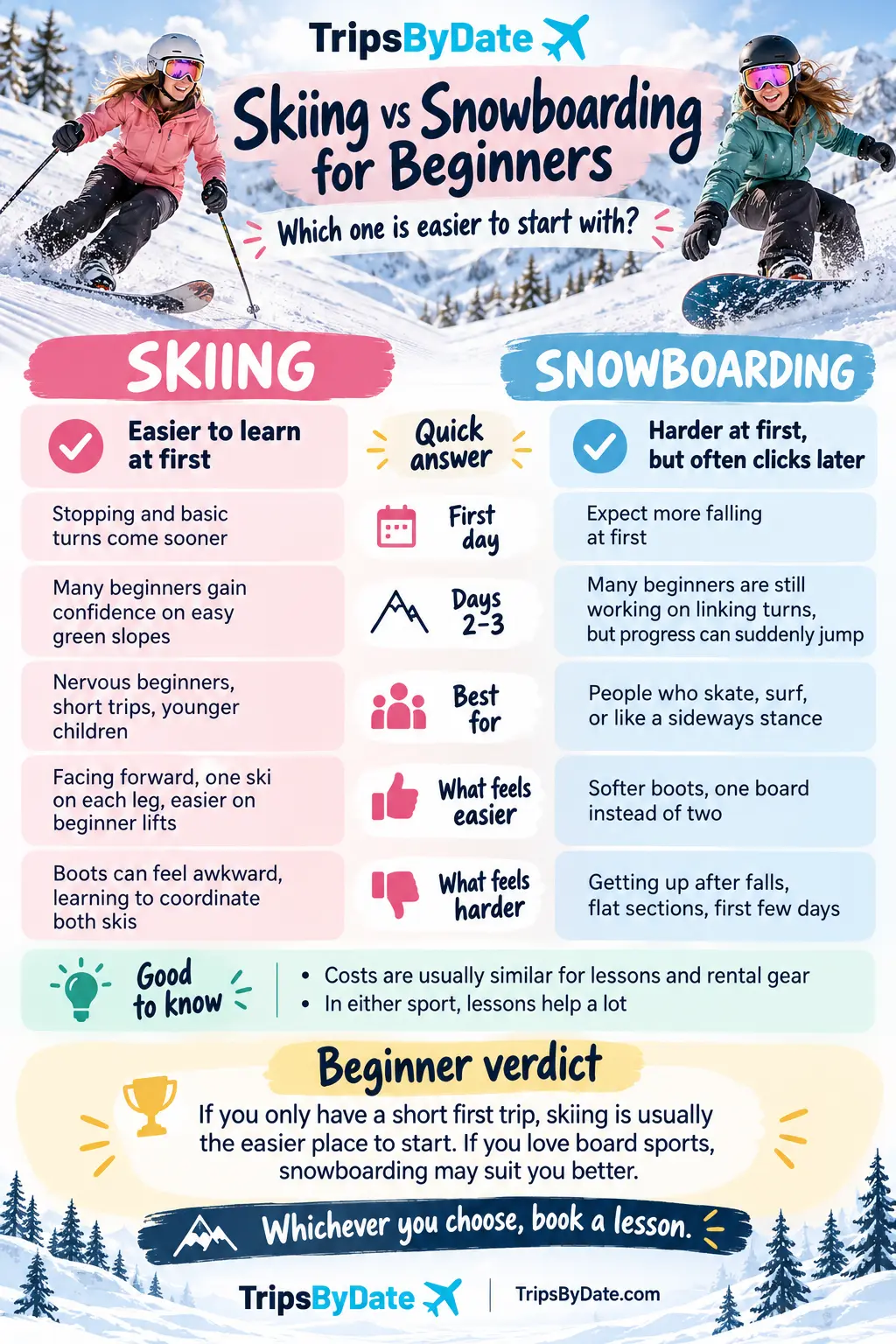
Two people arrive at the same ski resort, put on completely different equipment and spend their first morning discovering completely different ways of moving. One has a ski on each foot. The other has both feet attached to one snowboard. They are on the same snow, but the learning experience is not quite the same.
If you are choosing between skiing and snowboarding for your first mountain holiday, the decision is about more than which looks easier in a video. Think about your first few lessons, how much time you have, what kind of movement you enjoy, and which sport you actually want to do.
The good news is that both are learnable with appropriate instruction. Neither requires you to arrive with perfect balance, a sporting background or expensive equipment. And choosing one for your first trip does not stop you trying the other later.
Explore Upcoming Ski Holidays
Planning your first mountain trip? Here are some upcoming ski holidays from specialist operators, ordered by departure date. Check that your chosen resort offers lessons and rental equipment for the sport you want to try.


 BHX • 7 nights
 RO · Skiline

 BHX • 7 nightsHB · Skiline
 GLA • 7 nightsHB · Skiline
 GLA • 7 nightsHB · Skiline
Is skiing or snowboarding easier for beginners?
Skiing often feels easier at the very beginning. You face forwards, stand on two separate skis and can use a wedge-shaped snowplough to learn speed control on gentle terrain. For some newcomers, this makes their first slides and stops feel more intuitive.
Snowboarding may feel more awkward initially. Both feet are attached to a single board, your body stands sideways to the direction of travel, and you need to get used to balancing on your heel and toe edges. Falling and getting back up are common parts of early practice.
But the popular claim that snowboarding is automatically easier once you get past the first few days is too simplistic. Some learners find that linked snowboard turns suddenly begin to make sense; others need more practice. Likewise, a confident new skier can still take considerable time to develop controlled parallel turns.
Your instructor, physical confidence, snow conditions, practice time and individual coordination can matter more than any general rule about which sport is easier.
The biggest difference: how you stand and move
On skis, your feet face downhill on two separate pieces of equipment. You can move each leg independently and, when learning, use a wedge position to help regulate speed. Later you learn to turn the skis more efficiently and make smoother linked turns.
On a snowboard, both boots attach to the same board, usually with one foot leading. You travel side-on and steer using body positioning, pressure and the board's edges. Beginners learn to control an edge, slide across a gentle slope, stop, and gradually link turns.
Neither movement is automatically more natural for everyone. A person who enjoys skateboarding or surfing may like the sideways stance, but experience in another board sport is not a substitute for snowboard lessons.
What happens in your first skiing lesson?
A beginner ski lesson typically starts on flat or gently sloping snow. You learn how to stand and walk in ski boots, put on and remove skis, move with skis attached and recover after a fall. Your instructor will then introduce controlled gliding, stopping and changing direction.
Many ski schools teach a wedge or snowplough as an introductory way to control speed. You may practise small turns before attempting longer linked turns. Depending on the lesson area, you might also learn to use a beginner conveyor lift or other simple lift.
The goal is control, not speed or reaching a particular coloured run. For a more detailed description, see our first day skiing guide.
What happens in your first snowboarding lesson?
Your snowboard instructor normally begins by explaining the board, bindings, boots and which foot feels more comfortable leading. You will practise moving with one foot attached, often called skating, and learn how to stand up and position yourself on the board.
Early on-snow exercises often include a straight glide on suitable terrain, controlling an edge, stopping, heel-side and toe-side slipping, and simple changes in direction. These skills build toward linking turns. The exact order depends on your instructor and the lesson area.
This is why watching a good snowboarder carve smoothly down a mountain can give a misleading impression of the first morning: much of the early work involves learning to balance and control an edge at low speed.
Which sport involves more falling at first?
Snowboarding beginners often spend more time sitting in the snow, getting up and recovering balance as they learn how their edges behave. Skiers fall too, particularly when trying to turn or stop, but some find it easier to regain balance because their feet can move separately.
Neither sport is risk-free. A fall can injure you on skis or a snowboard, even on a beginner slope. A qualified instructor can teach safe stopping, suitable terrain choice and how to recover without putting yourself or other slope users at risk.
Appropriate helmets and well-fitted equipment are important for both. Wrist protection is also something snowboard beginners may want to discuss with their instructor and equipment provider; protective gear reduces some risks but never eliminates them.
Does snowboarding get easier after the first few days?
It can. When a learner begins understanding edge control and links turns confidently, snowboarding may start feeling much smoother. But there is no universal day-two or day-three breakthrough. You should not book a holiday expecting to be confidently riding entire pistes by a particular afternoon.
The same applies to skiing. A beginner who manages a gentle green run early is not necessarily ready for every green or blue run in the resort. Gradient, width, crowds, visibility and snow conditions all affect how demanding a piste feels.
Our guide to ski slope colours and difficulty explains why a map is only the starting point when choosing terrain.
Which is better for a short first holiday?
If you have only a weekend or a couple of days on snow and have no strong preference, skiing may be the more straightforward starting point. Some newcomers find it easier to begin sliding, slowing and turning on two skis in their first lessons.
That does not mean you should rule out snowboarding for a short trip. If snowboarding is what excites you, a well-organised beginner lesson is a perfectly worthwhile use of that time, even if you spend much of the first day practising edge control rather than completing runs.
It helps to measure a short holiday in time spent learning, not kilometres covered. For planning a two-, four- or seven-night stay, read How Many Days Do You Need for a Ski Holiday?.
Which has more comfortable boots?
Snowboard boots are generally softer and more flexible than downhill ski boots. Many people find walking in them easier. They still need to fit properly, and overly loose or painful boots make learning harder.
Alpine ski boots have a rigid shell designed to transfer movement to the skis. Their firmer feel can be unfamiliar, especially to someone trying them for the first time. They should feel secure, not painfully tight or numbness-inducing.
If you are interested in skiing, do not let the boots put you off before a fitting. Our ski boot fit guide explains what is normal and when to ask a technician for a different fit.
Which is easier on ski lifts?
Beginner conveyor lifts are designed to make early access to gentle terrain easier for both sports. Once you move to drag lifts or chairlifts, the experience differs.
Skiers usually keep both skis pointing forwards when getting onto and off a chairlift. Snowboarders normally release their back foot from its binding and ride the lift with one foot attached, then glide away carefully at the top. This takes practice.
Flat connecting paths can also be awkward for snowboarders, particularly if they lose speed and need to unstrap or push along. Skiers may find some flat sections simpler with poles, although beginners can struggle there too.
Let the instructor teach you lift technique and tell lift staff you are learning. Never feel pressured to take a lift or piste you are not ready for.
Is skiing or snowboarding cheaper?
Neither has a consistently lower total cost across all European resorts. Beginner lesson prices, equipment-rental packages and lift-pass options vary with the destination, provider, dates and package length.
Ski rental usually involves skis, boots and sometimes poles and helmet hire; snowboard rental generally involves a board, bindings and boots, with a helmet potentially charged separately. Compare complete packages, not just the headline price for the skis or board.
Check whether your lift ticket covers the beginner area, whether your course includes access to lifts, whether hire is included, and whether you can change your equipment if it fits badly. These details can affect the price more than the sport you choose.
For a broader holiday budget, see How Much Does a Ski Holiday Cost? and our explanation of what ski lift passes include.
Do you need to buy any equipment before your first lesson?
Usually not the skis or snowboard. Hiring is a sensible way to try either sport without committing to costly specialist equipment. A rental shop should help match your equipment to your height, size and beginner level.
You will still need suitable winter clothing, gloves or mittens, goggles or appropriate eye protection, and proper socks. Check the exact clothing and helmet rules for your ski school and resort.
Start with our ski holiday packing list and equipment hire versus buying guide.
What about fitness, balance and age?
You do not have to be especially athletic to take your first lesson. Both sports use your legs and core, challenge balance and involve repeated movements that can become tiring. General fitness and comfort with movement are useful, but beginners arrive with many different abilities and backgrounds.
You might find the independent-leg movement of skiing easier; you might prefer the coordinated stance of snowboarding. Previous skating, surfing or similar sports experience can feel familiar on a board, but transfer of skill varies from person to person.
For young children, minimum lesson ages and availability differ between ski schools and between skiing and snowboarding. Check directly with the school rather than assuming the same age policy applies to both.
If you want to prepare physically, our simple ski fitness guide covers balance, leg strength and stamina exercises that are also useful general preparation for a snowy holiday.
What if your friends ski but you want to snowboard?
You can still go on the same holiday. Most larger winter-sports resorts cater for both skiers and snowboarders, although you should confirm that the ski school, beginner area and hire shops support your choice.
You probably should not expect to spend your very first lesson skiing or riding down the mountain alongside experienced friends. Book proper tuition, agree on a meeting place for lunch, and meet the group when you are ready. Friends can be supportive without becoming your instructors.
If the group has different abilities, prioritise a resort with genuinely suitable beginner terrain, dependable teaching and straightforward access to the meeting areas. See our guide to choosing a ski resort.
Know when you can travel?
Choose your departure airport and the dates you are free, then explore ski holidays that fit your plans.
Find ski holidays by dateShould you book group lessons or private lessons?
Beginner group lessons can be a good way to learn alongside people at a similar stage, and often work out cheaper per person. Private lessons offer individual attention and may suit someone who is nervous, needs particular adaptations or has limited time on snow.
For either sport, tell the school you are a complete beginner. Check the language of instruction, meeting point, lesson duration, equipment requirements and cancellation terms before paying.
The Professional Ski Instructors of America and American Association of Snowboard Instructors recommend learning with a qualified instructor who can give feedback and choose suitable terrain. Their free introductory materials also show how the first lessons differ.
Read our beginner ski lesson planning guide for questions to ask a school before your holiday.
Can you try both skiing and snowboarding on one holiday?
Yes, provided your resort offers both and you make time for lessons. Trying both can be enjoyable, especially during a longer trip, but switching every few hours may make it harder to consolidate basic movements when both are completely new.
One approach is to give your first sport a lesson or two before deciding whether you want to continue or sample the other. Ask your hire shop if it permits exchanges between ski and snowboard packages; some do, sometimes with extra charges, while others do not.
Five questions to help you choose
1. How long is the trip? If it is very short and you have no clear preference, skiing may offer a more approachable introduction. But a short snowboarding lesson is still worthwhile.
2. Do you enjoy board sports? If skating or surfing appeals to you, the snowboard stance might be part of the fun. It will not automatically make the technique easy.
3. How comfortable are you with falling and restarting?Both sports involve falls, but early snowboard practice often involves repeated sitting down, standing up and practising edges.
4. What does your resort offer? Look for a suitable beginner school, dedicated learning slope, equipment hire and straightforward lifts for your chosen sport.
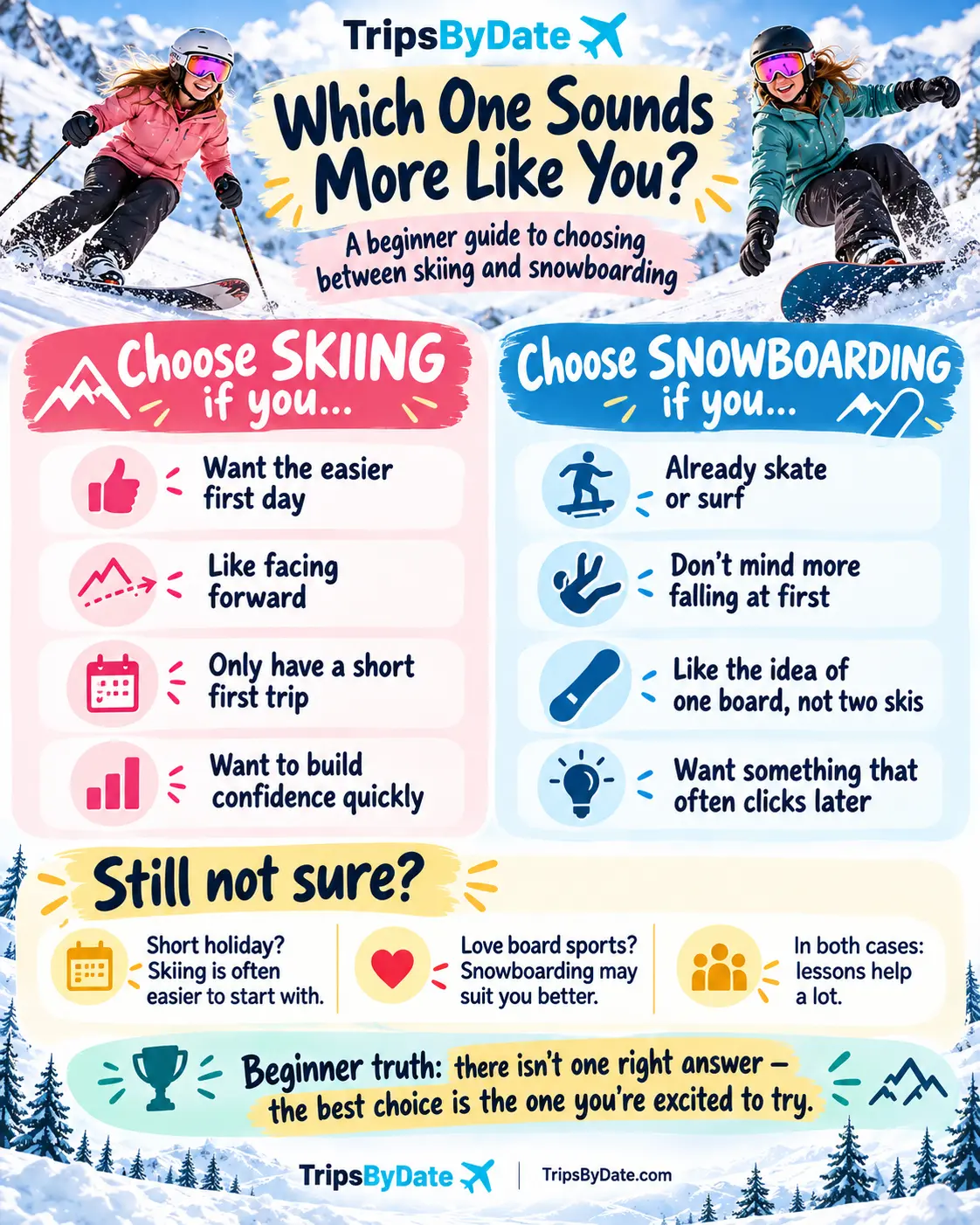
5. Which one actually excites you? This is not a trivial question. You are more likely to enjoy the early awkward stages when you genuinely want to learn the sport.
Common beginner mistakes to avoid
Skipping lessons: watching a video is no substitute for feedback on snow, particularly when learning to control speed, edges and direction.
Comparing progress by the clock: people learn at different rates. A friend mastering a turn before you does not mean you picked the wrong sport.
Using unsuitable terrain: a piste that feels easy to experienced friends may still be far beyond your skill. Follow your instructor's advice and check local piste classifications.
Putting up with bad equipment fit: painful boots and badly matched equipment can spoil either experience. Return to the hire shop for help instead of attempting equipment adjustments yourself.
Forgetting rest: new movements are physically demanding. Short breaks, water and enough food can make the afternoon more enjoyable than pushing on while exhausted.
Frequently asked questions
Is skiing easier than snowboarding on the first day?
Many beginners find basic skiing movements easier to grasp initially, but the experience is individual. An instructor, gentle terrain and correctly fitted equipment are more valuable than relying on a rule of thumb.
Does learning to snowboard hurt more?
Snowboarding beginners may fall repeatedly while learning their edges, and some feel sore afterward. Skiers also fall and can be injured. Safe technique, instruction, appropriate terrain and protection matter for both.
Can a complete beginner learn snowboarding in three days?
A beginner can learn meaningful basics in three days, but there is no guaranteed standard of independence after that period. Some learners will still be concentrating on stopping and linking simple turns.
Do snowboarders need a different lift pass?
Usually the same resort lift-pass system serves skiers and snowboarders, but you should check any restrictions for specific lifts, beginner areas or terrain parks. Lessons and hire are generally booked separately.
Is skiing or snowboarding better for a nervous beginner?
It depends on the person. The forward-facing stance and separate skis can feel reassuring to some people, while others are excited by snowboarding. A small beginner group or private lesson can be useful whichever you choose.
Trusted sources and further reading
These organisations offer practical introductory material for both sports and explain what newcomers learn in their first lessons:
- PSIA-AASI: Learn to Ski or Snowboard — beginner advice from professional ski and snowboard instructors.
- PSIA-AASI: Beginner's Guide to Skiing — equipment, gliding, turning, stopping and lifts.
- PSIA-AASI: Beginner's Guide to Snowboarding — stance, skating, gliding, edge control and chairlifts.
- Ski Club of Great Britain: New to Snowsports? — preparing for your first trip, finding UK practice centres and slope safety.
Our verdict: skiing or snowboarding for your first trip?
If you are undecided, have only a few days and mainly want a manageable first experience on snow, skiing is a reasonable starting choice. Many people find the first basic movements a little easier to understand.
If snowboarding is the sport you really want to learn, choose snowboarding. Expect to practise the fundamentals, accept that falling is part of learning, and book a proper lesson rather than judging your progress against someone who has been riding for years.
There is no single winner. Both offer a brilliant reason to travel to the mountains, and the best first holiday is one with appropriate lessons, comfortable equipment, suitable terrain and room to enjoy yourself.
Keep planning your first winter holiday
How Hard Is Skiing to Learn? · Best Ski Resorts for Absolute Beginners · How Ski Hire Works for Beginners · What to Wear Skiing for the First Time
‹BACK TO SKIING
Know when you can travel?
TripsByDate works the other way around. Choose your departure airport and the dates you are free, then explore holidays that actually fit.
Find holidays by date