

Get Fit for Skiing
A simple 6-week approach to building stronger legs, better balance, more endurance and greater confidence before your ski holiday.
You do not need to train like an Olympic skier before going on a ski holiday, but arriving with a reasonable level of strength, balance and cardiovascular fitness can make long days on the mountain feel considerably easier.
Skiing asks your legs and core to work repeatedly while you balance, turn, absorb uneven terrain and spend hours moving at altitude. If you are usually fairly inactive, even a few weeks of preparation can be worthwhile.
The Ski Club of Great Britain recommends thinking about ski fitness around six weeks before a trip, while NHS guidance also recommends combining aerobic activity with regular muscle-strengthening exercise.
Explore Upcoming Ski Holidays
Looking for your next ski trip? Here are some upcoming ski holidays from specialist operators, ordered by departure date.

 LHR • 7 nights
 Skiworld


 LHR • 7 nightsAI · Skiline
 MAN • 7 nightsAI · Ski Line
 BRS • 7 nightsHB · Iglu Ski
How fit do you need to be for skiing?
You do not need marathon-level fitness to enjoy skiing. What helps most is having enough stamina to stay active for several hours and enough strength and control to keep good form as your legs begin to tire.
Beginners may find skiing surprisingly tiring because unfamiliar movements often require more effort. As your technique improves, skiing usually becomes more efficient, but basic fitness still makes the experience easier.
Why start around six weeks before your ski holiday?
Six weeks is long enough to build some useful consistency without turning ski preparation into a major training programme.
The goal is not to transform your body in six weeks. It is to arrive better prepared than you would be if you did nothing.
Starting gradually also gives you time to learn the exercises properly and increase the workload rather than suddenly doing too much immediately before travelling.
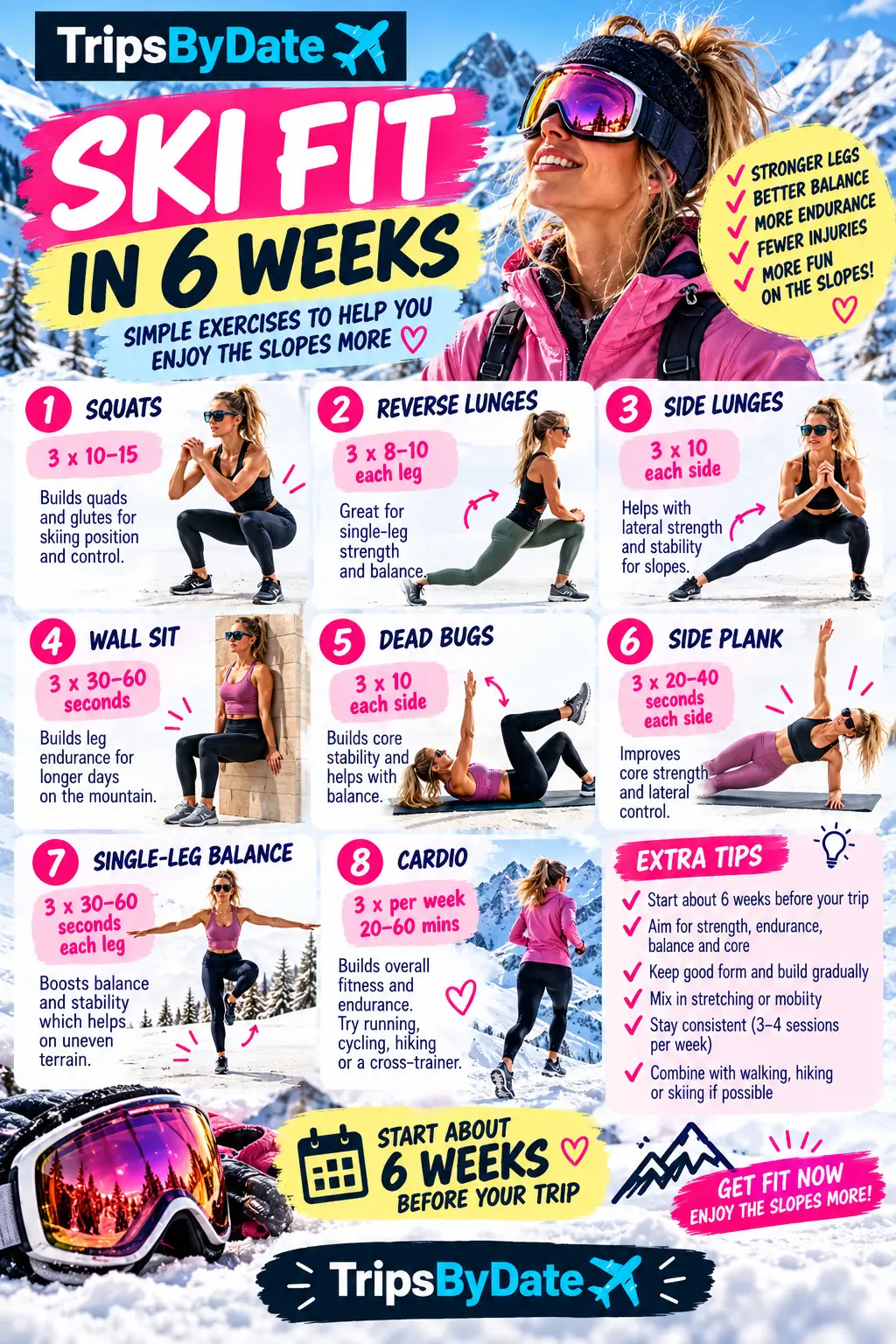
1. Squats for leg strength
Squats are useful because skiing repeatedly asks the hips, knees and ankles to work together while the legs support your body in a flexed position.
A simple bodyweight squat is enough to begin with. Keep your movement controlled and work within a comfortable range.
A practical starting point is around 3 sets of 10 to 15 repetitions, but the exact amount should depend on your current fitness and how comfortably you can maintain good form.
2. Reverse lunges for single-leg strength
Skiing constantly shifts pressure from one leg to the other, so single-leg exercises can be useful alongside ordinary squats.
Reverse lunges train the legs individually and also challenge balance and control.
Start with bodyweight and move slowly. Around 3 sets of 8 to 10 repetitions on each leg is a reasonable target for someone already comfortable with the movement.
3. Side lunges for lateral strength
Skiing involves significant side-to-side movement rather than only moving forwards and backwards.
Side lunges can help train the hips and legs in that lateral direction. They can also provide useful mobility through a wider range of movement.
Keep the movement controlled and avoid forcing yourself deeper than feels comfortable.
4. Wall sits for leg endurance
Skiers often recognise the familiar feeling of burning thighs after spending a long time in a flexed position.
Wall sits are a simple way to challenge the leg muscles without requiring equipment.
Start with a hold you can maintain with good control, perhaps 20 to 30 seconds, and gradually build towards longer holds as your endurance improves.
5. Dead bugs for core stability
Your core helps keep the upper and lower body working together while you move and balance.
Dead bugs are a controlled floor exercise that challenges core stability while the arms and legs move.
Move slowly rather than trying to complete repetitions quickly. The exercise becomes far less useful if you lose control of your position.
6. Side planks for lateral core strength
Side planks target the muscles that help resist sideways movement and maintain trunk stability.
That makes them a useful addition to a ski-fitness routine, where balance and lateral control matter.
Start with short holds if necessary. Ten or twenty seconds with good form is better than holding for longer while collapsing out of position.
7. Single-leg balance
Balance is an obvious part of skiing, and it is easy to train without equipment.
Stand safely on one leg and try to maintain control for around 30 seconds. Once that becomes easy, you can make the exercise more challenging by adding gentle movement or changing the surface.
Always do balance work somewhere safe where you can hold onto something if needed.
8. Build some cardiovascular fitness
Strength alone is not enough. A ski day can involve hours of repeated activity, so general cardiovascular fitness also matters.
Walking quickly, cycling, running, hiking and cross-training can all help improve aerobic fitness.
NHS guidance recommends at least 150 minutes of moderate aerobic activity a week, or 75 minutes of vigorous activity, alongside strength work on at least two days each week.
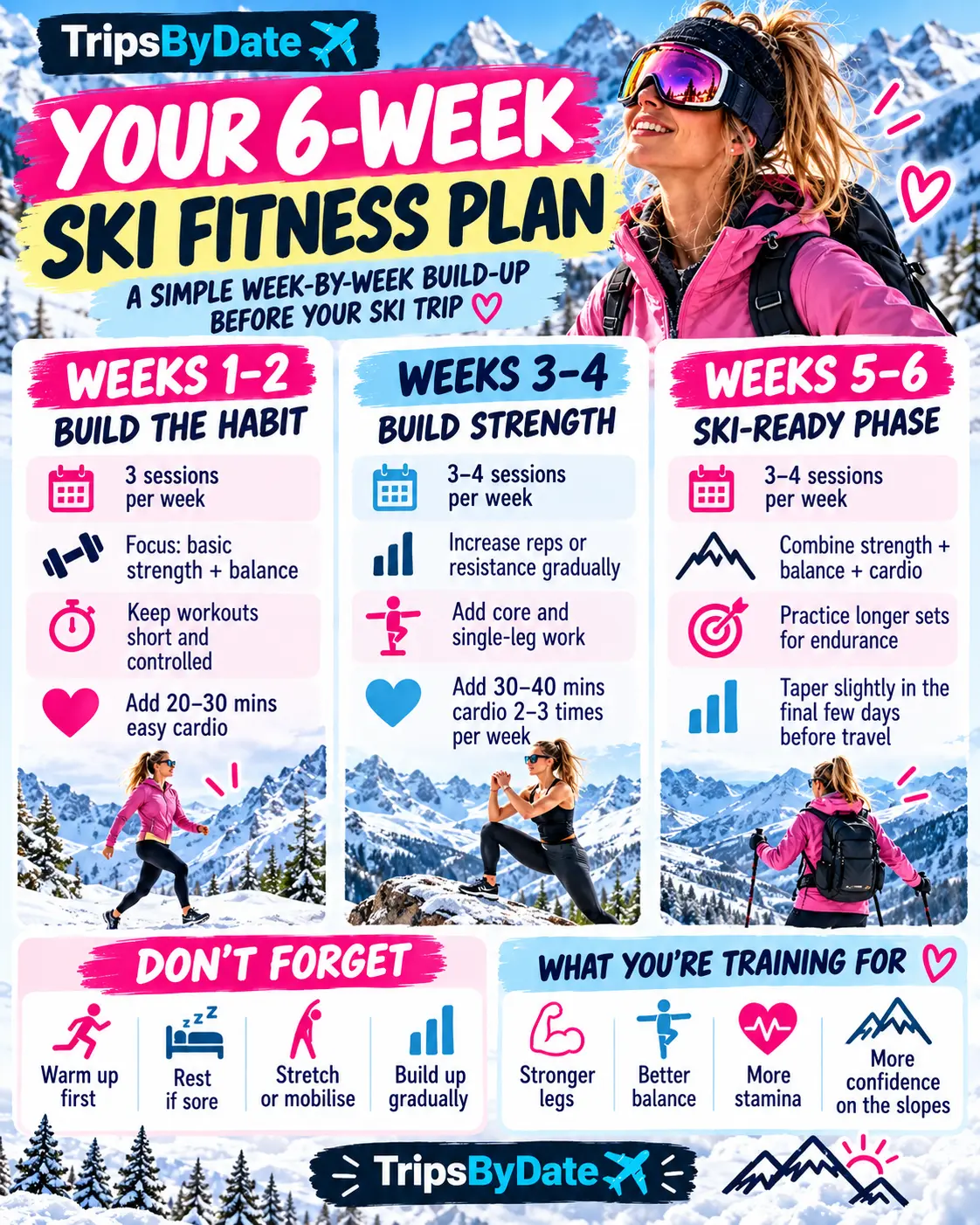
A simple 6-week ski fitness plan
You do not need to perform every exercise every day. Consistency matters more than trying to cram everything into one enormous workout.
A simple approach could be:
2 to 3 strength sessions each week: squats, lunges, wall sits, dead bugs, side planks and balance work.
2 to 3 cardio sessions each week: brisk walking, cycling, running, hiking or another activity that raises your heart rate.
Regular mobility: keep moving through a comfortable range and include gentle flexibility or mobility work where useful.
You can combine some of these into the same session rather than treating each one as a separate workout.
Weeks 1 and 2: build the habit
Concentrate on learning the movements and completing them comfortably.
There is no benefit in making yourself so sore after the first session that you cannot train again for a week.
Use bodyweight exercises, moderate cardio and manageable repetitions.
Weeks 3 and 4: gradually increase the challenge
If the exercises now feel comfortable, gradually increase the repetitions, hold times or resistance.
Cardio sessions can also become a little longer or more demanding.
Progress should feel controlled rather than dramatic.
Weeks 5 and 6: build endurance
As your trip gets closer, focus on being able to sustain repeated effort rather than simply producing one strong repetition.
Circuit-style sessions can work well here: complete several exercises in sequence, rest, then repeat.
Keep enough recovery between sessions so that you arrive on holiday feeling prepared rather than exhausted.

Know when you can travel?
Pick your departure airport and the dates you are free, then see the ski holidays that actually fit.
Find ski holidays by dateDo you need a gym to get fit for skiing?
No. A useful ski-fitness routine can be built around bodyweight squats, lunges, wall sits, core exercises, balance work and cardiovascular activities such as walking or cycling.
Gym equipment can make progression easier, but it is not essential for somebody simply trying to prepare for a recreational ski holiday.
Should beginners train differently?
Beginners should prioritise general fitness, leg endurance, balance and controlled movement rather than attempting complicated ski-specific exercises.
Good skiing technique will ultimately come from lessons and time on snow. Fitness preparation simply gives your body a better foundation for learning.
What should you avoid before a ski holiday?
Avoid suddenly introducing an aggressive training programme immediately before travelling.
Increasing exercise too quickly can leave you sore or create problems before you even reach the mountain.
Start gradually, focus on good technique and increase the workload over time.
What if you have not exercised for a long time?
Start more cautiously. NHS guidance recommends speaking to your GP first if you have not exercised for some time or if you have medical conditions or concerns.
The exercises on this page are general fitness ideas rather than an individual training or rehabilitation programme. If you have an existing injury, significant pain or specific medical needs, get advice from an appropriate healthcare or fitness professional.
Useful ski fitness guidance
The Ski Club of Great Britain has a detailed guide to preparing physically for skiing, including strength, endurance and ski-specific conditioning.
Ski Club of Great Britain: getting fit for snowsports
The Ski Club also has practical ski-fitness exercises from British Olympic skier Dave Ryding, including squats, lateral work, core training and cardiovascular fitness.
Ski Club of Great Britain: ski fitness exercises
For general activity guidance, the NHS recommends combining aerobic exercise with regular strength work.
NHS: physical activity guidelines for adults
NHS: improving strength and flexibility
More help for your ski holiday
Best Ski Resorts for Beginners · Ski Slope Dos & Don'ts · Ski Skin Survival Guide · Ski Hair Survival Guide
‹BACK TO SKIING
Know when you can travel?
TripsByDate works the other way around. Pick your departure airport and the dates you are free, then see the holidays that actually fit.
Find holidays by date