

What Do the Ski Slope Colours Mean?
Green, blue, red and black pistes explained, plus the country differences and map-reading skills that matter on your first ski holiday.
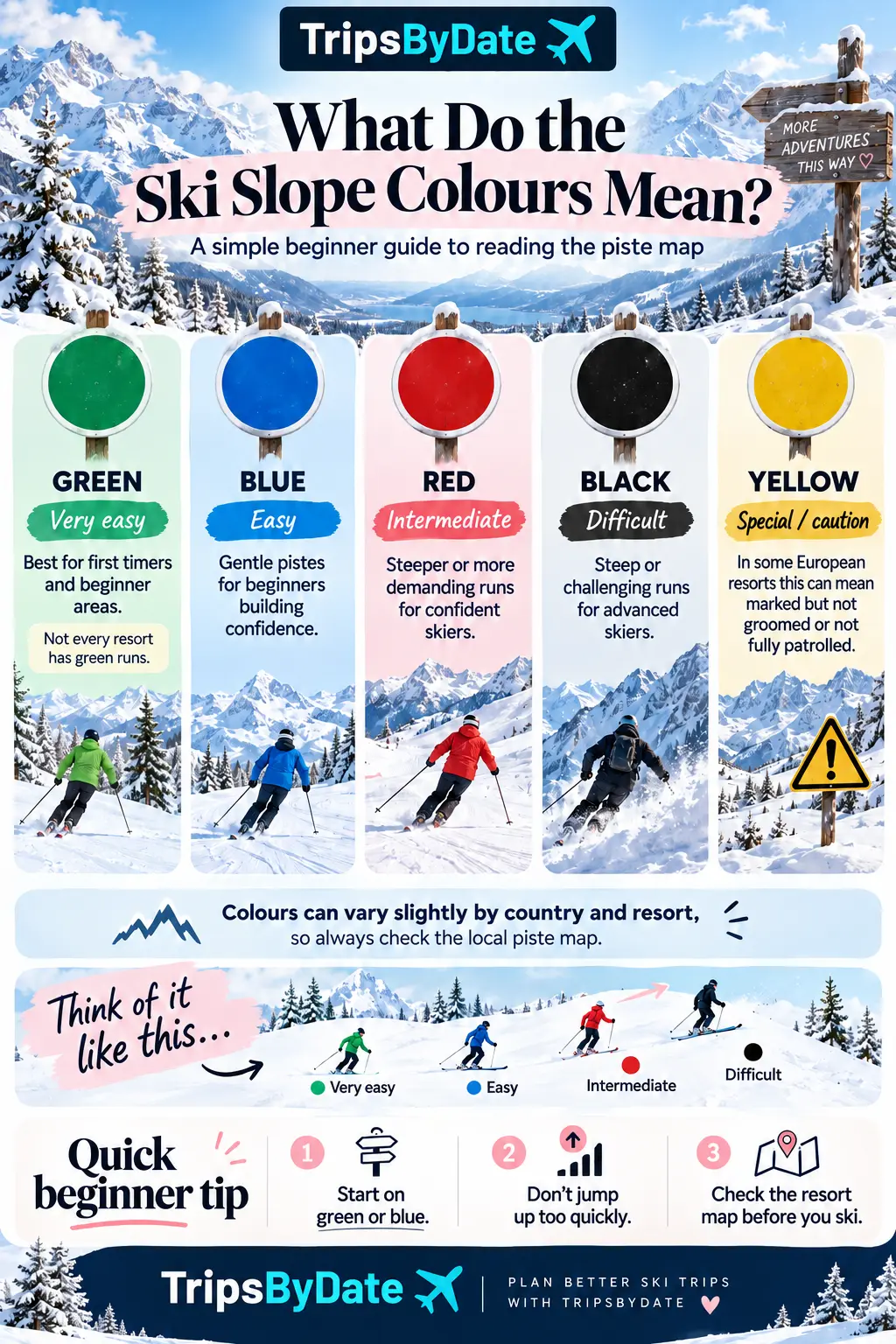
Your first piste map can look like a tangle of coloured lines. There are green runs, blue runs, dramatic-looking red and black lines, lift symbols and sometimes colours or markings nobody mentioned in your ski lesson. The good news is that the basic system is easy to learn.
Piste colours tell you the expected difficulty of a ski run. In many European resorts, green is the easiest, followed by blue, red and black. But the exact system changes between countries, and the colour is only a guide: snow, weather, terrain and your own ability still matter.
Here is how to read the signs, choose your first slopes and avoid accidentally following a route that is harder than you expected.
Explore Upcoming Ski Holidays
Looking for your next ski trip? Here are some upcoming ski holidays from specialist operators, ordered by departure date.


 LHR • 7 nights
 AI · Ski Line

 BHX • 7 nightsB&B · Iglu Ski
 GLA • 7 nightsB&B · Iglu Ski
 BHX • 7 nightsB&B · Iglu Ski
Ski slope colours at a glance
In a French-style four-colour piste system, the progression is: green for the gentlest runs, blue for relatively easy pistes, red for more demanding skiing and black for the most difficult marked descents. A first-time skier should generally begin in a designated nursery or beginner area, even if a green piste is nearby.
Not every European ski area has a green category. In much of Austria, Switzerland and Italy, blue is the easiest standard graded piste. That does not necessarily make the resort less beginner-friendly: look for learning slopes, nursery areas and the ski school's designated terrain.
What does a green ski slope mean?
A green piste is generally the gentlest category in resorts that use it, particularly in France. Greens usually have relatively mild gradients and are suited to practising the basics: starting, stopping, making controlled turns and building confidence without confronting a steep descent.
They can be an excellent next step after a nursery slope, but green does not mean completely flat, empty or risk-free. A green run may contain narrow sections, busier crossings or longer stretches than you are used to. Your instructor can advise when you are ready to leave the learning area.
What does a blue ski slope mean?
Blue pistes are generally relatively easy, groomed ski runs. In countries without a green category, blue is commonly the entry-level graded run. In resorts that have greens, blues are typically the next progression.
A blue can be a wonderful confidence-building run once you can reliably control your speed, turn in both directions and stop when needed. However, some blues include steeper pitches, narrow paths, busy junctions or long distances to the next easy exit. A blue that is manageable in soft morning snow may feel much harder when icy or crowded.
Do not assume you should ski a blue on day one simply because its description says “easy”. Your first lesson, control and comfort are better indicators than the number of days you have been on holiday.
What does a red ski slope mean?
Red pistes are for skiers with stronger, more consistent technique. They may be steeper, narrower or more varied than blues and can include demanding changes in gradient, tighter turns and sections where speed control needs to be especially reliable.
Red runs are often described as intermediate, but that word can be misleading. Someone who has just learned to link snowplough turns is not automatically ready for a red. You should be comfortable skiing a range of blues, adjusting your turns and maintaining control in changing conditions before considering more difficult terrain.
What does a black ski slope mean?
Black pistes indicate the most demanding category in the common European on-piste colour system. They may involve steep pitches, bumps, variable snow or challenging terrain that requires confident skiing and sound judgement.
Black does not always mean an ungroomed or off-piste route. Some black pistes are regularly prepared; others may be left with natural bumps or receive less frequent grooming. You must check the resort's descriptions and current piste report rather than guessing from the colour alone.
For a first ski holiday, there is no reason to treat black runs as a goal. Plenty of experienced skiers enjoy entire holidays on blue and red pistes.
What does a yellow ski slope mean?
Yellow is not a universal fifth piste difficulty.This is the most important qualification to the main infographic. Yellow markings can refer to special routes, cautionary information or other local classifications depending on the resort and country.
In Switzerland, for example, official safety guidance distinguishes standard graded pistes from yellow-marked ski routes or itineraries. Such routes can be marked and secured against avalanche danger while remaining ungroomed and not subject to the same preparation as ordinary pistes. They are not appropriate beginner shortcuts.
Elsewhere, yellow may be used in warning notices or symbols rather than as a run classification at all. Always check the legend on the local piste map, any accompanying warning signs and the published status of the route before using it.
Do ski slope colours mean the same thing in every European country?
No. The broad principle, easier pistes versus more demanding pistes is similar, but the categories and grading criteria are not fully standardised across European resorts.
France
France commonly uses green, blue, red and black. French government guidance describes green as easy, blue as medium difficulty, red as difficult and black as very difficult. There are no universal Europe-wide numerical slope limits that make every piste of the same colour identical.
Austria
Austrian ski areas normally use blue, red and blackfor standard graded pistes. Ski Arlberg, for example, explains blue runs as gentle slopes, red as moderately challenging and black as demanding. It also identifies ski routes separately from standard prepared runs.
Switzerland
Switzerland also generally grades standard pistes as blue, red and black. Swiss Snow Safety explains that prepared pistes are graded and marked at their edges, while ski routes follow separate conventions.
Italy
Italian ski areas widely use blue, red and blackcategories for groomed downhill runs, with local legislation and resort information explaining the grading. As elsewhere, check the specific ski area's map rather than relying on a colour remembered from another country.
How do resorts decide whether a run is blue, red or black?
Steepness is important, but it is not the whole story. Resort operators also consider the character of the terrain, including how long a steep section lasts, how narrow the piste becomes, changes in gradient and the level of technical skill required.
Some countries or resorts publish gradient thresholds. For example, Ski Arlberg describes blue pistes as having gradients of up to 25%, red as 25–40% and black as over 40%. Those figures are not a universal rule for every European ski resort. Different countries and operators can apply different criteria.
A gradient expressed as a percentage is also not the same as an angle in degrees. For first-time skiers, the practical point is simply that colour gives you a useful warning, not a guarantee that every metre of the route will feel easy.
Can a blue run be harder than a red run?
In certain conditions, a particular blue can feel harder than a relatively gentle red elsewhere. Think of a narrow, icy blue with lots of traffic versus a wide red with soft, forgiving snow. The published category still matters and you should not choose a red just because someone calls it an easy one but local conditions can change the experience dramatically.
It is especially important not to judge suitability from a photograph or a piste's average gradient. Ask a ski instructor or local piste staff which named routes are appropriate for your current ability and the day's conditions.
How to read a ski piste map before you set off
Start by locating where you are: the ski-school meeting point, nursery area, nearest lift and the base area you want to return to. Next, trace a complete route down, not just the first attractive-looking run.
Look for each junction and the colour of the connecting piste. Check where the lifts start and finish, whether a route is open, and whether a seemingly simple descent ends in an unavoidable harder section.
Piste maps are diagrams designed to show connections and terrain, not perfectly scaled road maps. A short-looking coloured line can represent a long ski run; a distant cluster of lifts may be a substantial journey away.
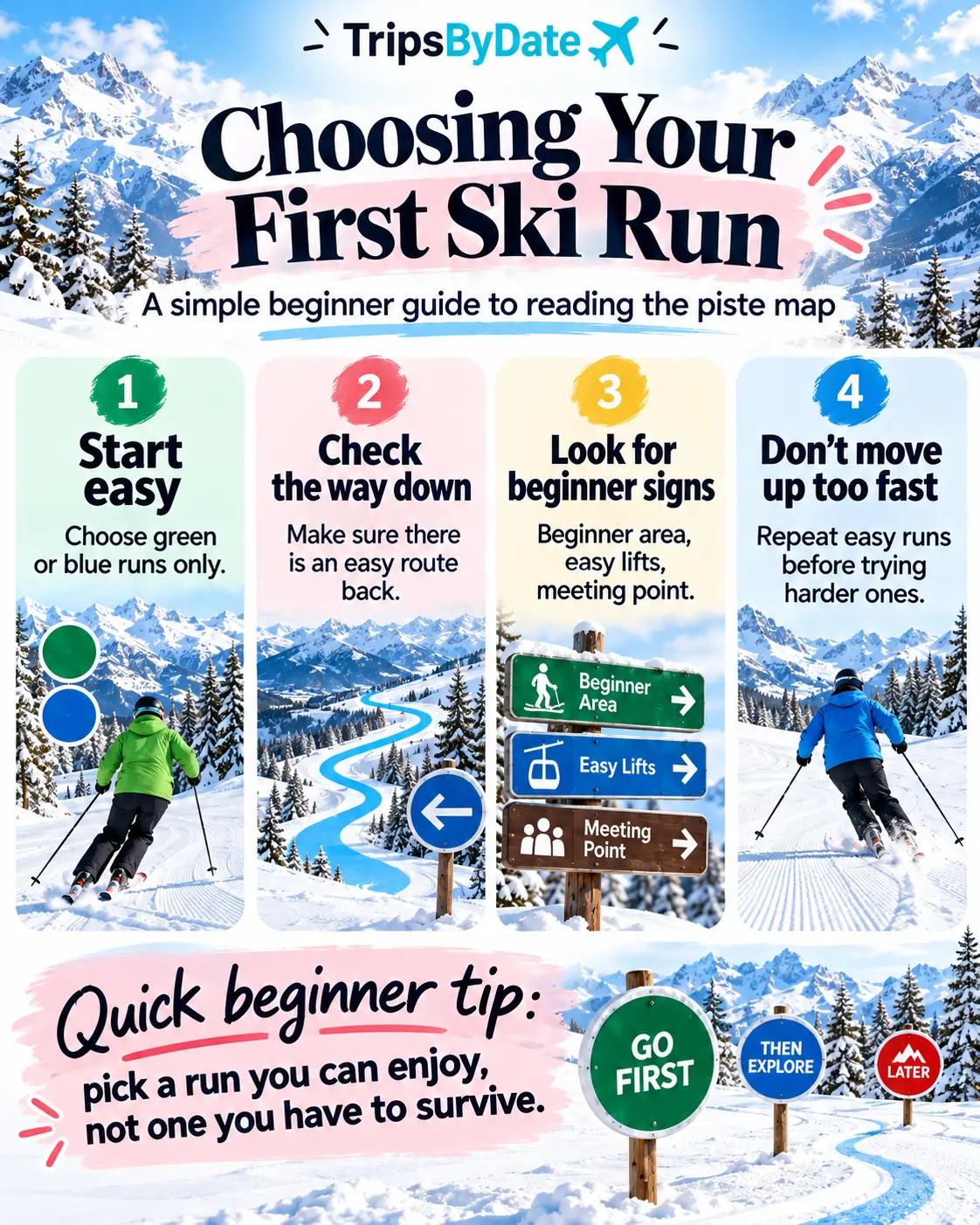
Choosing your first ski run: five practical checks
1. Start with the nursery area, not the biggest mountain
A first-timer's best terrain is usually the dedicated teaching slope recommended by the ski school. Some resorts offer free or reduced-price beginner lifts, so check before buying a full-area pass.
2. Pick a run you can comfortably repeat
A familiar easy run is useful for practising your turns and speed control. Repetition is not a failure to explore; it is how you develop the technique that makes wider exploration enjoyable later.
3. Check the entire route back
Never ride a lift simply because you can see one blue section near the top. Confirm there is a continuous suitable way down or an approved option for returning without skiing a section beyond your ability.
4. Check openings and snow conditions
Read the resort's live piste report and notices. Fresh snowfall, hard-packed snow, ice, poor visibility and wind can all affect how challenging a run feels. A piste marked closed must not be used, whatever its colour.
5. Ask a local instructor before moving up
Ski-school staff know the specific runs and can judge whether your speed control and turns are reliable enough for a new challenge. A recommended blue run is a much better first step than choosing one at random.
How can you tell whether a piste is open?
Consult the resort's current piste report or official app, then respect signs and closures on the mountain. On-site closure notices take precedence over an older screenshot or a printed piste map.
French government winter-sports guidance stresses that marked and open pistes receive the relevant preparation, checking and protection. Leaving a marked run takes you into a different risk environment, where those safeguards should not be assumed.
What do piste signs, numbers and coloured markers tell you?
Beside the piste map, look for coloured circular markers, run names and numbers. On French ski slopes, government guidance explains that numbered markers identify the run and count down as you descend. These details are useful for navigation and can help rescue services locate you in an emergency.
Other signs identify hazards, junctions, lift crossings, restricted areas or closed pistes. Their exact appearance can vary by resort. When in doubt, stop in a safe place off the main skiing line and consult the map or staff.
Is a blue run suitable for an absolute beginner?
Sometimes, but not automatically. In countries without green runs, beginner-friendly blues exist, often alongside nursery slopes. However, a blue run is not a substitute for learning how to stop, turn and control speed.
If you are still practising your first snowplough turns, stay in the ski school's teaching area until your instructor recommends a suitable route. Our guide to what to expect on your first ski day covers how those early lessons generally progress.
When should you move from green to blue, or blue to red?
Move up when your technique is consistently comfortable on a variety of appropriate runs, not because you have completed a certain number of ski days. You should be able to control your speed, turn both ways, stop where needed and respond calmly if the piste gets busier.
Progress can vary enormously with lessons, fitness, conditions and confidence. Our articles What Ski Lessons Do Beginners Need? and How Hard Is Skiing to Learn? explain the learning process in more detail.
What if you accidentally end up on a run that is too difficult?
The priority is to avoid losing control. Stop somewhere safe and visible, away from the middle of the piste or the landing area of a steep section. Do not attempt to ski a slope you cannot control simply because others are passing you.
Ask your instructor or resort staff for help if available, and follow their advice. Depending on the location, there may be a suitable alternative route or lift-assisted return, but never assume either exists. Call the resort's piste services if you are unable to descend safely.
Are black runs the same as off-piste skiing?
No. A black piste is a graded run within the resort's marked ski area. Off-piste terrain lies outside the prepared and controlled piste network, and may expose skiers to avalanche danger, hidden obstacles and other serious hazards.
Similarly, a marked ski route or itinerary is not automatically the same as an ordinary groomed piste. Read local signs carefully, particularly where the resort distinguishes ski routes from open pistes.
Know when you can travel?
Pick your departure airport and the dates you are free, then see the ski holidays that actually fit.
Find ski holidays by dateWhy piste colours matter when choosing a ski resort
A resort that advertises hundreds of kilometres of pistes is not necessarily the best place to learn. What matters more is how much suitable terrain is easy to reach from your accommodation, whether the ski school has dedicated teaching slopes, and how easy it is to move around without encountering a run beyond your ability.
A compact mountain with well-connected blues can be a better match for a nervous beginner than an enormous area where returning to the village requires a red descent. Check the ski area's map before booking.
For resort ideas and practical selection criteria, see Best Ski Resorts for Absolute Beginners and How to Choose the Right Ski Resort.
Does a ski pass give access to every colour of run?
A ski pass normally grants access to specified lifts and areas, not permission to ski terrain beyond your skill level. Some tickets cover just beginner lifts, a local sector or a larger linked area. A full-area pass may be unnecessary for your first few lessons.
Read our What Does a Ski Pass Include? guide before comparing tickets and packages.
Do ski slope colours change for snowboarders?
The piste's grade usually applies regardless of whether you are skiing or snowboarding. But the difficulty you experience can differ: for example, long flat connecting pistes can be awkward for snowboarders, while steep or narrow sections may challenge beginners in either sport.
Skiers and snowboarders should both choose terrain matching their own control and experience, rather than relying solely on the colour.
Three beginner mistakes worth avoiding
Following a confident friend without checking the map
A run that feels easy to an experienced skier may be overwhelming on your second day. Agree in advance to stay on terrain that suits the least experienced person in the group.
Judging a piste only by its colour
A blue may still be long, icy or crowded. Look at conditions, the full route and any recent warnings, and be prepared to choose something easier.
Assuming every country uses green beginner runs
Many excellent beginner areas are signed or described differently. Check the local grading legend and the ski school's advice before your trip.
Frequently asked questions about piste colours
What is the easiest ski slope colour?
Green is generally the easiest where the French-style four-colour system is used. In Austria, Switzerland and much of Italy, blue is commonly the easiest standard piste grade. Nursery slopes can be easier than either category.
What is harder, red or black?
Black is the harder category in the standard European grading sequence. Conditions still matter, and some black pistes are much more demanding than others.
Do ski slopes have yellow runs?
Some places use yellow to identify routes or special conditions, but it is not a standard fifth difficulty everywhere. Check the piste map legend and on-mountain signage.
Are all blue pistes the same difficulty?
No. Terrain varies within a resort and between countries. Blue means relatively easy in that area's system, not identical steepness or identical conditions.
Can beginners ski a red run?
A true beginner should normally remain on nursery slopes and easier pistes. Red runs are intended for skiers with more developed skills and confidence, and should not be rushed.
Official sources and further reading
These are useful official references for understanding piste grading and signs. Always check the local ski-area map for your particular holiday.
French Ministry of Sports: piste marking, signs and closures
France's official alpine ski piste classification guidance
Ski Arlberg: blue, red and black pistes and ski routes
Swiss Snow Safety: piste markings and signs
The simplest rule for your first ski holiday
Choose the run you can enjoy and control, not the hardest one you can survive. Start with your ski school's recommended teaching area, learn the local piste colours, check the whole way down and move up gradually when you are ready.
A little route planning makes the mountain feel less intimidating and leaves more time for the best part of skiing: enjoying it.
More skiing advice for beginners
Best Ski Resorts for Absolute Beginners · Ski Etiquette · Ski Slope Dos & Don’ts · What Ski Lessons Do Beginners Need?
‹BACK TO SKIING
Know when you can travel?
TripsByDate works the other way around. Pick your departure airport and the dates you are free, then see the holidays that actually fit.
Find holidays by date