

How Hard Is Skiing to Learn?
What your first ski lesson really involves, why the first hours can feel awkward, and how to build confidence at your own pace.
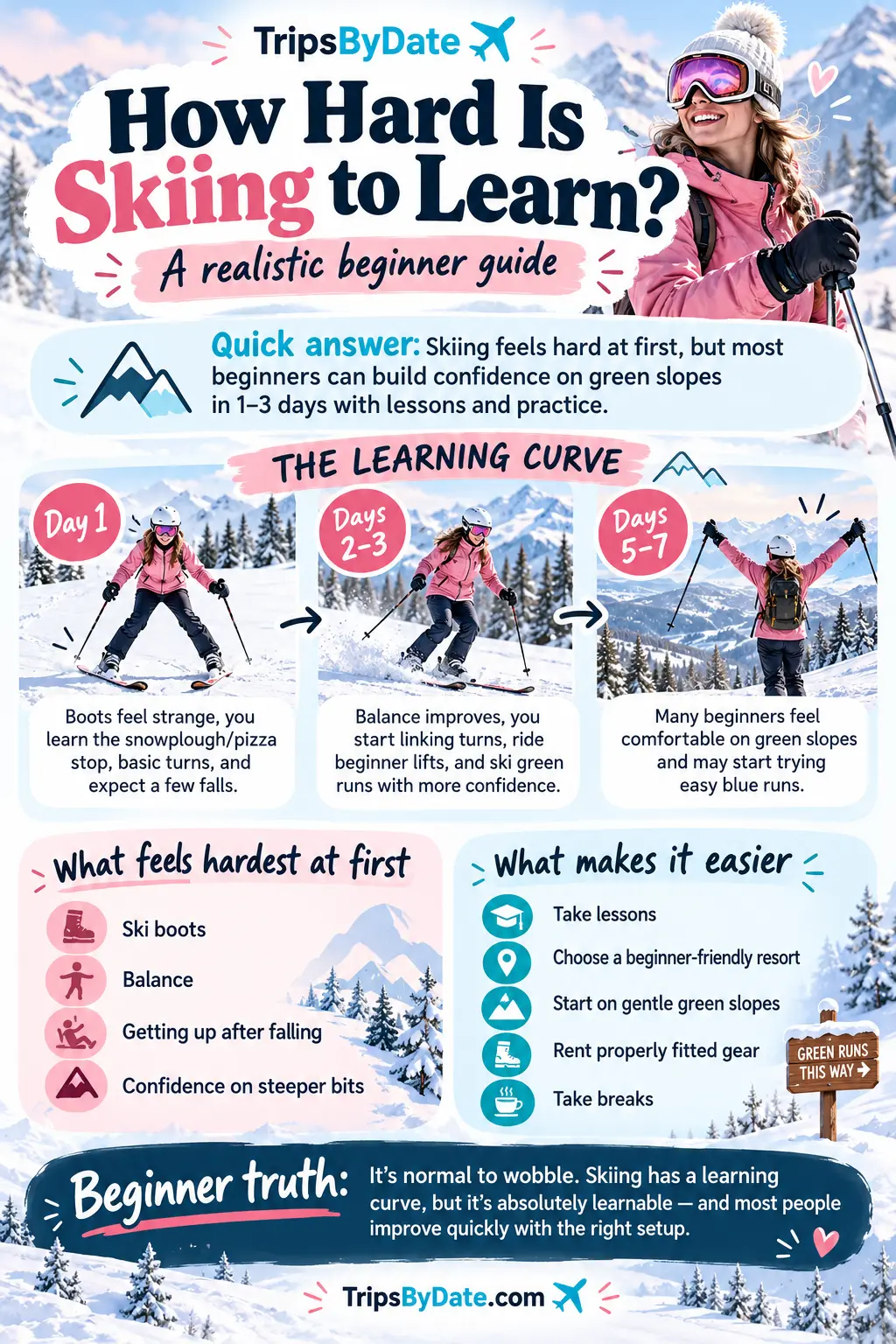
Is skiing hard to learn? For many first-timers, the first few hours feel awkward: ski boots are stiff, two long skis seem to have minds of their own and even a tiny slope can look intimidating. That is normal.
Skiing has a learning curve, but you do not need to be athletic or fearless to begin. Good beginner lessons start on gentle terrain and prioritise standing, balance, slowing down and stopping before speed or steeper runs.
This guide explains what you actually learn, what progress may look like, the skills people struggle with, and how to make a first ski holiday enjoyable without racing against someone else’s timetable.
Explore Upcoming Ski Holidays
Looking for your next ski trip? Here are some upcoming ski holidays from specialist operators, ordered by departure date.
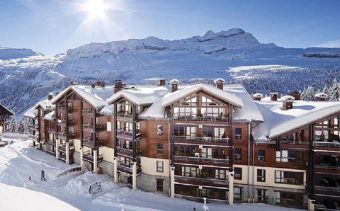

 LGW • 7 nights
 SC · Ski Line


 BRS • 7 nightsHB · Iglu Ski
 BHX • 7 nightsSC · Ski Line
 BHX • 7 nightsB&B · Iglu Ski
Is skiing difficult for complete beginners?
Skiing often feels difficult initially because you must balance on sliding equipment while learning to steer and regulate speed. Ordinary walking habits are not a reliable guide to movement on snow.
However, beginner lessons break the task into manageable parts. You usually practise on flat snow or a very gentle slope before using a beginner lift. Early progress is about control, not elegance or speed.
A nervous beginner who can stop when asked is making more useful progress than someone who slides quickly but cannot control where they go.
How long does it take to learn to ski?
There is no universal number of hours or days. An adult might make their first controlled wedge turns during an introductory lesson; another may spend longer becoming comfortable standing, stopping or using a lift. Both experiences are normal.
The illustrated day-one, days-two-to-three and days-five-to-seven examples above are possible milestones, not a timetable or guarantee. Progress depends on teaching, snow conditions, fatigue, confidence, prior movement skills and opportunities to practise.
Also distinguish learning the basics from skiing independently. Being able to make one successful turn on a beginner slope is not the same as navigating an entire mountain safely.
What will you learn in your first ski lesson?
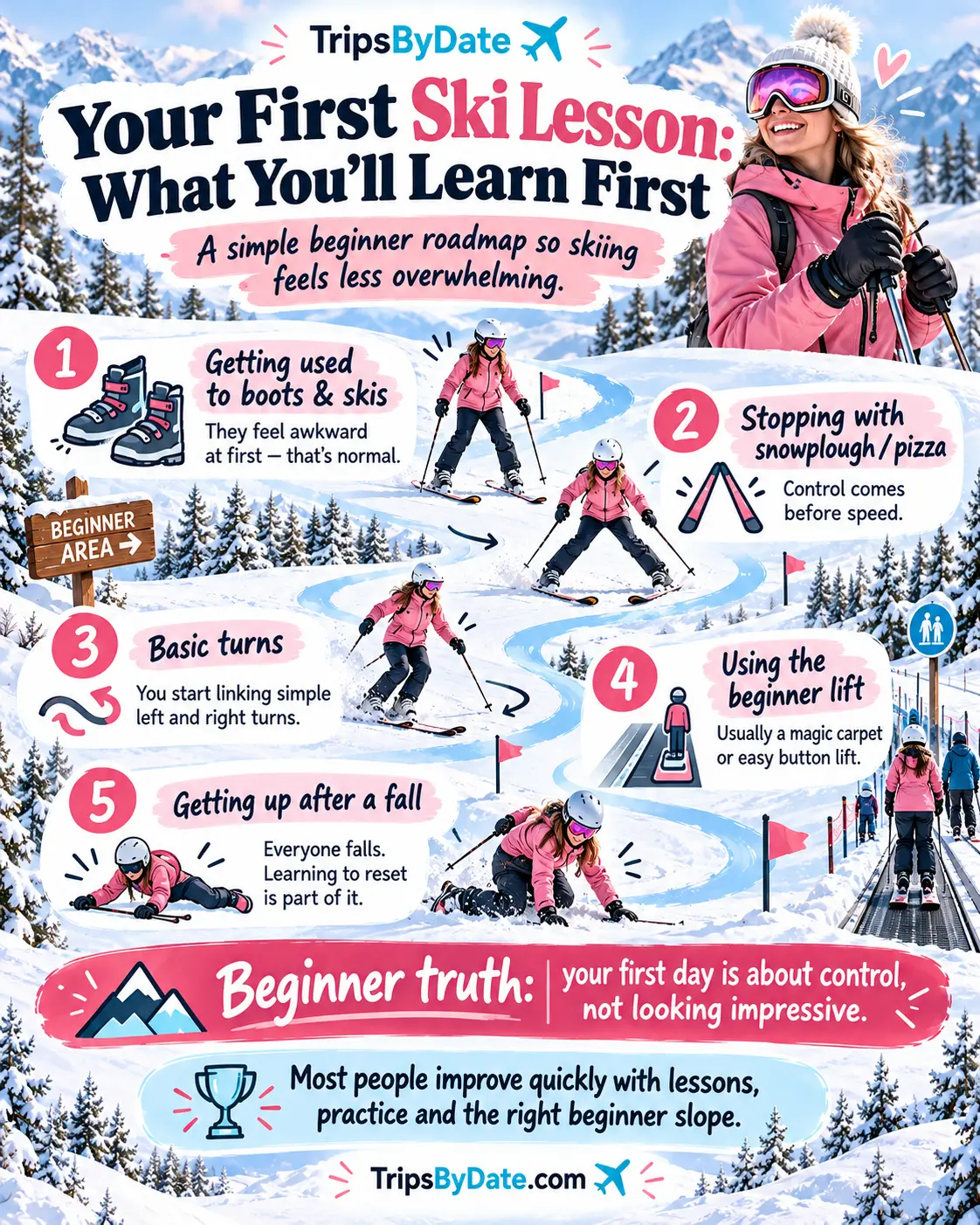
Most ski schools start by introducing equipment, the teaching area and safe ways to move around. You may practise walking in ski boots, carrying skis, putting skis on and off, standing in a comfortable stance and getting up after a fall.
Next often come sliding short distances, practising a wedge or “snowplough” to manage speed, turning toward a chosen point and linking simple turns. These are building blocks, not a checklist you must finish on day one.
The professional ski-instructor progression from PSIA-AASI includes equipment familiarity, basic sliding, gliding and braking wedges, and then initial wedge turns. Exact lessons and terminology vary between schools.
1. Getting used to boots and skis
Ski boots are stiffer and less flexible than ordinary footwear. That can make walking or bending at first feel clumsy. Your instructor will show you a balanced stance and how to move on flat ground.
You may begin with only one ski attached, depending on the lesson. This helps you discover how skis slide without immediately managing both at the same time.
Boots should feel supportive rather than painfully tight. If you feel numbness, sharp pressure or excessive heel movement, return to the fitter rather than assuming pain is part of learning. See our ski boot fit guide.
2. Learning to slow down and stop
One common introduction is the snowplough or wedge: ski tips closer together and ski tails farther apart. Instructors teach how to change the position and use the skis to manage speed on gentle terrain.
It is not enough to point your skis into a wedge and hope for the best. Your instructor helps you understand pressure, direction and terrain appropriate for your control.
If you cannot reliably reduce speed and stop, stay in the supervised beginner area instead of following friends onto a more demanding slope.
3. Making your first turns
Turning allows you to choose a direction and control speed through your route across the slope. Early exercises might involve steering left toward a landmark, stopping, then repeating in the other direction.
Over time you practise connecting turns smoothly. Professional instructors describe linked wedge turns on easy groomed green terrain as a foundational skill; they teach both leg steering and turn shape rather than simply twisting the upper body.
You do not need to learn parallel skiing immediately. Many happy beginners spend their early lessons improving a controlled wedge turn.
4. Using a beginner lift
Your first lift may be a surface conveyor or “magic carpet”. Some lesson areas use button or drag lifts. Your instructor will explain how to queue, board and exit the particular lift safely.
Lift use can feel unfamiliar, but you can practise at your own pace. Do not guess how an unfamiliar lift works, especially with skis attached; ask staff or your instructor.
For the distinction between equipment hire and lift access, read What Does a Ski Pass Include?.
5. Getting up after a fall
Falls are possible when learning and can feel frustrating or embarrassing. Your instructor can show you how to move skis into a manageable position and stand up on safe terrain.
If you fall on a busy piste, focus first on your safety and awareness of other skiers. Ask an instructor or resort staff for help if you cannot safely get up or move aside.
Practise falling and getting up only under suitable instruction; avoid trying deliberately on slopes where collisions are a concern.
What progress might look like during a week
First session: equipment familiarity, balanced stance, sliding a short distance and early speed-control exercises. Some learners begin turns; others benefit from repeating simpler drills.
After several sessions: you may start linking turns, using a beginner lift and skiing a suitable easy run under instruction. Fatigue can also make one day harder than another.
Later in the week: some learners become comfortable repeating easy pistes; others still work on stopping or turns. An instructor should decide when new terrain is appropriate, not a calendar.
If your goal is confidence rather than a particular piste colour, focus on whether you can control speed, stop, turn both ways and respond to changes in the terrain.
What makes skiing feel hardest at first?
Balance: both skis move independently, and sliding changes your sense of stability. Gentle drills help you learn where your weight belongs.
Stiff boots: ski boots restrict ankle movement and can feel strange even with a good fit. Fitting problems make everything unnecessarily harder.
Fear of speed: even slow sliding can be frightening if you do not yet trust your ability to stop. This is why control comes before speed.
Falling and standing up: unfamiliar equipment makes simple movements awkward. Instruction and repetition are more useful than rushing.
Busy terrain: crowds, changing snow and poor visibility can make even an easy run feel harder. Choose quieter beginner zones when possible.
Does age or fitness make skiing harder?
You do not need elite fitness to book a beginner lesson, but leg endurance, balance and mobility affect comfort. If you tire quickly, technique becomes more difficult and a shorter session may be more productive.
Adults sometimes worry more about falling than children do; children may also need frequent breaks and age-appropriate instruction. Neither age group follows one fixed progression.
If you have a medical condition, injury or particular access need, discuss appropriate instruction and equipment with a qualified professional or the ski school before your trip.
Our Get Fit for Skiing guide covers sensible pre-holiday preparation without promising instant technique.
Are group lessons or private lessons better for learning?
Group lessons can be sociable and economical, and instructors structure exercises around a level. The compromise is that the pace needs to suit several learners.
Private lessons offer individual feedback and can be useful if you are particularly nervous, have specific needs or want help correcting a repeated difficulty. They usually cost more.
Neither is automatically better. The critical factors are suitable teaching, appropriate terrain and adequate practice time. Compare formats in What Ski Lessons Do Beginners Need?.
Should you practise on an indoor slope before your holiday?
If you can, a lesson at an indoor snow centre or a dry slope can make your holiday arrival less daunting. You become familiar with boots, skis, instructions and early movements before dealing with a new resort.
The Ski Club of Great Britain recommends trying a couple of lessons at an indoor or dry slope as a practical introduction.
The snow surface and atmosphere may differ from the Alps, so still tell your holiday instructor exactly what you have practised.
How to make learning skiing easier
Book lessons early. Leave enough space in your holiday for instruction and gentle practice rather than assuming friends can teach you.
Choose a genuinely beginner-friendly resort. Look for accessible nursery slopes, ski schools and convenient beginner lifts rather than just a large total piste area. See Best Ski Resorts for Absolute Beginners.
Hire suitable gear. Ski equipment should match your ability, size and comfort. Never adjust binding release settings yourself. See How Ski Hire Works for Beginners.
Repeat easy runs. Confidence usually grows through controlled repetition, not by moving onto steeper runs before you can stop and turn consistently.
Take breaks. Cold, hunger and tired legs reduce your concentration. An enjoyable short session is often better than an exhausting one.
Know when you can travel?
Pick your departure airport and the dates you are free, then see the ski holidays that actually fit.
Find ski holidays by dateHow do you know when you are ready for a blue run?
Never decide solely because it is day three or because someone in your group is ready. Run colours differ between countries and resorts; even an easy run can become difficult in poor snow or visibility.
Ask your instructor whether you can manage the whole route, including any steeper sections and the return to the lift. You should be able to control your speed, stop and steer reliably on the relevant terrain.
Our guide to ski slope colours explains the local grading differences.
Common beginner mistakes that slow progress
Trying to keep up with experienced friends can lead to unsuitable slopes. Starting on terrain that feels frightening makes relaxed practice much harder.
Ignoring painful boots or skipping rests can turn a manageable lesson into a miserable one. Also avoid treating ski poles, speed or parallel turns as trophies to chase before your balance and steering are ready.
If you struggle with one skill, tell your instructor precisely what happens. A small adjustment in the exercise or terrain can be more useful than repeating the wrong movement.
Is skiing harder than snowboarding?
The two sports use different movement patterns and learning progressions, so the easiest choice depends on the person. Skiers have two separate skis and poles later on; snowboarders stand sideways on one board.
It is difficult to declare a universal winner. If you are choosing between them, think about your interest, comfort and available instruction rather than assuming one sport will be effortless.
Read Skiing vs Snowboarding for Beginners when that next guide is published.
Frequently asked questions about learning to ski
Can you learn skiing in one day? Some people learn introductory stopping and turning skills in one day, but this does not make them competent to ski independently across a resort.
Can you teach yourself? Professional lessons are a much safer starting point. An instructor can select terrain and correct problems you might not recognise.
Do you have to be able to do the splits or be very flexible? No. Ordinary mobility and basic balance are useful, but you are not expected to perform acrobatics.
What if everyone else learns faster? Learners progress at different rates. Ask for level-appropriate teaching and focus on being in control rather than comparing yourself with friends.
Do beginners need poles? Some instructors begin without them so the focus stays on balance and turns. Follow your ski school’s advice.
Useful external sources and further reading
Ski Club of Great Britain — New to Snowsports? explains introductory lessons and getting familiar with equipment before travelling.
PSIA-AASI Central — Wedge Turn describes the teaching progression toward controlled turns on easy terrain.
PSIA-AASI Northwest — Level I Alpine teaching outline covers beginner-skill assessment and progression.
Snowsport England — Ski Instructor Pathway explains the structured progression of ski instruction.
The real goal of your first ski holiday
Your first ski holiday does not need to end with a dramatic black run. Learning to move, slow down, turn and enjoy gentle terrain is a valuable result.
The best measure of progress is reliable control and growing confidence, not the colour of the steepest piste you tried. Give yourself time, take lessons and enjoy the learning process.
More beginner skiing guides
What to Expect on Your First Ski Day · What Ski Lessons Do Beginners Need? · How Many Days Do You Need for a Ski Holiday? · Ski Etiquette
‹BACK TO SKIING
Know when you can travel?
TripsByDate works the other way around. Pick your departure airport and the dates you are free, then see the holidays that actually fit.
Find holidays by date