

What Ski Lessons Do Beginners Need?
Group lessons, private lessons, children's ski school and how many days you should actually book on your first ski holiday.
If you have never skied before, lessons are one of the easiest parts of your first ski holiday to overthink. Group or private? One lesson or five? Morning or afternoon? Do you need a lift pass? And what exactly are you supposed to learn?
The simple answer is that most complete beginners will do well with several structured lessons spread over the first part of the holiday.
You are not trying to become an expert in a week. You are learning enough technique and mountain awareness to control your speed, stop, turn and use beginner terrain safely.
Explore Upcoming Ski Holidays
Looking for your next ski trip? Here are some upcoming ski holidays from specialist operators, ordered by departure date.


 BHX • 7 nights
 HB · Skiline

 BHX • 7 nightsB&B · Skiline
 GLA • 7 nightsB&B · Skiline
 GLA • 7 nightsB&B · Skiline
Do complete beginners really need ski lessons?
Yes, in most cases.
Skiing looks deceptively simple when you watch somebody experienced. But controlling two skis on a slope while managing speed, balance and other people takes proper technique.
The Ski Club of Great Britain recommends learning to ski properly before venturing onto the mountain independently. Lessons teach both technique and the basic mountain behaviour that helps keep you and other skiers safe.
What is the best ski lesson for an adult beginner?
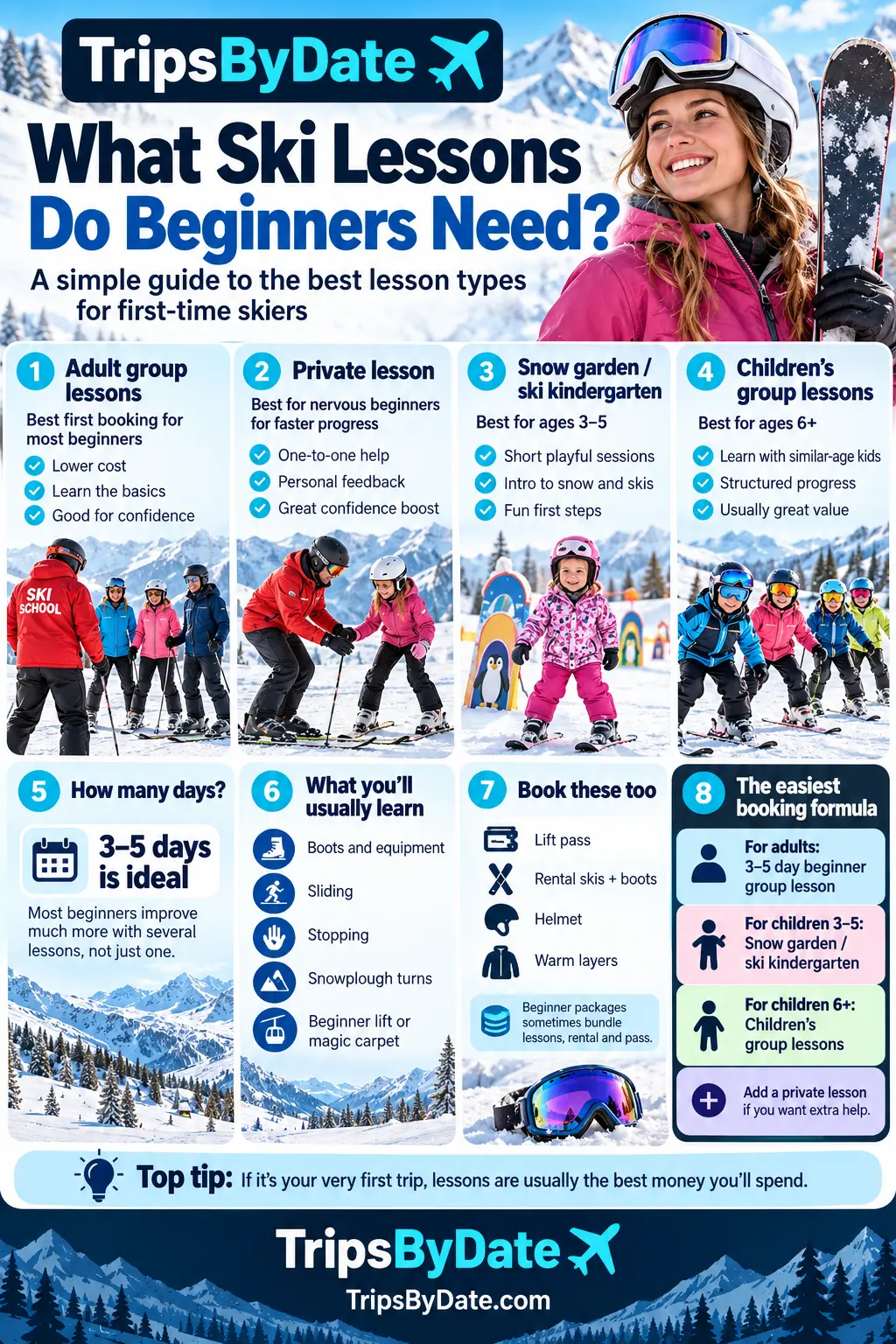
For most adults taking their first ski holiday, a beginner group course is the most straightforward option.
Group lessons are usually organised by ability, so complete beginners learn alongside people dealing with the same awkward boots, balance problems and first attempts at stopping.
They are normally substantially cheaper than private tuition and give you several days to build skills gradually.
Adult group ski lessons
Group lessons are generally the best-value starting point for somebody who has never skied before.
A typical beginner programme may run for several mornings or afternoons, often around two or three hours at a time.
The exact format varies enormously between ski schools. Some courses run Monday to Friday, some for three days, and others let you book individual sessions.
The advantage of a multi-day course is continuity. Instead of starting again with a different instructor every day, the same group can gradually build from basic balance to stopping and turning.
What are the advantages of group lessons?
The biggest advantage is price.
You share an instructor with several other people, which makes group tuition much cheaper per person than private instruction.
Groups can also make the first few days feel less intimidating. Everyone is learning, everybody makes mistakes and you quickly realise that falling over is not particularly remarkable.
Watching other beginners can be useful too. Sometimes seeing somebody else make a correction helps you understand what your instructor is explaining.
What are the disadvantages of group lessons?
The main disadvantage is that the lesson has to work for several people at once.
If you learn much faster or slower than the rest of the group, the pace may not feel perfect.
You also receive less individual attention than you would in a private lesson.
Good ski schools regularly reorganise groups when ability levels become obviously mismatched, so speak to the instructor if the lesson feels far too easy or far too difficult.
When is a private ski lesson worth it?
Private tuition can be particularly useful if you are nervous, have limited time or want very focused help.
The instructor can spend the entire session working at your pace and correcting your technique.
You can also explain exactly what worries you, whether that is speed, chairlifts, turning or simply feeling unstable.
Should a nervous beginner book a private lesson?
It can be a very good option.
Nervous beginners sometimes struggle in a group because they feel pressure to keep up with everybody else.
A private instructor can slow the lesson down, repeat the same exercise and choose terrain specifically around your confidence level.
You do not necessarily need private lessons all week.
One private lesson at the beginning or middle of a group course can sometimes solve a particular problem and make the rest of the week much easier.
Can two beginners share a private lesson?
Often, yes.
Many ski schools allow private lessons to include two or more people, although pricing and maximum group sizes vary.
Sharing can make private tuition much better value if both people are at roughly the same ability level.
It works less well if one person is a complete beginner and the other is already skiing confidently.
How many days of ski lessons does a beginner need?
There is no magic number, but several consecutive lessons are usually more useful than one short lesson followed by five days of guessing.
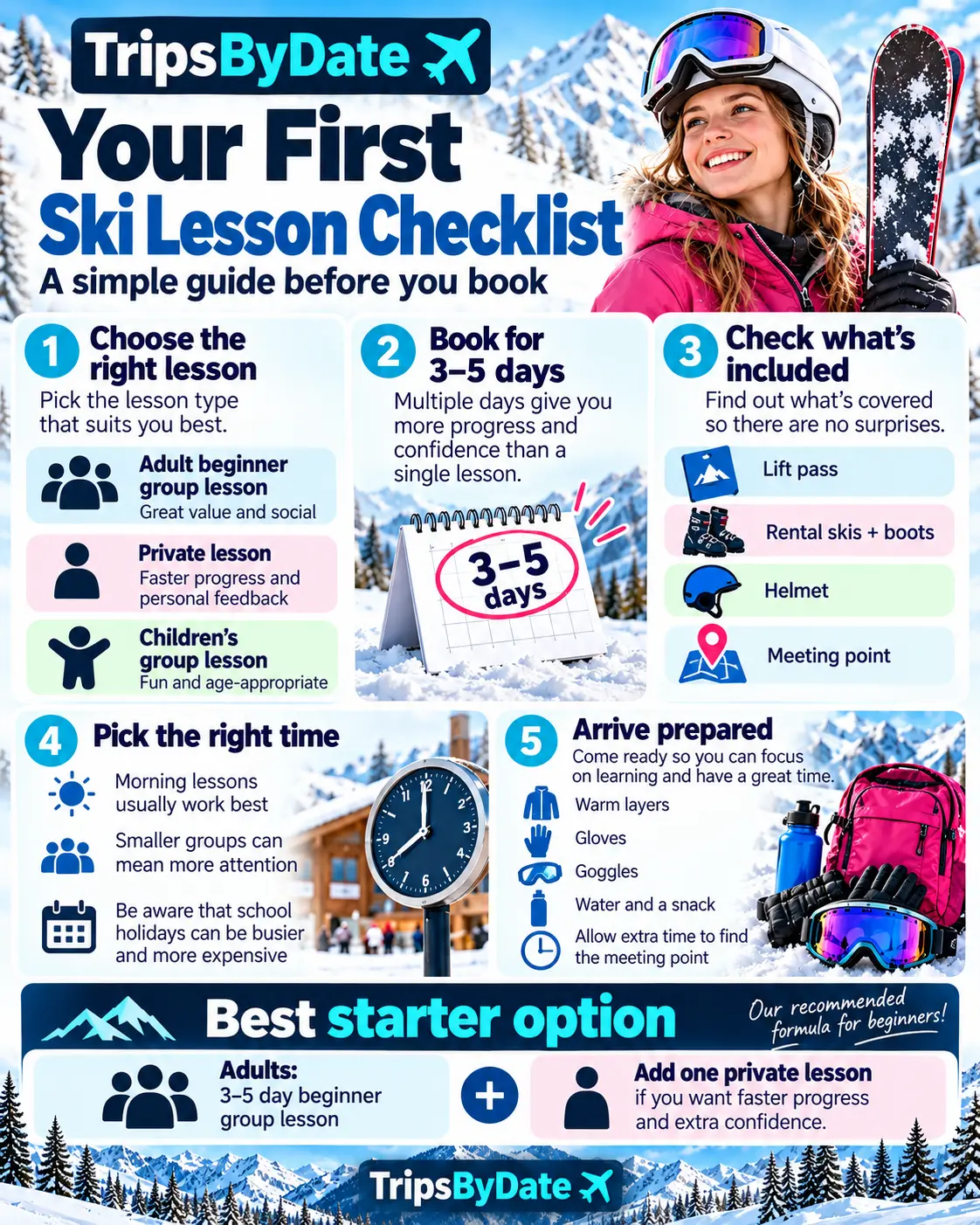
For a typical week-long first ski holiday, three to five days of beginner group lessons is a sensible structure if your resort offers it.
That does not mean everybody needs exactly five days.
Some people progress quickly and become comfortable practising independently sooner. Others benefit from tuition throughout most of the week.
Is one ski lesson enough?
Usually not for a complete beginner.
One lesson can introduce the equipment and basic movements, but skiing involves several separate skills that need repetition.
You need to become comfortable with sliding, stopping, controlling speed, changing direction and eventually using lifts and longer pistes.
A single two-hour lesson may be enough to discover whether you enjoy skiing. It is rarely enough to make a complete beginner genuinely independent.
What will you learn in your first ski lesson?
Your first lesson may feel much more basic than you expected.
You may learn:
How to put skis on and take them off
How to stand in a balanced position
How to move on flat snow
How to slide gently downhill
How to control your speed
How to stop
How to get up after falling
That is a successful first lesson.
Nobody needs to reach the top of the mountain on day one.
When do beginners start learning turns?
Usually once you can slide with reasonable balance and have started controlling your speed.
Many ski schools introduce turns using a wedge or snowplough position before gradually progressing towards more parallel skiing.
Teaching methods vary between instructors and countries, so do not worry if your lesson does not exactly match a YouTube video you watched before travelling.
Will ski lessons teach you how to use the lifts?
Yes, as you progress.
Beginner areas often start with magic carpets or very simple surface lifts.
Once you are ready for longer terrain, your instructor can introduce drag lifts or chairlifts and explain how to load, unload and move safely away from the exit.
Do beginners need a lift pass for lessons?
Often, yes — but not always the full resort pass.
Some beginner zones use free lifts or have cheaper beginner passes.
Other ski schools require a normal lift pass even during lessons.
Ask the ski school exactly which pass you need before buying one. There is little point paying for an enormous ski area if your first three days will be spent on nursery slopes.
Do ski lessons include equipment hire?
Not automatically.
Ski tuition, equipment hire and lift passes are often sold separately.
Some resorts and tour operators sell beginner bundles that combine several of them, which can make booking easier and sometimes cheaper.
Always check exactly what is included rather than assuming the word "lesson" covers everything.
What equipment does a beginner need for lessons?
For skiing, you will normally need:
Skis
Ski boots
Helmet
Suitable ski clothing
Poles may be supplied too, although some instructors do not use poles during the very first beginner exercises.
For a complete clothing checklist, see What to Wear Skiing for the First Time.
Should you book ski lessons before travelling?
Yes, particularly during busy weeks.
Christmas, New Year, February half term and other school holidays can create high demand for instructors.
If lessons are important to the holiday, book them before choosing to "sort it out when we get there".
You should also check the lesson start day. Some multi-day courses only begin on particular days of the week.
Morning or afternoon ski lessons?
Morning lessons are popular because beginners are usually fresher and snow conditions can be better earlier in the day.
They also leave the afternoon free to practise what you learned.
Afternoon lessons can sometimes be quieter or cheaper and may suit your travel schedule better.
The best choice is the one you are actually awake, fed, dressed and ready for.
How long should each ski lesson be?
Beginner group sessions commonly last a few hours rather than the whole day.
That can be plenty.
Skiing requires concentration as well as physical effort, and complete beginners often become tired faster than they expect.
A focused morning lesson followed by lunch and some gentle practice can be more productive than eight hours of struggling.
Should you practise after your lesson?
Yes, if you still feel fresh and your instructor says the terrain is suitable for you.
Repeating the same simple movements shortly after learning them can help build confidence.
But do not immediately follow experienced friends onto terrain beyond your ability.
Practising badly while frightened and exhausted is not a shortcut to learning faster.
Can a friend teach you instead?
They can show you things, but that is not the same as professional instruction.
Being a good skier does not automatically make somebody good at teaching beginners.
Qualified instructors are trained to break skiing into manageable steps, choose appropriate terrain and identify mistakes before they become habits.
There is also a relationship advantage: paying an instructor to tell you what you are doing wrong is often much less irritating than hearing it from your partner all week.
Can you take ski lessons before your holiday?
Yes, and it can be very useful.
The Ski Club recommends using UK indoor snow centres or dry ski slopes to become familiar with the equipment and basic techniques before travelling.
Even a couple of introductory sessions can mean your first morning in the mountains is not the first time you have ever stood on skis.
Are indoor ski lessons worth it?
For complete beginners, they can be excellent value.
You can learn how ski boots feel, how bindings work and the beginnings of stopping and turning before spending expensive holiday time learning those basics.
Indoor snow cannot recreate an entire mountain, but that is not what you need from your first sessions.
Know when you can travel?
Pick your departure airport and the dates you are free, then see the ski holidays that actually fit.
Find ski holidays by dateWhat ski lessons do young children need?
Very young children are often taught differently from adults.
Resorts may operate snow gardens, ski kindergartens or dedicated children's programmes that combine short ski sessions with games and snow activities.
The minimum age varies between ski schools.
Grandvalira's current Snow Garden, for example, caters for children aged roughly three to five, with adapted teaching, games and age-appropriate activities.
Do not assume that every resort accepts children from the same age.
What about children aged six and over?
Older children are commonly placed into dedicated group lessons organised by both age and skiing ability.
They may spend more time skiing and progress onto proper pistes more quickly than very young children in a snow garden.
Grandvalira's current Kids Program, for example, provides longer ski sessions for children aged six to eleven and organises groups according to level.
Group or private lessons for children?
Neither is automatically better.
Group lessons can be fun and social, and children often enjoy learning alongside others of a similar age.
Private tuition can make sense for a nervous child, somebody who needs extra attention or a family with limited time.
Ski Club guidance notes that both formats can teach children core skills such as speed control, basic technique and mountain safety; the biggest differences are individual attention, flexibility and price.
Should parents teach their own children?
Some parents do successfully, particularly if they are experienced skiers and patient teachers.
But ski school has several advantages.
Children learn with instructors accustomed to teaching their age group, parents get time to ski themselves, and family tensions tend to be lower when somebody else is responsible for the lesson.
What if your child does not want to ski?
Do not assume forcing a terrified four-year-old through a full day of tuition will create a lifelong skier.
Younger children's snow programmes often deliberately combine skiing with games and other activities because the aim is to make being on snow enjoyable.
A positive short session can be more valuable than an exhausting day that makes them hate skiing.
What age should children start skiing?
There is no universal perfect age.
Some ski schools accept children from around age three in specially designed snow gardens, while structured group skiing may start later.
The right age depends on the child, the ski school and the type of programme available.
Always check the actual resort's age rules before booking.
What if you already skied once several years ago?
Be conservative when describing your ability.
If you can barely remember how to stop, booking an intermediate group because you technically skied once in 2018 is unlikely to help anybody.
Ski schools can move you up if you are stronger than expected.
Starting too high is much harder to fix once the group is already halfway up the mountain.
How do ski schools decide your level?
They normally ask what you can already do.
Useful information includes:
Whether you have skied before
Whether you can stop reliably
Whether you can link turns
What colour pistes you ski comfortably
Whether you can use chairlifts and drag lifts
Be accurate rather than ambitious.
What happens if your group is too easy?
Tell your instructor.
Ski schools routinely deal with people progressing at different speeds and may be able to move you to another group.
Do not spend four days silently frustrated because you were embarrassed to ask.
What happens if the lesson is too difficult?
Again, say something.
Feeling permanently frightened is not an effective learning strategy.
Good tuition should challenge you without repeatedly placing you on terrain you cannot control.
Do experienced skiers still take lessons?
Absolutely.
Lessons are not only for beginners.
Intermediate and advanced skiers take coaching to improve carving, moguls, steep skiing, off-piste technique and other specific skills.
The difference is that beginners need tuition to build the basic foundation first.
How much do ski lessons cost?
Prices vary hugely between countries, resorts and lesson types.
Group courses generally offer the lowest cost per hour. Private tuition costs more because you are paying for the instructor's exclusive time.
For one current example, Grandvalira offers multi-day group lesson programmes and beginner packages, but prices vary by dates and format.
For a wider look at budgeting, see How Much Does a Ski Holiday Cost?.
What should you ask before booking ski lessons?
Check these before paying:
What ability level is the course for?
How many days does it run?
How long is each lesson?
What day does the course start?
Where is the meeting point?
Is the lift pass included?
Is equipment included?
What lift pass will you need?
What languages do instructors teach in?
What happens if your level is wrong?
The easiest booking formula for a first ski holiday
If you are an adult complete beginner taking a normal seven-night holiday, a very simple starting point is:
Book a multi-day beginner group course for the first part of the week.
Practise gently after lessons if you still have energy.
Add a private lesson if you are particularly nervous, struggling with one skill or want more individual attention.
That gives you structure without paying private-lesson prices for the entire week.
The easiest formula for young children
Check the resort's age-specific programmes rather than booking an ordinary ski lesson.
Very young children may be better suited to a snow garden or ski kindergarten.
Older children will usually join dedicated children's groups split by age and ability.
Exact ages differ between resorts, so check before booking your accommodation.
The biggest mistake beginners make with lessons
Waiting until they arrive.
Ski lessons are not an unlimited resource.
During peak weeks, good lesson slots can sell out before you reach the resort.
If you already know you are a beginner, lessons are not an optional afterthought. Treat them as part of the holiday when you are comparing resorts and costs.
Useful beginner ski-school guidance
Ski Club of Great Britain has a detailed introduction for people starting skiing and recommends taking lessons both for technique and on-mountain safety.
Ski Club of Great Britain: new to snowsports
Grandvalira publishes current information about its snow gardens and children's ski programmes, which is useful for seeing how age-specific teaching works in a real resort.
More help with your first ski holiday
Skiing for Beginners: Your First Day · Best Ski Resorts for Beginners · What to Wear Skiing for the First Time · How to Choose the Right Ski Resort
‹BACK TO SKIING
Know when you can travel?
TripsByDate works the other way around. Pick your departure airport and the dates you are free, then see the holidays that actually fit.
Find holidays by date