

What to Wear Skiing for the First Time
A simple beginner guide to staying warm, dry and comfortable on your first ski holiday.
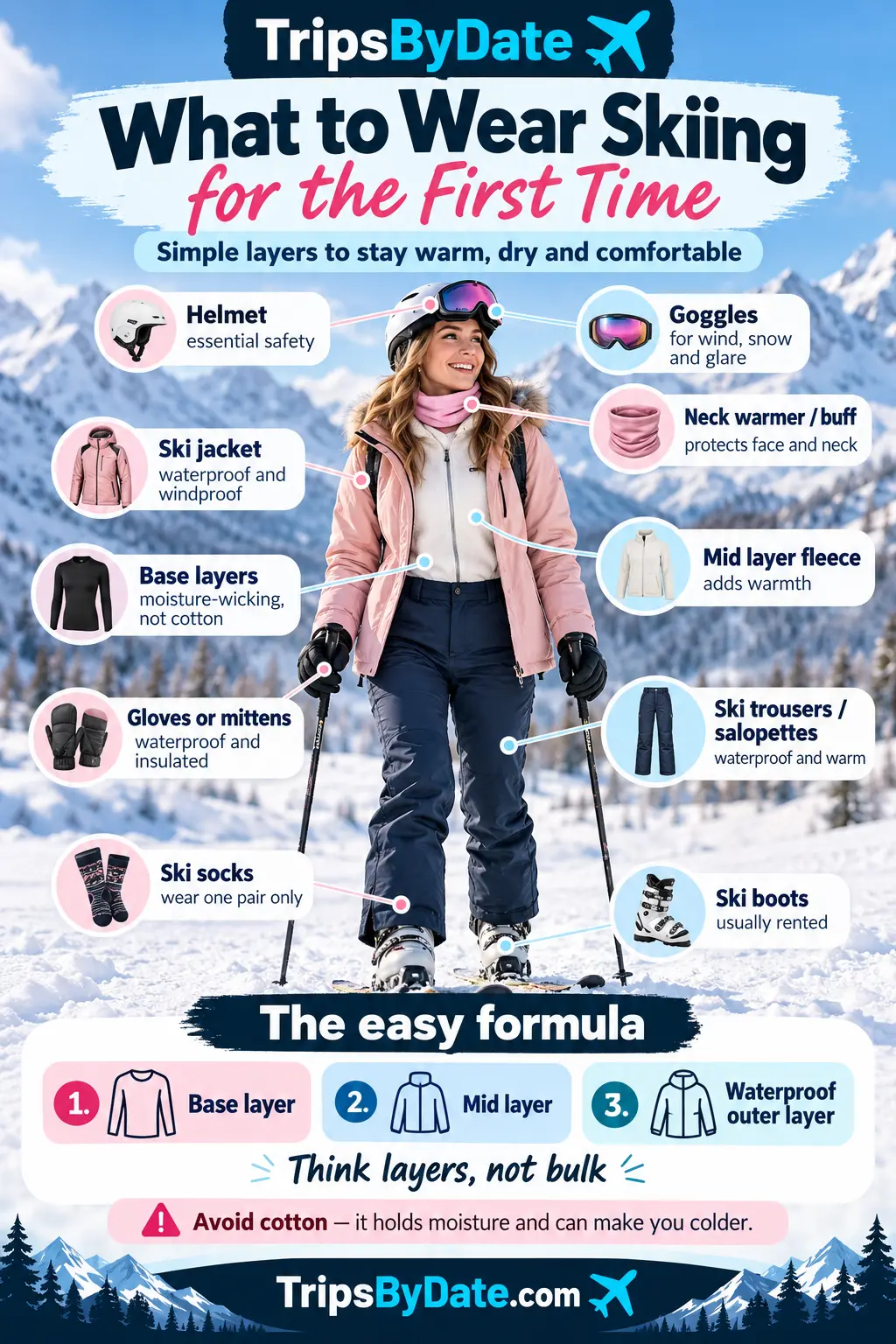
The easiest way to dress for your first day skiing is not to wear one enormous coat. It is to build a simple system of layers that keeps you warm, moves moisture away from your body and protects you from wind and snow.
Skiing can feel very cold while you are sitting on a chairlift and surprisingly warm once you start moving. That is why proper ski clothing is designed around layers rather than bulk.
For most beginners, the basic formula is straightforward: a moisture-managing base layer, an insulating middle layer and a weatherproof outer layer.
Explore Upcoming Ski Holidays
Looking for your next ski trip? Here are some upcoming ski holidays from specialist operators, ordered by departure date.


 BRS • 7 nights
 HB · Skiline

 LGW • 6 nightsSkiline
 BHX • 7 nightsB&B · Skiline
 GLA • 7 nightsHB · Skiline
The simple ski clothing formula
Think of your ski outfit as three main layers.
1. Base layer: worn next to your skin to help move sweat away from your body.
2. Mid-layer: usually a fleece or lightweight insulated layer that provides warmth.
3. Outer layer: your ski jacket and ski trousers, protecting you from snow, wind and changing mountain weather.
This system also lets you adjust your clothing during the week. On a mild sunny day you may need less insulation. On a freezing or windy day you may want an extra layer.
Start with a proper base layer
Your base layer sits directly against your skin, so its main job is moisture management rather than simply making you feel thickly wrapped up.
Ski Club of Great Britain recommends merino wool or synthetic sports base layers because they help move perspiration away from the body while remaining suitable for active use.
A long-sleeved thermal top and thermal leggings are a sensible starting point for most beginners.
Avoid treating an ordinary heavy cotton T-shirt as your technical base layer. For skiing, a proper merino or synthetic layer is generally much better suited to managing moisture while you are active.
What should you wear on your legs?
The normal setup is much simpler than many beginners expect.
Wear thermal leggings or long underwear underneath your ski trousers.
You generally do not need jeans, jogging bottoms or several thick pairs of trousers underneath.
Ski Club guidance notes that your legs generate plenty of heat while skiing, so a base layer underneath proper insulated ski trousers is often enough.
Wear a fleece or insulating mid-layer
Your middle layer provides much of the warmth between your thermal top and your jacket.
A technical fleece is one of the easiest options for a beginner because it is warm without being excessively bulky.
On colder days you might prefer a lightweight synthetic or down insulating jacket underneath your outer shell.
The important thing is that your layers still allow you to move comfortably.
Do you need a proper ski jacket?
Yes, or at least a suitable waterproof and wind-resistant winter sports shell.
Your ski jacket is the layer that protects you from wind, falling snow and wet conditions.
For a first ski holiday, buying an extremely expensive technical jacket is unnecessary. But ordinary fashion coats are not always designed for several hours of physical activity in snow and changing mountain weather.
Look for something that gives you weather protection, freedom of movement and enough space to layer underneath.
Ski trousers or salopettes
Proper ski trousers are just as important as the jacket.
They provide protection from snow and wind while allowing your knees and hips to move freely.
Bib-style salopettes can be particularly useful for beginners because the higher waist helps stop snow getting inside if you fall.
And on your first few days, there is a reasonable chance you will fall.
What ski socks should a beginner wear?
Wear one pair of proper ski socks.
Ski socks are long enough to extend above the top of your ski boot and are designed to work inside the boot without creating unnecessary bulk.
Thick socks are not automatically warmer. A ski boot needs to fit correctly, and adding multiple pairs can make the boot tighter and less comfortable.
Ski Club guidance favours thinner technical ski socks, with merino or synthetic materials both common choices.
Do beginners need ski gloves?
Yes. Ordinary knitted gloves are not a good substitute for proper ski gloves or mittens.
Ski gloves are designed to protect your hands from cold, wind and snow while still letting you hold ski poles and operate lift bars and bindings.
Beginners often spend more time touching the snow because they are getting up after falls, which makes decent gloves particularly worthwhile.
Mittens can be warmer than gloves because your fingers share warmth inside one compartment.
Helmet: buy one or rent one?
You do not necessarily need to buy a helmet for your first ski holiday.
Helmets are commonly available to rent alongside skis and boots, which is a sensible option if you are not yet sure whether skiing will become a regular hobby.
Ski Club describes a helmet as one of the most important pieces of ski equipment and advises using a proper snowsports-specific helmet.
GOV.UK also notes that helmet rules vary between resorts and that many winter-sports insurance policies require helmet use, so check both the local rules and your insurance.
Do you need ski goggles?
Yes. Goggles are useful in far more conditions than just heavy snow.
They protect your eyes from wind, snow and bright reflected light while also making it easier to see the terrain in difficult conditions.
Snow reflects a large amount of ultraviolet radiation, and UV exposure is stronger at altitude, so proper eye protection matters even when the air temperature is very cold.
Make sure your goggles fit comfortably with your helmet.
Take a neck warmer or Buff
A neck warmer is a small piece of kit that can make a very cold chairlift considerably more comfortable.
It protects your neck and can be pulled over your lower face when the wind picks up.
Ski Club recommends face or neck protection for beginners because it helps keep cold air, snow and wind away from exposed skin.
What about a hat?
A warm hat is useful around the resort, but you normally should not need a thick woolly hat underneath a correctly fitted ski helmet.
Your helmet should fit securely as designed.
Keep the hat for walking to restaurants, wandering around the village and après-ski.
What do you wear inside ski boots?
Just your ski sock.
Do not tuck thermal leggings, jeans or other bulky layers deep inside the boot.
Ideally, the only fabric between your foot and the boot liner is your sock. Your thermal leggings can finish above the top of the boot or sit smoothly without creating folds or pressure points.
What should you wear on a warmer ski day?
Mountain weather can change dramatically during a ski week.
Spring skiing can sometimes mean sunshine and temperatures well above freezing.
Keep your base layer and weatherproof outer layer, but you may be able to remove or use a lighter mid-layer.
This is one reason layering works better than relying on one extremely thick piece of clothing.
What should you wear when it is extremely cold?
Add insulation rather than simply stacking random bulky clothes underneath your jacket.
A warmer fleece or lightweight insulated jacket can sit between your base layer and outer shell.
Glove liners, a neck warmer and appropriate face protection can also make a significant difference.
If conditions become severe, follow local resort advice and do not assume that having more clothing makes every weather condition safe to ski in.
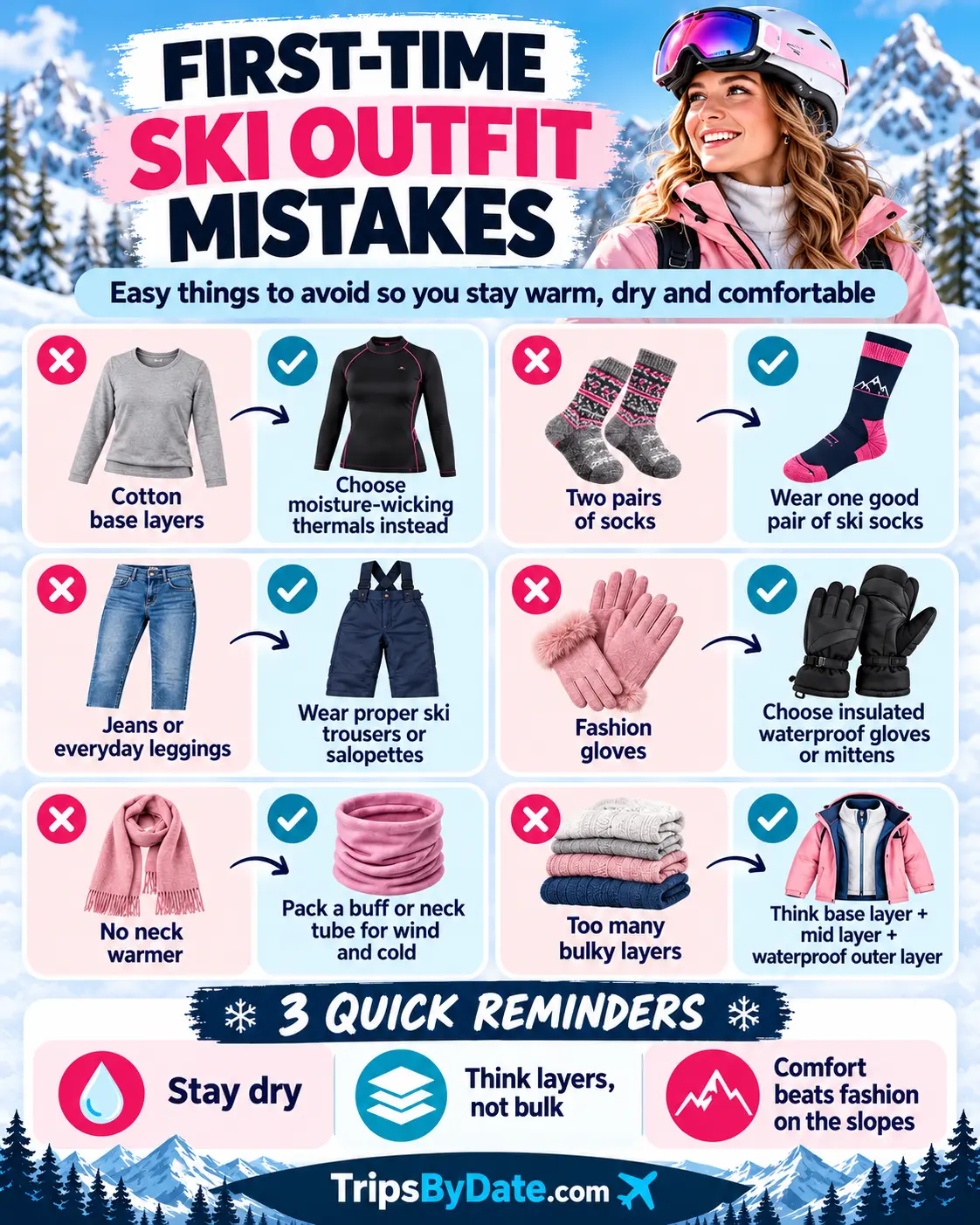
What should you NOT wear skiing?
There are several common beginner mistakes worth avoiding.
Jeans: uncomfortable inside ski clothing and poor once wet.
Several pairs of socks: they can make ski boots tighter and create uncomfortable folds.
Ordinary fashion gloves: they are unlikely to provide the same weather protection as ski gloves.
A giant scarf: a fitted neck warmer is generally much easier around ski equipment and lifts.
Too many bulky layers: you still need to move freely.
Do you have to buy all your ski clothes?
No.
If this is genuinely your first ski holiday, borrowing or renting some clothing can make much more sense than buying an expensive wardrobe before you know whether you enjoy skiing.
Ski Club notes that rental clothing is available through some specialist suppliers, while helmets are routinely available through ski-hire shops.
The items most worth owning early are usually the things that are inexpensive, personal and useful again: base layers, ski socks, gloves and a neck warmer.
Do ski boots come with your ski hire?
Usually, yes, if you book a standard ski-hire package that includes skis and boots.
Exact packages vary between rental shops, so check what is included before travelling.
Beginners generally do not need to buy ski boots before their first trip. Properly fitted rental boots are the normal starting point.
What should you wear to your first ski lesson?
Arrive fully dressed for skiing rather than expecting the lesson itself to provide clothing.
A simple setup is:
Thermal top and leggings, fleece, ski jacket, ski trousers, one pair of ski socks, ski gloves, helmet, goggles and a neck warmer.
Your skis, boots and poles can normally be collected from your rental shop beforehand.
Do you need sunglasses as well as goggles?
They are useful rather than essential for every moment of skiing.
Sunglasses are useful when sitting outside at lunch, walking around resort or enjoying a sunny afternoon away from the slopes.
Choose proper UV protection. The Met Office warns that altitude and reflected UV from snow increase exposure during winter sports.
Know when you can travel?
Pick your departure airport and the dates you are free, then see the ski holidays that actually fit.
Find ski holidays by dateDo you need sunscreen when skiing?
Yes.
Cold temperatures do not remove the risk from ultraviolet radiation. At altitude there is less atmosphere filtering UV, while snow reflects a large amount of it back towards you.
Protect exposed skin and your lips even when conditions do not feel warm.
For more detail, read our Ski Skin Survival Guide.
How many ski outfits do you need for a week?
Far fewer than seven.
One ski jacket and one pair of ski trousers can be enough for a normal week.
Rotate your base layers and ski socks, and take one or two suitable mid-layers depending on the weather.
For a complete packing breakdown, see our What to Pack for a Ski Holiday.
What should you wear around the ski resort?
Away from the slopes, ski resorts are usually fairly casual.
Comfortable trousers or jeans, jumpers or fleeces, a warm coat and footwear with good grip will cover most evenings.
Proper footwear matters because pavements can be snowy or icy, particularly first thing in the morning and after dark.
The easiest beginner ski outfit to remember
If all the clothing advice becomes confusing, remember this:
Top: thermal base layer → fleece or insulating layer → ski jacket.
Bottom: thermal leggings → ski trousers.
Feet: one pair of ski socks → ski boots.
Accessories: helmet, goggles, gloves and neck warmer.
That basic setup will cover the majority of first-time recreational skiers. You can then add or remove insulation depending on the temperature.
Reliable advice on what to wear skiing
The Ski Club of Great Britain has a detailed guide explaining base layers, fleeces, insulation, ski jackets, trousers and the principles behind layering.
Ski Club of Great Britain: ski clothing and layering
Its beginner guide also covers the basic clothing and equipment first-time skiers need.
Ski Club of Great Britain: new to snowsports
For helmets, goggles, gloves and face protection:
Ski Club of Great Britain: ski accessories guide
GOV.UK also provides winter-sports guidance for British travellers, including helmets, insurance and mountain safety.
GOV.UK: preparing for winter sports abroad
The Met Office explains why UV protection remains important in snowy mountain environments.
More help with your first ski holiday
Best Ski Resorts for Beginners · What to Pack for a Ski Holiday · Get Fit for Skiing · Ski Slope Dos & Don'ts
‹BACK TO SKIING
Know when you can travel?
TripsByDate works the other way around. Pick your departure airport and the dates you are free, then see the holidays that actually fit.
Find holidays by date