

What Ski Boots Should Feel Like
Snug or too tight? Here’s how to tell whether your ski boots fit properly, what beginners should expect and when to ask for help.
Your first pair of ski boots can feel very strange. They are heavy, stiff and much more restrictive than trainers or hiking boots. That does not automatically mean you have the wrong size.
The confusing part is knowing the difference between normal, supportive snugness and a fit that is genuinely too tight. A good ski boot holds your foot and heel securely so that your movements reach the ski. It should not leave you in significant pain, make your toes curl or cause persistent numbness.
Below, we explain what each part of a ski boot should feel like, the standing-and-flexing test, common beginner mistakes and what to do if hired boots become uncomfortable during your holiday.
Explore Upcoming Ski Holidays
Looking for your next ski trip? Here are some upcoming ski holidays from specialist operators, ordered by departure date.

 LGW • 7 nights
 Skiworld
 LTN • 7 nightsSkiworld


 GLA • 7 nightsHB · Skiline
 GLA • 7 nightsHB · Skiline
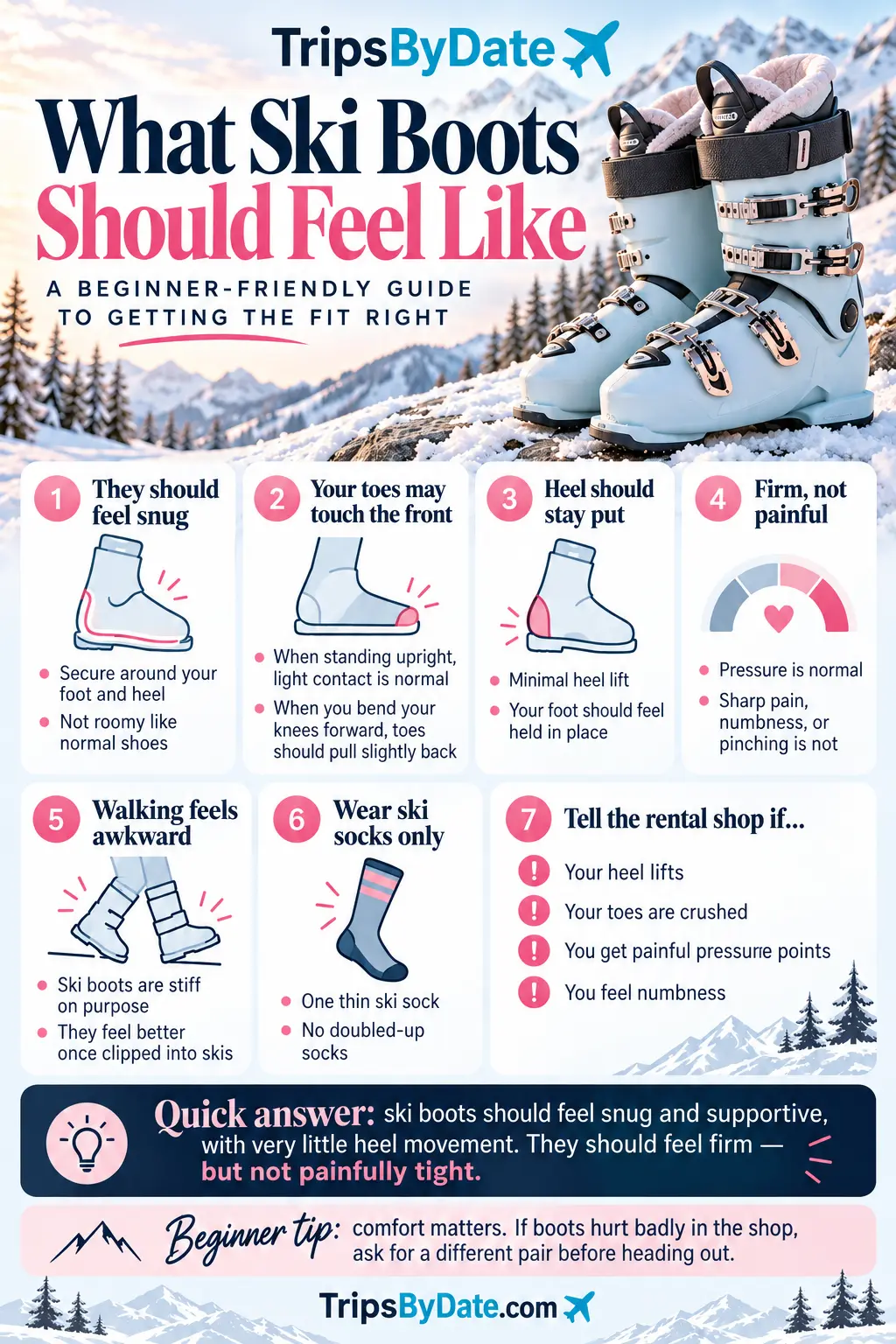
The quick answer: how should ski boots feel?
Ski boots should feel firm and close-fitting all around your foot and lower leg, without sharp pain or restricted circulation.Your heel should stay in place as you flex forward. When standing tall, your toes may lightly touch the front; when you bend your knees into a skiing stance, that contact should ease.
It is normal to notice the rigid shell and snugness around your ankle. It is not a good sign if your toes are crushed, you have a sharp pressure point, your foot goes numb or you have to overtighten the buckles to stop your heel sliding about.
This is consistent with ski-boot fitting guidance from REI’s ski boot sizing and fit guide, which explains the importance of both toe contact and heel hold.
Why ski boots feel different from ordinary shoes
A walking shoe is designed to bend with your foot. A downhill ski boot has a hard outer shell, a padded inner liner and a stiff cuff around the lower leg. Together they help transmit pressure and movements to your skis.
That is why there is less space for your foot to move around. An oversized boot can feel pleasant when you first put it on, but your foot may shift inside it when you turn or try to control your skis. A properly fitted boot feels more like secure support than soft, roomy footwear.
The goal is not to choose the tightest possible boot. It is to find one that supports you without creating painful pressure.
1. What should your toes feel like?
This is often the biggest surprise for beginners: light toe contact at the front of a ski boot while standing upright can be normal. It does not necessarily mean that the boot is too small.
Fasten the boot as directed, stand upright and notice where your longest toe sits. It may brush the liner at the front. Now bend your knees and gently press your shins towards the front of the boots, as if getting into your skiing position.
Your heel should settle back into its pocket and pressure on your toes should reduce. In a well-fitting boot, your toes should not remain painfully jammed at the front when you flex forward.
If your toes curl, your nails hurt or you feel strong pressure even in a skiing stance, tell the fitter. Do not automatically size up without checking the heel and overall foot fit as well.
2. Your heel should feel secure, not loose
Heel hold is a major part of boot fit. As you bend your knees, your heel should stay seated in the back of the boot rather than rising noticeably or sliding around.
A boot that allows your heel to lift too much can make ski control more difficult. Beginners sometimes compensate by fastening the buckles extremely tightly, but that can cause discomfort without correcting the underlying shape or size problem.
Ask a boot fitter to check the fit if your heel moves significantly. A different boot model or volume may be more appropriate than a smaller shoe-size number alone.
3. Your foot should feel held evenly, not crushed
You should feel contact around your foot, especially at the ankle and over the top of the foot. There should not be one painfully tight spot taking all the pressure.
If the sides of your forefoot feel squeezed, your boot may be too narrow or the wrong shape. If the top of your foot aches sharply beneath the buckles, the fit or fastening pressure may need adjusting.
Ski boots come in different shapes and internal volumes, not just different lengths. The width across the forefoot is often called the last. Two boots labelled with the same length can therefore feel quite different.
For more background, REI explains ski boot width and volume, while evo’s boot sizing guide covers common pressure and fitting issues.
4. How should ski boots feel around your calves and shins?
The upper cuff should support your lower leg. When you bend your knees, your shins should meet firm resistance from the front of the boots, without a sharp digging sensation.
You should be able to flex forward in a controlled way for the boot’s intended stiffness. You do not need to force your knees dramatically forward to prove the fit is right.
Calf shape, leg proportions and the cuff design can change how a boot feels. If the cuff pinches the side of your leg or creates painful concentrated pressure, ask for an adjustment or another model rather than simply accepting it.
A simple five-minute ski boot fit test
If you are in a rental shop, try this with the fitter present. You are checking for a comfortable, secure fit, not trying to adjust the boot mechanically yourself.
- Put on one smooth ski sock. Pull out any wrinkles and keep your base layer out of the boot cuff.
- Fasten the boot correctly. Ask staff to show you the buckles and power strap. They should feel secure, not painfully tight.
- Stand upright. Notice whether your toes lightly brush the front without being curled or crushed.
- Flex forward several times. Bend your knees gently. Toe pressure should ease, while your heel stays supported.
- Wear the boots for a while. Walk carefully on a suitable surface and pay attention to pressure, rubbing or numbness before leaving the shop.
If a pressure point gets worse rather than settling, tell the fitter before taking the equipment onto the mountain. REI recommends spending some time wearing boots during the fitting, rather than judging them only the moment you step in.
Normal ski boot sensations versus warning signs
Usually normal: a firm hold around your ankle, the cuff supporting your shin, mild toe contact when upright, less toe contact when flexed and a generally snug feeling.
Worth checking: one boot feels markedly different from the other, your heel rises when flexing, the forefoot is squeezed or your shin feels pressure in one small area.
Do not ignore: sharp pain, toes forced into a curled position, persistent pins and needles, numbness, marked changes in skin colour or a boot you cannot comfortably flex in. Stop using the boots and seek professional help with the fit.
Cold feet can have several causes, including the weather, moisture and unsuitable clothing. Overly restrictive boots can also contribute. If your feet become persistently numb or unusually cold, do not assume that is simply part of skiing.
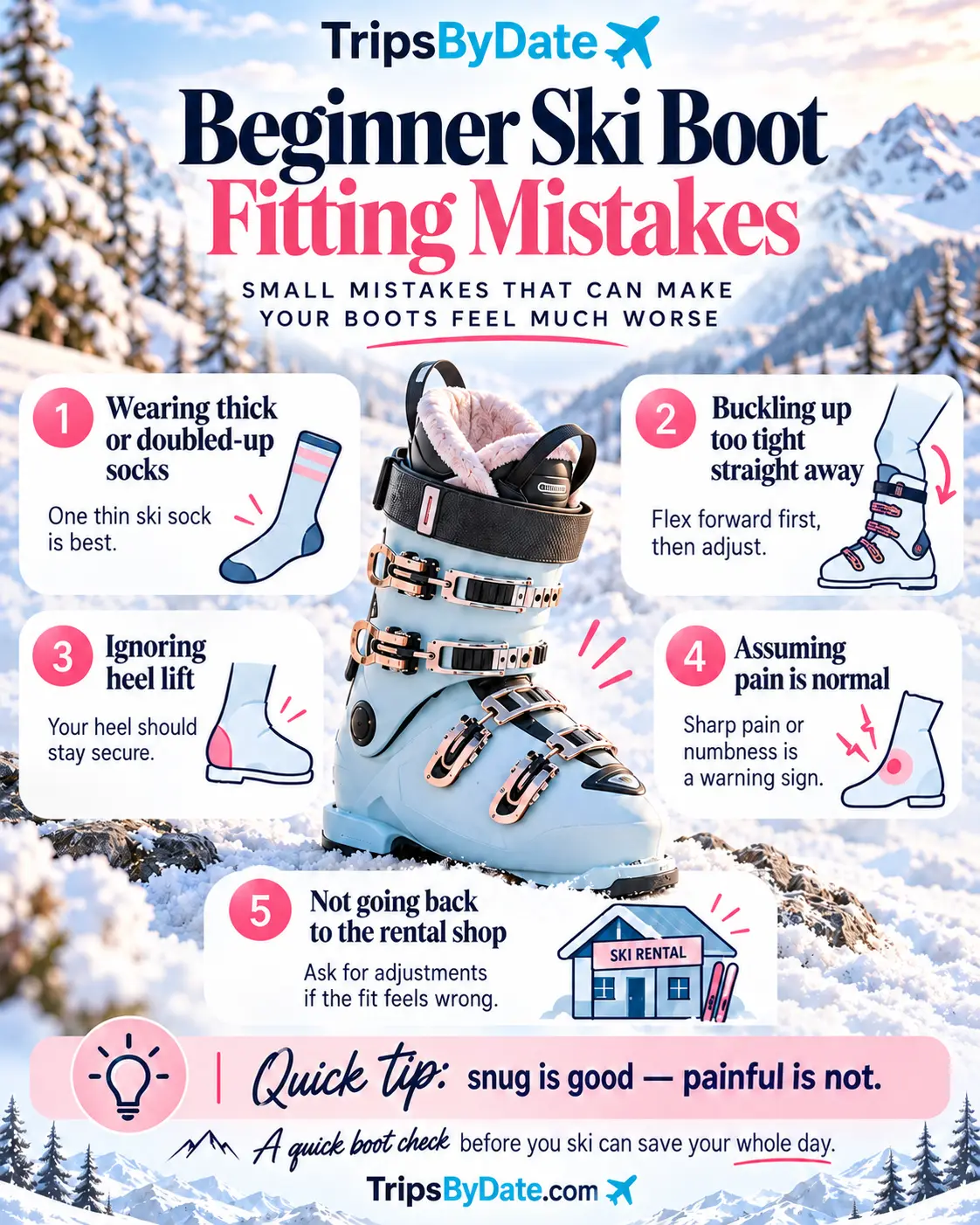
How tight should you fasten ski boot buckles?
Securely, but not with maximum force. The buckles and strap help keep your foot and lower leg supported, but excessive tightening can create painful pressure or interfere with circulation.
Different boots have different fastening systems, so ask the rental technician to show you the correct sequence for your pair. The important result is a secure heel and evenly distributed pressure, not having every buckle on its tightest setting.
You may need to make a small adjustment after skiing for a while as the liner settles and your feet warm up. If the boots only feel stable when fastened painfully tight, have the fit reassessed.
REI’s guide to putting on ski boots explains how the upper buckles, power strap and lower buckles work together.
Do ski boots have to hurt before they become comfortable?
No. A snug boot can feel unfamiliar, and new liners may soften with use, but pain is not a requirement of a good fit. You should not plan to endure several miserable days waiting for a badly fitted boot to change shape.
People sometimes confuse stiffness and snugness with pain. Stiffness is the resistance you feel when bending the boot forward. Snugness is the even support around your foot. Pain is a signal to investigate, particularly if it is sharp, persistent or concentrated in one spot.
Rental boots have been worn before, and their liners may already be relatively settled. If they hurt in the shop, ask to try another pair before accepting them.
Why your shoe size may be wrong for ski boots
Ski boots are commonly labelled using Mondopoint, a sizing system based roughly on foot length in centimetres. That makes ski boot sizes different from ordinary UK shoe sizes.
More importantly, your normal shoe size does not describe your heel shape, forefoot width, instep height or calf shape. Somebody who wears the same shoe size as you might need a completely different ski boot model.
An experienced fitter measures and assesses your feet rather than simply handing over the same number you wear in trainers. See REI’s fitting and sizing advice for a more detailed explanation.
Should you wear thick socks or two pairs of socks?
Usually neither. One pair of well-fitting ski socksis generally the better choice. Extra-thick socks and doubled layers can bunch up, increase friction or make an already snug boot painfully restrictive.
Look for ski socks made from materials designed to manage moisture, such as wool blends or technical synthetic fabrics. Avoid folds around the toes and ankle, and do not tuck several layers of trouser fabric into the boot.
For a full clothing checklist, see What to Wear Skiing for the First Time and What to Pack for a Ski Holiday.
What if you have wide feet, narrow heels or high arches?
Tell the boot fitter. Foot shape matters as much as length, and rental shops may have different boot models to suit different foot volumes.
Wide feet: a wider or higher-volume boot may feel better than simply choosing a longer boot. Sizing up in length alone can create a loose heel.
Narrow heels: the boot needs enough heel hold without the rest of your foot being squeezed excessively. A different shell shape may be more useful than overtightening.
High insteps or prominent arches: pressure over the top or sole of your foot should be discussed with the fitter. Supportive footbeds or a different boot shape may be options, depending on the equipment and shop.
Why one ski boot might hurt more than the other
Your feet are not necessarily identical. One may be slightly longer, wider or shaped differently; even your ankle range of motion can vary between sides.
That does not mean you should accept a painful boot on one foot. Have both boots checked individually. Tell the fitter exactly where you feel the pressure and whether it changes when you flex.
Can you walk normally in ski boots?
Not really. Downhill ski boots are rigid, so walking in them is more awkward than walking in ordinary shoes. A short, careful walk through a shop or resort can feel clunky even when the boots fit correctly.
That awkwardness alone is not evidence of a poor fit. But walking should not produce extreme pain. Take care on icy steps and slippery surfaces, and use a boot’s walk mode only if it has one and you understand how it works.
What if your boots feel fine indoors but hurt after a run?
Stop and work out what has changed. Your foot may have moved inside the boot, a buckle may be too tight, or an existing pressure point may become more noticeable with movement.
Make a note of exactly where the pain occurs: toes, instep, ankle bone, heel, shin or calf. That information is much more useful to the rental technician than simply saying the boots are uncomfortable.
If discomfort persists or you notice numbness, return to the rental shop for assessment. Do not attempt to modify the shell, liner or equipment setup yourself.

Know when you can travel?
Pick your departure airport and the dates you are free, then see the ski holidays that actually fit.
Find ski holidays by dateCan a ski hire shop swap uncomfortable boots?
Depending on its policy and available stock, a rental shop may be able to adjust or exchange your boots. It is worth asking about swaps when you collect your equipment, especially if you are renting for a full week.
Be specific: for example, “My heel lifts when I bend my knees,” or “My right little toe feels crushed even when I flex forward.” A technician can assess whether changing the size, shape or fit is appropriate.
If you are new to renting ski equipment, our How Ski Hire Works for Beginners guide explains what happens when you book, collect and return your kit.
Are rental ski boots less comfortable than owned boots?
They can be, but not always. Rental boots are designed to suit a range of people, whereas a personally purchased boot can be selected and professionally adjusted for your particular feet.
For someone on their first ski holiday, renting is usually a sensible way to begin. You can learn what ski boots feel like and whether you enjoy skiing before spending money on your own equipment.
If you later ski frequently, buying properly fitted boots may be more useful than buying skis first. For a wider comparison of the costs and trade-offs, read Should You Hire or Buy Ski Equipment?.
Does ski boot stiffness matter for beginners?
Yes, but it is separate from sizing. Boot stiffness is often described by a flex rating. A more flexible boot may be easier for a beginner to bend into a natural skiing position, while very stiff models are generally intended for skiers with different performance needs.
Flex numbers are not standardised perfectly between brands. Your size, strength and experience also matter, so do not choose a boot solely because somebody suggests a particular number. Ask the fitter for a suitable beginner model.
REI’s guide to choosing alpine ski boots explains the relationship between flex, skier build and intended use.
What should parents check about children’s ski boots?
Children need secure, correctly sized boots just as adults do. Avoid choosing boots with lots of growing room: a loose boot can allow the foot to move around and make skiing harder.
Ask the fitter to check the child’s heel hold and toe comfort, and encourage children to describe any pinching or painful pressure. Young children may struggle to explain the problem unless you ask specific questions.
Because children grow quickly, hiring can be convenient. See our Best Ski Resorts for Families guide for planning a family ski trip.
Frequently asked questions about ski boot fit
Should my toes touch the front of my ski boots?
Lightly, when standing upright, is often normal. When you bend into a skiing stance, the contact should reduce. Toes that remain crushed or painfully bent indicate a problem worth checking with a fitter.
Should I be able to wiggle my toes?
You should not feel as though your toes are jammed solidly together, but ski boots are not meant to have the roomy toe space of everyday shoes. Prioritise natural toe position, secure heel hold and the absence of painful pressure.
Is a little heel movement acceptable?
A tiny amount of movement may occur, but significant heel lift when flexing is a sign that the fit needs assessment. Do not attempt to solve a loose heel by crushing your foot with the buckles.
Should ski boots make my feet numb?
No. Persistent numbness, pins and needles or significant pain should not be accepted as a normal part of ski boot fit. Stop and seek a professional adjustment; seek medical advice if symptoms are severe or do not resolve after removing the boots.
Are ski boots meant to be uncomfortable?
They are meant to be firm and supportive, which can feel unfamiliar at first. They are not supposed to cause significant pain or leave you unable to enjoy skiing.
Should I buy bigger boots so they feel more comfortable?
Not automatically. Going up in length can create too much movement around your heel and foot. The solution may be a different boot shape or volume rather than a bigger size.
Reliable sources and further reading
These guides explain ski-boot fitting principles in more detail and are useful references before buying or hiring:
- REI — Ski Boot Sizing and Fit Guide: toe room, heel hold, volume and professional fitting.
- REI — How to Put on Ski Boots and Skis: fastening, flexing and checking fit.
- evo — How to Choose and Size Ski Boots: fit, boot shape and common pressure issues.
- Glisshop — How to Fit Ski Boots: upright and forward-flex checks.
The most important thing to remember
A good ski boot should feel snug, secure and supportive — never painfully tight. Light toe contact when standing can be normal, your heel should stay in place when you flex, and there should be no sharp pressure points or persistent numbness.
If something feels wrong, ask the rental technician or boot fitter to check it. A properly fitted pair makes learning easier and leaves you free to concentrate on the fun part: your first turns on the snow.
More skiing guides for beginners
How Ski Hire Works for Beginners · Skiing for Beginners: Your First Day · What to Wear Skiing for the First Time · What Ski Lessons Do Beginners Need?
‹BACK TO SKIING
Know when you can travel?
TripsByDate works the other way around. Pick your departure airport and the dates you are free, then see the holidays that actually fit.
Find holidays by date