

What Does a Ski Pass Include?
Lift access, beginner passes, linked resorts and the extras you might still need to pay for — explained without the jargon.
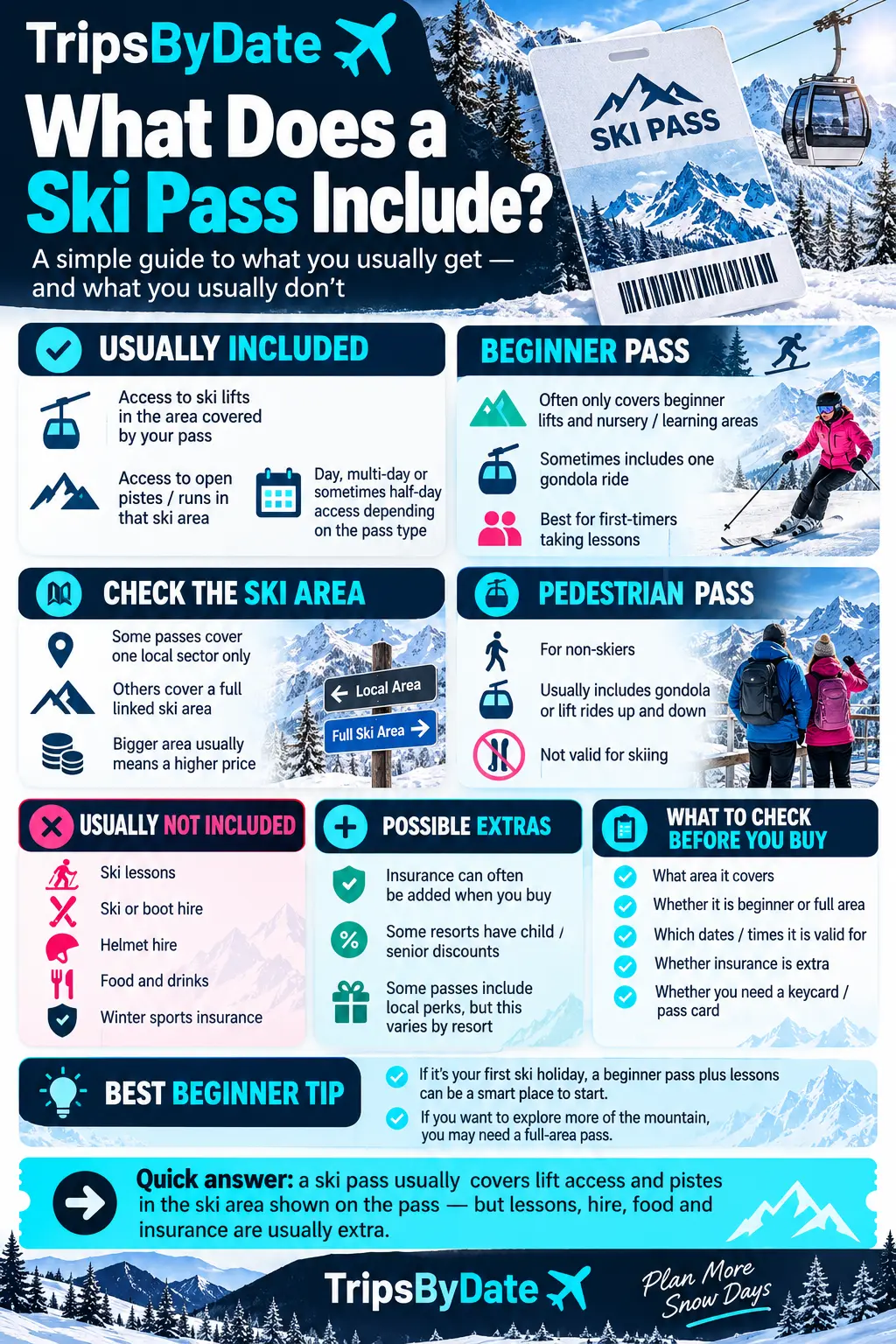
A ski pass is your ticket onto the mountain. But buying one for the first time can be confusing. Does it cover every ski lift? Can you visit the next resort? Do you still need to pay for lessons, equipment and insurance?
The short answer is that a ski pass usually pays for access to specific lifts and ski areas for a specified period. It does not automatically include everything you need for a ski holiday. Exactly what you can use depends on the pass you buy.
That distinction matters most for beginners. You may be able to save money with a smaller-area or beginner pass, rather than paying for an enormous mountain network you are not yet ready to explore.
Explore Upcoming Ski Holidays
Looking for your next ski trip? Here are some upcoming ski holidays from specialist operators, ordered by departure date.

 SEN • 7 nights
 Skiworld

 BRS • 7 nightsSkiworld


 MAN • 7 nightsAI · Ski Line
 BRS • 7 nightsHB · Skiline
What exactly is a ski pass?
A ski pass — also called a lift pass or ski lift ticket — normally gives its holder access to the lifts covered by that pass during its valid dates or hours. Those lifts might include chairlifts, gondolas, cable cars, drag lifts and beginner conveyor belts, depending on the resort and ticket.
You show or scan the pass when entering a lift. At many resorts it is a reusable electronic card that operates the lift gates when carried in your jacket pocket.
The pass is not a booking for a particular chairlift or a guarantee that every lift will run. Weather, maintenance, avalanche control and operating schedules can affect access.
What is normally included in a ski pass?
Covered lifts: access to lifts listed within the pass's geographical area and operating rules.
Marked pistes: the ability to reach and ski the open runs served by those lifts, subject to closures, restrictions and your ability level. It is not a separate payment for every individual run.
Specified duration: access for the purchased hours, days or season, rather than unlimited access forever.
Connected areas, sometimes: a larger-area pass may cover lifts across several neighbouring resorts. A local pass may not.
Some resorts also include particular experiences or benefits with certain passes, but these are optional extras rather than something to assume every ski pass provides.
What does a ski pass NOT normally include?
Ski lessons: group or private tuition is usually a separate booking with a ski school.
Equipment hire: skis, ski boots, poles, snowboard equipment and helmet hire generally cost extra.
Food and drinks: mountain restaurants, cafés and après-ski are not normally part of the ticket.
Winter-sports insurance: this may be offered as an add-on, and ordinary travel insurance may not cover every skiing activity you plan to do.
Transport to the resort: flights, airport transfers and accommodation are separate from a basic ski pass, unless sold in a combined package.
Ski-pass providers may bundle or promote extra services, so check the exact product before paying. A package deal including passes and lessons is different from buying the lift pass alone.
What is the difference between a local and a full-area ski pass?
One of the most important details on any ski pass is where it is valid.
A local-area pass typically covers lifts around one resort, village or section of a larger skiing region. A full-area pass gives access to a wider network of connected slopes and lifts, sometimes across several resort villages.
For example, Les 3 Vallées sells passes covering its extensive connected ski area, which links destinations including Courchevel, Méribel and Val Thorens. Its official pass range also contains options for different trip lengths and traveller needs.
Do not assume a lift pass with your resort's name on it automatically covers every neighbouring mountain. Look for the exact named ski area and check the resort's official piste map.
Is a full-area ski pass worth buying?
It can be excellent value for confident skiers who plan to explore different valleys and cover plenty of ground. But bigger does not automatically mean better.
If you are learning on a nursery slope all morning and practising on nearby gentle pistes in the afternoon, access to hundreds of kilometres of additional terrain may offer no practical benefit that day.
Before upgrading, ask whether the lifts and easy runs you will actually use require the bigger pass. A lower-priced local option might be enough, especially during your first few lessons.
Our How to Choose the Right Ski Resort guide explains why suitable terrain matters more than the headline size of a ski area.
What is a beginner ski pass?
A beginner pass is a restricted lift ticket intended for people learning to ski. Depending on the resort, it might give access to nursery slopes, beginner conveyors, selected drag lifts, a small set of chairlifts or a particular learning sector.
Some beginner areas have free lifts. Elsewhere, beginners need a paid ticket even for their first lesson. There is no universal rule, and a pass called a "beginner pass" in one resort may cover different lifts from a similarly named pass somewhere else.
That is why the most useful question is not simply "How much is the ski pass?" but "Which exact lifts will my instructor use, and which pass covers them?"
Should beginners buy a full ski pass on day one?
Not automatically. Ask your ski school before purchasing anything, especially if your course starts in a dedicated beginner area. A beginner ticket or free lifts may be sufficient at first.
On the other hand, some ski schools use lifts that require the standard area pass, and certain passes cannot easily be upgraded after purchase. Check the requirements before assuming the cheapest option will work.
If you have not booked lessons yet, read our What Ski Lessons Do Beginners Need? guide for advice on course length and lift-pass questions to ask.
What is a pedestrian ski pass?
A pedestrian pass is designed for people who want to use specified lifts without skiing. It can be useful for non-skiing partners, grandparents, photographers or anyone meeting friends for lunch at an accessible mountain restaurant.
It usually grants pedestrian journeys on particular gondolas, cable cars or approved lifts. It does not automatically permit skiing, and not every lift accepts pedestrians or provides a safe downhill pedestrian journey.
Les 3 Vallées publishes separate winter pedestrian-pass products alongside its skiing passes. Check the exact lift routes, direction of travel, restaurant access and return times before buying one.
Can you ride a gondola without skiing?
Often, yes, provided the gondola accepts pedestrians and you hold the correct pedestrian ticket or another pass that permits the journey.
Do not assume every chairlift, drag lift or cable car accepts non-skiers. Some are strictly for skiers and snowboarders, while others have restrictions based on weather, season or particular lift stations.
Can you ski between different resorts on one pass?
Sometimes. Large linked ski areas can let you travel between neighbouring resorts on skis, but only if the lifts and pistes forming the route are open and covered by your ticket.
An important detail is your return journey. If you cross into another valley, check when the connecting lifts close so you can get back to your accommodation without needing an expensive taxi.
Also check whether a bus or other transport link is required. A ski pass does not always include resort buses, railway journeys or every connection between ski areas.
Does a ski pass include ski hire?
Usually not. A standard lift pass buys lift access, while skis, boots, poles and helmets are rented or purchased separately.
Some tour operators and resorts sell bundles combining lift passes with lessons and equipment hire. These can be convenient, but you should compare the components rather than assuming every bundle offers a saving.
If you are not sure what you need, our How Ski Hire Works for Beginners guide explains what normally happens at a rental shop.
Is winter-sports insurance included with a ski pass?
Do not assume so. Some resorts offer optional insurance at the ski-pass checkout, but it may not be part of the basic price or may cover only specific risks.
Grandvalira's official season-pass information, for example, lists medical insurance as an additional purchase with rules about when it must be added.
A resort insurance add-on is not necessarily a substitute for comprehensive travel insurance. Check medical expenses, mountain rescue, repatriation, liability, equipment and any off-piste activities you intend to do.
If you are travelling from the UK, check your insurer's winter-sports terms carefully rather than relying only on a GHIC or EHIC for overseas medical costs.
What types of ski pass can you buy?
Half-day or hourly: useful for a partial skiing day, if your resort offers them. Some passes operate for a fixed time after first use; others apply during a specified morning or afternoon window.
Single-day: suitable for day trips, one-off lessons or occasional skiing.
Multi-day: common for ski holidays, including weekend and six-day products. Check whether the days must be consecutive.
Flexible or non-consecutive: offered by some areas for skiers who want rest days or do not plan to ski every day.
Season: generally designed for people skiing regularly throughout one winter.
These are product categories, not guaranteed options at every resort. Les 3 Vallées, for example, advertises short-duration, multi-day, seasonal and pedestrian products in its current pass range.
Do multi-day ski passes have to be used on consecutive days?
Often they do, but not always. A standard six-day pass may run over six consecutive dates, while certain flexible products allow days to be used separately within a defined period.
This matters if you want a rest day, expect poor weather or plan an excursion away from the slopes. Check the start date, final validity date and whether unused days expire before selecting a pass.
Our How Many Days Do You Need for a Ski Holiday? guide explains how to estimate the skiing days you will actually use.
Does a ski pass give you unlimited lift rides?
Many standard day and multi-day passes allow repeated rides on covered lifts during valid operating hours. But specialist tickets may have limitations, such as a single uphill journey, particular lifts or specific time windows.
Check the terms of the exact product rather than assuming every pass operates in the same way.
Does a ski pass include every open piste?
It allows access to the lifts within its designated area. The pistes you can actually ski depend on where those lifts take you, the terrain, marked connections and current closures.
A pass is not a promise that a particular run will be open. Strong wind, poor visibility, snow conditions and safety work can affect the ski area even when your ticket remains valid.
And holding a valid pass does not make difficult terrain appropriate for your ability. Respect piste signs, closures and local safety instructions.
How much does a ski pass cost?
Prices vary widely according to resort, season, age, length of stay and the size of the ski area. A pass for a small local sector may be much cheaper than one covering several connected valleys.
For a real-world example, Les 3 Vallées lists a 2026/27 six-day adult Solo pass at €421on its official pass page. That is an illustration of a large linked-area price, not a universal European ski-pass cost.
The advertised price may be different when you travel, and age categories, family offers, early-booking discounts and special dates can change what you pay.
Compare the price of the pass you actually need, not the most expensive full-area option by default. Our How Much Does a Ski Holiday Cost? guide covers how to budget for the whole trip.
Are children's ski passes cheaper?
Many resorts offer different prices for children, teenagers, older skiers or families. Some allow very young children to use eligible lifts free or for a nominal card charge.
Exact age boundaries and proof-of-age requirements vary. Check each family member's age category for your travel dates, especially if a birthday falls during the holiday.
Family bundles can sometimes be good value, but compare them with separate passes before assuming a special family ticket is cheaper.
Do ski-school packages include a lift pass?
Sometimes, but do not rely on it. Ski schools may sell tuition on its own, recommend a separate beginner pass or offer combined lesson-and-lift products through the resort.
Check whether your lesson booking says the lift pass is included. If it is not, ask which exact pass the instructor expects you to hold and whether you need it from the first morning.
For children, double-check whether the snow-garden or beginner programme provides lift access or requires an additional ticket.
Do you need a ski pass if you are just learning on the nursery slope?
Not necessarily. Some resorts provide free beginner conveyors or nursery lifts, while others charge for learning-area access.
A nursery slope itself may be free to reach, but a nearby lift used for repeated practice could still require a pass. This is exactly the kind of detail worth checking with your ski school before arriving.
What happens if you lose your ski pass?
Policies vary. Resorts may be able to block a missing electronic card and issue a replacement, sometimes for an additional fee.
Keep your receipt, confirmation email and any card reference number. These can make replacement easier. Avoid assuming that a lost pass will be replaced without proof of purchase.
Can you share a ski pass with somebody else?
Generally, no. Ski passes are commonly personal and non-transferable, even if the original holder has finished skiing for the day.
Resorts may check names, photographs or electronic usage records, and misuse can lead to penalties or cancellation under local terms.
If two people want to ski at different times, buy the ticket product permitted by the resort rather than sharing a personal pass.
Are ski passes refundable if the weather is bad?
Not automatically. Refund and interruption rules depend on the resort, the specific product and the reason skiing is disrupted.
Some providers sell cancellation or interruption protection, while others set minimum closure thresholds or exclude certain weather events.
Check the official terms before booking, especially for expensive multi-day passes. Keep records of any significant disruption if you later need to make a claim.
Know when you can travel?
Pick your departure airport and the dates you are free, then see the ski holidays that actually fit.
Find ski holidays by dateShould you book a ski pass online or at the resort?
Buying online can save time at lift-ticket offices, and some resorts offer advance-purchase discounts or online-only products.
Before paying, check whether the pass is immediately usable on your existing keycard, needs collecting from a machine or ticket office, or requires a separate card purchase or deposit.
Also confirm the activation date. Buying a pass early is useful only if it starts on the right day.
What is a ski-pass keycard?
Many resorts use a small electronic card carrying your lift-pass entitlement. At compatible lifts, the gate reads the card and opens automatically while it is in your pocket.
Depending on the destination, a keycard may be included, reusable, subject to a fee or refundable deposit. Some resorts allow online reloading of an existing card from a previous trip.
Keep it separate from other cards or devices if your resort's instructions recommend doing so, and avoid bending or damaging it.
Can you add more days to a ski pass?
Some resorts allow extensions or upgrades, but others require a fresh purchase. Whether an upgrade is permitted can depend on the pass type and whether you have already started using it.
If you are unsure how quickly you will progress, ask the ticket office or ski school before buying a shorter pass. It may be possible to start small and extend, but do not assume you can always do so.
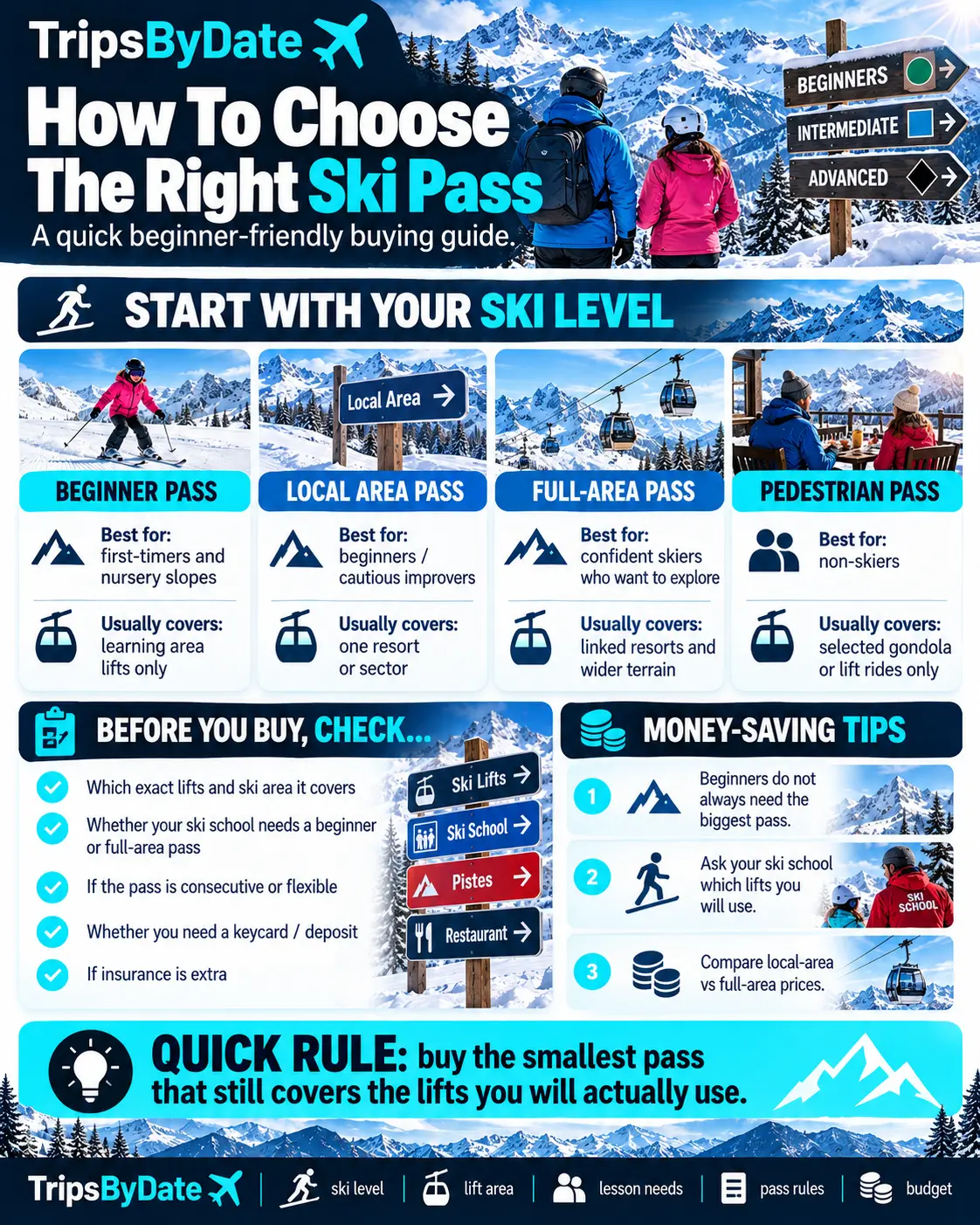
How do you work out which ski pass to buy?
Start with your actual plans rather than the advertised size of the ski resort.
If it is your first holiday: ask your ski school which beginner lifts and areas the lessons will use.
If you are an intermediate skier:compare the local piste map with the wider linked area and decide how much you realistically want to explore.
If your group has mixed abilities:check whether everyone needs the same pass, or whether beginners can buy smaller-area tickets.
If you are not skiing: investigate pedestrian tickets and which mountain restaurants or viewpoints are accessible without skis.
If you are skiing for part of the week:calculate the days you actually need and compare day, flexible and consecutive multi-day prices.
Ten things to check before buying your ski pass
1. The exact ski area and lifts covered.
2. Whether a beginner or local pass is enough.
3. The pass's start date and expiry time.
4. Whether days must be consecutive.
5. The ski school's lift-pass requirements.
6. Age categories and available discounts.
7. Whether insurance is extra.
8. Whether you need a separate keycard.
9. Refund, closure and upgrade rules.
10. Whether the holiday package already includes a pass.
A simple ski-pass example for a first-time skier
Imagine you have booked a seven-night holiday and five mornings of beginner ski lessons. The resort offers both a full-area ticket and a cheaper learning-area option.
Rather than automatically paying for the whole mountain, ask your ski school where the group will meet and which lifts it will use on each day of the course.
If the smaller pass covers everything you need, it may save money. If the lessons move onto lifts outside that area, you may need a different pass or an upgrade.
This is an illustrative scenario, not a promise that a particular resort offers those ticket options. Always check its current products.
Official ski-pass information and sources
Les 3 Vallées publishes a detailed range of passes for different durations, geographical areas and traveller types, including winter pedestrian and season passes.
Les 3 Vallées: official ski-pass options and prices
Its short-stay page explains four-hour, day and other shorter-duration options.
Les 3 Vallées: day and short-stay passes
Grandvalira's official pass information gives a useful real example of ski insurance being an additional purchase with specific conditions.
Grandvalira: Andorra Pass and insurance information
For UK travellers, the government explains why winter-sports insurance needs to cover the activities and risks relevant to skiing.
GOV.UK: winter-sports safety and insurance guidance
So what does a ski pass actually include?
In most cases, a ski pass is primarily a lift-access ticket for a defined area and period. It does not automatically include tuition, equipment, meals or insurance.
For first-time skiers, the most useful step is to ask the ski school which lifts you really need. For everyone else, compare the local and full-area options against the number of days and terrain you will use.
A well-chosen pass is not necessarily the biggest one. It is the one that gets you where you actually want to ski without paying for mountain access you will never use.
More help planning your ski holiday
How Many Days Do You Need for a Ski Holiday? · What Ski Lessons Do Beginners Need? · How Much Does a Ski Holiday Cost? · How Ski Hire Works for Beginners
‹BACK TO SKIING
Know when you can travel?
TripsByDate works the other way around. Pick your departure airport and the dates you are free, then see the holidays that actually fit.
Find holidays by date