

Should You Hire or Buy Ski Equipment?
A beginner-friendly guide to what is worth renting, what is worth owning and when buying your own ski kit actually makes sense.
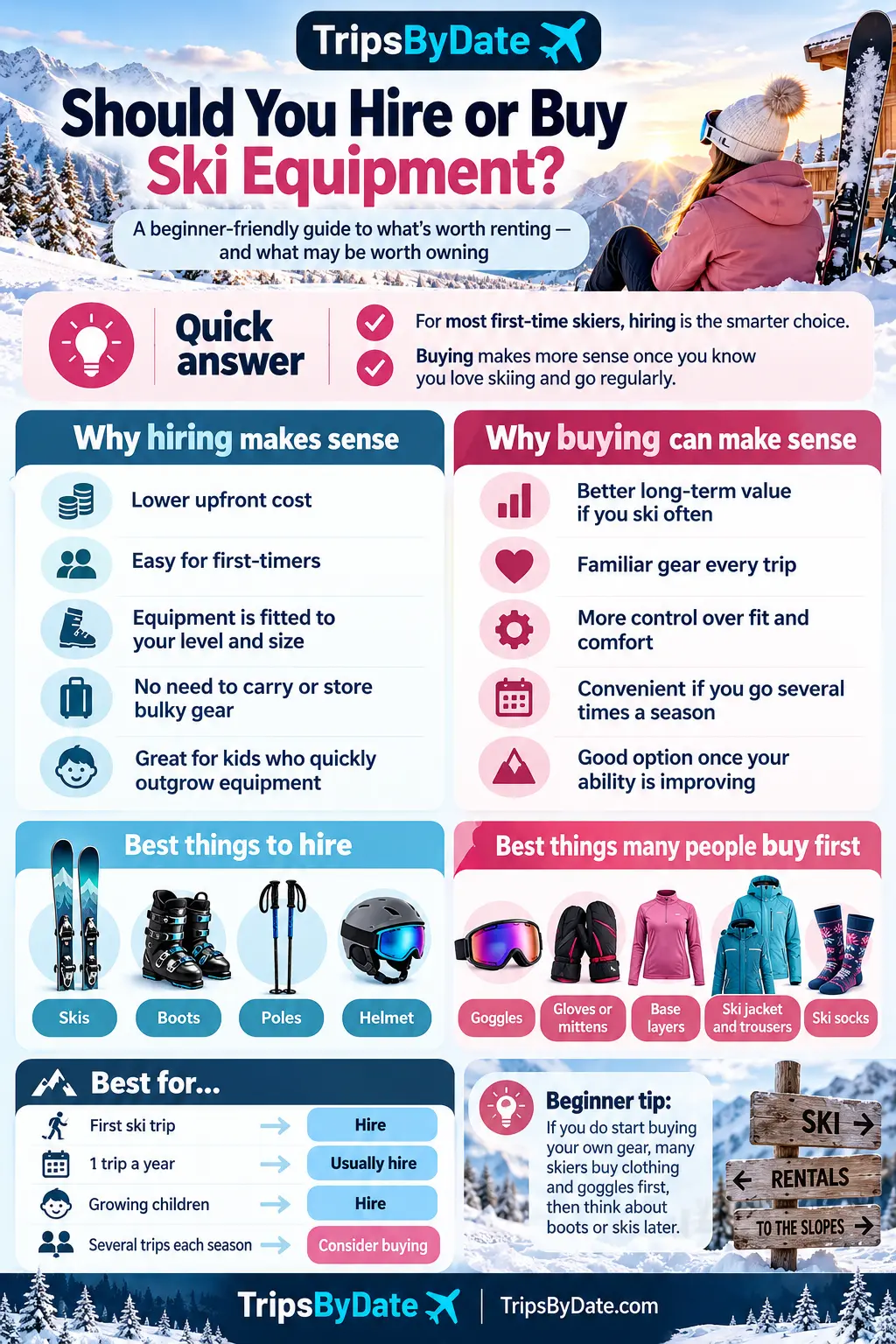
Ski equipment is expensive, bulky and surprisingly personal. If you are planning your first ski holiday, you might wonder whether buying your own skis and boots will save money, or whether hiring everything in the resort is the sensible option.
For most first-time skiers, hiring skis, boots and poles is the straightforward choice. You avoid a large upfront purchase, get equipment selected for your size and current ability, and do not have to carry skis through an airport.
Buying becomes more interesting once you know you enjoy skiing, travel regularly and understand what sort of equipment you actually like. But you do not have to choose between owning everything and owning nothing.
Explore Upcoming Ski Holidays
Looking for your next ski trip? Here are some upcoming ski holidays from specialist operators, ordered by departure date.


 MAN • 7 nights
 AI · Ski Line

 LGW • 7 nightsHB · Iglu Ski
 GLA • 7 nightsB&B · Iglu Ski
 BHX • 7 nightsSC · Ski Line
Should beginners hire or buy ski equipment?
If it is your first ski holiday, hire the technical equipment. You probably do not yet know what ski length, boot shape, stiffness or ski style will suit you as your technique develops.
A rental shop can choose a beginner-friendly setup and adjust it for your measurements and ability. If the boots cause problems or the skis are clearly unsuitable, you can ask for them to be checked or exchanged.
REI's first-time skiing guide recommends renting rather than making an expensive purchase before you have spent time on snow. That is a good starting principle, not a rule that you must keep renting forever.
Why hiring ski equipment makes sense
Lower upfront cost. You pay to use equipment for your trip instead of buying skis, bindings, boots, poles and possibly a helmet before you know whether you enjoy skiing.
Suitable gear for your ability. Beginners can use easier-to-handle skis rather than committing to equipment that may suit a very different skier.
Less travel hassle. Hiring in resort means no ski bag, no transporting long equipment and fewer storage problems when you return home.
Fewer maintenance responsibilities. Rental equipment is generally prepared by the shop, including checks appropriate to its condition and use.
Flexibility. You may be able to change boot size, ski model or equipment category if the initial setup is unsuitable, subject to the shop's policies.
What are the disadvantages of hiring?
Rental equipment has been used by other customers, so the exact choice and condition depend on the shop, its stock and the rental category you book.
Boots may fit less precisely than boots professionally fitted for your own feet. You may also have to queue for collection, particularly during school holidays and busy arrival days.
If you ski frequently, repeated rental charges can eventually exceed the cost of buying. You also may not get the same ski model or boot fit on every trip.
Those downsides matter more to a frequent skier than to somebody testing the sport for the first time.
Why buying ski equipment can make sense
Owning your kit gives you continuity. You know how the equipment feels, you are not starting from a different rental setup on every holiday, and you can choose products suited to the way you actually ski.
For regular skiers, buying may also reduce long-term spending. That is particularly true if you ski frequently, drive to resorts, have somewhere suitable to store equipment and take care of it between trips.
The biggest potential improvement is often boot comfort. A properly fitted personal boot can be more consistent than repeatedly choosing from rental stock, although buying an unsuitable boot is not an improvement on hiring.
What are the disadvantages of owning ski equipment?
Ownership comes with costs beyond the price on the shop label. Skis need maintenance, edges and bases require attention, and bindings must be inspected and adjusted correctly.
You also need somewhere to store the equipment, a way to transport it and potentially an airline sports-baggage allowance.
Your ideal ski may change as you progress. Equipment bought for your very first lesson might not be what you want once you are confidently skiing a wider range of pistes.
Which ski equipment should you hire on your first trip?
Skis: hire. A technician can select a suitable category and length for your height, weight and experience.
Ski boots: hire initially, unless you have a specific reason to seek professional boot fitting and are confident you will continue skiing.
Poles: hire. They are usually included in a ski rental package, and there is little advantage to buying your own poles for a first holiday.
Helmet: either hire a suitable snowsports helmet or buy one that fits correctly. Check whether helmet hire is included or charged separately.
Goggles, gloves and clothing: many travellers prefer to own these personal items, although borrowing or renting clothing can also be sensible for a first trip.
Our What to Wear Skiing for the First Time guide explains the clothing and accessories you need.
Are ski boots the first technical item worth buying?
For somebody who already knows they love skiing, boots can be a sensible first major purchase. The reason is fit: your boots connect your feet and legs to your skis, and uncomfortable boots can affect an entire holiday.
That does not mean walking into a shop and buying the same size as your normal trainers. Ski boots vary in internal shape, volume, flex and intended use.
A specialist boot fitter can assess your feet, discuss your skiing and help select a suitable shell and liner. Depending on the boot, adjustments may also be possible.
If you only ski occasionally and can find comfortable rental boots, there is no urgency to buy. And if rental boots cause pain, numbness or significant pressure, ask the rental shop to check the fit rather than enduring it all week.
Should you buy skis before ski boots?
Many occasional skiers do better with the opposite approach: continue hiring skis while considering properly fitted boots once they become regular skiers.
Hiring skis allows you to try different types and choose equipment appropriate to your current level and the resort conditions. Owning boots can give a more familiar fit from one holiday to the next.
There is one important check: the boots must be compatible with the bindings being used. Tell the rental technician when you bring your own boots, and have the equipment checked and set by a qualified professional.
How much does hiring ski equipment cost?
Ski-hire prices vary substantially by country, resort, season, number of days, equipment category and the retailer. A beginner ski package may be priced differently from higher-performance skis, and helmets may cost extra.
Rather than quoting one supposed European average, compare a real rental quote for your departure dates with the cost of equipment you would actually consider buying.
For a fair comparison, make sure the quote states whether boots, poles, helmet, damage protection and fitting are included. The cheapest advertised figure may not cover the complete package you need.
You can find more on budgeting in our How Much Does a Ski Holiday Cost? guide.
When does buying become cheaper than hiring?
There is no universal break-even point. It depends on the price of your chosen equipment, the rental rates you would otherwise pay, how many days you ski and your extra ownership costs.
For a simple calculation, compare the total purchase and maintenance cost with the rental charges you would avoid over the period you expect to own the gear.
Imagine a purely illustrative example: a setup costs £600 to purchase, with £100 of servicing and travel-related costs over the period you are comparing. If equivalent hire would cost £140 per trip, you would need five trips to reach £700 in avoided rental charges.
That example is arithmetic, not a live rental quote or a realistic price for every resort. Your figures could be very different, and equipment may need replacing before you reach your expected break-even point.
What costs do people forget when buying skis?
The price of skis is not always the total price of owning them. Depending on the product, you may also pay for bindings, professional setup and adjustment, servicing, waxing, repairs and replacement parts.
If you fly, check whether your airline charges for ski carriage and whether the sports-baggage allowance is separate from your ordinary checked suitcase.
You may also want a padded ski bag, boot bag or a secure way to carry your equipment by car. Storage space and maintenance are real considerations even when there is no separate bill for them.
Is it cheaper to own ski equipment if you only ski once a year?
Often not, especially if your holiday involves flights and you need to pay to transport the equipment.
One seven-night ski holiday each year does not automatically justify ownership. You need to compare the exact number of skiing days, how long you would keep the equipment and what rentals would otherwise cost.
Someone driving to a nearby ski area every winter may reach a different conclusion from somebody flying from the UK to a different Alpine resort once a year.
What if you ski several times each season?
Buying becomes more attractive when you ski regularly, know your equipment preferences and can spread the purchase cost across many outings.
But before buying, consider whether a season-long rental or lease is available. Some retailers provide seasonal arrangements that are more economical or convenient than repeated short-term rentals, without requiring ownership.
The best choice is usually determined by your actual skiing frequency, not by how often you hope to ski next winter.
Should children hire or own ski equipment?
Hiring is often particularly sensible for growing children. Skis and boots that fit properly one winter may be too small the next, so buying new equipment every year can become expensive.
For families who ski regularly, seasonal rental programmes, second-hand equipment and carefully chosen hand-me-downs may be worth investigating.
But children's equipment must still fit properly and be appropriate for their current size and ability. Do not keep a child in badly fitting boots simply to get another season out of a purchase.
REI's advice on teaching children to ski discusses renting, leasing and buying as different options, depending on frequency and how quickly children grow.
Is buying second-hand ski equipment a good idea?
Buying second-hand can reduce costs, but technical equipment needs careful inspection. The lowest price is not good value if boots do not fit or skis and bindings are unsuitable.
In particular, used ski bindings may be too old for a shop to service or adjust. Ask a qualified ski technician to inspect used skis and bindings before relying on them.
With used boots, consider the condition of the shell, buckles and liner as well as the fit. Avoid buying solely by normal shoe size or online appearance.
For helmets, the history matters. A helmet may have experienced an impact that is not obvious from a quick visual check. Buying a new, correctly fitted helmet from a reputable retailer is the safer choice when you cannot establish a used helmet's history.
Should you rent or buy a ski helmet?
Renting a helmet is a normal option for first-timers. The Ski Club of Great Britain notes that proper snowsports helmets are widely available through ski-rental businesses.
A personal helmet can make sense if you ski regularly, prefer a consistent fit or want a particular model that works with your goggles.
Whether you rent or buy, make sure it is designed for snowsports, fits securely and is in suitable condition. A helmet reduces certain risks but does not make unsafe skiing safe.
Check the local rules and your winter-sports insurance requirements before travelling.
What ski clothing is worth buying first?
If you know you will be skiing again, personal clothing and accessories can be useful first purchases even while you continue hiring all the technical equipment.
Consider well-fitting ski socks, gloves or mittens, thermal base layers, goggles and a suitable outer jacket and trousers.
You do not need premium brands for your first week, and borrowing or renting clothing may be sensible before committing to a full ski wardrobe.
Our What to Pack for a Ski Holiday guide has a detailed seven-night checklist.
Can you bring your own boots but hire skis?
Yes, many rental shops can provide skis for customers bringing their own boots. In fact, this can be a useful middle ground for regular travellers.
Tell the shop the boot type and bring the boots for binding-compatibility checks and correct adjustment. Never assume a rental binding will automatically work safely with every boot.
Renting skis also lets you choose equipment suited to the snow conditions and terrain of each holiday.
How does ski hire work when you arrive?
Rental shops typically ask for your measurements, skiing experience and equipment requirements before selecting skis, boots and poles.
The technician should help check the fit and set up the bindings appropriately. You can then ask about exchanges, collection times, damage policies and returning everything at the end of the trip.
Booking ahead can be useful in busy periods, particularly if you need a specific boot size or want to collect equipment before your first lesson.
We cover the complete process in How Ski Hire Works for Beginners.

Know when you can travel?
Pick your departure airport and the dates you are free, then see the ski holidays that actually fit.
Find ski holidays by dateIs hiring equipment at the resort better than hiring in advance?
Both approaches can work. Hiring at the resort is convenient because the rental shop is nearby if you need another boot size or have a problem with the equipment.
Hiring before you travel, or through a shop further from the lifts, may offer different prices or a wider choice. But you need to transport the equipment and understand what happens if something needs adjusting.
For beginners, convenience and reliable fitting may be worth more than a small headline saving.
Should you pay for premium ski hire?
Not automatically. Premium rental categories often include higher-performance skis aimed at more confident skiers, and those benefits may be unnecessary during your first lessons.
A beginner is generally better served by manageable, suitable equipment and comfortable boots than by choosing the most expensive category.
Ask the shop what the upgrade changes and whether it is appropriate for your ability before paying more.
Does renting equipment include damage insurance?
It varies. Some rental packages include limited damage protection, while others offer it as an optional extra or require payment for certain losses and damage.
Read the rental agreement, especially the rules for theft, damaged skis, missing poles, unattended equipment and excess charges.
Rental damage cover is not necessarily the same as winter-sports travel insurance, and you should check both separately.
What about renting or buying snowboard equipment?
The same broad decision applies to snowboarders. Beginners can hire a board and boots while discovering which type of riding they enjoy.
As with skiing, fit and suitability matter more than buying an expensive setup immediately.
A snowboard rental package is not identical to a ski package, so check what the operator includes. Ski poles, for example, are not standard snowboard equipment.
Five questions to ask before buying your own skis
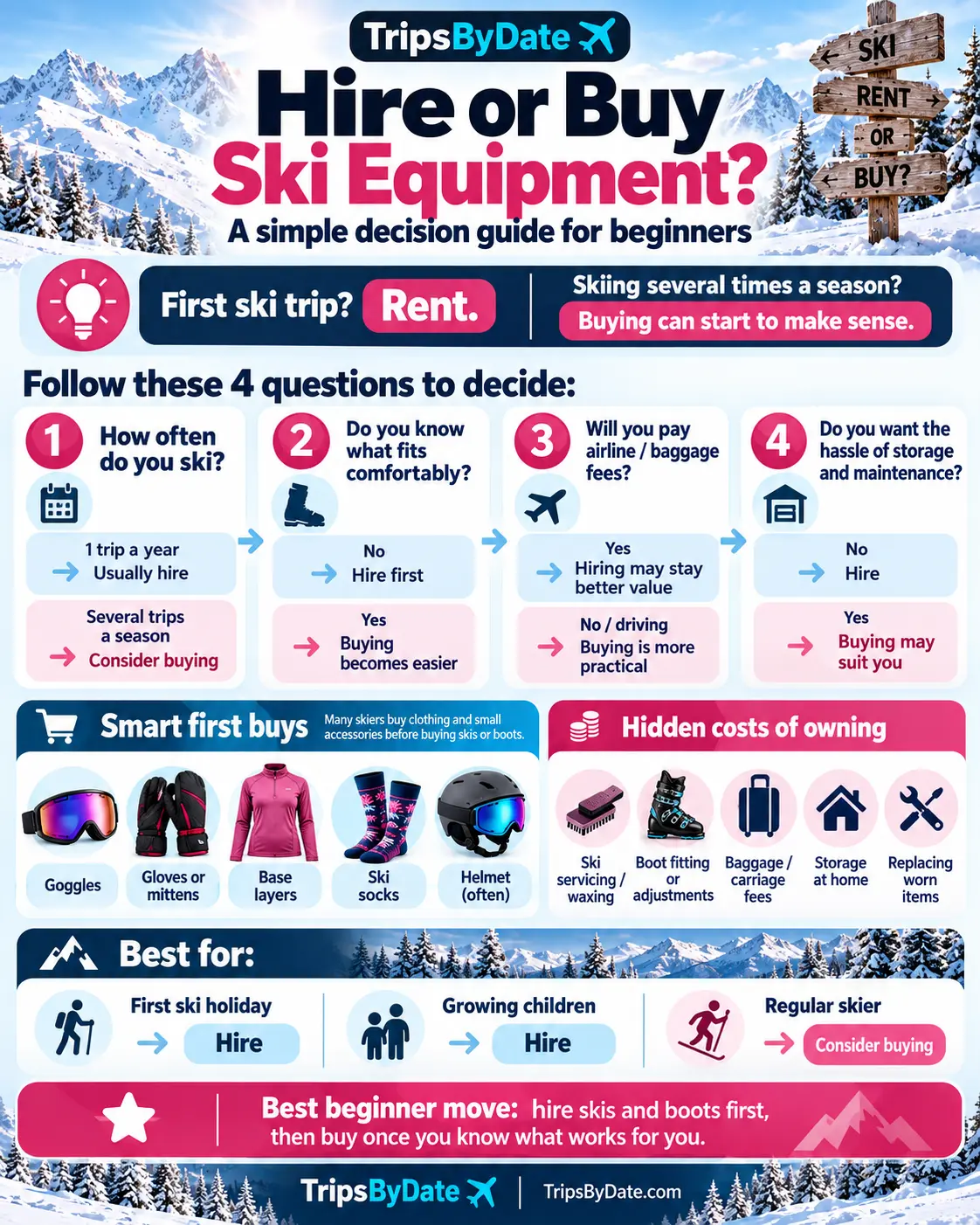
1. How many days do I actually ski? Use your real number of days on snow, not an optimistic estimate of future holidays.
2. Do I know what type of skis I enjoy? If you have only tried one beginner rental model, testing a few options could be more useful than buying.
3. Will I need to fly with them? Include baggage charges and the convenience of travelling with your own gear.
4. Can I maintain and store them? Consider servicing, dry storage and protection during travel.
5. Is the purchase comfortable within my budget? Do not sacrifice lessons or a suitable holiday just to own equipment before you need it.
The simplest approach for a first ski holiday
Hire skis, boots and poles. Rent or buy a suitable helmet, depending on preference and fit. Bring your own personal clothing and accessories where practical, but do not feel you need to buy an expensive wardrobe.
Spend your early budget on the things most likely to improve the trip: lessons, suitable accommodation, appropriate insurance and equipment that fits.
Once you have a few skiing trips behind you, you will have a much better idea of what is worth owning.
Useful equipment guidance and sources
REI's first-time skiing guide explains why beginners generally benefit from renting and what rental shops commonly provide.
REI: planning your first time skiing or snowboarding
The Ski Club of Great Britain has dedicated advice on ski equipment, clothing, accessories and different types of boots.
Ski Club of Great Britain: kit and equipment
Its accessories guide discusses snowsports helmets, rental availability and safety considerations.
Ski Club of Great Britain: ski accessories
For families, REI also explains the advantages and limitations of buying and leasing children's equipment as they grow.
REI: teaching children to ski and choosing equipment
Christy Sports provides a retailer's explanation of the differences between daily hire, seasonal rentals and buying equipment.
Christy Sports: rental versus ownership
So should you hire or buy ski equipment?
For your first ski trip: hire. You will save yourself a substantial upfront commitment and can learn on equipment chosen for your current ability.
For occasional holidays: often still hire. It keeps travel simple and avoids storing equipment that spends most of the year unused.
For regular skiers: compare buying. Start with the kit where fit and familiarity matter most, calculate the full costs and choose equipment that suits your skiing.
There is no prize for owning everything. The smartest choice is the one that keeps you comfortable, safe and enjoying the mountain without spending money unnecessarily.
More help planning your ski holiday
How Ski Hire Works for Beginners · What to Wear Skiing for the First Time · What to Pack for a Ski Holiday · How Much Does a Ski Holiday Cost?
‹BACK TO SKIING
Know when you can travel?
TripsByDate works the other way around. Pick your departure airport and the dates you are free, then see the holidays that actually fit.
Find holidays by date