

Skiing for Beginners: What to Expect on Your First Day
From collecting your boots to learning how to stop, here is what your first day on skis will probably actually feel like.
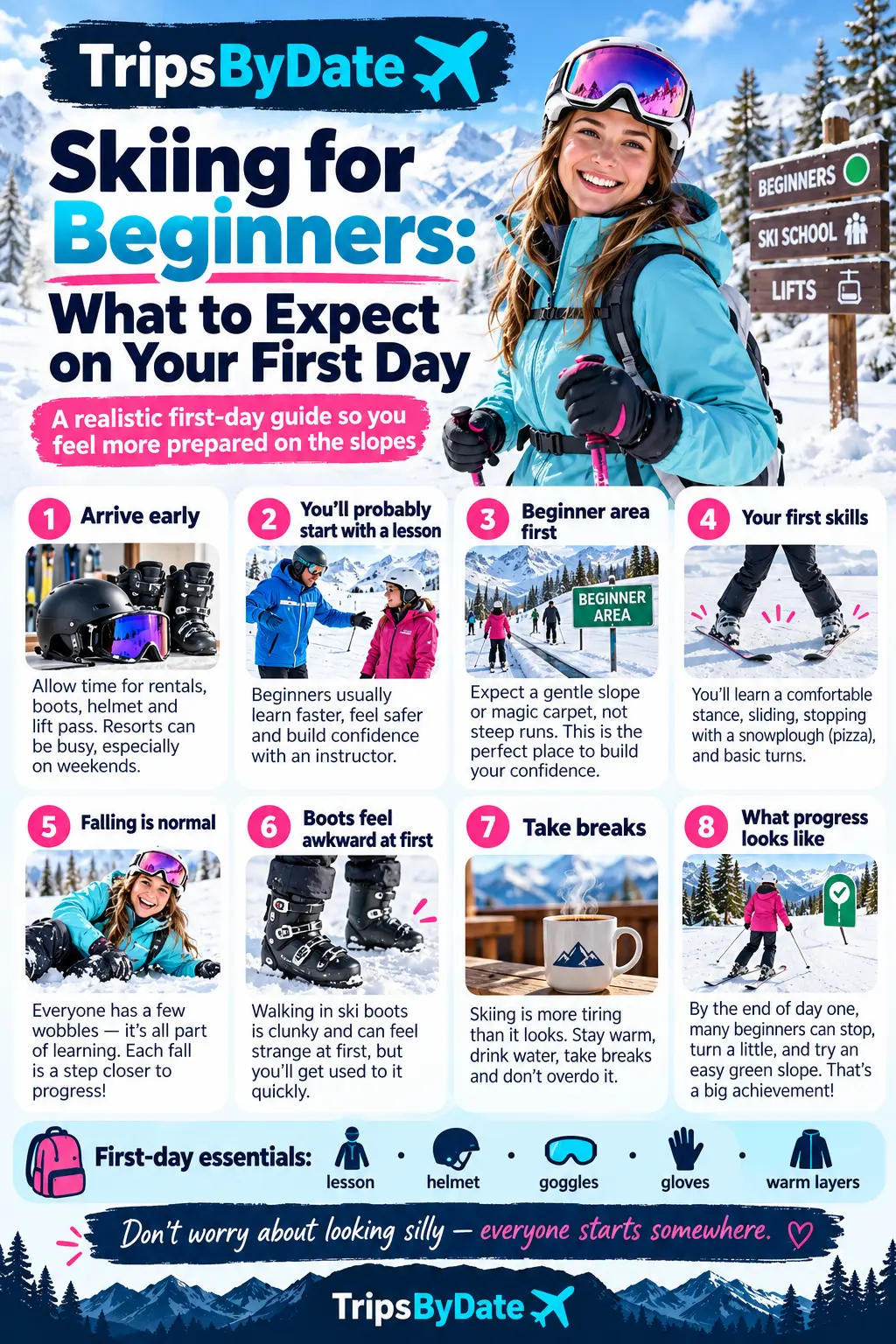
Your first day skiing is unlikely to involve racing down a mountain. It will probably involve awkward boots, learning how to move on flat snow, falling over a few times and discovering that stopping is far more important than going fast.
That is completely normal.
A good first day is not about how far you ski. It is about becoming comfortable with the equipment, learning the basic movements and finishing the day feeling slightly more in control than you did that morning.
Explore Upcoming Ski Holidays
Looking for your next ski trip? Here are some upcoming ski holidays from specialist operators, ordered by departure date.

 SEN • 7 nights
 Skiworld


 LGW • 7 nightsSkiline
 LGW • 6 nightsSkiline
 LGW • 7 nightsHB · Skiline
What happens on your first day skiing?
Most complete beginners will spend the first part of the day sorting out equipment and then head to a dedicated beginner area or nursery slope with an instructor.
Your lesson will normally start with very basic skills: standing in skis, moving around on flat snow, balancing, sliding slowly, stopping and beginning to change direction.
You are not expected to know anything before you arrive. That is the point of a beginner lesson.
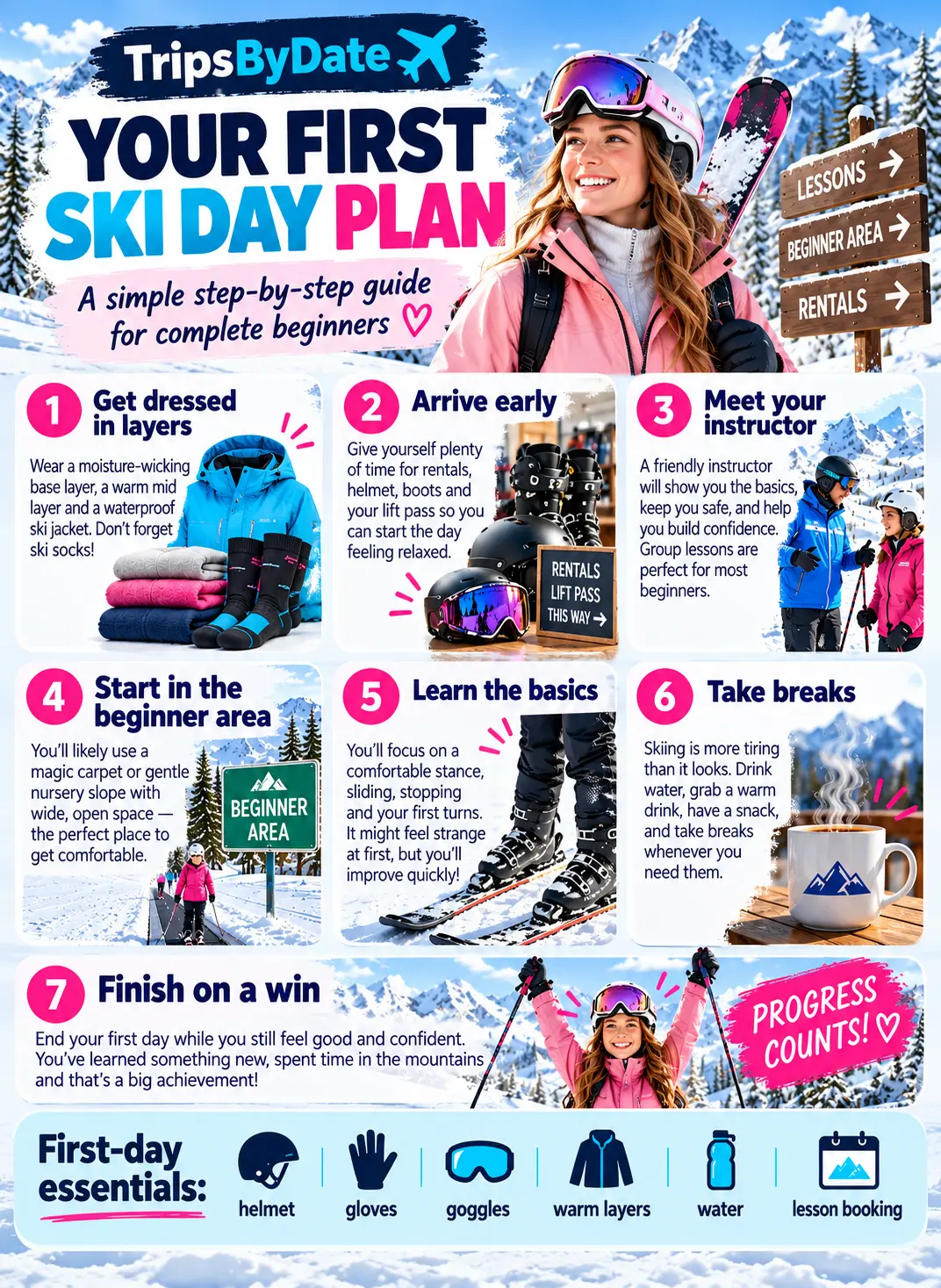
1. Arrive earlier than you think you need to
One of the easiest ways to make your first ski day stressful is to leave everything until ten minutes before your lesson.
Collecting rental equipment can take time, particularly on a busy weekend or during school holidays.
You may need to collect:
Ski boots
Skis
Poles
Helmet
Lift pass
You then need time to walk to the ski-school meeting point, which can feel surprisingly slow when you are wearing ski boots for the first time.
If your rental shop allows you to collect equipment the evening before, that can make your first morning much easier.
What should you wear on your first ski day?
Dress in layers rather than simply wearing the thickest clothes you own.
A typical beginner setup is:
Thermal base layer
Fleece or insulating mid-layer
Ski jacket
Thermal leggings
Ski trousers
One pair of ski socks
Gloves
Helmet
Goggles
Neck warmer
For a more detailed clothing guide, see What to Wear Skiing for the First Time.
2. Your ski boots will probably feel strange
Ski boots are not normal footwear.
They are stiff because they need to transfer movement from your legs to your skis. Walking in them feels clumsy at first, particularly on stairs or icy ground.
They should feel secure around your foot and ankle, but they should not cause sharp pain, numbness or unbearable pressure.
If something feels genuinely wrong, go back to the rental shop rather than suffering all day.
Should ski boots feel tight?
They should feel snug rather than loose.
A rental technician may ask your shoe size, but ski-boot fit is more important than simply matching your everyday footwear.
Do not wear two pairs of socks to make loose boots feel tighter. One proper ski sock is normally the better setup.
3. You will probably start with a ski lesson
For a complete beginner, professional instruction is one of the most useful things you can buy.
Ski Club guidance specifically encourages beginners to learn through proper instruction, and UK indoor and dry slopes are also promoted as useful places to learn stopping and turning before travelling to the mountains.
A qualified instructor can teach you how to control your speed, stop safely and use beginner lifts without relying on a friend who may be an excellent skier but a terrible teacher.
Group lesson or private lesson?
Both can work.
Group lessons are usually cheaper and let you learn with people at a similar level.
Private lessons give you more individual attention and can move at your own pace, but they normally cost considerably more.
For many first-time adults, a group beginner course over several days is a sensible starting point.
4. You will probably begin in a dedicated beginner area
Do not imagine your instructor immediately taking you to the top of a huge mountain.
Good resorts usually have nursery areas with very gentle gradients where complete beginners can learn without needing to manage normal piste traffic.
You may use a magic carpet — essentially a moving conveyor belt — rather than a chairlift.
That lets you practise the same short section repeatedly while learning the fundamentals.
What is a nursery slope?
A nursery slope is a gentle learning area designed for new skiers and snowboarders.
It is normally flatter, slower and less intimidating than the main pistes.
This is where you want to be on your first morning.
5. Your first skill may simply be standing still
Before learning to ski downhill, you need to become comfortable wearing skis.
Your instructor may show you:
How to clip into and release the bindings
How to stand in a balanced position
How to move on flat snow
How to get up after falling
How to carry your skis safely
These things sound trivial until you try them while wearing unfamiliar equipment on slippery snow.
6. Then you learn how to slide
Your first proper skiing may be nothing more than a short, controlled glide down a very gentle slope.
The important part is learning to stay balanced rather than trying to travel quickly.
Your stance will probably feel unnatural at first. Knees need to remain flexed, your weight needs to stay centred and you need to resist the instinct to lean backwards when the skis begin moving.
7. Learning to stop is the big first milestone
Before you worry about elegant turns, you need a reliable way to control your speed and stop.
Many beginner ski schools introduce a wedge-shaped position commonly called a snowplough or pizza.
By adjusting the angle of the skis and pressure through your legs, you can begin controlling your speed and eventually bring yourself to a stop.
Different ski schools may use different teaching methods and terminology, so follow your instructor rather than worrying about doing exactly what you saw in a video online.
8. Basic turns usually come next
Once you can slide and control your speed, you will start learning how to change direction.
Early turns may feel exaggerated and awkward.
That is normal. At this stage you are learning how pressure, balance and ski position change your direction.
Nobody expects a first-day beginner to make perfect parallel turns.
Will you use a ski lift on your first day?
Possibly, but it depends entirely on your progress and the resort.
Many beginner areas use magic carpets or easy drag lifts.
You might progress to a chairlift later in the day, but there is no need to rush.
Getting on and off lifts is another skill your instructor can teach you.
Are ski lifts scary for beginners?
They can feel intimidating before you understand how they work.
Chairlifts keep moving while you load and unload, so beginners sometimes worry about getting off quickly enough.
The lift staff see beginners every day. Follow the signs, listen to your instructor and move clear of the exit once you get off.
9. Falling is completely normal
You will probably fall.
Almost everybody does when learning.
Falling does not mean you are bad at skiing. You are learning a new balance skill on a slippery surface with two long boards attached to your feet.
Your instructor will normally show you how to get back up efficiently.
Does falling on snow hurt?
Sometimes, but many low-speed beginner falls are more awkward than dramatic.
The important thing is not to deliberately push beyond your ability because you feel embarrassed about being a beginner.
GOV.UK guidance specifically recommends choosing pistes appropriate to your level and not attempting slopes beyond your ability.
10. Your legs may tire faster than expected
Skiing can be surprisingly tiring for beginners.
Part of that is physical effort. Part of it is that new skiers often tense muscles unnecessarily because they are concentrating so hard.
As your technique improves, skiing usually becomes more efficient.
On day one, expect tired thighs.
Take breaks before you are exhausted
You do not get bonus points for skiing continuously until your legs stop working.
Have a drink, eat something and warm up if necessary.
Fatigue makes it harder to maintain good technique and can make a beginner feel less confident.
Finishing slightly early is better than turning the last hour into a battle.
Do you need to drink much when skiing?
Yes.
Cold weather can make you less aware of thirst even though skiing is physical exercise.
Drink regularly during the day and remember that alcohol is not a substitute for hydration.
GOV.UK also warns that alcohol affects judgement, coordination, reaction time and awareness of cold at altitude.
What should you eat on your first ski day?
Eat a proper breakfast.
Learning to ski requires energy and concentration, and your first morning is not the ideal time to discover that coffee alone was not enough.
Have lunch before you are completely exhausted and carry a small snack if that works with your jacket or backpack.
What progress should you expect after one day?
There is no correct answer.
Some beginners may finish the day able to stop confidently and make controlled turns on gentle terrain.
Others may still be working on balance and speed control.
Both are normal.
Age, fitness, confidence, snow conditions, lesson size and previous experience with sports such as skating can all affect how quickly somebody progresses.
Will you ski a proper piste on day one?
Maybe.
If you make good progress, your instructor may take you onto an easy marked run.
But there is absolutely nothing wrong with spending the whole first day in the beginner area.
Piste grading also varies between countries and resorts, so do not focus too much on whether you have completed a particular colour by the end of the day.
Control matters more than collecting piste colours.
What if everybody else in the lesson is better than you?
Beginner groups should normally be organised by ability, but people still progress at different speeds.
If you are struggling badly or feel unsafe, tell the instructor.
Ski schools routinely move people between groups when the level is clearly wrong.
There is no prize for pretending you are more advanced than you are.
What if you are scared?
That is also normal.
Sliding downhill while attached to skis is a very unfamiliar sensation.
Good beginner areas are deliberately gentle so you can build confidence gradually.
Tell your instructor if you are nervous. It is useful information, not something to hide.
Know when you can travel?
Pick your departure airport and the dates you are free, then see the ski holidays that actually fit.
Find ski holidays by dateDo you need to be fit before your first ski day?
You do not need elite fitness, but skiing is a physical activity.
General leg strength, balance and aerobic fitness can make the first few days more comfortable.
GOV.UK advises winter-sports travellers to consider their fitness before travelling, while Ski Club guidance also recommends preparing physically before a ski holiday.
See our Get Fit for Skiing guide if you have time to prepare beforehand.
Should you practise before going abroad?
If you have access to an indoor snow centre or dry ski slope in the UK, it can be useful.
Ski Club specifically notes that learning basics such as stopping and turning before travelling can give first-time skiers a head start and let them make better use of their mountain holiday.
It is not essential, though. Thousands of people learn for the first time after arriving in resort.
Do you need poles on your first day?
Possibly not.
Some instructors begin complete beginners without poles so they can concentrate on balance, stance and leg movements.
Poles become more useful as you progress, but do not worry if your first lesson barely uses them.
What should you carry with you?
Keep it simple.
Useful first-day items include:
Lift pass
Phone
Sunscreen
SPF lip balm
Tissues
Small amount of money or payment card
Water if practical
Avoid carrying a huge backpack unless you genuinely need it.
Do you need sunscreen when it is cold?
Yes.
Cold temperatures do not remove UV exposure, and snow can reflect sunlight.
Protect exposed skin and lips even when the temperature is below freezing.
See our Ski Skin Survival Guide for more detail.
What beginner ski etiquette should you know?
Even on your first day, there are a few useful rules.
Look uphill before starting.
Stop somewhere visible and out of the way.
Respect signs and closures.
Keep control of your speed.
Give other people space.
You do not need to memorise everything before your lesson, but understanding basic piste etiquette makes the mountain less intimidating.
Read our Ski Etiquette guide before you travel.
What should you NOT do on your first ski day?
Do not let experienced friends pressure you onto a run that feels too difficult.
Do not chase speed.
Do not skip lessons because somebody in your group says they can teach you.
Do not continue skiing when you are exhausted simply because everybody else is staying out.
And do not judge your progress against somebody else's.
Your first-day ski checklist
The night before:
Confirm your lesson time and meeting point.
Check where your equipment hire shop is.
Check whether you already have your lift pass.
Lay out your ski clothing.
Check the weather forecast.
In the morning:
Eat breakfast.
Apply sunscreen.
Get dressed in layers.
Collect equipment early.
Arrive at ski school before the lesson starts.
The most important thing to remember
Nobody looks elegant on their first morning.
You are learning a completely new movement in unfamiliar equipment on snow.
If you finish day one knowing how to control your speed, stop more reliably and make the beginning of a turn, you have made real progress.
You do not need to reach the top of the mountain.
Useful beginner skiing guidance
The Ski Club of Great Britain has a dedicated guide for people completely new to skiing and snowboarding.
Ski Club of Great Britain: new to snowsports
It also explains how indoor snow centres and dry slopes in the UK can help beginners learn basic stopping and turning before travelling.
Ski Club of Great Britain: UK snowdomes and dry slopes
GOV.UK provides practical winter-sports guidance covering insurance, helmets, piste difficulty and skiing within your ability.
GOV.UK: preparing for winter sports abroad
More help with your first ski holiday
What to Wear Skiing for the First Time · Best Ski Resorts for Beginners · Ski Slope Dos & Don'ts · What to Pack for a Ski Holiday
‹BACK TO SKIING
Know when you can travel?
TripsByDate works the other way around. Pick your departure airport and the dates you are free, then see the holidays that actually fit.
Find holidays by date