

How Many Days Do You Need for a Ski Holiday?
A simple guide to choosing the right trip length, whether you are trying skiing for the first time or planning a longer mountain escape.
How many days do you actually need for a ski holiday? Is a long weekend enough to learn, or do you need a full week before skiing starts to feel enjoyable?
There is no perfect trip length for everybody. Some people want a quick introduction to snow and mountain life. Others want several days of lessons, time to improve their technique and the chance to explore a larger ski area.
For many beginners, four or five days on snow is a useful starting point. But the best length also depends on your budget, travel time, fitness, confidence and who you are travelling with.
Explore Upcoming Ski Holidays
Looking for your next ski trip? Here are some upcoming ski holidays from specialist operators, ordered by departure date.


 LHR • 7 nights
 AI · Ski Line

 MAN • 7 nightsAI · Ski Line
 BRS • 7 nightsB&B · Iglu Ski
 BRS • 7 nightsHB · Iglu Ski
How many days is best for a ski holiday?
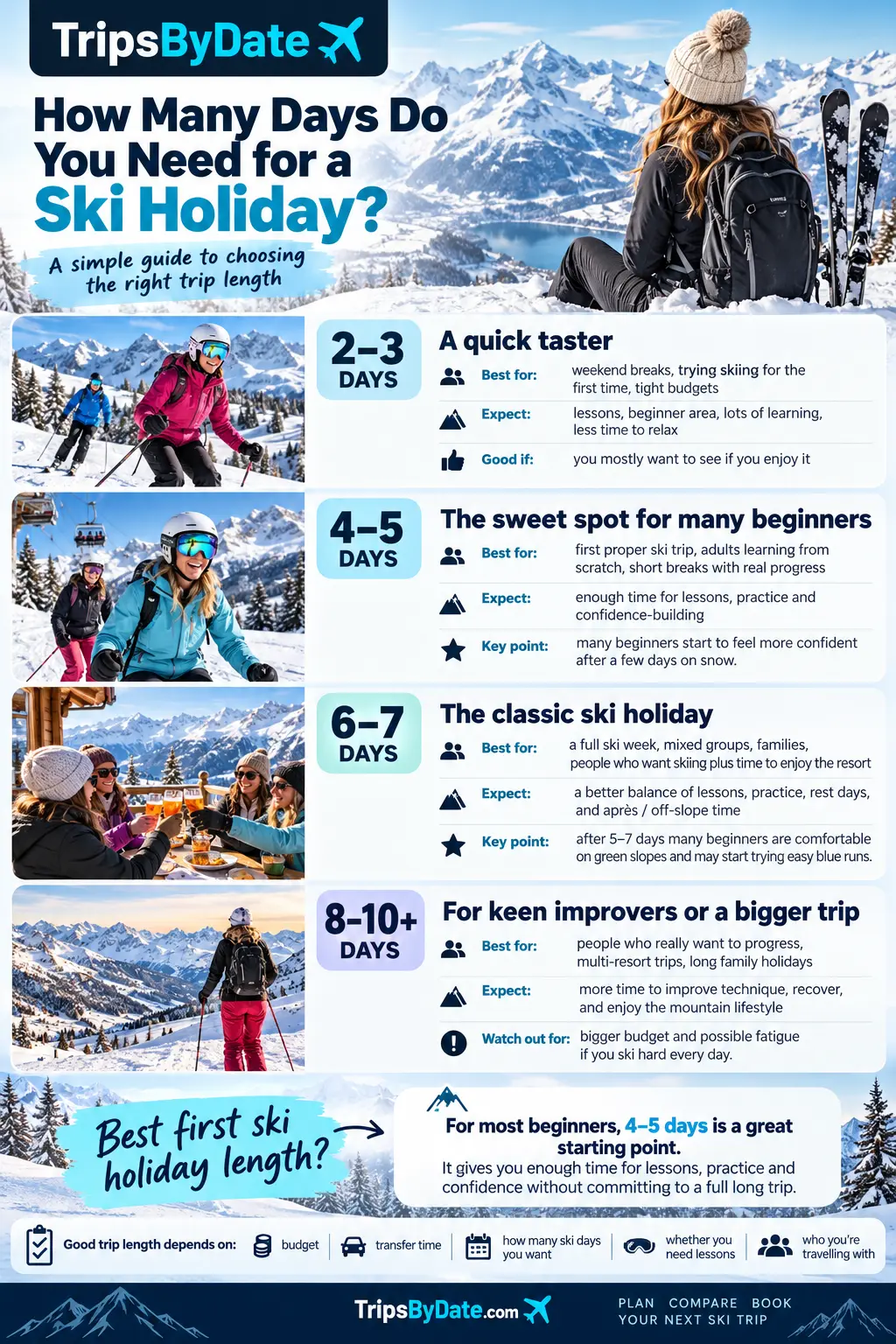
A useful way to think about ski holiday length is to divide trips into four categories.
2–3 days: a quick introduction, weekend break or short escape for people who already know how to ski.
4–5 days: a good balance for many beginners who want time for lessons, practice and building confidence.
6–7 days: a more traditional ski holiday, with time to settle in, explore the resort and enjoy activities away from the slopes.
8–10 days or more: an extended trip for keen skiers, people who want to improve significantly or travellers planning to visit several resorts.
These are guidelines rather than rules. Someone skiing for three well-organised days might have a better experience than somebody spending a poorly planned week on the mountain.
2–3 days: a quick introduction to skiing
A two- or three-day ski break can be a brilliant way to find out whether you enjoy skiing.
It is particularly appealing if you do not want to commit the time and money required for a full week.
For complete beginners, however, a short trip may involve more learning than actual independent skiing.
Your first sessions may cover putting on equipment, balancing, sliding, stopping and beginning to turn.
There is nothing wrong with that. Discovering whether you enjoy the experience is a perfectly good reason to book a shorter holiday.
Who is a 2–3 day ski break best for?
Short breaks work particularly well for experienced skiers who can arrive, collect their equipment and head straight onto familiar terrain.
They can also suit first-timers who want to experiment with skiing without committing to an entire week.
But beginners should manage their expectations. Two days of tuition is unlikely to turn most complete beginners into confident independent skiers.
What is the biggest problem with short ski trips?
Travel time.
If you spend several hours flying, collecting luggage and travelling from the airport to the resort, a short holiday can feel surprisingly rushed.
Flight delays and poor weather can also affect a much greater proportion of a three-day trip than a full week.
For short breaks, choose a resort with straightforward transfers, convenient accommodation and easy access to ski hire and lifts.
4–5 days: the sweet spot for many beginners
Four or five days is a particularly useful length for people taking their first proper ski holiday.
You have time to get used to the equipment, take a series of lessons, practise basic movements and gradually build confidence.
Unlike a very short break, you are not spending such a large proportion of the holiday getting organised and learning how everything works.
There is also more room for recovery. If you are tired after an intensive lesson, you can finish early without feeling that your entire holiday has disappeared.
Can you learn to ski in four or five days?
You can learn a useful amount in four or five days, although the outcome varies considerably between people.
A complete beginner may progress from finding their balance on nursery slopes to making controlled turns on suitable beginner terrain.
Some will progress further. Others may still be working on stopping, turning and feeling comfortable with their equipment.
The important goal is not reaching a particular piste colour by a particular day. It is developing enough control to ski safely at your own level.
For a closer look at tuition, read our What Ski Lessons Do Beginners Need? guide.
How many ski lessons should you book for a short holiday?
If you are a complete beginner, several structured lessons are generally more useful than one introductory session followed by days of guessing.
Many ski schools offer multi-day beginner courses, although the number of lessons, start days and daily duration vary.
Before booking, check whether the ski school offers a course that actually matches your travel dates.
A four-day holiday is much less useful if the only suitable beginner course begins on the day you leave.
6–7 days: the classic ski holiday
Six or seven days on the slopes gives you time for more than simply learning the basics or racing around a ski area.
For beginners, a longer trip allows several days of lessons followed by more practice on appropriate terrain.
Intermediate skiers can explore different sectors of a large resort without feeling they must cover everything immediately.
Families and mixed-ability groups also benefit from the extra flexibility. Some people may ski every day, while others prefer shorter sessions or occasional afternoons away from the mountain.
Why are seven-night ski holidays so common?
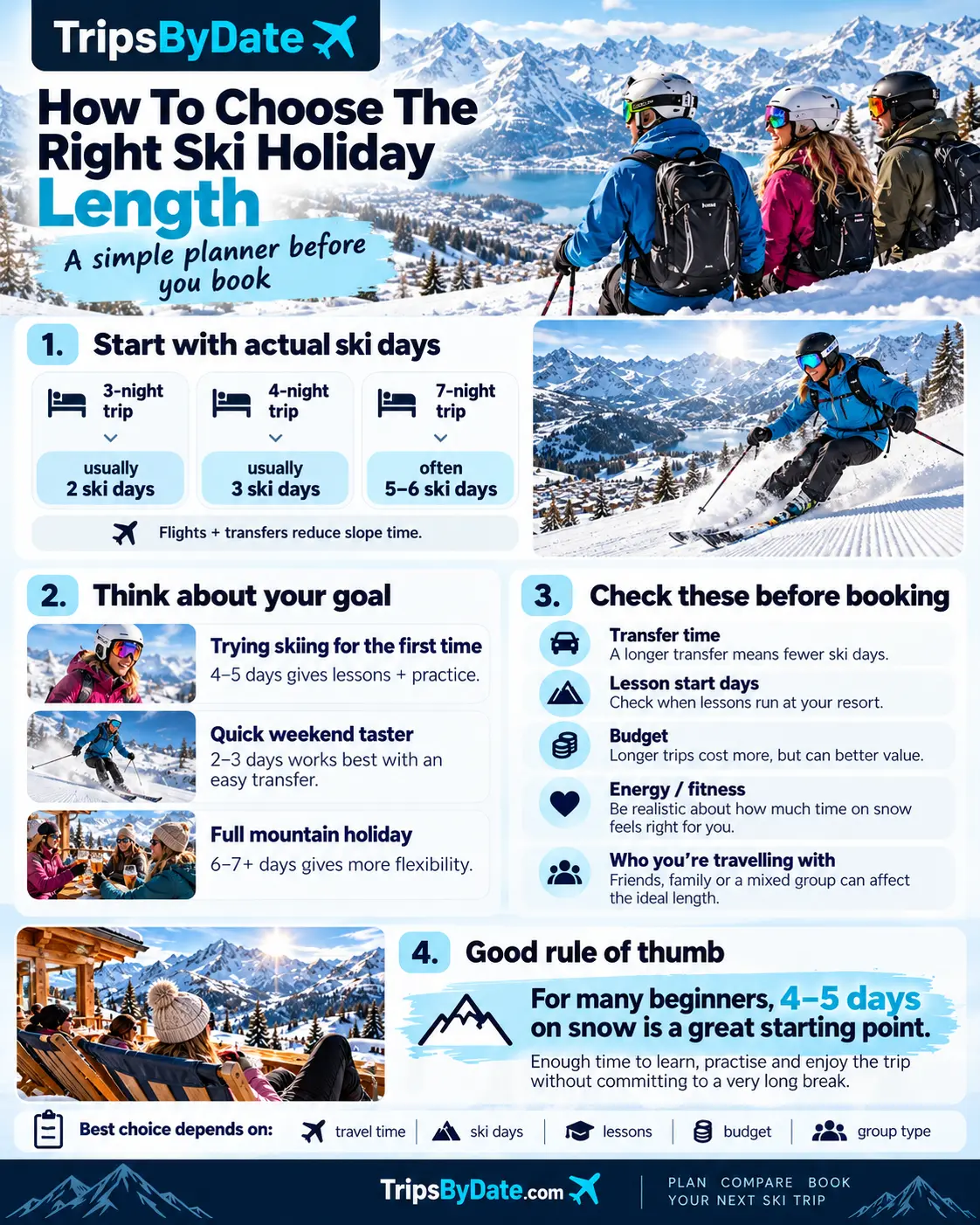
Many traditional ski packages are organised around seven nights of accommodation and approximately six days of skiing.
The first and last days are often largely occupied by flights, airport transfers, accommodation check-in and the return journey.
This arrangement is common, but it is not universal. Your exact skiing time depends on the operator, flight schedule, transfers and package details.
For example, the Ski Club of Great Britain advertises organised trips with seven nights of accommodation and six days of skiing.
Should beginners book a full week?
A full week can be an excellent choice if you have the budget and genuinely want to learn.
It gives you more opportunities to practise, make mistakes, recover and improve gradually.
It also means you can experience the resort beyond the beginner slopes, even if that simply means enjoying the restaurants, mountain scenery or village atmosphere.
But do not feel obliged to ski hard every day simply because you have paid for a week.
Tiredness can make it harder to maintain good technique. A shorter session or rest day may be more useful than pushing yourself too far.
8–10 days or more: extended ski holidays
Longer ski holidays can appeal to experienced skiers, enthusiastic learners and people who enjoy the whole mountain lifestyle.
An extended trip gives you more time to improve your technique, explore a large connected ski area or visit several nearby resorts.
It can also work for families who want a slower pace with activities and rest days between skiing sessions.
The disadvantage is cost. More accommodation nights, lift-pass days, equipment hire, meals and spending money can make an extended holiday significantly more expensive.
Is skiing every day for ten days too much?
It depends on your fitness, experience, conditions and how intensely you ski.
Ten consecutive hard skiing days can be physically demanding, particularly for somebody who normally spends much of the week sitting at a desk.
Even experienced skiers may appreciate lighter days, relaxed afternoons or occasional breaks.
For a longer holiday, think about the number of days you actually want to ski rather than assuming every day must be spent on the slopes.
Does your skiing ability change the ideal trip length?
Yes. Complete beginners, intermediate skiers and experienced skiers often want different things from a holiday.
Complete beginners: four or five skiing days can provide time for structured lessons and practice.
Intermediate skiers: a full week offers more opportunities to explore new pistes and improve technique.
Experienced skiers: a short weekend can be satisfying because you already know how to ski, while longer trips offer more exploration and variety.
If you have never skied, our Skiing for Beginners: Your First Day guide explains what to expect when you arrive.
How many days should a family ski holiday be?
Families often benefit from a longer trip because organising children, ski-school schedules and equipment takes time.
Younger children may not want to spend every day skiing for several hours.
A seven-night holiday allows more flexibility for shorter lessons, swimming, sledging, exploring the village and relaxing together.
However, a shorter trip can work if you choose a convenient resort and keep expectations realistic.
See our Best Ski Resorts for Families guide for help choosing a suitable destination.
How much does trip length affect your ski holiday budget?
The number of days affects more than your accommodation bill.
Longer trips may mean additional lift-pass days, equipment rental, lessons, meals and spending money.
Short trips, however, can have a relatively high cost per skiing day because flights and transfers are spread across fewer days on the mountain.
Before booking, compare the total holiday cost against the number of usable skiing days.
Our How Much Does a Ski Holiday Cost? guide explains the main expenses to include.
Do you need a lift pass for every day?
Not necessarily.
If you are planning a rest day, travelling between resorts or spending an afternoon away from skiing, check whether a shorter or more flexible pass would be better value.
Some resorts also offer beginner lift passes or access to free practice areas.
Pass options vary between destinations, so check the resort's current arrangements rather than automatically purchasing the longest pass.
See our What Does a Ski Pass Include? guide for more information.
Know when you can travel?
Pick your departure airport and the dates you are free, then see the ski holidays that actually fit.
Find ski holidays by dateHow do airport transfers affect a short ski holiday?
Transfers can make an enormous difference to how much time you actually spend skiing.
A resort close to the arrival airport may allow you to settle in quickly and reach the slopes sooner.
A longer mountain transfer can still be perfectly reasonable for a full week, but it may feel excessive for a short break.
When comparing destinations, look at the entire journey: flight time, baggage collection, transfer departure, road journey and accommodation check-in.
Should you choose a smaller resort for a short trip?
Often, a compact ski resort can be more convenient than an enormous linked ski area when time is limited.
If you only have three skiing days, you may never use most of a very large ski domain.
Prioritise suitable slopes, easy lift access, convenient accommodation and manageable transfers.
A larger resort becomes more appealing when you have time to explore several different areas.
Our How to Choose the Right Ski Resort guide explains which features matter most.
Should beginners take a rest day?
A rest day is not compulsory, but it can be helpful.
Skiing uses unfamiliar muscles and movements. Beginners sometimes find their thighs, knees and core working much harder than expected.
If you become very tired, reducing the length of a skiing session can be sensible.
A relaxed morning, a shorter lesson or a full day away from skiing can give you time to recover.
Preparing beforehand can also help. See our Get Fit for Skiing guide.
How many days do you need to become confident on skis?
There is no reliable number that applies to everybody.
Confidence depends on previous experience, fitness, instruction, conditions and how comfortably you learn new movements.
Some beginners become comfortable linking turns on gentle slopes after several lessons.
Others need considerably more practice before feeling confident.
Avoid treating skiing as a race to reach a particular level by the end of your holiday.
Is a longer ski holiday always better?
No. More days do not automatically mean a better experience.
A well-planned four-day break can be much more enjoyable than a week spent in an unsuitable resort or struggling with difficult transfers.
The quality of the experience matters: appropriate terrain, useful lessons, manageable costs and enough time to enjoy the trip.
How to work out the right trip length
Before booking, answer five practical questions.
1. What is your budget? Include accommodation, flights, transfers, equipment hire, lift passes and meals.
2. How long is the journey? A short trip works better when travelling to and from the resort is straightforward.
3. How many days do you actually want to ski? Separate travel days from the days available on the mountain.
4. Do you need lessons? If you are a beginner, make sure suitable tuition is available for your dates.
5. Who are you travelling with? Families, mixed-ability groups and experienced skiers may have different priorities.
Useful ski holiday planning sources
The Ski Club of Great Britain publishes organised trips showing how seven-night holidays can be structured around six skiing days.
Ski Club of Great Britain: seven-night ski holiday example
Its other organised holidays provide useful examples of longer stays, accommodation arrangements and skiing schedules.
Ski Club of Great Britain: Wengen ski holiday
For more information on learning to ski, equipment and preparing for your first trip:
Ski Club of Great Britain: new to snowsports
So how many days should you book?
If you are trying skiing for the first time and want a proper introduction, four or five days on snow is a good starting point.
If you have the budget and want more flexibility, a traditional seven-night holiday with around six skiing days can be an excellent choice.
Experienced skiers may be perfectly happy with a short weekend, while keen enthusiasts might prefer ten days or more.
The best trip is not necessarily the longest. It is the one that gives you enough time to enjoy the mountain without turning your holiday into a race.
More help planning your ski holiday
What Ski Lessons Do Beginners Need? · Best Ski Resorts for Beginners · How Much Does a Ski Holiday Cost? · What to Pack for a Ski Holiday
‹BACK TO SKIING
Know when you can travel?
TripsByDate works the other way around. Pick your departure airport and the dates you are free, then see the holidays that actually fit.
Find holidays by date