

What to Pack for a Ski Holiday
A practical 7-night ski holiday packing list covering everything you need on the slopes, around the resort and while travelling.
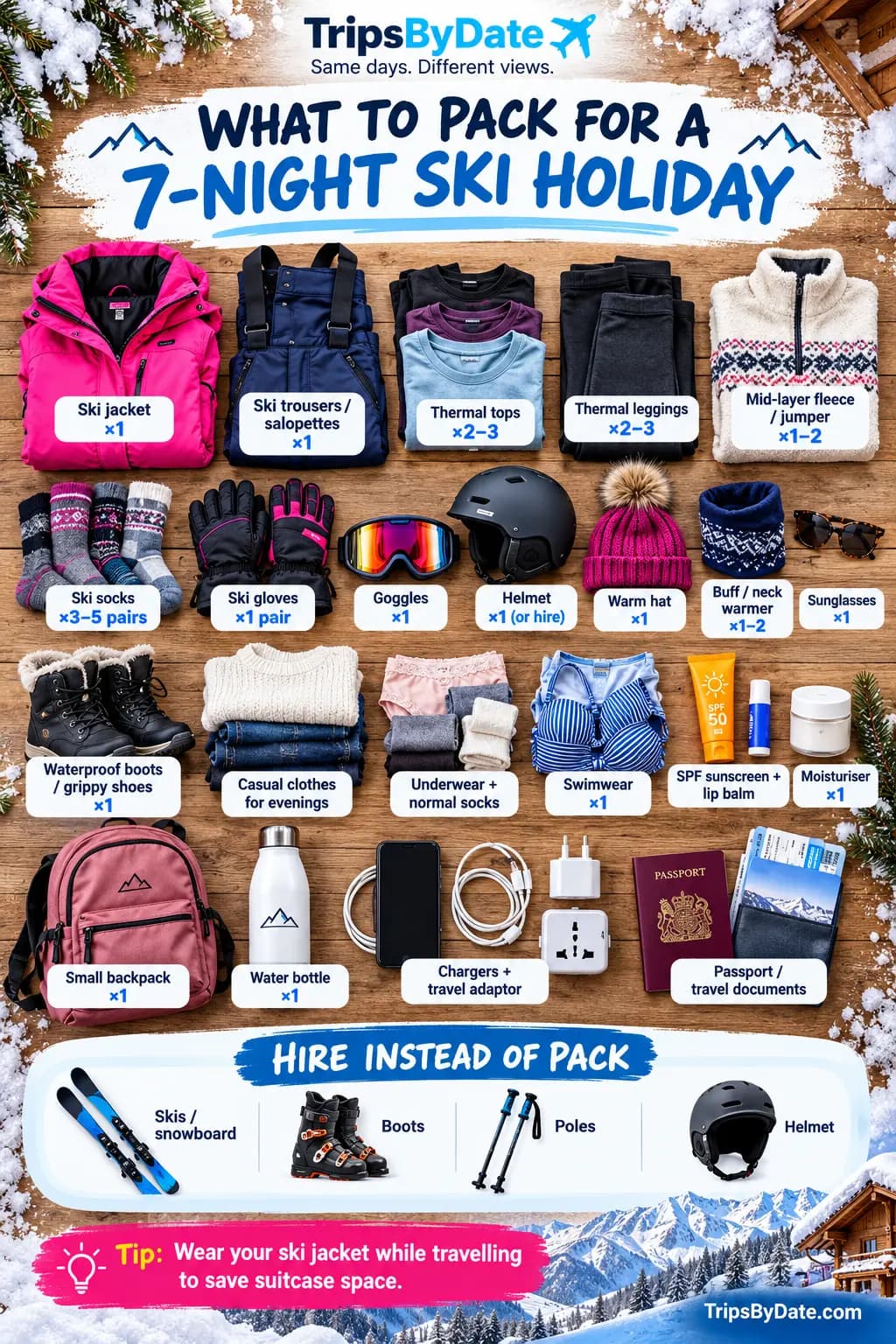
Packing for a ski holiday looks intimidating because skiing needs more specialist clothing than an ordinary winter break. But you do not need seven completely different ski outfits.
A good ski packing list is mostly about layering intelligently, bringing enough dry base layers and socks, protecting yourself from the weather and deciding which bulky equipment is better hired when you arrive.
The list below is designed around a typical seven-night ski holiday with around six days on the mountain.
Explore Upcoming Ski Holidays
Looking for your next ski trip? Here are some upcoming ski holidays from specialist operators, ordered by departure date.


 LHR • 7 nights
 AI · Skiline

 LTN • 3 nightsHB · Skiline
 BRS • 7 nightsHB · Skiline
 BHX • 7 nightsHB · Skiline
Quick 7-night ski holiday packing checklist
For most recreational ski holidays, a sensible starting point is:
Ski clothing: 1 ski jacket, 1 pair of ski trousers or salopettes, 2–3 thermal tops, 2–3 thermal leggings, 1–2 fleeces or mid-layers and around 3–5 pairs of ski socks.
Accessories: ski gloves, goggles, helmet, warm hat, neck warmer or Buff and sunglasses.
Off-slope: comfortable evening clothes, underwear, normal socks, swimwear if needed and waterproof or grippy footwear.
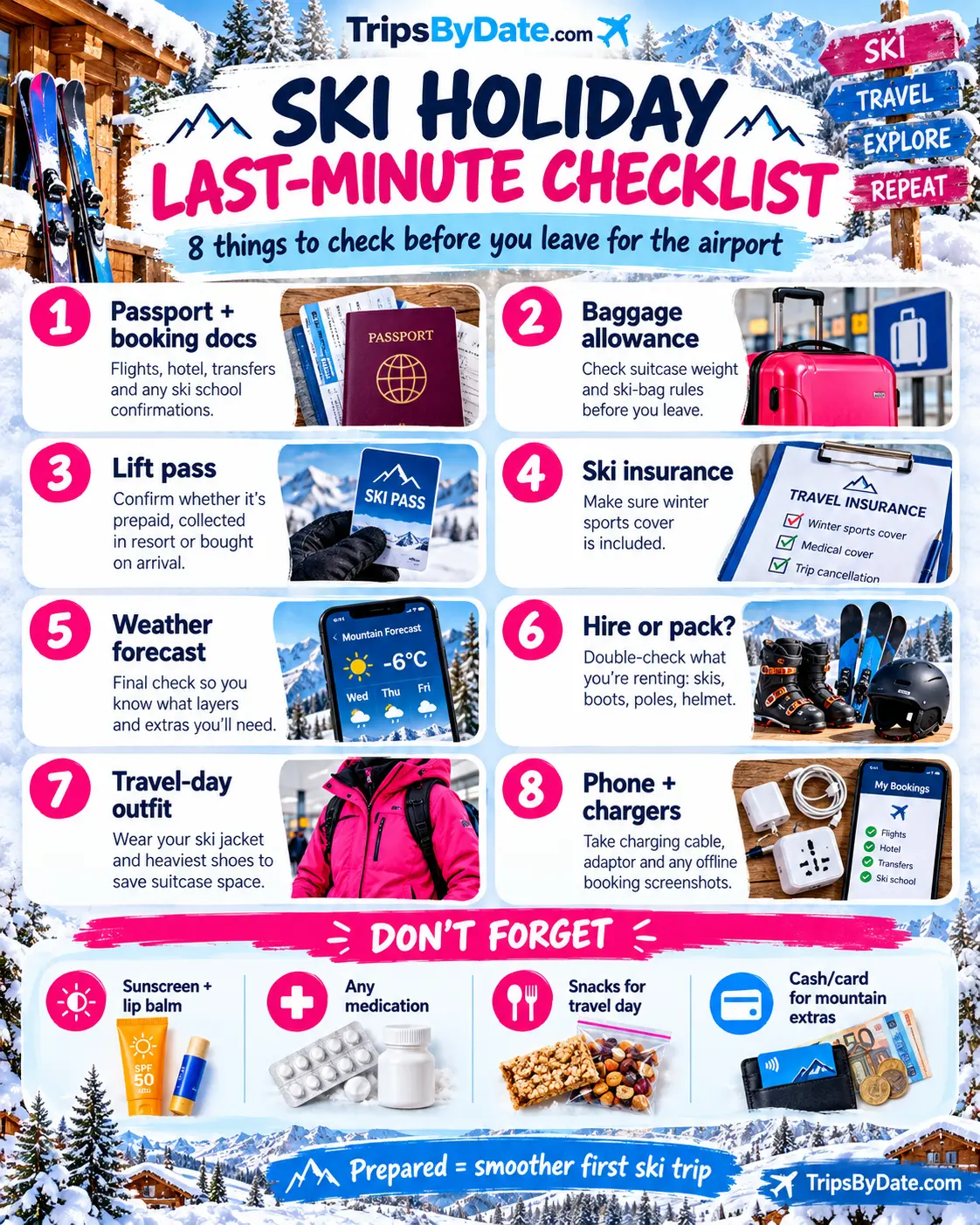
Travel: passport, booking information, insurance details, phone, chargers, travel adaptor and any medication you need.
Ski jacket: 1
One good ski jacket is normally enough for a week.
Its main job is to protect you from wind, snow and changing mountain weather. You then adjust how warm you are by changing the layers underneath rather than carrying multiple bulky jackets.
The Ski Club of Great Britain recommends a layering system, with the ski jacket or shell forming the main outer protection from wind and weather.
Ski trousers or salopettes: 1 pair
One pair of proper ski trousers is usually sufficient for a normal week unless you particularly want a spare.
They should keep snow and wind out while still allowing enough movement to ski comfortably.
Salopettes or bib-style trousers can provide additional protection around the waist and back, which can be particularly useful for beginners who may spend a little more time in the snow.
Thermal base-layer tops: around 2–3
Your base layer sits directly against the skin and helps move moisture away while you are active.
The Ski Club suggests that two or three good merino base layers can be enough for a week's skiing because merino can generally be worn more than once.
If you use synthetic sports base layers instead, you may prefer to take more so you have a fresh one for each ski day.
Thermal leggings: around 2–3
Thermal leggings or long underwear form the base layer beneath your ski trousers.
You do not normally need thick ordinary trousers underneath ski trousers. A proper thermal layer plus your ski trousers gives you a much more practical layering system.
Fleece or mid-layer: 1–2
The layer between your thermals and jacket provides extra warmth.
A technical fleece works well because it adds insulation without excessive bulk. Depending on the weather and your jacket, you may also use a lightweight insulated mid-layer.
You do not need to wear every layer every day. Mountain temperatures can vary significantly during a week.
Ski socks: around 3–5 pairs
Proper ski socks are worth packing because they are designed to work inside ski boots without creating excessive bulk.
Contrary to what beginners sometimes assume, wearing two thick pairs of socks is not necessarily warmer and can make ski boots fit badly.
The Ski Club notes that around three pairs of merino ski socks can be plenty for a week, while synthetic socks may need changing more frequently.
Ski gloves: at least 1 good pair
Your gloves need to keep your hands warm and reasonably dry for several hours at a time.
Beginners in particular may spend more time touching the snow while getting up after falls, so proper ski gloves are much more useful than ordinary knitted gloves.
If you suffer from cold hands, liners or hand warmers can also be useful.
Goggles: 1 pair
Ski goggles help protect your eyes from wind, snow and bright reflected light.
Lens choice matters because visibility can vary between bright sunshine, cloud, snowfall and flat light.
You do not necessarily need several expensive pairs, but make sure the goggles fit comfortably with your helmet if you are taking both from home.
Helmet: pack one or hire one
If you already own a comfortable ski helmet, you may prefer to take it with you.
Beginners can often hire a helmet with their skis, boots and poles instead, which saves luggage space.
Check your travel insurance conditions too. GOV.UK notes that many winter-sports policies require helmet use, so understand the conditions of your particular policy before travelling.
Warm hat: 1
You will not normally wear a thick woolly hat underneath a properly fitted ski helmet, but you will want one when walking around the resort before and after skiing.
It takes almost no suitcase space and is one of the simplest things to forget.
Neck warmer or Buff: 1–2
A neck warmer, Buff or similar face covering can make a huge difference on cold or windy lifts.
It can cover your neck, lower face and cheeks without creating the bulk of a large scarf.
Sunglasses: 1 pair
Sunglasses are useful around resort, on restaurant terraces and during sunny periods when you are not wearing goggles.
Snow can create very bright conditions, so proper UV protection matters.
Waterproof or grippy footwear
Ski boots are for skiing, not for wandering around the resort all evening.
Pack a pair of comfortable shoes or boots with decent grip for icy or snowy pavements.
This is particularly useful in traditional resorts where your hotel, restaurants and lifts may involve plenty of walking.
Casual clothes for evenings
You still need ordinary clothes once the ski boots come off.
A few tops, a jumper or fleece, comfortable trousers or jeans and normal socks are usually enough.
Ski resorts are generally casual, so you usually do not need an elaborate evening wardrobe unless you have something specific planned.
Underwear and ordinary socks
These sound obvious, which is exactly why they are easy to forget while concentrating on specialist ski equipment.
Pack your normal amount for the trip, plus whatever spare items make sense for your travel days.
Swimwear
Check your accommodation before deciding whether to pack it.
Many ski hotels and apartment complexes have pools, spas, saunas or wellness facilities. A swimsuit takes almost no space and is frustrating to discover you needed after arrival.
Sunscreen and SPF lip balm
Do not assume snow means you can forget sun protection.
Skiers spend long periods outdoors and snow reflects sunlight, so pack sunscreen suitable for exposed skin and an SPF lip balm.
A small tube is also much easier to carry in a ski jacket so you can reapply it during the day.
For more detail, see our Ski Skin Survival Guide.
Moisturiser
Cold air outdoors and heated accommodation indoors can leave skin feeling dry during a ski week.
Your normal moisturiser is usually sufficient. There is no need to build an entirely new skincare routine for the trip.
Small backpack
A small backpack can be useful for carrying water, an extra layer, sunscreen and small personal items.
Keep it compact. A large or badly adjusted backpack can become irritating when sitting on chairlifts.
If you are skiing off-piste or touring, equipment requirements become much more specialised and this basic resort packing list is not sufficient.
Reusable water bottle
Skiing is physical activity, and it is easy to forget to drink while spending the day in cold conditions.
A reusable bottle is useful in your accommodation and can be carried on the mountain if your bag allows.
Phone, charger and travel adaptor
Your phone is likely to contain flight information, accommodation details, resort maps, lift-pass apps and emergency contacts.
Pack the correct charger and check whether you need a travel adaptor for the country you are visiting.
A power bank can also be useful because cold temperatures can reduce battery performance.
Passport and travel documents
Check the entry requirements for the country you are visiting rather than relying on generic passport rules.
GOV.UK recommends checking passport validity, visa requirements, travel details and destination-specific foreign travel advice before departure.
Keep accommodation details, flight information and important contact numbers somewhere you can still access if your phone is lost or stops working.
Do not forget winter-sports travel insurance
Standard travel insurance does not automatically cover every skiing activity.
GOV.UK advises travellers to make sure their insurance covers the winter sports and activities they intend to do, and to understand exclusions such as off-piste skiing, equipment damage or rescue costs.
A GHIC or valid EHIC may provide access to some state healthcare in eligible countries, but it does not replace travel insurance and does not cover costs such as mountain rescue or repatriation.
Know when you can travel?
Pick your departure airport and the dates you are free, then see the ski holidays that actually fit.
Find ski holidays by dateWhat ski equipment should you hire instead of pack?
For many first-time and occasional skiers, hiring the largest pieces of equipment is considerably easier than flying with them.
Common rental equipment includes:
Skis or snowboard
Ski boots or snowboard boots
Ski poles
Helmet
Hiring means you avoid specialist sports baggage and do not need to store or maintain equipment at home.
More experienced skiers may prefer their own boots because fit is so important, even when they hire skis at the destination.
Should you take ski boots as hand luggage?
Airline rules differ, so there is no universal answer.
Some experienced skiers prefer to keep their boots with them because replacing badly fitting rental boots can affect the whole trip if checked baggage is delayed.
Always check the baggage rules of the airline you are actually flying with before deciding how to pack specialist ski equipment.
Should you wear your ski jacket on the plane?
You certainly can, and it is an easy way to create more space in your suitcase.
The Ski Club specifically suggests wearing your ski jacket while travelling when luggage space or weight is tight.
You can always take it off once you are seated.
How much luggage do you need for a ski holiday?
Ski clothing is bulky, but a well-planned week does not require seven separate sets of everything.
Reusing outer layers, rotating base layers and packing only a few casual outfits can reduce the amount of luggage considerably.
Compression packing cubes can help organise bulky clothing, although they do not reduce the actual weight of your suitcase.
What should go in your hand luggage?
Keep anything difficult to replace or essential to the journey with you where airline rules allow.
That can include your passport, medication, travel documents, phone, wallet, chargers and perhaps essential ski items such as goggles.
Liquids and other restricted items still need to comply with the airport and airline rules applying to your journey.
What people most often forget on a ski holiday
The big items are usually remembered. It is the small things that tend to disappear from the packing list.
Double-check your gloves, ski socks, goggles, neck warmer, sunscreen, lip balm, travel adaptor, swimsuit, sunglasses, insurance details and any medication.
Official ski holiday packing guidance
The Ski Club of Great Britain has a detailed packing list covering travel documents, ski clothing, equipment and off-slope essentials.
Ski Club of Great Britain: ski holiday packing list
Its clothing guide also explains how base layers, fleeces, mid-layers and outer shells work together on the mountain.
Ski Club of Great Britain: ski clothing and layering guide
GOV.UK also publishes specific guidance for British travellers preparing for winter-sports holidays.
GOV.UK: preparing for winter sports abroad
GOV.UK: foreign travel checklist
The easiest way to pack for a ski holiday
Pack from the skin outwards.
Start with thermal layers and ski socks, then add your fleece or mid-layer, ski jacket and trousers. Add your gloves, goggles, helmet, neck warmer and hat.
Then pack ordinary clothes, footwear, toiletries and finally your travel documents and electronics.
If you are hiring skis, boots and poles at the resort, you have already removed some of the largest and most awkward items from the suitcase.
More help for your ski holiday
Best Ski Resorts for Beginners · Get Fit for Skiing · Ski Etiquette · Ski Skin Survival Guide
‹BACK TO SKIING
Know when you can travel?
TripsByDate works the other way around. Pick your departure airport and the dates you are free, then see the holidays that actually fit.
Find holidays by date