

Ski Etiquette: 10 Rules Everyone Should Know
The simple rules that help keep ski slopes safer, calmer and more enjoyable for everyone.
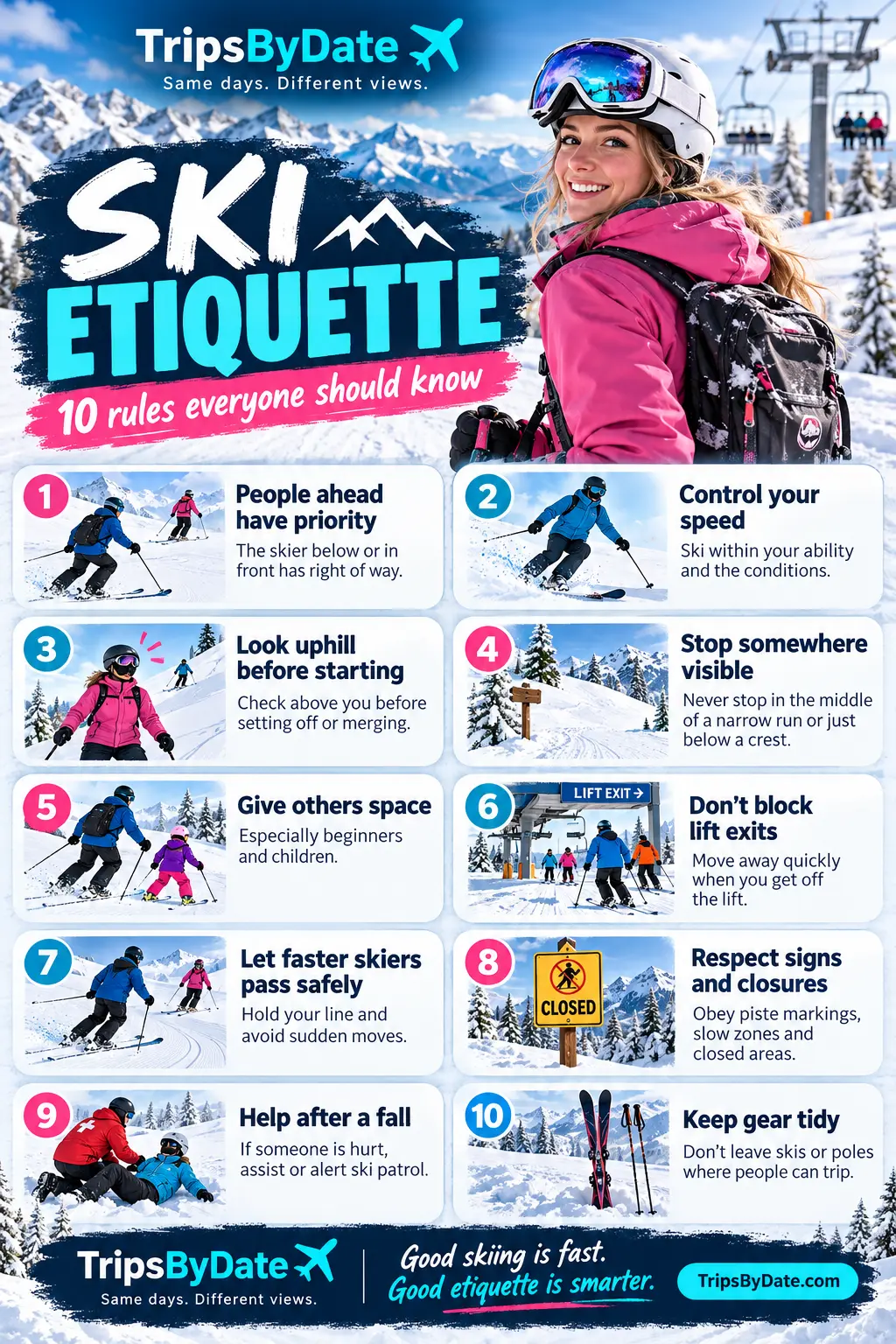
Ski etiquette is not about being overly formal on the mountain. It is mostly about making predictable decisions, giving other people space and understanding who is responsible for avoiding a collision.
The International Ski and Snowboard Federation (FIS) publishes an internationally recognised Code of Conduct for skiers and snowboarders. Many resorts use the same principles when explaining safe behaviour on marked pistes.
You do not need to memorise a rulebook before your first ski holiday, but these ten rules are worth understanding.
Explore Upcoming Ski Holidays
Looking for your next ski trip? Here are some upcoming ski holidays from specialist operators, ordered by departure date.

 MAN • 7 nights
 Skiworld


 LHR • 7 nightsAI · Skiline
 CWL • 7 nightsSC · Iglu Ski
 LGW • 7 nightsSC · Ski Line
1. People ahead of you have priority
One of the most important rules on a ski slope is that the person approaching from behind is responsible for choosing a route that does not endanger the skier or snowboarder ahead.
The person downhill often cannot see what is happening behind them, so responsibility largely sits with the person coming from above.
That does not mean the skier ahead can behave unpredictably without paying attention. Everyone should ski sensibly. But if you are approaching somebody from behind, give them enough room to turn, slow down or fall.
2. Control your speed
Skiing fast is not automatically bad etiquette. Skiing faster than you can safely control is.
The FIS Code says skiers and snowboarders should adapt their speed to their ability, the terrain, snow and weather conditions and the amount of traffic on the slope.
A wide, empty piste on a clear morning is very different from a crowded home run at the end of the day.
3. Look uphill before starting or joining a run
Before setting off from the side of a piste, joining from another trail or starting again after stopping, check what is happening both above and below you.
The FIS Code specifically says anyone entering a marked run or starting again after stopping should make sure they can do so without endangering themselves or others.
This matters particularly on busy pistes where faster skiers may already be approaching.
4. Stop somewhere visible
If you need to stop, move to the side of the piste somewhere other people can see you clearly.
Avoid stopping just below a brow, around a blind corner or in the middle of a narrow section.
The FIS Code says skiers should avoid stopping in narrow places or where visibility is restricted unless it is absolutely necessary.
If you fall in a poor position, move clear of the slope as soon as it is safe to do so.
5. Give other skiers plenty of space
Overtaking is allowed from either side, but you must leave enough room for the person you are passing to make an unexpected movement.
This is especially important around beginners. Their turns can be wider and less predictable, so give them considerably more space than you might give an experienced skier.
Passing somebody very closely may save a second or two, but it creates unnecessary risk.
6. Do not block lift exits
Chairlift and gondola exits can become congested very quickly.
Once you get off the lift, keep moving until you are somewhere safe to stop. Do not stand directly in the exit area while adjusting gloves, checking your phone or waiting for friends.
Move clear first. Regroup afterwards.
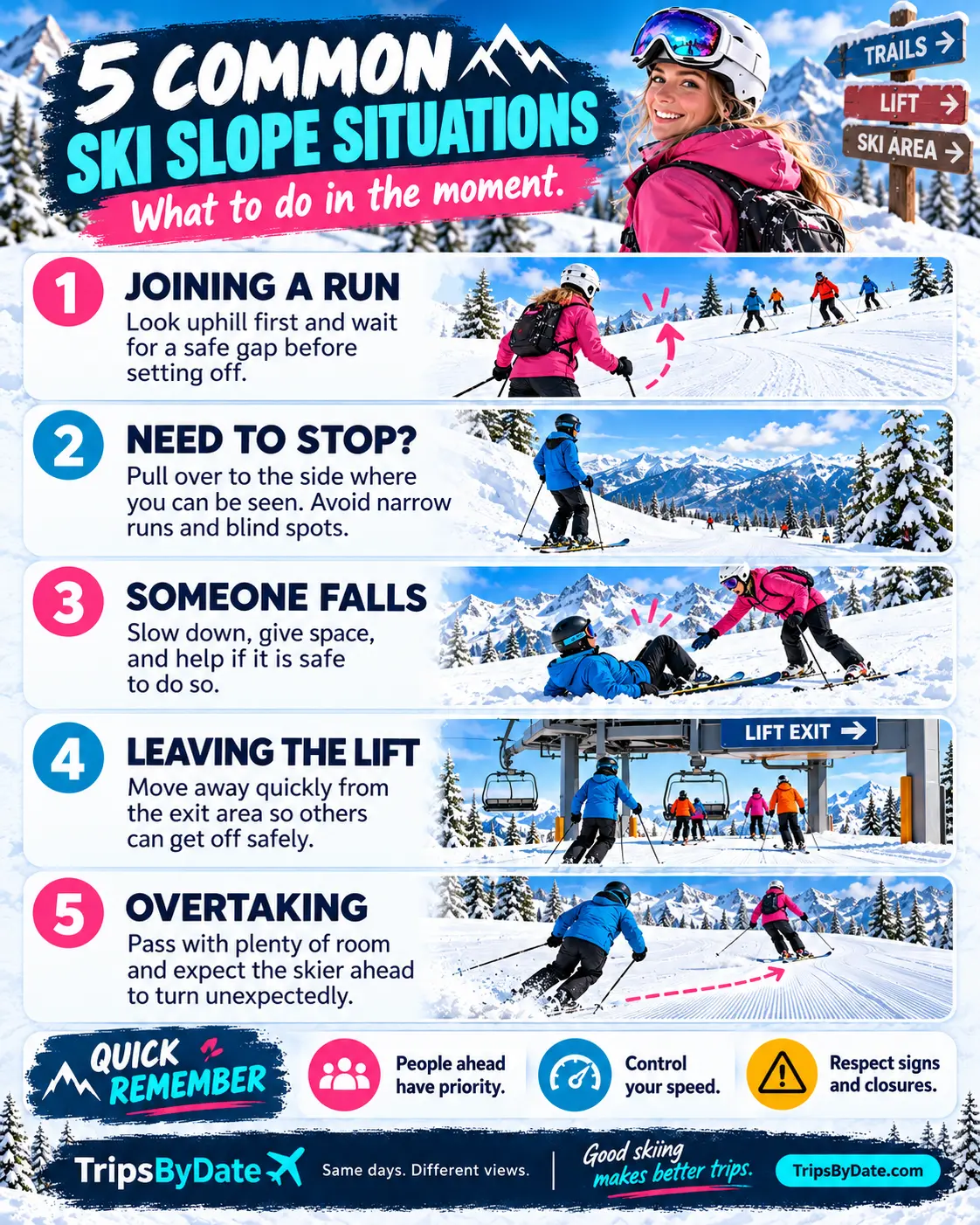
7. Let faster skiers pass safely
You do not need to panic or suddenly change direction when somebody faster approaches from behind.
Ski predictably and avoid making unnecessary sudden movements. The faster skier is still responsible for choosing a safe route around you.
On narrow pistes, giving people reasonable space where practical can help traffic flow, but you should never put yourself in danger simply to let somebody pass.
8. Respect signs, markings and closures
Piste signs and closures are there for a reason.
They can indicate closed runs, slow zones, intersections, hazards or terrain that should not be entered.
The FIS Code requires skiers and snowboarders to respect signs and markings, and local ski areas may have additional rules that go beyond the general international guidance.
9. Help after an accident
If somebody is clearly injured, do not simply ski past because you assume somebody else will help.
The FIS Code specifically states that skiers and snowboarders have a duty to assist at accidents.
The Ski Club of Great Britain advises securing the accident area, warning other skiers where necessary and contacting the resort emergency service.
Resort emergency numbers are usually printed on the piste map or available through the resort's official information.
10. Keep skis, poles and equipment tidy
Busy lift queues, mountain restaurants and piste-side areas can quickly become cluttered with skis, boards and poles.
Keep equipment under control and avoid leaving it where somebody could trip over it or where it blocks an entrance or walkway.
Use ski racks when they are available and be aware of where your poles are when standing close to other people.
What actually happens when overtaking?
The FIS rules allow overtaking from above or below and from either side.
The important part is not which side you choose. It is leaving enough room for the other person to make a normal or unexpected movement without causing a collision.
That means squeezing through a tiny gap simply because you technically can is poor etiquette.
Who has priority at a piste intersection?
There is no single rule covering every possible junction, because layouts vary between ski areas.
The safest approach is to slow down, pay attention to signs and markings and check carefully before joining another run.
If you are entering or restarting on a marked piste, the FIS Code makes it your responsibility to look both up and down the slope before moving.
What should you do after a fall?
Most falls are harmless, but where you fall matters.
If you are in the middle of a piste, below a blind rise or somewhere with restricted visibility, move to a safer position as soon as you are able.
If somebody is injured and cannot move, other skiers should help protect the area and alert ski patrol.
Know when you can travel?
Pick your departure airport and the dates you are free, then see the ski holidays that actually fit.
Find ski holidays by dateDo beginners have different ski etiquette rules?
No. The same basic rules apply to everybody.
Beginners do, however, tend to make wider turns, stop more frequently and move less predictably while learning.
Experienced skiers should recognise that and give them extra room rather than treating a beginner slope like a race track.
Beginners should also avoid following friends onto terrain that is beyond their ability simply to keep the group together.
Is ski etiquette legally binding?
The FIS Code is an internationally recognised code of conduct, but the exact legal position varies by country and ski area.
Local laws, resort rules and insurance conditions may also apply, so always follow the specific requirements of the destination you are visiting.
The Ski Club of Great Britain notes that some insurance policies may require skiers to stay within the boundaries of the FIS Code, so checking your policy is sensible.
The official FIS Code of Conduct
The ten formal rules cover respect for others, speed, route choice, overtaking, entering pistes, stopping, walking on pistes, signs, accident assistance and identification after an accident.
Read the official FIS Code of Conduct
The Ski Club of Great Britain also provides a practical explanation of the rules and what to do following an accident on the mountain.
Ski Club of Great Britain: on-piste safety
The easiest ski etiquette rule to remember
Be predictable.
Stay in control, leave space, look before joining a slope, stop somewhere visible and pay attention to the people around you.
If everybody did those few things consistently, most busy pistes would immediately feel safer and less stressful.
More help for your ski holiday
Ski Slope Dos & Don'ts · Best Ski Resorts for Beginners · Get Fit for Skiing · Ski Skin Survival Guide
‹BACK TO SKIING
Know when you can travel?
TripsByDate works the other way around. Pick your departure airport and the dates you are free, then see the holidays that actually fit.
Find holidays by date