

Best Months for a Ski Holiday
When should you ski for reliable snow, manageable crowds, family-friendly dates or sunny spring slopes? Choose the right month and the right mountain.
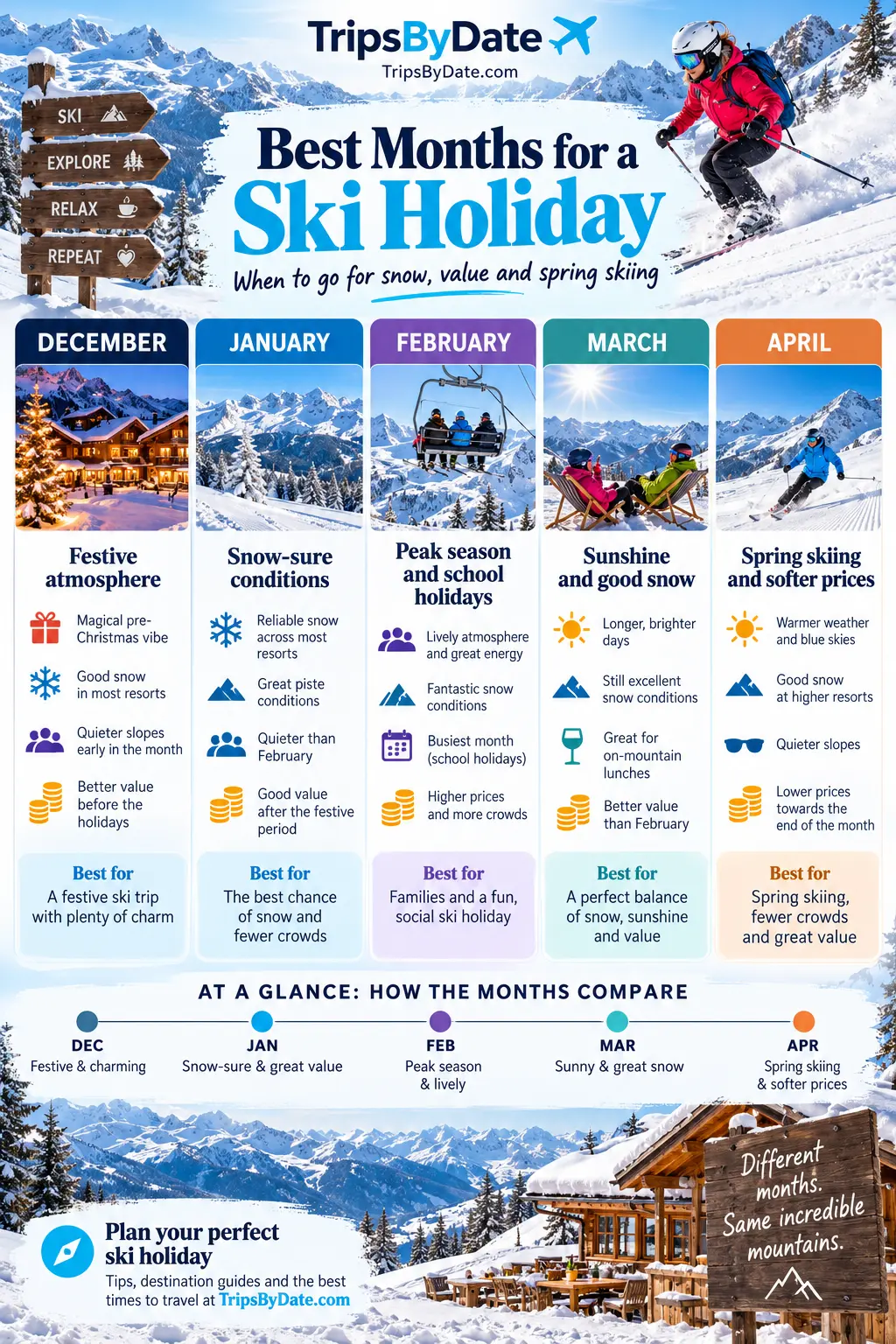
January and March are two of the most useful months to compare for a European ski holiday, but neither is automatically the best. January can bring wintry conditions and quieter weeks after New Year; March offers longer days and sunnier terraces. February is popular with families, while December and April demand much closer attention to resort altitude and operating dates.
Here is the detail that matters: a high resort in April may offer more skiing than a lower resort in December, and a quiet week in February may cost less than a famous festival week in March. The right choice depends on your skiing ability, school dates, budget, preferred snow conditions and the mountain itself.
Best ski months at a glance
- December: festive atmosphere and a chance of quieter early-season weeks; choose higher-altitude terrain and verify which lifts actually open.
- January: often attractive for cold winter conditions and potentially quieter weeks after New Year, but shorter days and low temperatures may not suit everyone.
- February: established winter season and a busy holiday atmosphere, with substantial demand around different countries' school breaks.
- March: longer daylight, frequently pleasant spring skiing, and opportunities to compare outside school holidays; lower slopes may soften in the afternoon.
- April: potentially excellent on high mountains, but shrinking choice at lower resorts and a growing risk of limited lift connections.
Our recommendation: if you can travel freely, start by comparing January and March at resorts suited to your skiing level. If you must travel at half-term, prioritise suitability, lessons and logistics over finding a supposedly secret cheap week.
Explore upcoming ski holidays
These are upcoming package examples from ski-specialist operators, selected across our available ski inventory and ordered by departure date. They are not filtered to a particular month or resort. Check the dates, destination, lift pass, baggage and transfer arrangements on the operator's own booking page.


 LHR • 7 nights
 AI · Ski Line

 BRS • 7 nightsB&B · Iglu Ski
 LGW • 7 nightsSC · Iglu Ski
 BHX • 7 nightsSC · Ski Line
December: festive villages, but check what is open
A December ski holiday has obvious appeal: lights in Alpine villages, Christmas markets, cosy restaurants and the excitement of the new season. But an open hotel is not the same thing as a fully open ski area. Lower links, beginner lifts and neighbouring valleys may not all operate from day one.
For an illustration, Val Thorens plans to open its own Val Thorens–Orelle area on 21 November 2026, but the broader Three Valleys area is scheduled from 5 December 2026. These are published operating plans, not promises that every piste or lift will be available in all weather. Check the official Val Thorens 2026–27 opening calendar.
Book December for atmosphere if that is your priority, and aim for altitude if extensive skiing matters more. Do not assume an early-December price includes the same skiable terrain as a mid-January break. Near Christmas and New Year, accommodation and travel demand can also change sharply.
Good for: festive escapes and higher-altitude resorts. Watch out for: incomplete links, short daylight hours and Christmas price premiums. For more choices, see our snow-sure European resorts guide.
January: serious winter skiing without the February half-term rush
January is worth investigating if your priority is spending time on the slopes. Snow generally has a better opportunity to accumulate through winter than at the start of the season, while the first weeks after New Year can offer a less hectic feel at many resorts. This is a planning advantage, not a guarantee of powder, sunshine or discounts.
The other side of January is cold and limited daylight. Early starts can feel uncomfortable for children or nervous beginners, particularly on exposed lifts. Pack for mountain temperatures rather than the weather shown in a resort's valley forecast. Our first-time skiing clothing guide and ski skin survival guide help with preparation.
January can be a particularly sensible month for intermediate skiers looking for mileage. Beginners may prefer a sunnier period, provided the resort offers gentle teaching slopes that are accessible throughout the day. Before booking, check where the ski school meets, whether the nursery area catches morning sun and how far your accommodation is from it.
Good for: winter atmosphere and potentially quieter non-holiday weeks. Watch out for: cold spells, shorter days and assuming all January dates cost the same.
February: a strong family month, but not always good value
February is attractive because much of the European season is firmly underway, resort services are geared towards winter visitors and ski schools are busy. It is also the month when UK half-term holidays can collide with school breaks in other European countries. Your local school's exact week matters, and different resorts can experience different demand patterns.
For families, a cheap package can become an expensive mistake if beginners must take a complicated lift journey to reach lessons, or the hotel is far from a ski-bus stop. Check meeting-point distances, lesson start times, childcare age limits and whether children's lift passes and equipment are included. Our family ski resort guide explains how to compare mountain layouts and facilities.
Book ski schools and family rooms early when you have fixed dates. Compare a complete holiday cost, including transfer, equipment hire, lessons, lift passes and food. A lower headline package price does not necessarily produce a lower final bill. For guidance on those costs, see how much a ski holiday costs.
Good for: families tied to school calendars and lively resorts. Watch out for: lift queues, lesson availability and school-holiday pricing.
March: more daylight and the appeal of spring skiing
For many adults with flexible dates, March deserves serious consideration. The days are longer than in midwinter, outdoor lunches are more appealing, and a sunny afternoon overlooking the mountains can be part of the holiday rather than a quick stop to warm up. You can still experience very wintry storms, so sunshine is a possibility, not a booking guarantee.
The useful detail is the snow's daily cycle. In spring conditions, a piste may start firm after an overnight freeze, soften into enjoyable snow as the sun reaches it, and become heavy or slushy later in the afternoon. Aspect and elevation matter: a north-facing run can ski differently from a sunny south-facing one at the same resort.
If you are an early riser, March can be particularly rewarding. Plan your main skiing for the best conditions rather than automatically staying on the slopes until the last lift. Beginners who dislike icy mornings should follow instructor advice about suitable areas and timings.
It is sensible to compare higher terrain as March progresses. The official Val Thorens piste information notes that much of its ski area is above 2,000 metres. That helps explain its long operating season but does not eliminate the risk of closures or difficult weather. See the resort's piste and live-area information.
Good for: sunny terraces, longer days and flexible adults. Watch out for: changing snow through the day and Easter or event-driven demand.
April: brilliant at the right resort, disappointing at the wrong one
April is where destination research can make or break the trip. It is misleading to say that every Alpine resort offers good spring skiing. Some areas close early, some lifts shut in stages, and attractive valley villages can be quite a distance below the remaining reliable snow.
Compare the published 2026–27 calendars: Saalbach's planned operation ends on 4 April 2027, while Ischgl lists lifts running into 2 May 2027 and Val Thorens–Orelle also lists 2 May 2027. These dates demonstrate a real difference between resorts. They are still subject to operating and weather changes.
Cervinia is another high-altitude option: its official 2026–27 information lists Breuil-Cervinia's season from 24 October 2026 to 2 May 2027, with different opening windows for neighbouring areas. A published closing date does not mean all linked terrain remains open until that date.
For April, scrutinise the precise week, ski-in/ski-out claims, nursery-slope altitude and where you must return to at the end of the day. Higher slopes might offer excellent conditions even when village-level snow has gone. If the only beginner area is low down, altitude higher up does little to help a new skier.
Good for: experienced skiers who enjoy spring conditions and choose suitable higher-altitude areas. Watch out for: reduced connections, melting lower slopes and assuming late-season prices must be cheap. Read our short ski-break guide if you are only travelling for a few days.
Altitude matters, but it is not a magic snow guarantee
Resort altitude is often used as a shortcut for snow reliability. It helps, but look at three separate numbers: where you sleep, where the beginner slopes sit, and how high the main ski area climbs. A low village with high lifts can work well for strong skiers but require longer journeys to reach good snow. A high village can reduce that problem, yet still suffer high winds or poor visibility.
Also consider which way key slopes face. In late winter, sunny lower runs may soften much sooner than shaded ones. In deep winter, south-facing beginner areas can feel more welcoming than icy, shaded teaching slopes. A piste map and current snow report offer more than a generic “snow-sure” badge.
For example, Ischgl describes its skiing between approximately 1,377 and 2,872 metres, with planned operations into early May. See its official ski area details. Compare that with your actual ability and preferred runs, not simply the resort's highest summit.

Know when you can travel?
Choose your departure airport and available dates, then compare upcoming ski holidays without checking every resort separately.
Find ski holidays by dateWhich ski month is best for your kind of trip?
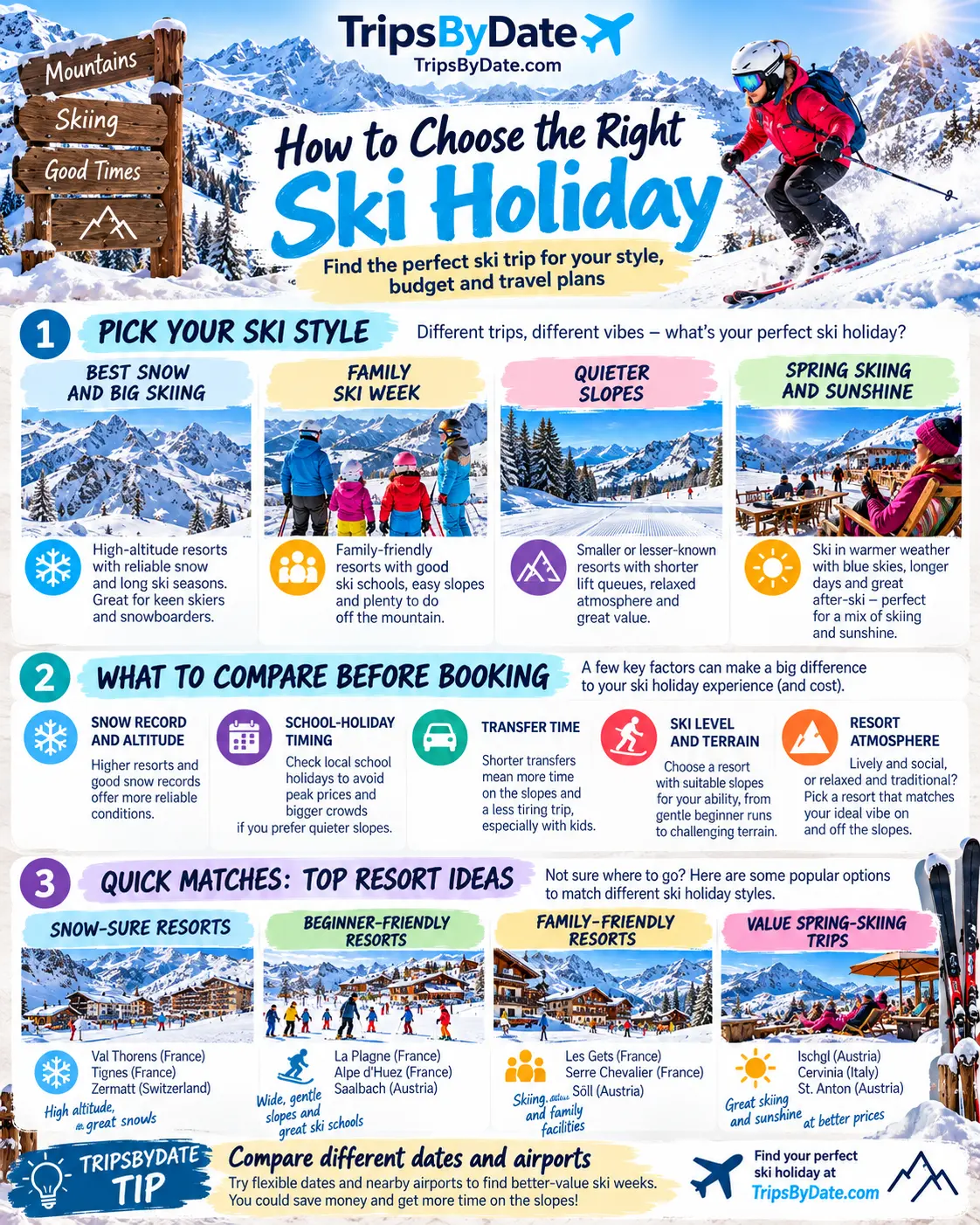
- Complete beginner: choose accessible nursery terrain and a strong ski school before choosing a month. January or March outside busy holidays can both work. Start with our beginner-friendly resort recommendations.
- Family with school-age children: February half-term or Easter may be unavoidable. Choose suitable slopes, pre-book lessons and verify all children's facilities.
- Experienced skier seeking winter conditions: January and February are natural months to compare, with current snow reports and weather still decisive.
- Spring-skiing enthusiast: March and April can be rewarding, provided you choose terrain high enough and plan around changing snow.
- Mixed skiing and après-ski group: choose a resort with enough to enjoy off the mountain, then compare its event calendar with your dates. See our après-ski resort guide.
- Non-skier in the group: research pedestrian lifts, winter walks, spa access and transport. Our non-skiers guide is a useful starting point.
How to find better value without choosing the wrong resort
Change just one variable at a time: departure week, departure airport, trip length or resort. Compare the full package rather than the airfare alone. January after New Year and some March weeks are sensible starting points for a search, but school calendars, concerts, snow conditions and inventory can overturn general patterns.
Check the flight arrival time against the transfer. An apparently cheap late arrival may cost you much of your first ski day. Compare whether the package includes hold luggage suitable for winter clothes, airport transfers, equipment carriage, ski lessons and lift passes. If you are bringing your own equipment, check the airline's sports-baggage rules.
Families should also compare the costs of lessons and hire for each child, not just the headline accommodation. Sometimes an expensive-looking resort is simpler and more economical overall because the school meeting point, rental shop and beginner slopes are together. Read our detailed guide to saving money on skiing for more ways to compare.
Check these five details before paying
- Exact lift opening dates: check the official calendar for your specific area, not only the linked region's brand name.
- Snow and weather reports: compare current coverage and open lifts nearer departure. Historical averages cannot promise your week's conditions.
- Appropriate terrain: confirm the slopes you need are practical to reach, especially nursery areas and return routes.
- Lesson and transfer logistics: check ski-school times, hire collection, travel times and any extra local transport costs.
- Winter sports insurance: confirm cover for the activities you plan, including any off-piste skiing, equipment and mountain rescue as relevant.
The UK Foreign, Commonwealth & Development Office specifically advises travellers to check winter-sports insurance exclusions, local piste information and avalanche warnings. A GHIC or EHIC is not a replacement for travel insurance and does not cover costs such as mountain rescue or repatriation. Read the official UK winter-sports safety guidance and foreign travel insurance advice.
Frequently asked questions
Is January or March better for skiing?
January may suit skiers who prefer a colder, wintrier atmosphere and quieter non-holiday weeks. March can suit those who prefer longer days and sunnier breaks. Resort altitude, snow conditions, cost and your ability matter more than a blanket winner.
Is February the snowiest month?
There is no single snowiest month across all European ski resorts. Snowfall varies substantially by region, altitude, weather pattern and year. February is an established ski month, but that does not guarantee fresh snow or better conditions than January or March.
Can you ski in April in Europe?
Yes, at suitable high-altitude resorts. For the 2026–27 season, Val Thorens, Ischgl and Cervinia publish operating schedules extending into May. Check your exact dates and which lifts remain open before booking.
Which month is cheapest for a ski holiday?
There is no universally cheapest month. Specific January and March weeks may offer good opportunities outside popular holiday periods, while early December and April can sometimes be attractive if you accept a narrower selection of open terrain. Compare complete packages rather than month labels.
What is the best month for a first ski holiday?
For a first trip, look for good ski-school availability, convenient beginner terrain and a reasonable total cost. January and March can be worth comparing if you have flexible dates, but the suitability of your resort is more important. See our complete first ski holiday guide.
Explore more skiing guides
Planning a trip? You may also find when to ski in Europe, how to choose the right ski resort, ski slope colours explained and our ski packing guide useful. For a wider range of travel ideas by season, return to the Holidays by Month hub.
Final thought: the best ski holiday is not necessarily in the coldest month or the highest resort. It is the trip where the terrain, dates, conditions and total cost work for the people travelling.
‹ BACK TO HOLIDAYS BY MONTHKnow when you can travel?
Pick your departure airport and travel dates to discover package holidays that fit. Less searching. More choosing.
Find holidays by date