

When Is the Best Time to Go Skiing in Europe?
December celebrations, February snow, quieter January weeks or sunny spring skiing? Find the dates that suit your holiday, not just the calendar.
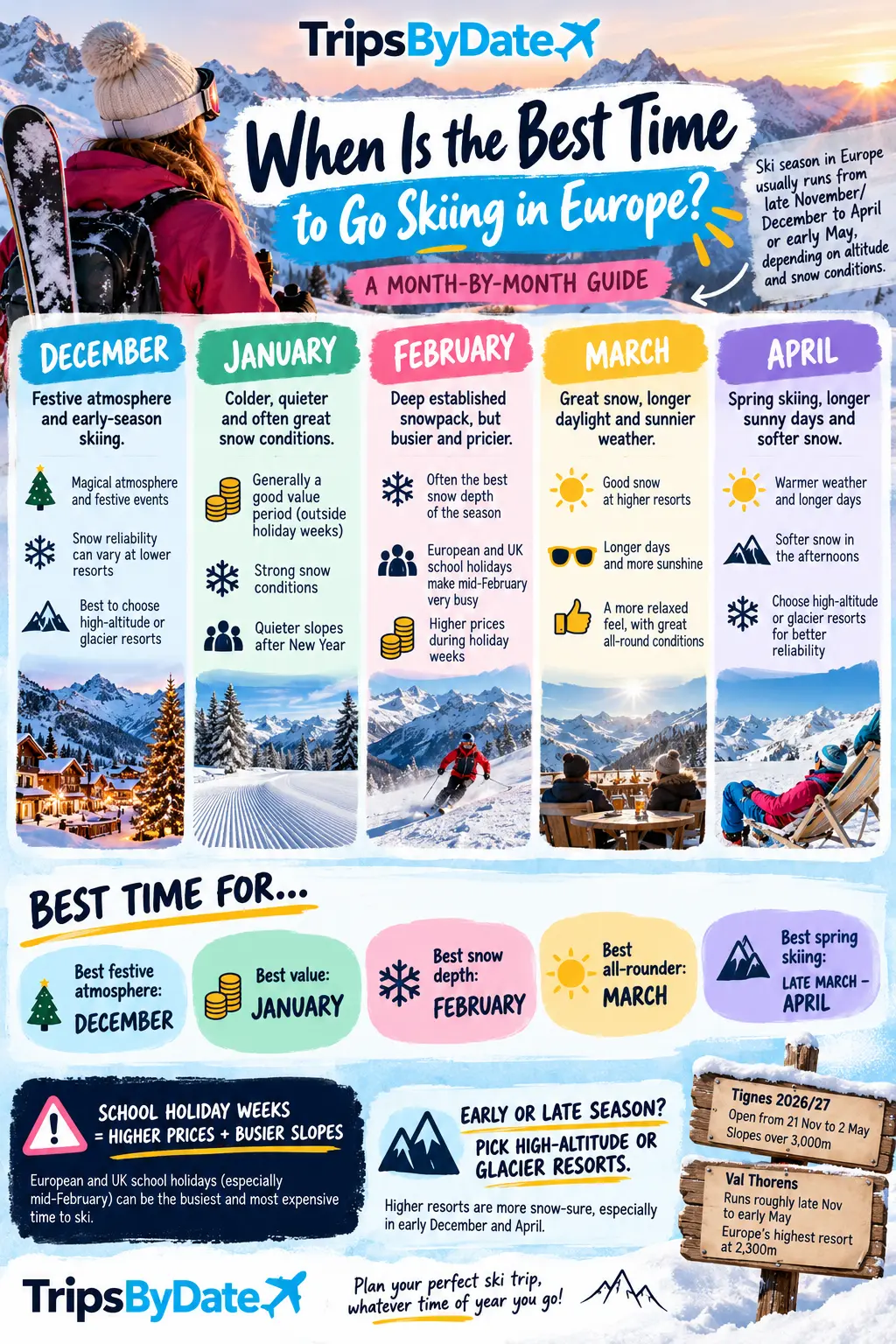
The best time to ski in Europe depends on what you want from your holiday. The deepest winter snow, the lowest crowds, a festive mountain village and sunny terrace lunches rarely peak in exactly the same week. Your destination matters just as much as the month.
For most Alpine holidays, the main season runs broadly from December into April, with some high-altitude areas opening earlier and closing later. Opening dates do not mean every lift or run will be available from the first day to the last. Resorts open terrain progressively, and weather can interrupt operations at any time.
Our month-by-month guide compares typical advantages and trade-offs, then shows how to check the actual dates before committing your money. We have also included published 2026/27 examples from Tignes and Val Thorens, which illustrate why individual ski areas should be checked rather than guessed.
Explore Upcoming Ski Holidays
Compare ski holidays by departure date. Before booking, check the resort opening calendar, lift-pass coverage and the skiing conditions normally expected in that part of the season.


 LHR • 7 nights
 AI · Skiline

 MAN • 7 nightsAI · Ski Line
 CWL • 7 nightsSC · Iglu Ski
 GLA • 7 nightsHB · Skiline
Quick answer: which month is best for skiing in Europe?
January: Often an appealing balance of winter conditions and value after the New Year break, especially outside popular non-school-holiday weeks. It is not guaranteed to be empty or cheap.
February: Established winter conditions in many Alpine areas, but school holidays can make accommodation, lessons and lift queues particularly busy.
March: A strong all-round option if you like longer days and a mix of winter snow and sunshine. Aim higher or choose north-facing terrain when planning later trips.
December: Excellent for festive atmosphere, but early-season snow and the amount of open terrain vary considerably between resorts.
April: Great for warmer-weather spring skiing at suitable high-altitude areas, with softer afternoon snow and fewer lower-altitude options as the season progresses.
December: Christmas atmosphere, with early-season uncertainty
There is something special about snowy village lights, mountain restaurants and pre-Christmas skiing. December is ideal if the festive feel is part of the holiday, but it has two quite different periods: the quieter weeks before Christmas and the more sought-after Christmas and New Year holidays.
Early December is particularly sensitive to altitude and recent weather. Some high resorts are already running lifts, while linked areas or lower villages may still be preparing to open. When comparing a December package, check the opening status of the pistes you can realistically ski, not simply whether the destination describes itself as open.
For example, official plans for 2026/27 list Tignes opening progressively from 21 November and the linked Tignes–Val d’Isère area from 28 November, subject to snow conditions. The broader 3 Vallées area has a later published opening than Val Thorens itself. These are useful examples of why neighbouring sectors can have different dates.
Is early December a good time for beginners?
It can be, if the nursery slopes and ski schools you need are operating. However, beginners usually benefit more from a properly open, convenient learning area than from an impressive top-lift altitude. Confirm lesson availability, beginner-lift status and whether the nursery slope is accessible from your accommodation.
January: cold winter conditions and potentially better value
January brings short days, colder weather and often a developing winter snowpack. It can also offer attractive prices once the New Year holiday rush has passed. Many skiers enjoy the quieter feel of some midweek dates and the chance to ski slopes that retain their winter character.
But January is not automatically the cheapest or quietest month. Popular resorts attract groups outside school holidays and individual weeks can be busy. Compare actual package prices for your departure airport and dates instead of trusting a blanket rule.
The trade-off is the cold. Prepare for low temperatures, variable visibility and the possibility of wind-related lift disruption. Well-fitting boots, good layers and sensible breaks can matter more to your enjoyment than squeezing in every possible run.
February: excellent midwinter skiing, often the busiest holiday weeks
February is popular because many resorts have an established base and families can travel during school holidays. The downside is demand. UK half-term dates overlap with holidays in parts of France, Switzerland and elsewhere, although schedules differ across regions.
Expect some weeks to be substantially more expensive or crowded than adjacent dates. Ski schools may fill quickly, larger accommodation can be harder to find and beginner areas can become busy at predictable times. If February is your only option, book lessons early and compare lift infrastructure and access rather than focusing on resort fame.
Do not assume the deepest snow of the entire season will always fall in February. Snowfall timing varies from winter to winter, and conditions on individual pistes depend on recent weather, grooming, altitude and slope orientation.
March: a strong balance of snow, daylight and mountain atmosphere
March is often an excellent all-round choice. Days are longer than in midwinter, sunny mountain terraces become more appealing and high-altitude slopes can still have a substantial snow base. It may be particularly enjoyable for mixed groups where some people ski and others prefer walks, restaurants and scenery.
The main consideration is when and where you ski. Lower or sunny-facing runs can become slushy in the afternoon after a mild spell. North-facing pistes and higher ski sectors may hold firmer snow for longer. Start earlier when conditions warrant it and be willing to change your route as the day warms.
March is not automatically quiet. School holidays, resort festivals and busy adult travel weeks can all affect availability. Some winter events are deliberately scheduled outside February, so check the resort calendar.
April: spring skiing, warmer afternoons and a narrower resort choice
April can be wonderful if you prefer milder temperatures, longer daylight and a relaxed end-of-season atmosphere. It is also the month when choosing the right resort becomes especially important. Lower ski areas may have closed, while high-altitude destinations and glacier sectors can still offer excellent skiing.
Look for high terrain, a realistic amount of open skiing, north-facing runs and good lift links from your accommodation. Snow can be firm or icy early in the morning, enjoyable as it softens, and heavy or slushy later in the day. The precise pattern changes with overnight temperature and weather.
Easter holidays can create busy weeks even when the season is winding down. If you are travelling late in April, confirm that lifts, ski schools, rentals and restaurants will operate for the full stay, not just on arrival day.
What about November or May?
A handful of high-altitude European resorts offer skiing in November or May, usually on selected terrain. These dates suit flexible travellers who understand that piste choice may be restricted. You should check webcams, current openings and the exact ski area covered by your lift pass.
For winter 2026/27, both Tignes and Val Thorens publish dates from 21 November 2026 to 2 May 2027. In Tignes, the first opening is phased and depends on conditions. At Val Thorens, the Val Thorens–Orelle area has a longer season than the full linked 3 Vallées domain.
How the published 2026/27 dates differ between ski areas
Tignes: Official plans state progressive opening from 21 November 2026, expansion towards the Tignes–Val d’Isère linked area from 28 November, and a closing date of 2 May 2027, subject to conditions.
Val Thorens–Orelle: The official resort calendar lists 21 November 2026 to 2 May 2027.
Full 3 Vallées domain: Its published main season is 5 December 2026 to 18 April 2027. Booking Val Thorens before or after those dates does not mean you have access to the entire linked area.
These are published plans, not promises about every lift, run or day. Recheck the official operational status close to departure.
Best time for beginners and first-time ski holidays
For a first ski holiday, prioritise accessible beginner terrain, suitable lesson availability and comfortable weather. January can be appealing if prices fit and you are prepared for cold conditions. March can be pleasant for its daylight and milder temperatures. Both work well, but neither guarantees good beginner conditions.
If you need school holiday dates, February or Easter may be your practical choice. Look at ski school capacity and beginner-lift access before choosing a resort. Our guide to learning skiing explains what the first few days can involve, and our lesson guide helps you decide what to book.
Best time for powder, groomed pistes and spring sunshine
For powder: No calendar date guarantees fresh snowfall. Midwinter increases the likelihood of cold winter weather in many regions, but safe off-piste skiing requires local avalanche knowledge, suitable equipment and qualified guidance. Fresh snow on an open piste is not the same as travelling into uncontrolled terrain.
For groomed pistes: Midwinter can provide cold, firm snow, while spring days may start with a firm surface before softening. Check daily grooming reports and weather, especially after thaw-freeze cycles.
For sunny lunches: March and April often provide longer daylight and a more spring-like feel. Choose the resort carefully and schedule skiing around the changing snow.
Know when you can travel?
Choose your departure airport and free dates, then explore ski holidays that fit your calendar.
Find ski holidays by dateFive checks before choosing your ski week
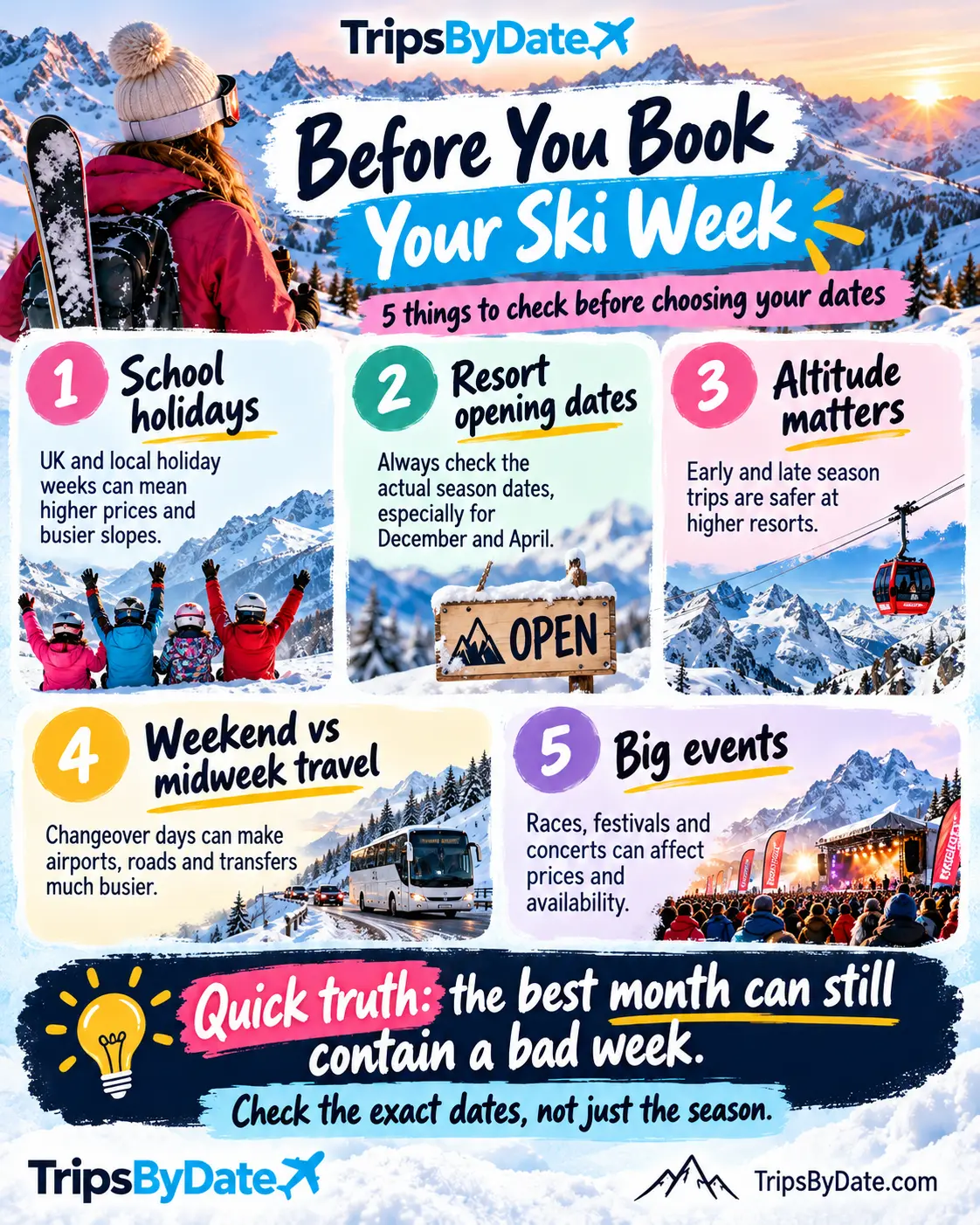
1. School holidays: Check UK half-term, Christmas and Easter, plus local school calendars in your destination country. A neighbouring country may be on holiday even when the UK is not.
2. Official opening dates: Find the dates for the particular ski sector, not just the resort village or the larger regional pass. Some linked areas open later and close earlier than the highest lifts.
3. Ski-area altitude and aspect: Look at the elevation of your preferred runs, not just the village. North-facing terrain and access to higher pistes can help during warm periods, although none is a guarantee.
4. Changeover days and transfer times: Saturdays can be busy on Alpine roads. Midweek arrivals may work better for some short holidays, but compare actual flights and accommodation rules before assuming.
5. Major events: Ski races, festivals and concerts can make a resort livelier and more expensive. Decide whether you want to join the atmosphere or avoid the crowds.
How to check whether a resort will actually be good for your dates
Start with the official resort ski-area calendar. Then open the piste map and identify the altitude of the slopes you will really use. Check whether you need a connected lift area, nursery slope or return route to your village, as these can have shorter operating windows.
In the days before travel, check the resort snow report, open-lift percentage and webcams, rather than snow-depth figures alone. A deep upper-mountain snow report may tell you very little about a low-altitude beginner area.
Also distinguish snowfall forecasts from actual conditions. A forecast can change rapidly in the mountains, especially at the edges of the season. For an explanation of the factors behind more reliable coverage, see Best Snow-Sure Ski Resorts in Europe.
When can a cheaper ski week become a false economy?
A discounted early-December or late-April package might be great value, but check what you are buying. If you must travel by shuttle to the only open runs, if lessons are not operating nearby or if the pass covers only a small sector, the apparent saving can disappear.
Compare the full holiday price, including luggage, transfers, equipment hire, lessons, lift passes and meals. A moderately priced week with convenient ski access may provide more actual skiing than a cheaper week with long journeys every morning. See our ski holiday cost guide and budget ski resorts for more ways to compare value.
Is it better to book early or wait for snow reports?
Booking early can secure the accommodation, flights and lesson places you want, especially for school holidays. Waiting can give you more information about conditions, but good flights and convenient rooms may no longer be available.
If your dates are fixed, choose a sensible altitude and buy according to the flexibility in your budget. If you can travel with little notice, monitoring official conditions may help you select a good week. Check cancellation and amendment terms instead of assuming you can move a booking because of poor snow.
Frequently asked questions
Is January or March better for skiing in Europe?
January often suits skiers seeking a more wintry feel and potentially better value outside peak weeks. March suits those who prefer longer daylight and milder mountain conditions. Both depend on recent snowfall, altitude, resort choice and your budget.
Is February the best month for snow?
February is a popular midwinter month with established snow in many resorts, but it cannot promise the deepest snow or freshest powder. Its main practical downside for UK families is high demand around half-term.
Can you ski in the Alps in early December?
Yes, at many resorts, particularly higher-altitude destinations. But ski areas open gradually and may have limited terrain in early December. Check specific sectors, pistes and ski schools before booking.
Is March too warm for skiing?
Not necessarily. March often offers excellent skiing, especially higher up. Afternoon snow may soften on sunny or low-altitude pistes; cooler and north-facing slopes may hold winter-like conditions longer.
Can you ski in Europe in late April?
Yes, at selected high-altitude and glacier destinations with published late-season operations. A resort advertising spring skiing does not guarantee every lift, run or service will remain open.
Do school holidays affect skiing prices?
They often do. Christmas, New Year and February half-term can see stronger demand and higher package costs. Easter prices vary with dates, destination and how much terrain remains open.
Should I pick dates first or choose the resort first?
If your time off is fixed, start with dates and filter for resorts whose ski areas are suitable for that part of the season. If you can travel whenever you like, choose the style of trip you want, then compare several weeks for conditions and value.
Official guidance and research sources
These sources are useful for checking the season rather than relying on broad monthly assumptions:
Ski Club of Great Britain: When to Go, including school-holiday patterns, January, February and spring skiing.
Ski Club of Great Britain: Choosing the Right Resort, including altitude and snow reliability considerations.
Tignes: Official Opening Dates, including the 2026/27 phased opening and published closing date.
Val Thorens: Official Ski Area Opening Dates, distinguishing local and linked ski areas.
Les 3 Vallées: Winter Ski Area Dates, including the main 2026/27 linked season.
So when should you book your next ski holiday?
For an all-round skiing holiday, January or March often make appealing starting points. Choose February if it matches school holidays and you are comfortable with busy weeks. Choose December for festive experiences or April for spring sunshine, with extra care over snow and open terrain.
The strongest decision is not simply picking a month. It is choosing a specific week at a resort that suits your ability, budget and preferred atmosphere, then checking the published opening dates and the real conditions.
More skiing guides to help you plan
Best Snow-Sure Ski Resorts in Europe · How Many Days Do You Need for a Ski Holiday? · Best Ski Resorts for a Short Break · Best Ski Resorts for Beginners
‹ BACK TO SKIING
Know when you can travel?
TripsByDate works the other way around. Pick your departure airport and the dates you are free, then see the holidays that actually fit.
Find holidays by date