

How to Save Money on a Ski Holiday
Ten practical ways to get more skiing for your money, plus seven hidden costs that can turn a cheap package into an expensive trip.
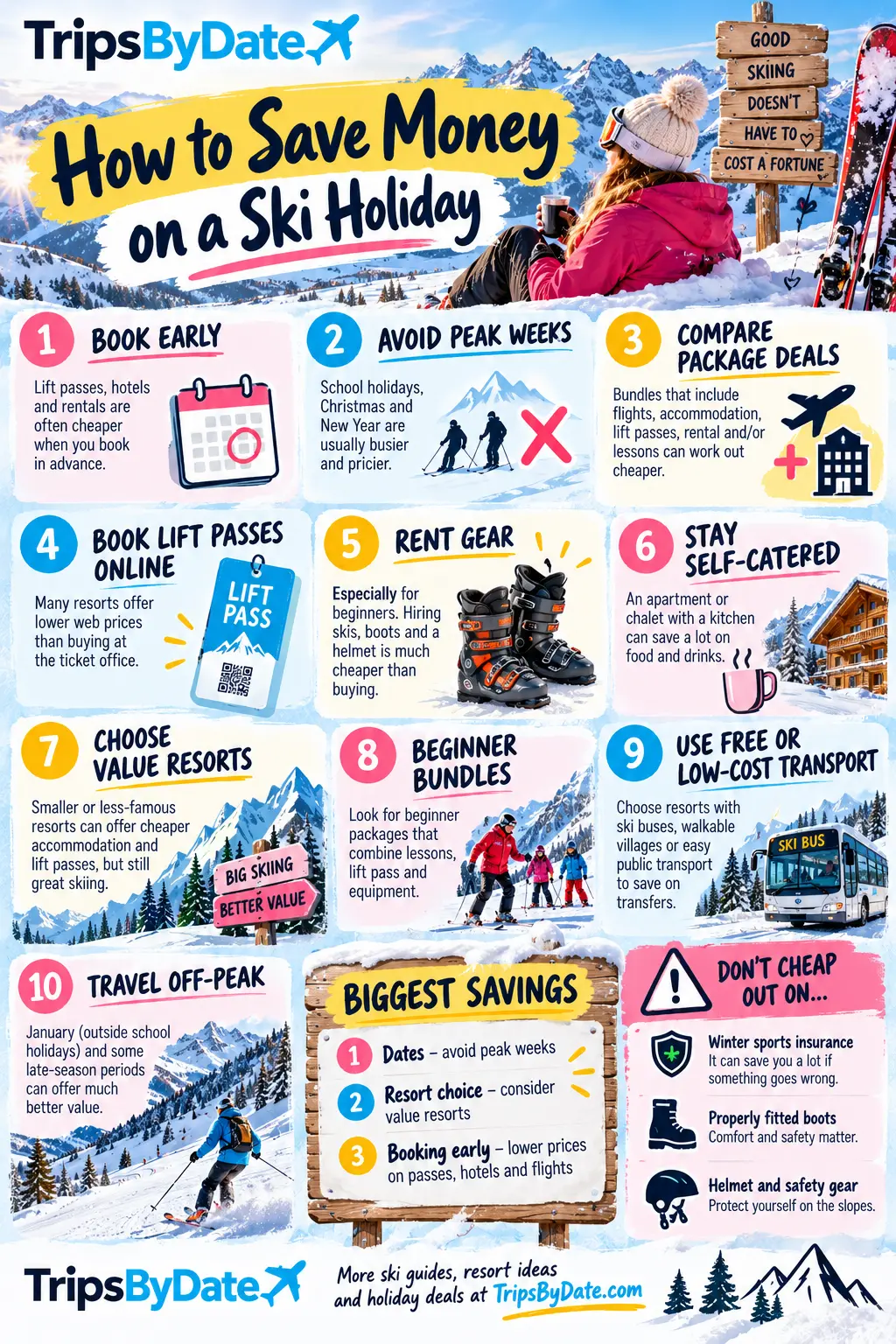
Ski holidays can be expensive, but the most useful savings rarely come from one magical discount code. They come from choosing the right week, checking what is included, booking the lift pass you actually need and avoiding everyday charges that quietly inflate the final bill.
Two holidays advertised at the same price can have very different totals. One might include flights, checked luggage and transfers. The other could leave you paying for airport parking, a mountain transfer, equipment, lift passes and lessons before you have even reached the first slope.
This guide covers ten practical ways to save, the seven costs that are easiest to overlook, and a straightforward method for comparing two ski holidays fairly. Prices and offers change by resort, date and supplier, so we focus on checks that work from season to season rather than invented bargain figures.
Explore Upcoming Ski Holidays
Compare upcoming ski packages by departure date. Check the supplier's inclusions and any extras before deciding which holiday represents the best value.


 BRS • 7 nights
 B&B · Iglu Ski

 CWL • 7 nightsSC · Iglu Ski
 GLA • 7 nightsB&B · Iglu Ski
 BHX • 7 nightsSC · Ski Line
Quick answer: what saves the most money on a ski holiday?
For many travellers, the biggest opportunities are avoiding expensive peak dates, comparing the full cost of different resorts, checking packages against independent arrangements, and buying only the ski-area access and equipment needed for the trip. A short airport transfer and self-catering apartment may be worth more than a small discount on a lift pass.
If you are new to skiing, avoid spending extra on the largest ski area or premium equipment before you know what you will use. Our ski holiday cost breakdown explains the main components of the budget, and our budget resort guide offers destinations worth comparing.
1. Compare dates before you commit to a resort
School holidays, Christmas, New Year and certain event weeks can increase demand for flights, beds and ski school places. If you can travel outside these periods, comparing a few departure dates may reveal a larger saving than changing hotel or equipment package.
January after the New Year holidays and some spring weeks are worth checking, but neither is automatically cheap. School calendars differ across European countries and spring snow conditions vary by altitude. Compare actual live prices and check the ski area's operating dates rather than trusting a blanket rule about the cheapest month. Our month-by-month skiing guide explores these trade-offs.
2. Book early when the price and cancellation terms make sense
Booking in advance can help secure well-located apartments, flight seats, ski-school places and rental equipment before popular dates fill. Some lift-pass and hire suppliers offer advance web prices, while certain resorts use demand-based pricing.
But early does not guarantee the lowest possible price. Before committing, compare the final total and check deposits, amendments and cancellation charges. A slightly more expensive flexible booking can be worth considering if your plans are uncertain.
3. Compare a package holiday with booking independently
A package may include flights and accommodation, and sometimes transfers, luggage or other services. The simpler comparison is not the advertised package price versus the flight and apartment alone. Add everything needed to create an equivalent trip.
Independent booking can be especially attractive for groups sharing an apartment or travellers using trains or their own car. The Ski Club of Great Britain specifically recommends comparing independent travel and apartments as potential value options, alongside packages. Neither method wins on every date.
Check booking protection as well as the total. An independently assembled trip does not necessarily have the same consumer protections as a qualifying package holiday.
4. Choose a lift pass for the skiing you will actually do
The biggest multi-resort pass is impressive, but it can be unnecessary for a beginner who expects to spend most of the week on gentle pistes near ski school. Ask about beginner-area tickets, local-area passes, short-duration passes and any free nursery lifts.
Check the official operator's website before buying. Some resorts offer lower online or early-booking prices, while others use dynamic pricing. If you are unsure which pass to get, ask your ski instructor which lifts the lessons will use. Read What Does a Ski Pass Include? for a closer look at pass coverage and exclusions.
5. Hire equipment if you are just starting out
Buying skis, bindings and boots for a first holiday can involve a substantial upfront commitment. Renting lets a shop help with fitting and allows you to try skiing before deciding what equipment suits you. It also avoids owning gear that needs storage, servicing and possible airline carriage.
Compare ski-and-boot packages rather than looking only at a promotional ski-only rate. Check whether poles, a helmet and any damage protection are included. Our ski hire guide explains how fitting and collection work; our hire-versus-buy guide covers the longer-term decision.
6. Consider self-catering and shared accommodation
A well-located apartment with a kitchen can cut the cost of breakfasts, drinks and some evening meals. Sharing with friends or family may reduce the cost per person, particularly when the property is priced for the whole group.
However, check whether linen, end-of-stay cleaning, local tourist tax and a security deposit are included. An apartment outside the village may involve buses, taxis or a car every day, cancelling out part of the saving. Compare the whole stay, not simply the nightly rate.
7. Choose a better-value ski resort, not just the cheapest room
Less-famous ski areas can offer excellent terrain and more manageable budgets than headline luxury destinations. Consider places such as Bansko, Borovets, Bardonecchia or Sauze d'Oulx alongside the Alpine household names, while comparing the actual holiday costs for your airport and travel dates.
Resort size should match the group. A beginner does not necessarily need hundreds of kilometres of pistes. But a tiny ski area is not a bargain if experienced companions will have to pay extra to reach more varied runs. See How to Choose the Right Ski Resort before committing.
8. Look for genuinely useful beginner bundles
Some ski schools and holiday providers sell combinations of lessons, local passes and equipment rental. A bundle can be convenient and sometimes costs less than the components purchased separately.
Do the maths. Check lesson hours, group size, equipment class, helmet provision and exactly which lifts the pass covers. A bundle is only a saving if it includes what you need. Our ski lesson guide helps with the course decision.
9. Save on airport and resort transport
Transfer prices can erase the savings on a cheaper flight. Compare shared transfers, scheduled buses, trains and any resort shuttle services. If you are travelling in a group, calculate the cost of a private transfer per person rather than assuming it will always be dearer.
Check the final arrival time. A flight that lands late might mean an overnight airport stay, a costly private transfer or losing your first ski morning. A practical arrival can save money and holiday time. For shorter trips, see Best Ski Resorts for a Short Break.
10. Budget your daily spending before arriving
Slope-side lunches, takeaway coffees, snacks and drinks can add up over a week. Bringing a refillable water bottle, carrying an appropriate snack and planning a few apartment meals can make a noticeable difference without making the holiday feel restrictive.
For après-ski, decide what you want to spend before heading out. A lively afternoon can be part of a great trip, but don't allow a string of small purchases to become a surprise expense. Our après-ski resort guide explains the different nightlife styles.
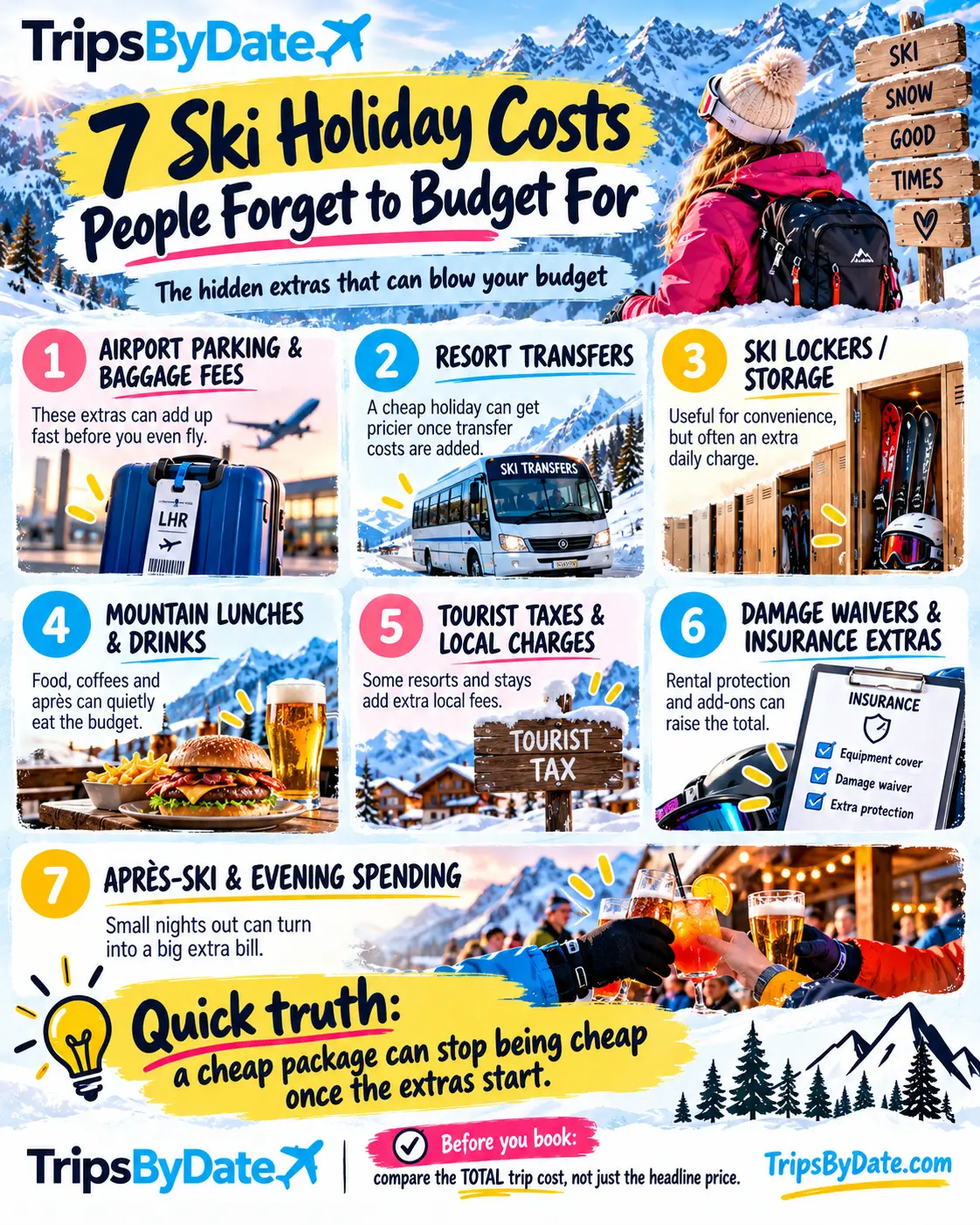
Seven ski holiday costs people frequently forget
1. Airport parking and baggage: Ski clothing is bulky, and carrying your own skis may require a specialist sports-equipment allowance. Compare the complete airline baggage rules and parking or train-to-airport costs.
2. Resort transfers: The cheapest flight into a distant airport can produce the most expensive journey to the slopes. Calculate the full door-to-door journey.
3. Ski lockers and storage: Convenient lockers at lift stations sometimes carry a daily or weekly fee. Check whether accommodation includes a secure ski room and boot dryers.
4. Mountain lunches and drinks: Eating out for every meal can transform the budget, especially for families. Check whether half-board is better value than self-catering for your group.
5. Tourist taxes and property charges: Local charges, cleaning fees and accommodation deposits vary between destinations and booking providers. Read the price breakdown before paying.
6. Equipment protection and insurance extras: A rental shop's optional damage waiver and your travel insurer's winter-sports cover are different products. Compare what each does and does not cover, including theft, excesses and off-piste exclusions.
7. Après-ski and evening spending: Bars, taxis and extra restaurant meals should have a place in the budget, even if your package includes flights and accommodation.
What should you never cut to save money?
Appropriate winter-sports insurance. Standard travel policies may exclude skiing, equipment damage or particular activities. GOV.UK advises checking cover for the sports you plan to do and points out that emergency medical costs and repatriation can be very expensive. A GHIC or EHIC is not a substitute for travel insurance.
Properly fitted boots and a suitable helmet. Poorly fitted equipment can turn a first ski trip into an uncomfortable experience. Use a professional fitting and do not alter binding-release settings yourself. Read What Ski Boots Should Feel Like.
Good instruction. Beginners should not choose dangerous terrain or skip appropriate lessons simply to save money. Check for suitable group courses and beginner bundles instead. Saving money is useful; learning safely is essential.
Worked example: compare two ski packages properly
Imagine Holiday A is advertised at £550 per person and Holiday B at £650. The lower headline price does not automatically make Holiday A better value. These are illustrative amounts only, not live offers.
If Holiday A requires £80 for baggage, £90 for transfers and £60 for a ski-school-area shuttle, its comparable total becomes £780. If Holiday B already includes baggage and transfers and offers accommodation near the lifts, it may work out cheaper overall and save valuable skiing time. The same comparison should then be made for lift passes, lessons, hire and meals.
To make a fair comparison, create a column for each candidate holiday. Use the same number of travellers and nights, then fill in flights, accommodation, luggage, transfers, ski passes, lessons, rental equipment, insurance, local fees and likely spending money. Keep refundable deposits separate from non-refundable costs.
Know when you can travel?
Choose your departure airport and available dates, then compare ski holidays that fit your plans.
Find ski holidays by dateHow to save money when travelling with children
Families should check child lift-pass rules, the ages covered by discounts, family ski-school packages and accommodation layouts. Some resorts have free or discounted beginner lifts, but eligibility differs and proof of age may be required.
Hiring children's equipment is often practical because sizes change quickly. Apartments can be good value for larger groups, provided transport to ski school is straightforward. Our family resort guide helps identify destinations with convenient beginner facilities.
Is a small ski area better value for beginners?
Often, but not automatically. Paying for a vast linked ski domain has little value if your first few days are spent learning on nursery slopes. A smaller area with well-positioned beginner lifts may provide everything you need.
Equally, an established larger resort may have excellent beginner facilities and competitively priced local passes. Compare teaching areas, access and actual prices rather than assuming that small always means cheap.
Are package deals cheaper than booking everything yourself?
Sometimes. Package operators may offer competitive combinations of transport and beds, while independent travel can suit groups sharing apartments or travelling by rail. The winning option depends on dates, group size, baggage, transfers and cancellation terms.
Make like-for-like comparisons and check consumer protections. The Ski Club of Great Britain's ski holiday planning guide discusses both packages and independent holidays.
Can booking lift passes online save money?
It can, depending on the resort and date. Some destinations publish advance-purchase or demand-based prices while others offer fixed rates. Always use the official lift operator where possible and check which sectors, dates and age categories your ticket covers.
If you are taking lessons, check whether a pass is included and ask your instructor which lifts you actually need before purchasing a multi-day ticket.
Is January always the cheapest month to ski?
No. January outside school holidays can offer good value, but popular resorts, events and specific non-school-holiday weeks may still sell strongly. Check March and other dates too. The Ski Club notes that even January and March can contain busy adult-traveller periods.
How much spending money should I budget?
There is no reliable single figure for all resorts. Decide which meals you will cook, how many lunches you will buy on the mountain, whether you expect evening drinks and whether you need taxis or extra activities. Price those choices for your destination rather than using a generic Europe-wide allowance.
Should you join a ski club to get discounts?
Membership organisations can offer discounts on equipment, holidays and related services. Check the current offers, membership fee and eligibility before joining. A discount is valuable only if the amount you will genuinely use outweighs the subscription cost. See the Ski Club of Great Britain discounts directory for an example.
Reliable sources and further reading
Ski Club of Great Britain: Creating the Perfect Ski Trip discusses off-peak travel, accommodation choices, lift-pass selection and package versus independent booking.
GOV.UK: Preparing for Winter Sports Abroad explains key insurance checks, equipment exclusions and safety precautions.
GOV.UK: Foreign Travel Insurance provides further advice about travel insurance cover, exclusions and emergency assistance.
Ski Club of Great Britain: Discounts lists membership-related offers, which should be checked against membership costs and terms.
The simplest rule for a cheaper ski holiday
Choose the dates and terrain you actually need, then compare the full price from your front door to the slopes and back. Look beyond the headline deal, especially when flights, transfers and ski passes are sold separately.
Saving money should make the holiday easier, not mean cutting insurance, lesson quality or equipment fit. For a final planning overview, see Your First Ski Holiday: Complete Beginner's Guide once published.
Related skiing guides
Best Budget Ski Resorts in Europe · How Much Does a Ski Holiday Cost? · When Is the Best Time to Go Skiing in Europe? · What Does a Ski Pass Include?
‹ BACK TO SKIING
Know when you can travel?
TripsByDate works the other way around. Pick your departure airport and free dates, then see holidays that fit.
Find holidays by date