

Best Snow-Sure Ski Resorts in Europe
Eight high-altitude ski destinations worth considering when snow reliability matters, plus a practical guide to choosing the right resort for your dates.
A ski holiday is a sizeable investment. If you have booked flights, accommodation, lessons and lift passes, naturally you want enough snow to enjoy them. Choosing a higher resort can improve your odds, especially for an early December or late March trip, but the word snow-sure deserves a closer look.
A resort can have excellent snow on its upper slopes while the village looks almost springlike. A glacier can extend the potential skiing season without guaranteeing that lifts will run every day. And artificial snowmaking can preserve important pistes without replacing fresh snowfall everywhere.
The eight destinations below have strong altitude, glacier or season-length credentials. They are not a guarantee of good weather or powder on any particular date. This guide explains both their strengths and the details you should check before booking.
Explore Upcoming Ski Holidays
Looking for a ski trip? Here are upcoming ski holidays from specialist operators, ordered by departure date. Check the current snow and lift reports before choosing a departure.


 LGW • 7 nights
 B&B · Skiline

 LGW • 7 nightsHB · Iglu Ski
 GLA • 7 nightsHB · Skiline
 LGW • 7 nightsHB · Skiline
What does snow-sure actually mean?
Snow-sure is a descriptive term, not a standardised European certification. It generally refers to destinations where geography, altitude, temperature, glaciers or snowmaking improve the prospects of skiable pistes over a relatively long season.
It does not mean that every slope is open, that all pistes have natural snow or that bad weather will never close lifts. Wind, avalanche-control work and unusual temperatures can disrupt high-altitude skiing just as they can elsewhere.
It is also worth distinguishing snow cover from snow quality. A piste can have enough snow to operate yet be icy in the morning, heavy by the afternoon or difficult for a beginner. Recent conditions and the resort's grooming report matter too.
Eight of Europe's best-known snow-sure ski resorts
These resorts are selected for their altitude, glacier access or established long-season skiing. The order below is for comparison, not a measured ranking of annual snowfall.
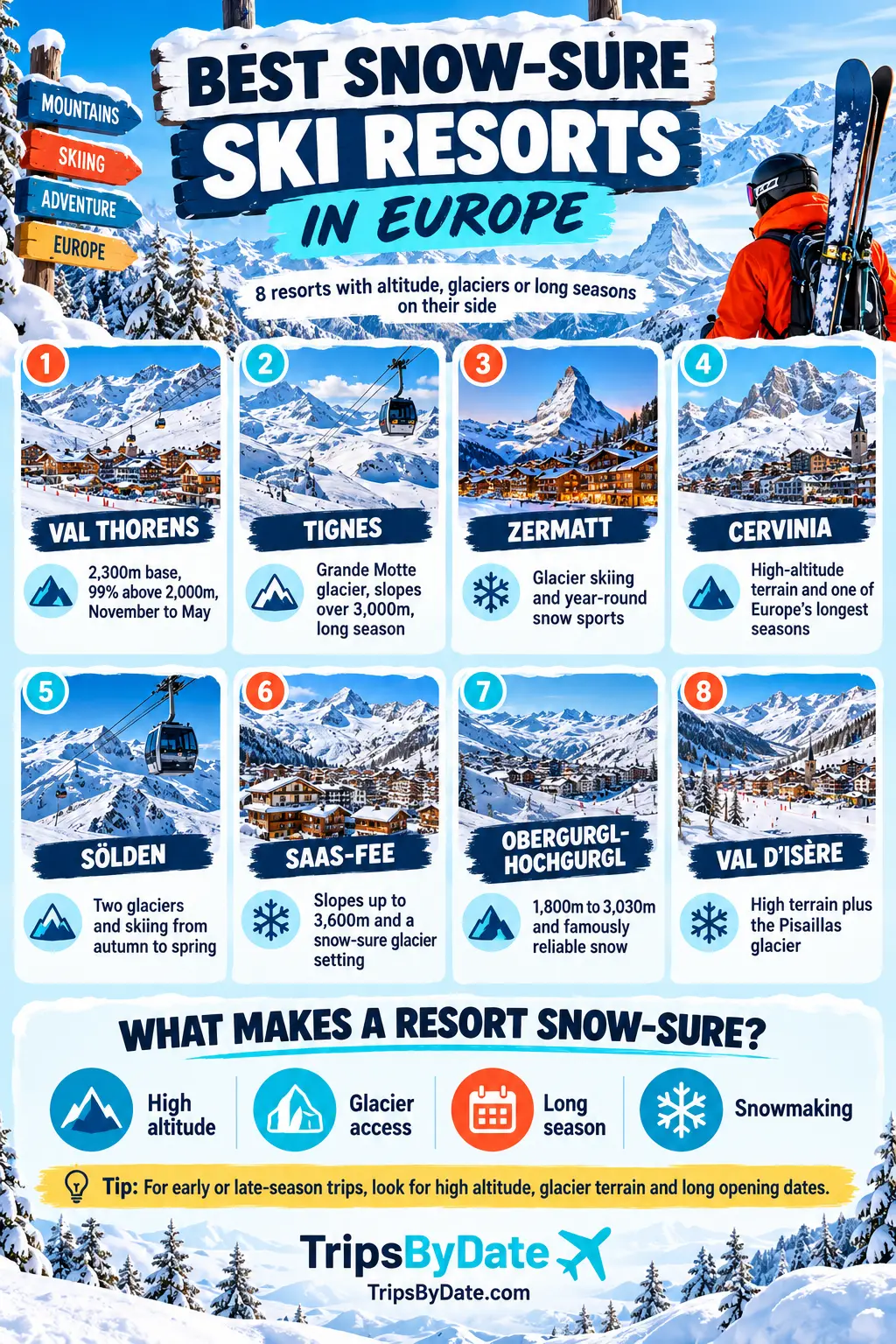
1. Val Thorens, France: high-altitude village skiing
Val Thorens is an obvious place to start. The resort village sits at approximately 2,300 metres, and the tourism office says 99% of its ski area lies above 2,000 metres. That is an unusually useful combination: you can stay in a genuinely high resort rather than rely solely on long lifts up from a low valley base.
It connects to the wider Les 3 Vallées network, although the extent of linked skiing available depends on the date, weather and lift openings. A high-altitude base can make the return to accommodation more practical in marginal snow periods, subject to individual piste conditions.
Best for: skiers wanting a high base, extensive terrain and a lively resort atmosphere. Watch for: cold, exposure and wind on higher slopes, plus different opening schedules for Val Thorens and the full linked area.
For current operating dates and the piste map, consult the official Val Thorens ski-area guide.
2. Tignes, France: the Grande Motte glacier advantage
Tignes combines high resort sectors with access to the Grande Motte glacier. The highest summit reaches 3,656 metres, while lifts give access to extensive skiing above 3,000 metres. The altitude gives Tignes an advantage at both ends of the traditional winter season.
The resort has published a planned 2026/27 ski season from 21 November to 2 May, with progressive openings and explicit weather-dependent conditions. That distinction matters: a resort announcing a November opening does not mean every lift and linked piste will open immediately.
Best for: flexible early- or late-season planning, longer trips and groups with mixed abilities. Watch for:glacier lift closures in strong wind, variable access from lower accommodation and a phased start to the ski season.
Check the official Tignes opening calendar and Grande Motte glacier information.
3. Zermatt, Switzerland: exceptional glacier altitude
Zermatt has access to exceptionally high glacier terrain below the Matterhorn. The Matterhorn Glacier Paradise lift station reaches 3,883 metres, and the Theodul Glacier supports skiing beyond the ordinary winter period when operations and conditions permit.
This makes Zermatt particularly interesting for people seeking high terrain. The trade-off is that some of the most elevated pistes require considerable lift travel, and high-altitude weather can interrupt access. Staying in the beautiful, car-free village does not put you at the altitude of the upper glacier runs.
Best for: dramatic scenery, high-altitude skiing, a memorable village and travellers who want substantial non-ski appeal too. Watch for: transfer time up the mountain, international-area lift arrangements and potentially high trip costs.
Explore the official Matterhorn glacier ski information.
4. Cervinia, Italy: high-altitude skiing below the Matterhorn
Breuil-Cervinia is another strong option on the Matterhorn massif. Its extensive high terrain and access towards Plateau Rosà give it a reputation for a long ski season. The resort has published a planned Breuil-Cervinia season from 24 October 2026 to 2 May 2027, though actual piste and cross-border access remains dependent on conditions and the operating calendar.
Cervinia can appeal to holidaymakers seeking high, broad pistes, scenic skiing and an Italian mountain-village base. The link to Zermatt creates more possibilities when open, but should not be assumed available on every day of a trip.
Best for: long-season possibilities, confident cruisers and travellers who want an Italian resort experience. Watch for: wind affecting upper lifts, cross-border closures and the exact lifts included in your pass.
Confirm the latest details with Cervino Ski Paradise.
5. Sölden, Austria: two glaciers and a long season
Sölden stands out because it has two named glacier ski areas, Rettenbach and Tiefenbach. The official ski-area information places the glacier terrain between approximately 2,675 and 3,250 metres, helping the destination offer skiing from autumn into spring.
That does not make the entire Sölden network equally snow-reliable. The glacier slopes and lower mountain runs operate in different conditions, and the connection between sectors is worth checking before you head out.
Best for: an autumn ski trip, early winter training and travellers who enjoy a substantial resort with lively evenings. Watch for: which glacier or mountain sectors are open, the time needed to reach them and lift closures in wind.
See the official Sölden glacier information.
6. Saas-Fee, Switzerland: glacier skiing above a car-free village
Saas-Fee combines a particularly attractive mountain setting with skiing reaching about 3,600 metres. Its high glacier environment and the steep mountain walls around the village help explain its enduring reputation as a late-season ski destination.
The resort's published 2026/27 winter operation runs from 1 November 2026 to 18 April 2027. Do not confuse the Saas-Fee season with opening dates for neighbouring Saas Valley resorts, which have separate schedules.
Best for: high-alpine scenery, a peaceful car-free village and travellers who value an attractive resort experience beyond the slopes. Watch for: exposure at altitude, lift access times and the difference between the village and the highest open terrain.
Check the Saas-Fee winter guide and season dates.
7. Obergurgl-Hochgurgl, Austria: snow reliability without a glacier
Not every snow-sure resort depends on glacier access. Obergurgl- Hochgurgl, also marketed as Gurgl, sits high in the Austrian Ötztal and offers skiing from around 1,800 to 3,030 metres. The ski area promotes a November-to-April season thanks in large part to that elevation.
It is an interesting counterpoint to Sölden. Gurgl is known for a comparatively calm, convenient resort setup, with skiing close to much of the accommodation. High altitude here means a useful proportion of your skiing starts well above the valley floor.
Best for: couples, intermediate skiers, beginners wanting an organised high-altitude area and travellers prioritising slope access. Watch for: early-season partial openings and how exposed upper sections are on poor-weather days.
Read the official Gurgl ski-area information.
8. Val d'Isère, France: high terrain and the Pisaillas glacier
Val d'Isère combines a traditional village at approximately 1,850 metres with extensive high-altitude skiing and the Pisaillas glacier area. The tourism office describes upper ski terrain reaching approximately 3,230 metres, with a large share of the wider Tignes–Val d'Isère area above 2,200 metres.
For a later-season trip, this offers a useful range of options. But the resort's lower village runs and more exposed upper glacier terrain can behave very differently. Good snow on a high sector does not guarantee a comfortable ski-home route at the end of the day.
Best for: experienced skiers who want extensive terrain, a lively village and serious high-altitude options. Watch for: localised lift closures, the practical route back to accommodation and early- or late-season linked-area access.
For local altitude details, read Val d'Isère's official spring-skiing guide.
How to choose a snow-sure resort for your travel dates
Start with the time of year rather than the most impressive mountain photograph. December, January and April create different risks and priorities. Our guide to the best time to ski in Europe explores the wider seasonal trade-offs.
Early season: November and the first half of December
Prioritise resorts with glacier skiing or well-established early openings, such as Sölden, Cervinia, Tignes or Saas-Fee. Check the actual published start date, then examine which pistes and lifts are expected to be operational. A glacier sector may open while village-return routes remain closed.
Opening dates are plans, not promises. Snowfall, snowmaking temperatures, wind and safety checks can all alter them. Book flexibly where possible and avoid planning your whole trip around one particular high lift.
Midwinter: January and February
More European resorts ordinarily have a good chance of adequate piste coverage by midwinter, so you can widen your choices. The question may become whether you prefer sheltered tree-lined runs or exposed high-alpine terrain. The highest resort is not always the most enjoyable option in strong wind or poor visibility.
If you are new to skiing, accessible green or blue pistes, convenient lessons and a manageable lift network can matter more than the maximum advertised altitude. Read Best Ski Resorts for Absolute Beginners before making a final decision.
Late season: March and April
High altitude becomes particularly attractive as daytime temperatures rise. Glaciers, north-facing slopes and strong upper-mountain terrain can preserve colder snow longer. Spring snow often changes during the day, so the best run at 9 am may feel quite different by 2 pm.
In April, confirm the end dates for individual lifts and linked ski areas. A resort may remain open while some connections, low-altitude runs or outlying sectors have already closed.
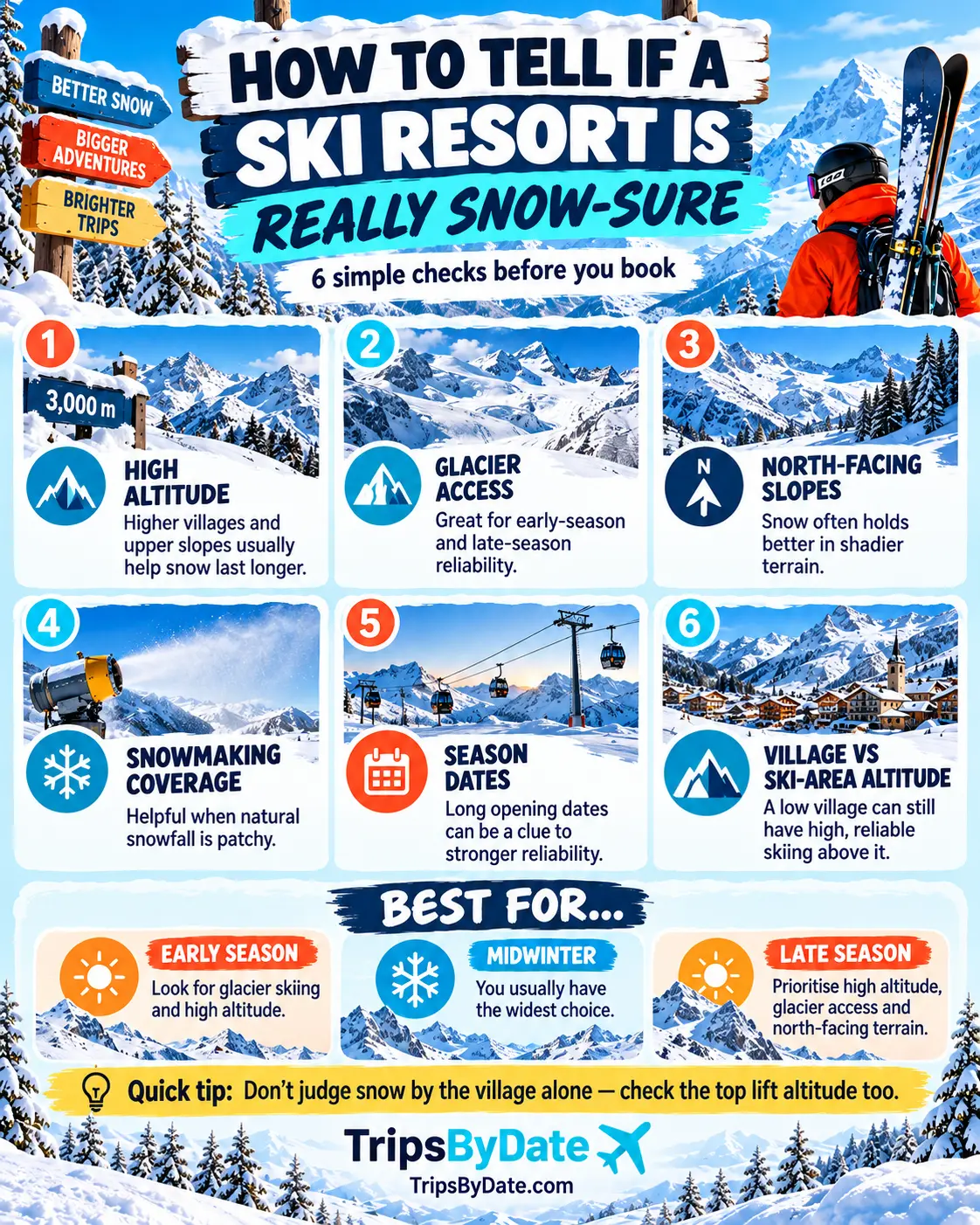
Six checks that matter more than a snow-sure label
1. Compare ski-area altitude, not just village altitude
A village at 1,200 metres can have access to excellent high skiing. Equally, a high village can still have lower, sun-exposed slopes. Look at the vertical range and where the runs you will actually use sit within that range.
2. Check glacier access and which runs it opens
A glacier is helpful for seasonal reliability, but it may offer only a portion of the full ski area. Find out whether your ability suits that terrain and how many lifts you need to reach it. A glacier name alone is not enough reason to book.
3. Look at slope orientation
North-facing slopes in the Northern Hemisphere generally receive less direct sun and can retain colder snow for longer. South-facing runs can soften earlier, which may be welcome in icy weather but less attractive during a warm spell. Wind and local terrain also affect the outcome.
4. Understand snowmaking coverage
Snowmaking can help resorts maintain key pistes when natural snowfall is limited. But it requires suitable operating conditions, water, equipment and time. Coverage is not necessarily uniform across a mountain, and artificial snow does not mean fresh powder.
5. Check actual season and lift-opening dates
A long published season is useful evidence of a resort's operating ambitions, but look for progressive opening notes, closing schedules and lift-by-lift updates. A date range on a promotional image is not the same as a live piste report.
6. Check whether you can ski back to the village
For some trips, ski-in/ski-out convenience matters almost as much as the upper snow. Find out whether your accommodation relies on a lower return piste. In spring you may need a gondola ride or a bus back, even when high skiing is excellent.
Know when you can travel?
Choose your departure airport and available dates, then explore ski holidays that fit your plans.
Find ski holidays by dateHow to read a resort snow report properly
Do not stop at the headline snow depth. Compare recent snowfall, the base and upper-mountain depth, the percentage of lifts open, the number of kilometres of pistes operating and the weather forecast for your intended skiing days.
A large snow-depth number at the mountain top may tell you very little about access to beginner runs lower down. Conversely, well-prepared pistes can offer enjoyable skiing even when photographs of the village show limited natural snow.
Resort webcams are particularly useful. Compare a village camera, an upper lift camera and a piste camera when possible. Check whether the images are live and look for the capture time, rather than assuming every sunny photograph shows today's conditions.
Does a glacier guarantee good skiing?
No. Glacier terrain improves the chance of skiable snow through some marginal periods, but it can also be exposed to strong winds, poor visibility and lift closures. Conditions change with the season and the specific area that is open.
Glacier skiing is not automatically suitable for complete beginners. Always confirm that the open runs and lift access match your ability, especially outside peak winter. For more on grading, see What Do the Ski Slope Colours Mean?.
Are snow-sure resorts more expensive?
They can be, particularly well-known high-altitude destinations with expensive lift infrastructure and strong demand. But the total cost still depends on accommodation, transfer distance, holiday dates, equipment hire and lift-pass choice.
It may be better value to pay slightly more for a resort with a stronger chance of keeping your planned ski area open than to book a cheaper destination with limited suitable terrain. On the other hand, a beginner may not need an enormous high mountain ski pass. Compare the whole holiday, not the resort's reputation. Our Best Budget Ski Resorts in Europe guide offers a useful alternative shortlist.
What if there is not enough snow after you book?
First, check the precise terms of your accommodation, lift pass, package holiday and travel insurance. Ski-area closure, insufficient snow and weather disruption are not necessarily treated as the same event by different suppliers.
Some resorts or operators advertise specific snow-related guarantees, but eligibility, exclusions and refunds vary. Never assume every ski holiday comes with snow protection. Consider flexible accommodation or booking terms if your dates fall at the margins of the season.
Frequently asked questions about snow-sure ski resorts
Which European ski resort has the most reliable snow?
There is no honest single winner for every week or winter. High-altitude resorts such as Val Thorens, Tignes, Zermatt, Cervinia, Sölden, Saas-Fee, Gurgl and Val d'Isère all have meaningful reliability advantages, but the best choice depends on your month, the terrain you want and real conditions.
Is skiing in December risky?
Early December can be less predictable than midwinter, particularly at lower resorts. Glacier areas and established early-opening, high-altitude destinations can improve the odds. Check which lifts are scheduled to open rather than relying on a resort-wide season start date.
Is March or April too late for a ski holiday?
Not necessarily. Many high-altitude resorts plan skiing into April and some into May. Spring conditions are often best higher up and earlier in the day. Confirm the end date and practical return options for your accommodation.
Does north-facing terrain always have better snow?
No. North-facing slopes often retain colder snow longer, but fresh snowfall, wind, altitude, shading and grooming all matter. In cold midwinter weather, sunnier slopes may be more pleasant, especially for learners.
Does a high ski resort always suit beginners?
Not automatically. A high resort can provide more dependable snow but also colder, windier or more exposed conditions. Look for accessible nursery slopes, a good ski school, appropriate lift passes and easy routes back to your base. Start with How to Choose the Right Ski Resort if you are comparing your first trip.
Are published ski season dates guaranteed?
No. They are planned operating periods and can change. Ski lifts may open progressively and particular runs can close for weather, snow or maintenance. Check the resort's live information shortly before travelling and each morning during your stay.
Official resort information and research sources
The following official operator and tourism resources provide the altitude, glacier and season details used in this guide. Dates and lift availability may change, so these are also the most useful places to verify your own travel dates.
Val Thorens: ski area and official opening dates · Tignes: current opening dates · Matterhorn Glacier Paradise: glacier skiing · Cervino Ski Paradise
Sölden: glacier ski areas · Saas-Fee: winter season · Gurgl: ski area and altitude · Val d'Isère: spring skiing
So where should you go for the best chance of snow?
For an early or late winter trip, focus on how much suitable high-altitude terrain is open, how easy it is to reach and whether its closing dates match your booking. For midwinter, consider whether a sheltered, lower resort could be more comfortable than the highest exposed glacier area.
The most practical choice is not necessarily the one with the highest lift. It is the resort with a good chance of offering the kind of skiing you want on the dates you can travel. For a broader comparison of timing and prices, see How Much Does a Ski Holiday Cost?.
More skiing guides
When Is the Best Time to Go Skiing in Europe? · How to Choose the Right Ski Resort · Best Ski Resorts for Beginners · Best Budget Ski Resorts in Europe · Best Ski Resorts for a Short Break
‹BACK TO SKIING
Know when you can travel?
TripsByDate works the other way around. Choose your departure airport and dates, then explore holidays that fit your schedule.
Find holidays by date