

Ski Slope Dos & Don'ts
The simple rules and unwritten etiquette that make a day on the mountain safer and less stressful for everyone.
Skiing has an unusual problem: beginners are expected to share the same mountain with people who have been skiing for decades.
Fortunately, piste etiquette is mostly common sense. Stay in control, pay attention to the people around you and remember that the person downhill usually cannot see what is happening behind them.
There is also an official international code. The International Ski and Snowboard Federation (FIS) publishes ten rules of conduct for skiers and snowboarders covering speed, overtaking, stopping, entering pistes, signs and helping after accidents.
Explore Upcoming Ski Holidays
Looking for your next ski trip? Here are some upcoming ski holidays from specialist operators, ordered by departure date.


 LHR • 7 nights
 AI · Skiline

 MAN • 7 nightsHB · Skiline
 MAN • 7 nightsAI · Ski Line
 BHX • 7 nightsHB · Skiline
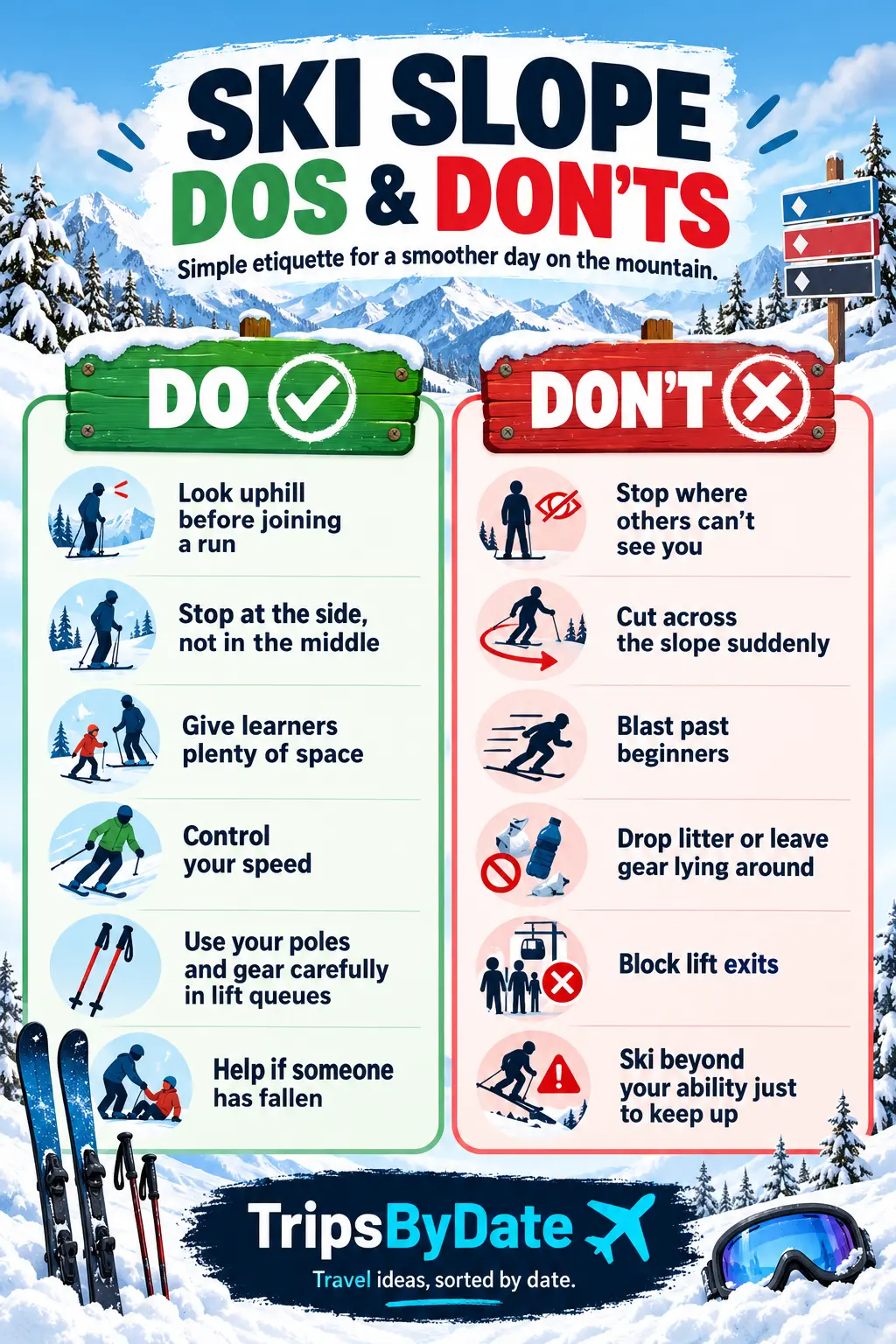
Do: look before joining a ski run
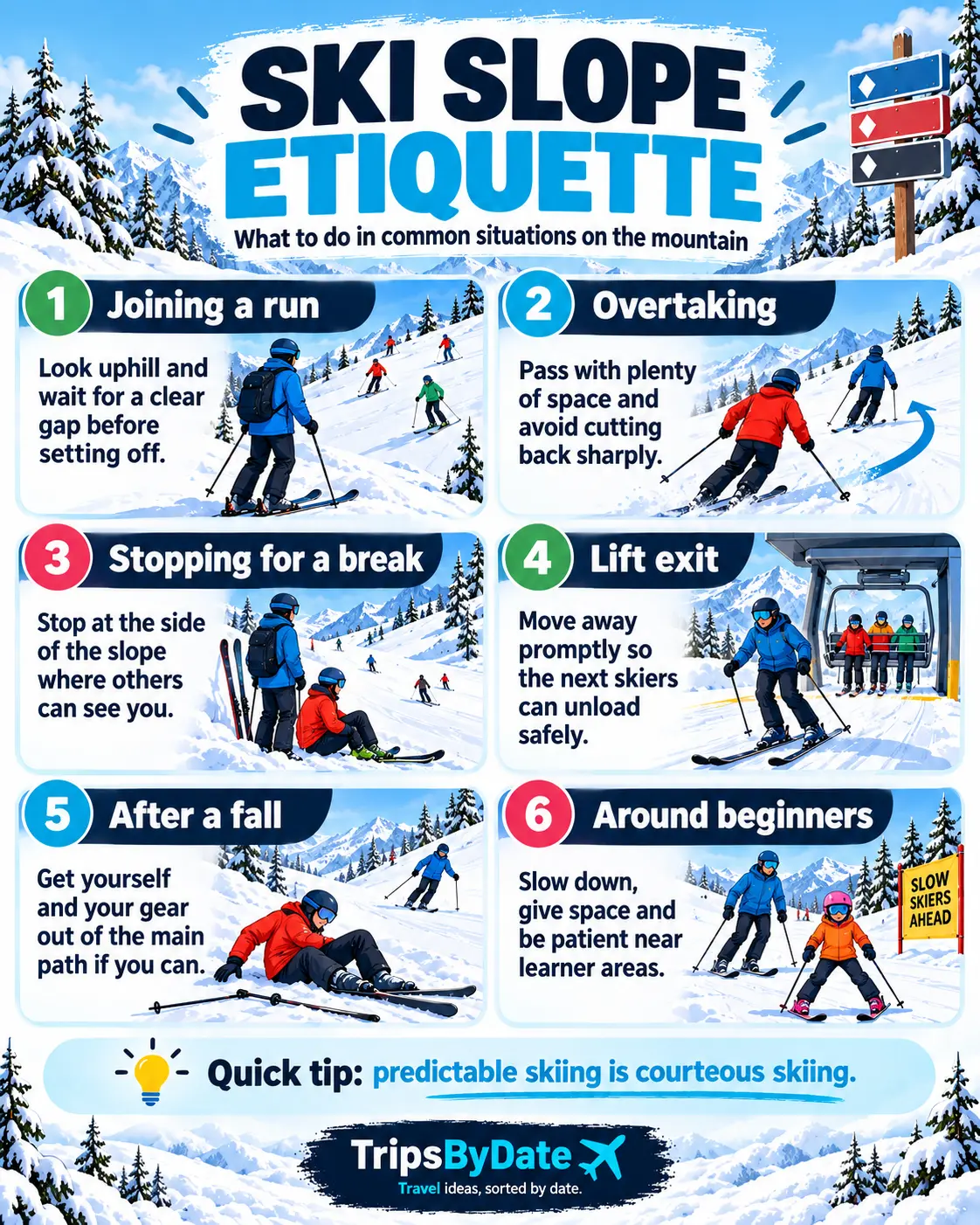
Before pushing off from the side of a piste, joining from another trail or starting again after stopping, check what is happening around you.
This is particularly important on busy runs. Someone travelling downhill may already be moving considerably faster than you.
The FIS code says anyone entering a marked run or starting again after stopping should look both up and down the slope and make sure they can move safely.
Don't: stop where people cannot see you
Need to stop? Move to the side of the piste where you are visible and leave plenty of room for others to pass.
Avoid stopping immediately below a brow, around a blind corner or in the middle of a narrow section. A skier coming towards you may have very little time to react.
If you fall somewhere with poor visibility, move clear as soon as you safely can.
Do: give the skier in front plenty of space
One of the most useful rules to remember is simple: responsibility largely sits with the person approaching from behind.
The skier ahead might turn suddenly, slow down or fall. Your job is to choose a route that gives them enough room.
This matters even more around beginners. Their turns may be wider and less predictable, so give them considerably more space than you think you need.
Don't: cut across someone's path
Technically there is no rule saying you must ski in a perfectly straight corridor. Skiing involves turning across the slope.
But suddenly cutting closely across another skier's line is a good way to create a collision.
Before making a large traverse across a busy piste, be aware of who is approaching and make your movement predictable.
Do: control your speed
Skiing quickly is not automatically bad etiquette. Skiing faster than you can safely control is.
Your speed should suit your ability, the snow conditions, visibility and how crowded the piste is.
A wide empty run on a clear morning is very different from a narrow home run at the end of the day with dozens of tired skiers heading back to the village.
Don't: blast past beginners
Passing another skier is allowed, but leave enough space that they can make an unexpected movement without you hitting them.
That means squeezing past a nervous beginner at speed is unnecessary even if technically there appears to be room.
Give people space. You will lose almost no time and make the slope considerably more pleasant for everyone.
Do: stop at the side of the piste
Sometimes you need to stop to wait for friends, check the piste map or simply give your legs a rest.
Move to a visible position at the side rather than forming a group across the middle of the run.
If several people are skiing together, try not to create a human roadblock while deciding where to go next.
Don't: block lift exits
When you get off a chairlift or gondola, keep moving until you are somewhere safe to stop.
Standing directly at the exit while adjusting gloves, checking phones or waiting for friends creates congestion surprisingly quickly.
Move away first. Regroup second.
Do: keep poles and equipment under control
Lift queues are crowded places full of skis, boards and poles. Be aware of where your equipment is.
Avoid swinging poles around, walking over other people's skis or leaving equipment where people can trip over it.
The same applies outside restaurants and mountain bars: use the ski racks rather than abandoning equipment across paths and entrances.
Don't: ski terrain beyond your ability just to keep up
This catches out plenty of new skiers.
Your friends disappear onto a run that is harder than anything you have skied before and the temptation is to follow them rather than admit you are uncomfortable.
Don't.
Choosing terrain that suits your ability is part of skiing responsibly. There is no prize for reaching the bottom terrified.
Do: help if someone has an accident
If somebody has clearly been injured, do not simply ski past because you assume another person will deal with it.
The FIS code specifically states that skiers and snowboarders have a duty to assist at accidents.
Resorts have their own procedures for contacting piste patrol, so learn the local emergency information for the ski area you are visiting.
Do: pay attention to signs and piste markings
Signs are not decoration.
They can warn about closed runs, dangerous terrain, intersections, slow zones and other hazards. The FIS code requires skiers and snowboarders to respect signs and markings.
Local resort rules also matter and can go beyond the general international guidance.
Know when you can travel?
Pick your departure airport and the dates you are free, then see the ski holidays that actually fit.
Find ski holidays by dateWho actually has priority on a ski slope?
A useful rule of thumb is that the skier further downhill has priority because they generally cannot see what is approaching from behind.
The person coming from above therefore needs to choose a safe route around them and leave sufficient space while overtaking.
But having priority does not mean you can ignore what is happening around you. Everyone still has a responsibility to ski sensibly and predictably.
The official FIS rules
The infographic above is our simple practical version. For the formal guidance, read the International Ski and Snowboard Federation's Code of Conduct for Skiers and Snowboarders.
Read the official FIS Code of Conduct
The Ski Club of Great Britain also provides a useful explanation of the FIS rules for recreational skiers.
Ski Club of Great Britain: on-piste safety
The easiest rule to remember
You do not need to memorise a rulebook before your first ski holiday.
If you stay in control, give other people plenty of room, stop somewhere sensible and pay attention before moving across the slope, you are already doing most of the important things right.
And if somebody is learning, give them a little extra space. Everyone on the mountain was a beginner once.
More help for your ski holiday
Best Ski Resorts for Beginners · Ski Etiquette · What to Pack for a Ski Holiday
‹BACK TO SKIING
Know when you can travel?
TripsByDate works the other way around. Pick your departure airport and the dates you are free, then see the holidays that actually fit.
Find holidays by date