

Warmest Places in Europe in March
Where spring starts early, and how to choose a March getaway that delivers more than a sunny-looking forecast.
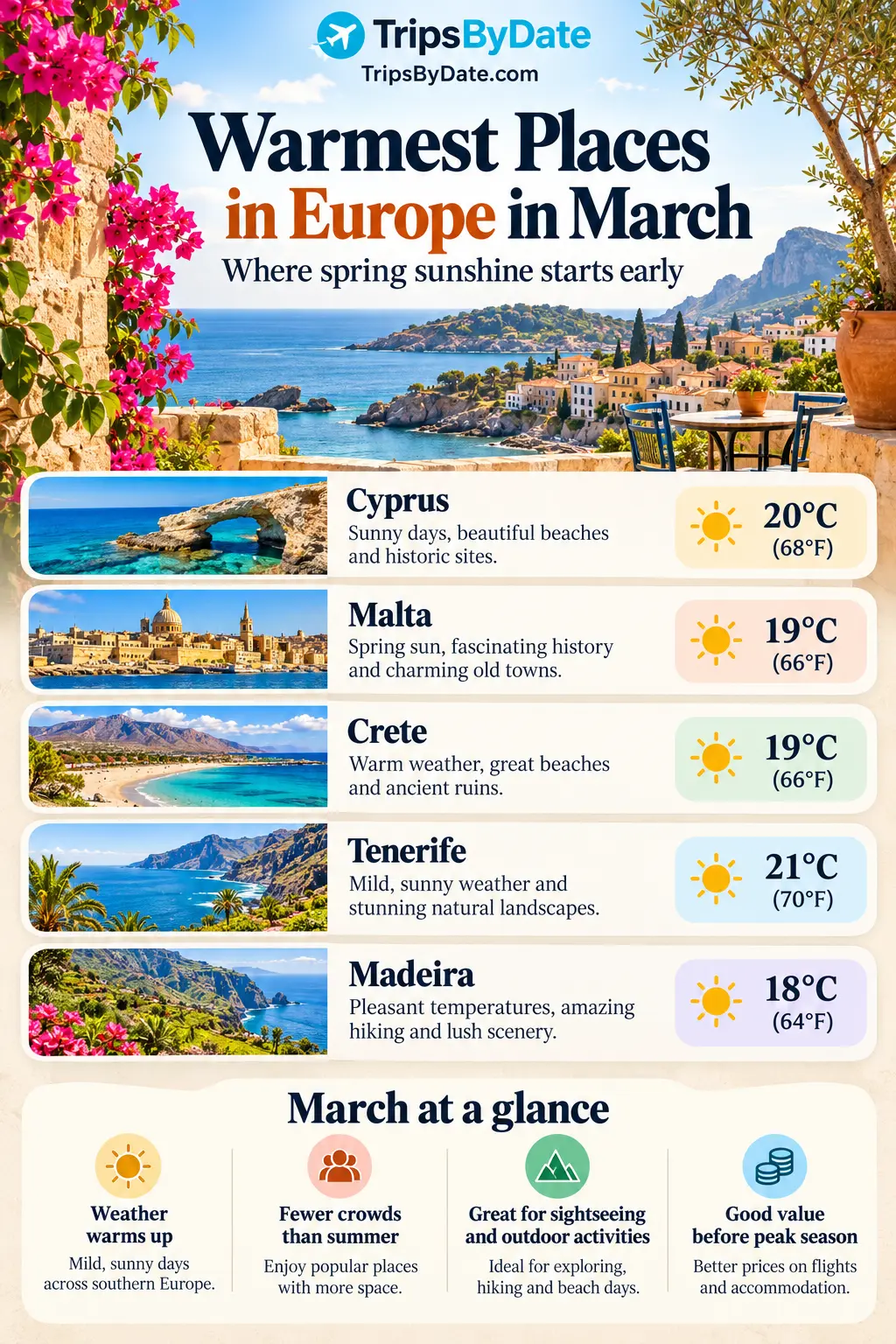
March is an awkward month for holiday planning in the best possible way. Winter is losing its grip, the days are getting longer and several southern destinations are lovely for wandering outside. But the warmest air temperature is not always the best predictor of a good holiday. A 22°C afternoon in a sheltered resort can feel like a beach break; the same number with a cold wind or chilly sea might be better for walking.
The short answer: southern Tenerife is one of the strongest established options for warmth in March. Cyprus, Malta and Crete are increasingly appealing for spring sightseeing, while Madeira excels at landscapes, food and walking. These are different kinds of holidays, not interchangeable promises of summer.
A geographical note: the Canary Islands and Madeira are Atlantic islands geographically off north-west Africa, but are part of Spain and Portugal respectively. Cyprus is geographically in the eastern Mediterranean and often included in searches for European holidays. Here, “Europe” means destinations typically sold and searched as European breaks, not a formal ranking of geographical Europe.
How warm is March, really?
The most useful number is a historical average daily maximum from a named weather station, not the hottest day recorded or a resort advertisement. These figures are not forecasts, and coastal, inland and mountain conditions can vary enormously.
- Tenerife South: 23.1°C average March daily maximum at the airport, according to Spain's meteorological service, AEMET (1981–2010 normals).
- Funchal, Madeira: 20.6°C March average daily maximum, according to Portugal's IPMA (1991–2020 normals).
- Seville: 21.9°C at the airport, a useful warm city-break comparison, although nights are much cooler and this does not imply beach weather.
- Cyprus, Malta and Crete: promising for spring outings, but temperature varies by town and exposure. Their image figures should be treated as illustrative rather than directly comparable official station averages.
Check the underlying AEMET Tenerife South record, IPMA Funchal climate normal and AEMET Seville record. These measurements have different reference periods, so avoid reading a few tenths of a degree as an exact ranking.
Worth knowing: March can have noticeably longer daylight than January even where the afternoon temperature has barely changed. That makes a substantial difference if you want hikes, photography, a café lunch and sightseeing in the same day.
Explore holidays departing on your dates
TripsByDate shows advertised package holidays across its wider inventory. The changing options below are not necessarily Christmas-week departures or packages to these five destinations. Use them as starting points, then compare your own dates and check the final price, availability and festive arrangements with the provider.


 STN • 7 nights
 RO · Hays Travel


 STN • 7 nightsSC · Thomas Cook
 MAN • 7 nightsRO · Hays Travel
 LTN • 7 nightsB&B · Hays Travel
1. Tenerife: the strongest all-round option for March warmth
The reliable reason to put Tenerife high on your shortlist is not that it always beats every other place on every day. It is that its southern coast combines relatively warm historical daytime temperatures with established year-round tourist facilities. A 23.1°C average March maximum at Tenerife South Airport is a useful benchmark, but the weather at your hotel still depends on its position, altitude and exposure.
Where to stay: Costa Adeje offers beaches, family hotels and plenty of restaurants; Los Cristianos has a more town-like harbour setting; Playa de las Américas has a busier resort atmosphere. Rather than choosing any Tenerife hotel, look at how far it is from the coast, whether the pool is heated, and whether the beach is sheltered.
What to do beyond sunbathing: mix beach afternoons with volcanic scenery, coastal walks and a trip to Teide National Park if conditions allow. Temperatures at altitude can be dramatically lower than at the beach. Take extra layers and check park and road conditions before travelling uphill.
The trade-off: the Atlantic remains cooler than a summer Mediterranean sea. If daily swimming is essential, a verified heated hotel pool may be more valuable than a small difference in the forecast high. Use the official Tenerife tourism website for destination planning.
For a different take on spring departures, see Where to Go on Holiday in March and our Best Months for Winter Sun comparison.
2. Cyprus: a promising early spring escape, not guaranteed beach heat
Cyprus is an appealing March choice when you want a mix of archaeology, seaside walks, mountain villages and cafés rather than seven full days of lying on a beach. You might get lovely sunny afternoons, but March is a transitional month. Nights can be cool and spells of rain are possible.
Where to base yourself: Paphos is practical for coastal views and historic sites; Larnaca works well for an easier urban-and-seafront break; Limassol has a lively town base for food and day trips. Choose by the holiday you want rather than assuming that one island-wide weather statistic describes every resort.
A particularly useful March tip: plan at least one inland day. The Troodos region offers a very different landscape from the coast, but its mountain weather can be much colder. The contrast makes Cyprus interesting even when beach conditions are mixed.
The drawback: March sea temperatures are still cool for many swimmers, and not all seasonal beach facilities operate at summer levels. Check hotel opening arrangements, pools and excursions against your actual travel dates. For official destination information and seasonal guidance, start with Visit Cyprus.
3. Malta: spring temperatures that suit history and exploring
Malta can be an excellent March break if you think in terms of cities and coastlines rather than summer resort weather. The compact scale of the islands makes it possible to combine historic streets, museums, harbours and walking routes without spending the whole holiday travelling between places.
Best bases: Valletta has atmosphere and easy access to history; Sliema offers seafront accommodation and connections; St Julian's suits visitors wanting more restaurants and nightlife. For a quieter experience, consider how a Gozo stay compares with frequent ferry trips from the main island.
Build a flexible itinerary: save a calmer day for outdoor spots such as Mdina's streets and Malta's coastal viewpoints; keep churches, museums and long lunches in reserve for windier or rainy spells. A relatively low-key plan often makes better use of March than trying to imitate an August beach itinerary.
The trade-off: wind off the Mediterranean can make a sunny harbour feel cooler than the air temperature suggests. Pack a light waterproof layer, and do not book solely because a photograph shows clear blue water. Look at official Visit Malta guides for attractions and events, and see Best Months for a European City Break for wider timing advice.

4. Crete: an island for culture and scenery before summer
Crete is easy to misunderstand in March. The island's dramatic beaches look inviting in pictures, but much of its greatest March appeal is away from the sun lounger: archaeological sites, cities, villages, food and a landscape turning greener after winter rain.
Where to stay: Chania has a picturesque old town and west-island access; Heraklion is especially useful if Knossos and museums are on the itinerary; Rethymno offers a pleasant historic centre between the two. For March, a town with restaurants and year-round services may be more useful than an isolated summer-only resort.
The smart approach: choose one side of Crete for a short break rather than driving the length of this very large island. Check the actual opening hours of attractions and the frequency of local transport, especially outside peak season.
The drawback: early spring weather is variable and the sea is cool. If you want hot weather and classic beach-club days, later in the year is a stronger fit. Greece's official tourism portal offers Crete destination information; our Best Months to Visit Greece guide explains the broader seasonal trade-offs.
5. Madeira: perhaps the best March choice for scenery and active days
Madeira is not a conventional sandy-beach destination, and that is precisely why it can be such a good March holiday. Funchal's official March average daily maximum is 20.6°C, but the island's steep elevation changes mean that the coast, forests and mountains can experience completely different conditions on the same day.
Where to stay: Funchal is a practical base for restaurants, accommodation and excursions. Travellers renting a car may prefer different parts of the island, but should take mountain roads, parking and driving conditions seriously. Do not assume a short straight-line distance means a quick trip.
Important booking update: Madeira's official classified hiking trails require advance reservations, with timed slots and applicable fees. The tourism board also posts each trail's open, restricted or closed status. Check Visit Madeira's hiking and reservation guidance before planning your days; weather can close routes at short notice.
The trade-off: low cloud and mountain rain can spoil a high viewpoint on a day when Funchal is pleasant. Build two possible versions of each outdoor day, one coastal and one elevated, then choose using local conditions. Read Best Months to Visit Portugal for the wider comparison.
A surprising alternative: Seville for warmth without a beach holiday
If your priority is pleasant afternoon temperatures rather than being beside the sea, consider Seville. AEMET records a March average daily maximum of 21.9°C at Seville Airport. That is comparable to several island destinations, but the experience is completely different: long walking days, tapas, gardens and major historical sights.
The important distinction is the daily temperature range. Seville's March average minimum is just 9.2°C, so pack for cool mornings and evenings even if daytime is warm. Official AEMET climate records show why daytime warmth alone can be misleading.
If you only have three or four days, a city may deliver more satisfying warm-weather experiences than a beach resort in early spring. That is especially true if you would otherwise spend several days waiting for conditions suitable for swimming.
How to choose your March destination in 60 seconds
- You want the closest thing to a winter beach holiday: start with southern Tenerife, then check the specific resort, sheltered beaches and pool heating.
- You want history with mild afternoons: compare Malta and Cyprus. Both reward an itinerary with indoor options.
- You want scenery and hiking: Madeira stands out, provided you book official trails and respect mountain weather.
- You want Greek food, towns and culture: look at Crete, while accepting that beach-resort services may still be quiet.
- You want a short, warm-ish city break: Seville is worth checking alongside Mediterranean islands.
Try this test: write down the three things you most want to do. If two of them need hot seawater, March may simply be too early for the European holiday you have in mind. You may enjoy a later European beach holiday much more.
Know when you can travel?
Choose your departure airport and compare upcoming holidays by date, without deciding on one destination before you see the options.
Find holidays by dateSeven small checks that can save a disappointing March holiday
- Look at maximums and minimums: a pleasant daytime high can hide cold evenings. Check both before you pack.
- Ask whether the pool is heated in March: it is not enough for a hotel to advertise an outdoor pool or to heat it only in some weeks.
- Read the beach conditions: sea temperature, wind, swell and shelter matter more than postcard colours.
- Confirm what is open: seasonal restaurants, excursions, kids' clubs and direct flights can have limited timetables before summer.
- Use a central base for short stays: a cheaper hotel far from cafés or attractions can mean extra transport costs and wasted time.
- Compare total trip prices: include baggage, transfers, meals, local transport and any trail or attraction fees. See Cheapest Months to Go on Holiday.
- Check travel advice and weather nearer departure: requirements and local conditions change. Start with UK government country-by-country advice and the destination's official weather service.
Is March actually cheaper?
It can offer value outside major holiday periods, but March is not automatically a bargain. Popular Canary Islands hotels still attract winter-sun demand, while some Mediterranean resorts reduce opening hours before the summer season. The cheapest hotel is not always the best-value holiday if nearby restaurants are closed or you need a hire car for every outing.
Compare the same trip length on more than one departure date and from more than one practical UK airport. Then check accommodation location and the total price rather than relying on a headline offer. If your dates are flexible, comparing early and late March can be worthwhile, but neither period is guaranteed cheaper.
Frequently asked questions
Where is warmest in Europe in March?
Southern Tenerife is a strong established winter-sun option, with an official March average daily maximum of 23.1°C at Tenerife South Airport. This is not a comprehensive ranking of every place in geographical Europe, and the warmest location on your travel dates may differ.
Is Cyprus warmer than Tenerife in March?
Cyprus can have comfortable, sunny spring days, but the March image's ordering should not be read as proof that Cyprus is hotter. Tenerife South has a verified historical average daily maximum of 23.1°C. Compare named weather stations and similar measurement periods before making precise claims.
Can you swim in Europe in March?
Some travellers swim in March, but the sea remains cool at many European beach destinations, including the Mediterranean and the Canaries. If comfortable swimming is essential, check current sea conditions and choose a hotel with confirmed pool heating.
Is Malta a good March holiday?
Yes, particularly for food, history, walking and a short cultural break. It is not a dependable hot-weather beach holiday, and you should plan for wind and possible rain.
Is Madeira warmer than the infographic suggests?
The graphic gives a single illustrative 18°C figure. IPMA's 1991–2020 climate normals put Funchal's March average daily maximum at 20.6°C. Madeira's mountains can still be much colder and wetter than Funchal.
Which destination is best with children?
For a resort-focused trip, southern Tenerife may be the easiest of these options to plan because there are established hotels, restaurants and facilities. Check pool heating, the child's activities and journey times rather than assuming warm weather alone makes a family holiday. See Best Months for a Family Holiday.
Should I wait until April?
If your priority is Mediterranean beaches and warmer afternoons, April may offer a better choice, although the sea can still be cool. For walks, archaeology and less intense sightseeing conditions, March can be excellent. Compare Where to Go on Holiday in April before deciding.
More March and winter-sun guides
Where to Go on Holiday in March · Warmest Places in Europe in February · Best Months for Winter Sun · Best Months to Visit Greece
‹ BACK TO HOLIDAYS BY MONTHKnow when you can travel?
TripsByDate starts with your airport and available dates, then lets you compare holidays that fit instead of searching destination by destination.
Find holidays by date