

Best Months for a European City Break
Find the sweet spot for sightseeing, food, festivals and memorable weekends, without automatically choosing the busiest or hottest dates.
April, May, September and October are excellent starting points for many European city breaks. You can often spend longer outdoors without the intensity of midsummer heat, and cities tend to have plenty happening. But that answer changes if you want Christmas markets, summer festivals, museum-heavy days or the lowest possible price.
A great city break is not simply a famous place with a cheap flight. It is a destination you can actually enjoy in the time available: comfortable enough to explore on foot, with convenient transport, attractions you can get into and accommodation that leaves money for meals and experiences. This guide explains when to go, which cities fit different seasons, and the details that can make or break a two- or three-night trip.
Best months for a European city break at a glance
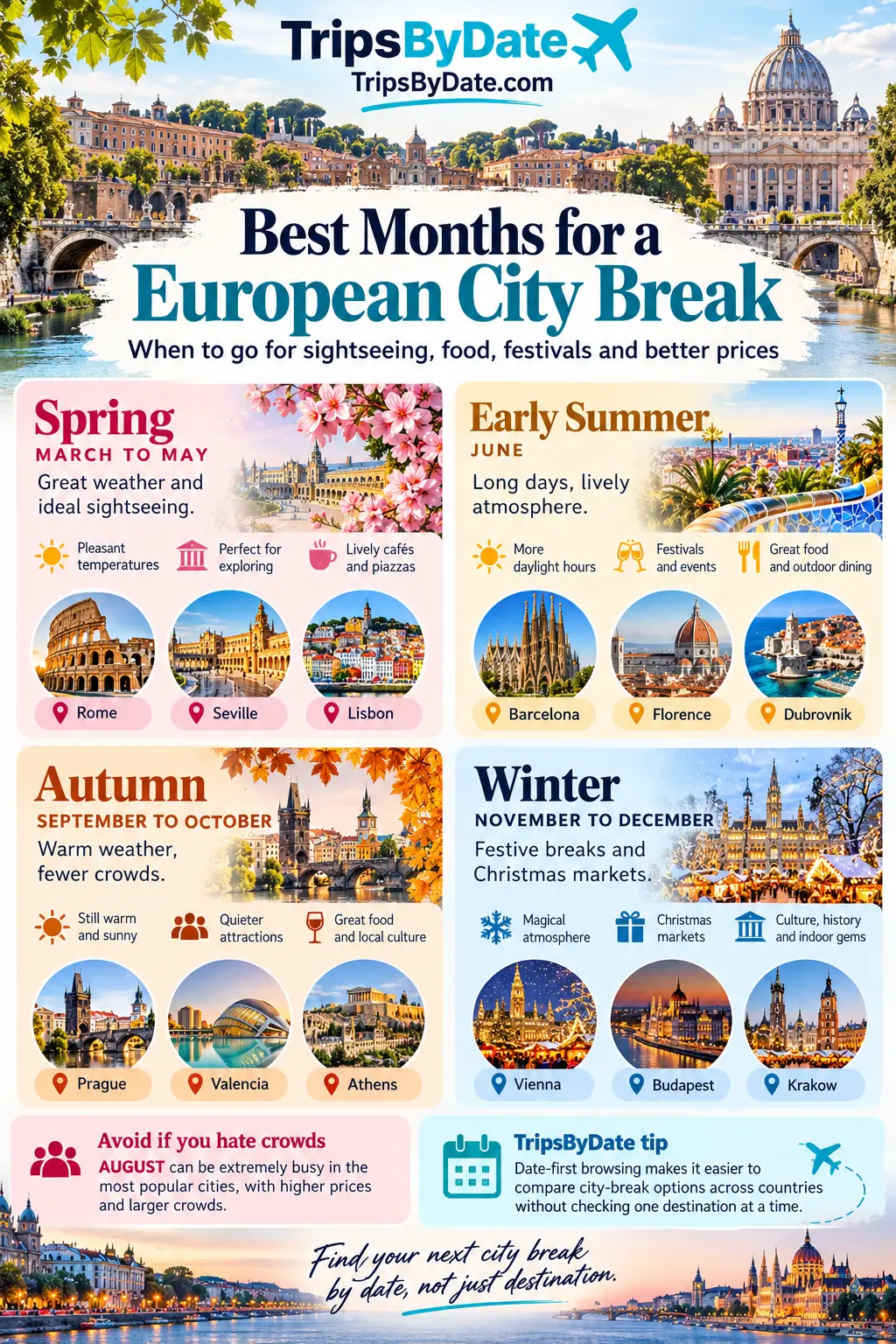
- March to May: excellent for walking-focused sightseeing in Rome, Lisbon and Seville, with spring weather but some variable days.
- June: long evenings and outdoor life in Barcelona, Florence and Dubrovnik, although heat and crowds are already building.
- September to October: strong choices for Prague, Athens and Valencia, with autumn atmosphere and often more comfortable sightseeing.
- November to December: attractive for Vienna, Prague, Budapest and Kraków when festive markets, cafés and indoor culture are the main attraction.
- January to February: worth comparing for museum and food trips, if you accept shorter days and potentially cold or wet conditions.
These are recommendations, not fixed rankings. Major festivals, school holidays, conferences, public holidays and specific weekends can turn a normally quiet month into an expensive one. For price-focused planning, see our guide to the cheapest months to travel.
Explore upcoming holidays
Here are examples from our current package-holiday inventory across operators, dates and destinations. They are not filtered to city breaks or to the months recommended here. Use them as inspiration, then compare your own departure airport and available dates. Prices and availability change.



 EWR • 4 nights
 AI · CheapCaribbean

 LGW • 7 nightsSC · TUI
 STN • 7 nightsB&B · Olympic Holidays
 STN • 7 nightsB&B · Olympic Holidays
Spring city breaks: March, April and May
Spring is often the easiest season to recommend to people who want to spend most of the day exploring. You can mix museums with squares, markets, neighbourhood walks and outdoor dining without automatically planning around extreme heat. The trade-off is variable weather, especially earlier in the season. Pack layers and treat a rain-friendly museum as part of the itinerary, not an emergency backup.
Rome: choose walkable weather, then secure your tickets
Rome rewards wandering, but its highlights are spread across busy streets, large archaeological sites and neighbourhoods where you may stand outside for long periods. April and May are appealing if your ideal day combines the Colosseum, piazzas, churches and a long dinner. March can also work if you are happy with cooler evenings and the possibility of showers.
Practical advantage: staying around the historic centre makes a short visit easier than staying far out and spending precious time commuting. But compare hotel prices against the cost of a central location; a property close to a metro stop can also work well.
Booking trap: do not book flights assuming you can walk straight into the Colosseum at your preferred hour. The official archaeological park requires a reserved entry slot for Colosseum visits, and standard ticket sales open 30 days before the visit. Different ticket types have different rules. Check official Colosseum ticket and opening information. A sensible approach is to plan the one or two sights that need timed admission first, then leave room to explore.
Seville: a lesson in why the month matters
Seville is lovely for tapas, courtyards, architecture and evenings outdoors, but summer changes the experience dramatically. Spain's official AEMET climate normals put the city's average daily maximum at 23.4°C in April, 27.2°C in May and 36.0°C in July. Those are historical averages at Seville Airport, not forecasts or the hottest temperatures that can occur. See AEMET's Seville climate table.
That is why April or May can be more rewarding than July for someone who wants to walk from the cathedral area to Plaza de España and stop for lunch along the way. But spring is not automatically quiet: Semana Santa and the Feria de Abril can create enormous demand, and their dates vary. Check the current year's official event calendar before assuming you have found an inexpensive weekend.
Lisbon: views, food and hills require the right pace
Lisbon suits people who enjoy a city that unfolds over viewpoints, trams, tiled streets and neighbourhood restaurants. April and May can provide an excellent balance, while early autumn is another strong choice. A good itinerary is not about visiting every landmark; it is about allowing time to move between steep streets, enjoy the waterfront and actually stop for coffee.
Consider where you stay: Baixa is convenient for first-timers and central connections; Chiado works well for restaurants and central exploring; areas farther up the hills can be atmospheric but less suitable if mobility or luggage is a concern. Comfortable shoes matter more here than squeezing in another attraction. See our March and May travel guides for more spring options.
June city breaks: longer evenings, but pick the city carefully
June gives you long days for late dinners, riverside walks and sightseeing after work on arrival day. That can be particularly valuable on a three-night trip. Yet it can already be quite hot in Mediterranean cities, and popular sights may be busy well before July and August.
Barcelona is a good all-round option if you want major architecture, neighbourhood cafés and a beach in the same trip. Pre-book the Sagrada Família through its official ticket pages rather than counting on last-minute entry. Decide whether you genuinely want a beach afternoon: the coast is an enjoyable extra, but Barcelona is still a substantial city that deserves its own sightseeing time.
Florence is extraordinary for art, architecture and food, but compact streets and limited shade can make hot afternoons tiring. Build the day around one major gallery or museum, some time outdoors and a proper break rather than trying to see everything in a single afternoon.
Dubrovnik is visually spectacular, but the Old Town is relatively compact and can become intensely busy with cruise visitors and day-trippers. For a short break, investigate arrival times, accommodation access and whether you prefer an early start or a later walk after the busiest hours. Do not assume June is crowd-free. For wider travel inspiration, see where to go in June.
September and October: the autumn sweet spot
Autumn is an excellent time to compare southern and central European cities side by side. In warmer places, sightseeing can feel easier than in high summer. In central Europe, café culture, architecture, changing leaves and cooler walks become part of the experience. But September can remain busy and expensive, so it is not necessarily a budget month.
Athens makes sense if ancient sites are the centre of the trip. Earlier starts and cooler months can make climbing around exposed archaeological areas more comfortable. Combine the Acropolis with neighbourhood eating and a museum visit rather than building an itinerary consisting only of outdoor ruins.
Valencia is a useful alternative to the biggest headline cities. It combines a historic centre, the Turia gardens, modern architecture and access to the sea. It suits people who want a relaxed mix of walking, markets, culture and food rather than a schedule of back-to-back ticketed landmarks. It is still important to check local event dates and accommodation prices.
Prague is rewarding in autumn for the historic core, bridges and neighbourhood cafés, although its celebrated central streets can be busy in any season. If you have time, explore beyond Old Town Square rather than experiencing the whole city as one crowded visitor corridor. Prague City Tourism's official event listings are particularly useful for checking what is actually happening during your dates.
For more choices, see our September and October holiday guides.

Know when you can travel?
Compare your dates and departure airport across different cities, instead of deciding on the destination before you know what fits.
Find holidays by dateNovember and December: choose the experience, not the weather
Winter city breaks work best when you embrace what winter offers: illuminated streets, museums, atmospheric restaurants and Christmas markets. They work less well if you expect the long daylight hours and outdoor cafés of June. Before booking, check whether your trip falls before, during or after a specific festive event.
Vienna is a standout for ornate architecture, cafés, museums and Christmas markets. Its main Rathausplatz market is listed by the official tourism board for the 2026 season through 26 December, while some other markets end earlier and some continue later. Check Vienna's official market-by-market calendar. A trip arriving after Christmas could feel quite different from one in early December.
Prague has a particularly attractive historic setting for winter evenings. Prague City Tourism lists the 2026 Old Town Square Christmas market from 28 November to 6 January 2027. That does not mean every smaller market follows the same schedule. Verify individual markets on the official city events website.
Budapest is worth exploring for architecture, cafés and thermal baths; Kraków is another strong option for historic streets, food and cultural attractions. Both can be very cold, especially at night. Verify the specific opening dates of Christmas markets, baths, museums and restaurants rather than assuming everything operates normally on 24–26 December or New Year's Day.
For a different kind of December holiday, explore our December destination guide.
Is August a bad month for a European city break?
Not universally. August can be brilliant if you enjoy warm evenings, outdoor events and combining a city with a beach. But in some cities, sightseeing in the midday heat is difficult and central attractions are crowded. Some locally focused businesses may also alter hours during holiday periods.
The bigger mistake is treating all European cities alike. A coastal city with breezes, swimming options and plenty of evening life behaves differently from an inland city with exposed monuments and little shade. Seville's historical July daytime maximum of 36°C is a useful warning about planning a walking holiday during intense summer heat. If August is your only option, schedule outdoor sights early, reserve key attractions and choose accommodation with effective cooling.
How to choose a city that works for a two- or three-night trip
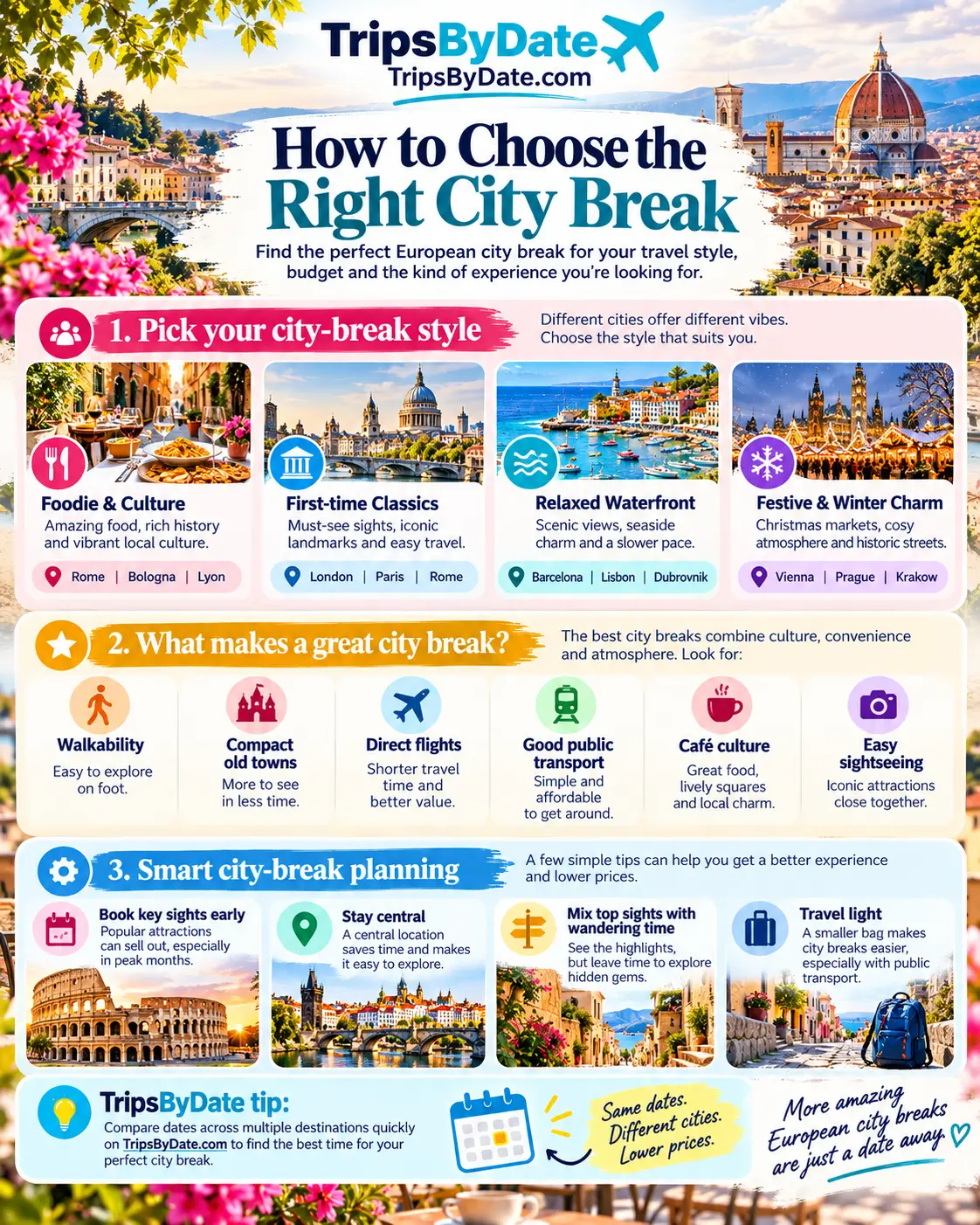
A cheap flight is not automatically a cheap or satisfying break. For a shorter trip, use these checks before booking:
- Door-to-door travel: compare the journey to your UK departure airport, arrival airport transfer, check-in times and the journey home. A flight landing very late can eat into a two-night stay.
- Location: a hotel a long commute from the centre may save money but cost time and transport fares. Compare the total rather than the nightly rate alone.
- One anchor attraction: if seeing the Colosseum, Sagrada Família or a major gallery is the reason for the trip, check ticket availability before committing.
- Walkability and access: cobbles, hills, steps and large museums can be tiring. Check accessibility and local transit if anyone in the group needs it.
- Weather-proof plans: one substantial indoor option gives you a good day even if it rains.
- Events and local holidays: a festival may make the trip special but also raise hotel prices, limit restaurant availability or disrupt transport.
A useful two-night plan: spend the arrival evening exploring one neighbourhood and having a meal; book one major sight the next morning; leave the afternoon open for cafés, streets and smaller discoveries; then use departure day for something near the airport transfer route. A third night creates much more breathing room. TripsByDate also has two-night and three-night trip guides, which explore the trade-offs of short breaks.
When are European city breaks cheapest?
There is no single cheapest month. Winter weekdays outside festive dates can be worth comparing, as can quieter dates in late autumn or early spring. But a major trade fair, football match, festival, school break or conference can push hotel prices up in an otherwise quiet period. Equally, a last-minute deal in a popular month can beat an ordinary low-season fare.
Compare the total trip cost: flights, luggage, airport transport, accommodation, attraction tickets and public transport. For a two-night trip, a cheaper departure at an awkward time may provide so few usable hours that it is poorer value than a slightly dearer, better-timed flight. Compare the same nights and hotel standard across nearby dates and more than one UK airport where practical.
For more detail, read Cheapest Months to Go on Holiday, which explains why price patterns are not guarantees.
Two planning details many people miss
1. Some cities have extra visitor rules. Venice, for example, operated a day-visitor access-fee scheme on selected dates in 2026. Whether it applies to your future trip, who is exempt and how it is paid should be checked with the City of Venice's official access-contribution information. Do not assume last year's scheme applies unchanged.
2. Entry requirements are not identical across Europe. For UK passport holders, the UK government explains the Schengen 90-days-in-180 rule and passport requirements. Check the current official UK guidance, plus the individual country travel advice, before departing. Be wary of unofficial sites claiming you must immediately pay for future travel authorisations.
Frequently asked questions
What is the best overall month for a European city break?
May and September are excellent starting points for many travellers, because they often balance outdoor sightseeing with comfortable weather. They are not consistently the cheapest or least busy, and the right choice depends on the city and its event calendar.
Which European cities are good in winter?
Vienna, Prague, Budapest and Kraków suit travellers interested in historic streets, culture, cafés and festive experiences. Expect short days and cold weather. Confirm the opening days of the attractions or markets you specifically want to see.
Which cities are better in spring than summer?
Seville is a particularly clear example because historical summer temperatures are much higher than in spring. Rome and Athens can also be more comfortable for long, exposed outdoor sightseeing days outside the hottest part of summer.
Is October too late for a city break?
Not at all. October can be excellent for food, museums and exploring places such as Valencia, Rome or Athens. Bring layers and allow for shorter days and a greater possibility of rain than in midsummer.
Should I choose the city or the dates first?
If there is a once-in-a-lifetime event or particular attraction you must see, choose the city and confirm the dates of that experience first. If you mainly want a good weekend away, starting with the dates you can travel gives you more freedom to compare several cities and find the most enjoyable option within your budget.
More month-by-month travel inspiration
Explore our guides to March, April, May, June, September, October and December. The best city break is the one that works with your available time, interests and budget, not merely the month with the prettiest weather forecast.
‹ BACK TO HOLIDAYS BY MONTHKnow when you can travel?
Choose your airport and dates, then compare holidays across destinations. Less searching. More choosing.
Find holidays by date