

Best Months for a Beach Holiday in Europe
Choose the right month for swimming, sunshine, quieter sands and a holiday that suits your budget, not just the temperature on a weather chart.

For many European beach destinations, June and September offer an appealing balance of warm weather and a holiday that is easier to enjoy outside the busiest weeks. July and August generally bring the fullest summer atmosphere and warmer seas, but also more heat, crowds and competition for accommodation. May and October can be excellent, provided you choose the right coast and know whether you want a beach to sit on or a sea to swim in.
The key is that air temperature, sea temperature, wind and resort season are four different things. A gorgeous sunny afternoon in Portugal can still mean a bracing Atlantic swim. A milder October day in Cyprus can come with warmer seawater than a hot May day. This guide explains the differences and helps you decide when and where to go.
At a glance: when is best for a European beach holiday?
- April–May: appealing for coastal walks, sightseeing, sunbathing on suitable days and quieter beaches; swimming can feel chilly.
- June: an excellent all-round choice for summer resort facilities and sunshine before much of the UK school-holiday peak.
- July–August: the classic choice for heat, active resorts and warm Mediterranean swimming; not automatically best for comfort or value.
- September: a particularly strong option for adults who value warm seas and a potentially calmer atmosphere.
- October: worth considering for Cyprus, the Canary Islands and parts of southern Turkey, but check rainfall, wind, flight schedules and resort closures.
Important: these are seasonal starting points, not guarantees. Prices and weather vary considerably by destination, week and year. For detailed trip ideas, see our May, June and September holiday guides.
Explore upcoming holidays
These are examples from our current package-holiday inventory across available operators, dates and destinations. They are not filtered to beach resorts or specific months and should not be treated as a ranking of the cheapest offers. Use them for inspiration, then search by your own airport and dates. Prices and availability can change.


 LTN • 5 nights
 HB · Skiline

 LGW • 7 nightsHB · Neilson
 STN • 7 nightsRO · Hays Travel
 LGW • 7 nightsHB · Skiline
Why the warmest month may not be the best beach month
When you picture a beach holiday, you may think only about daily highs. But comfort can change completely when a destination is humid, exposed to strong breezes or busy enough that sunbeds and restaurants need planning. Equally, a quieter month may be perfect for people who enjoy sitting by the sea but unsuitable for children who expect hours swimming.
Spain's official meteorological agency, AEMET, reports average daytime maximums at Palma de Mallorca Airport of 28.1°C in June, 31.3°C in August and 27.9°C in September. That makes September substantially less intense than August on this measure, while still typically summery. These are historical climate averages for the airport, not a forecast for a specific beach or holiday. Check the official AEMET climate table.
For a couple who wants restaurants, walks and a swim every day, September might be the more satisfying choice. For a family restricted to the main summer school holidays, July or August may make more sense. Neither is universally "best".
April and May: early sunshine, with realistic swimming expectations
Southern Europe starts to feel like summer before its seas do. April is often better for enjoying uncrowded coastal towns, outdoor lunches, viewpoints and sandy walks than for a dedicated swimming holiday. May brings longer sunny spells and more operating resorts, particularly as the month progresses, but sea temperatures often lag behind air temperatures.
Where to investigate: Cyprus, Crete, Mallorca and the Algarve. They serve different purposes. Cyprus can already feel quite warm inland or in the afternoon; Crete can be lovely for combining ruins, villages and coastal stops; Mallorca has a broad mix of family resorts and scenery; the Algarve offers spectacular cliffs and long beaches but Atlantic water can still feel chilly.
Cyprus's official tourism climate table gives a May mean maximum of 25.3°C on the Limassol coast, yet an average sea temperature of just 17.8°C. That is the difference between enjoying lunch in warm sunshine and expecting a long, comfortable swim. See Cyprus's official monthly air and sea temperatures.
Best for: people who care as much about walking, exploring and relaxed meals as they do about the beach itself. Before booking a May family holiday, check whether the hotel pools are heated and whether kids' clubs, beach facilities and water parks have opened.
June: the strongest compromise for many UK travellers
June is when much of the Mediterranean has settled into a proper summer rhythm. More seasonal hotels, boat trips and beach businesses are operating, days are long and the high summer rush has not reached its full intensity in many destinations. Swimming usually becomes more inviting, especially later in the month.
Consider: Mallorca for accessible sandy beaches and resort variety; Rhodes and Crete for combining swimming with historic towns; the Turkish coast for established resort facilities; and Sardinia for spectacular coves if you can handle potentially costly transport and accommodation.
There is a catch for value hunters: an early-June resort holiday and a late-June resort holiday can price very differently, and destination-specific school calendars can affect demand. If your dates are flexible, compare the same hotel across several departures rather than assuming the entire month is low-priced.
Best for: couples and adults seeking the classic beach experience without automatically choosing the hottest or busiest weeks. See our complete June destination guide for practical choices.
July and August: hot weather, warm water and the busiest beach scene
Summer is at full strength in the Greek islands, Balearics, Croatia, southern Italy and Mediterranean Turkey. These months can be ideal if your holiday means hours in the water, long evenings and a lively resort where almost everything is open. But it is worth asking whether you need maximum heat or merely reliable summer conditions.
In August, Cyprus's official figures show an average 25.5°C sea temperature at Limassol and a coastal mean maximum of 31.2°C. Inland locations can be considerably hotter. For visitors sensitive to heat, plan sightseeing in the morning and choose accommodation with effective cooling and shade.
Popular coves can fill early, coastal roads can become congested and the best family rooms may command a premium. On island destinations, a beach that looks close on a map may involve a winding road, steep steps or a boat. Check the actual walk, not just the distance in kilometres.
Best for: travellers prioritising warm seawater, full resort facilities and school-holiday timing. For more nuanced suggestions, read our July and August guides.
September: the overlooked advantage of a sea that has spent all summer warming up
September is more than a cheaper version of August. In many Mediterranean destinations, seawater retains warmth accumulated over summer even as average daytime temperatures ease. That can make swimming feel especially enjoyable without the peak-summer heat. It is a useful distinction for people who enjoy the sea more than sunbathing in extreme temperatures.
Cyprus's official climate data puts September's coastal mean maximum at 29.5°C and the sea at 24.2°C. This is still a hot beach month in many coastal locations. Meanwhile, Mallorca's September average maximum at the airport falls below its August figure, though its September rainfall average rises. Autumn brings trade-offs, not a guarantee of perfect skies.
Strong candidates: Crete, Rhodes, Mallorca, Cyprus, Malta and parts of southern Turkey. On some islands, a late-September stay can feel noticeably quieter, but very popular destinations remain busy and the weather becomes more changeable as autumn advances.
Best for: couples, independent travellers and anyone who values a warm sea more than the school-holiday calendar. See where to go in September for more location-specific ideas.

Know which dates you can travel?
Start with your departure airport and available dates, then see which holidays fit across destinations instead of searching one beach at a time.
Find holidays by dateOctober: an extra beach month, but only in the right places
October should not be written off, particularly for travellers who do not need the hottest days. But a European October beach holiday is more destination-dependent than one in July. Cyprus, the Canary Islands and parts of southern Turkey deserve attention, while many more northerly Mediterranean resorts are winding down.
Cyprus is a striking example of seasonal lag: its official average October sea temperature is 23°C, much warmer than May's 17.8°C. The October mean coastal maximum is 27.2°C, though rainfall becomes more likely than in summer. For a traveller who loves swimming, this could be a stronger bet than a seemingly sunnier May trip.
The Canary Islands can offer pleasant beach days across more of the year, but Atlantic swell, wind, local geography and individual beaches all matter. A hotel's heated swimming pool may be a better reason to book than a broad claim of "year-round beach weather".
Before booking: ask whether hotel pools are heated, whether beach clubs are still operating, whether your intended excursions run in late October and whether direct flight options change. Read our October holiday guide for the wider picture.
Atlantic versus Mediterranean: one of the biggest booking mistakes
The Algarve and Canary Islands can look every bit as inviting as Greece or Cyprus in holiday photography, but they face the Atlantic. Air temperatures alone tell you very little about how the water will feel. Atlantic coasts may experience cooler water, swell and locally stronger currents even when the sand is hot.
The Mediterranean is generally more sheltered geographically, though this does not make every cove safe or calm. An exposed rocky beach can still have difficult conditions; a sheltered Atlantic bay can be delightful on the right day. Choose an individual beach based on its orientation, seabed, lifeguard provision and current conditions.
UK government guidance for Portugal specifically warns of unpredictable waves, rip currents and falling rocks near some Algarve cliffs. Read the official Portugal beach-safety advice. Beach photography rarely shows the conditions that matter most to swimmers.
Choose the actual beach, not just the destination
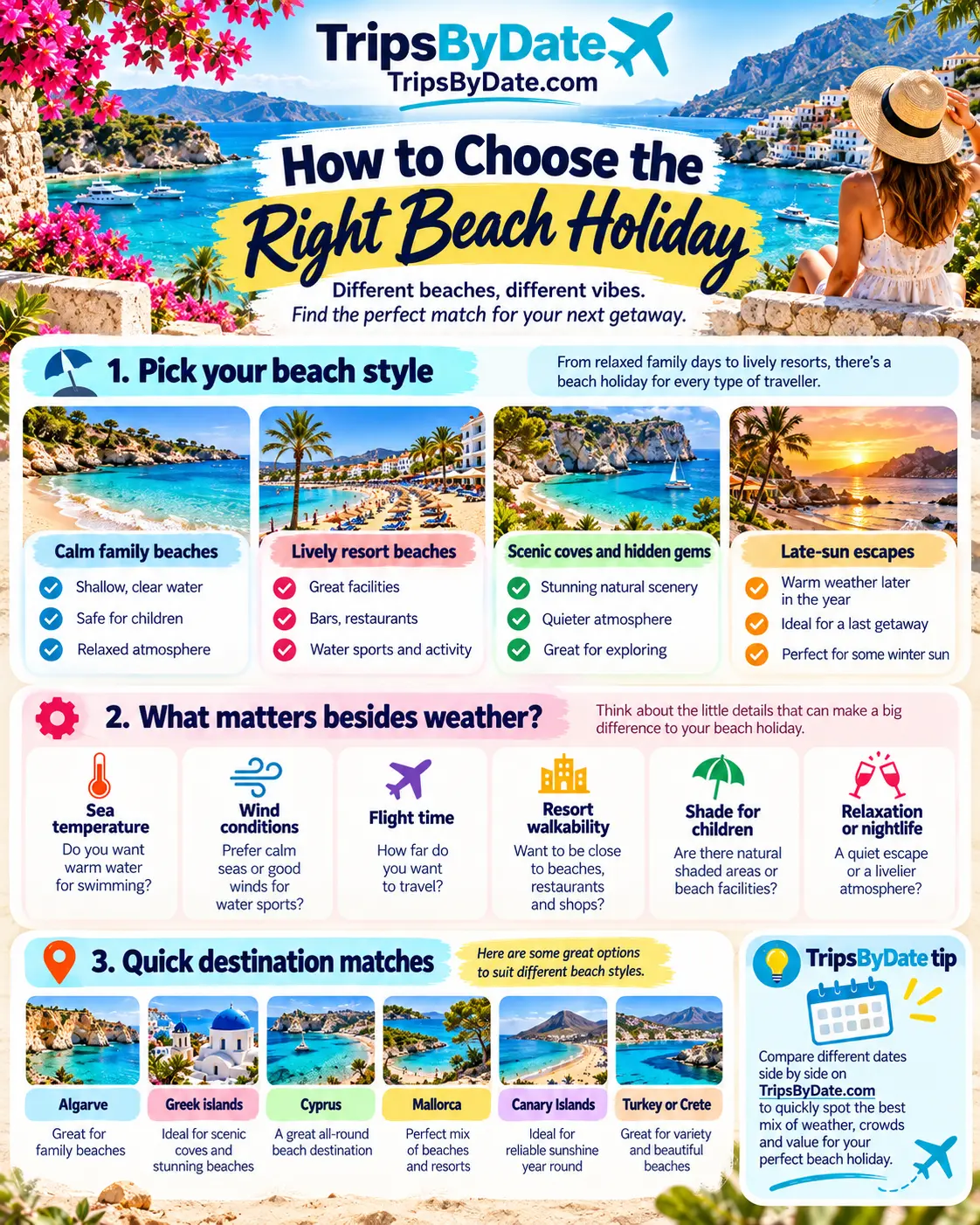
Two beaches on the same island can offer completely different holidays. A sheltered sandy bay near shops and restaurants is not interchangeable with an isolated pebble cove requiring steep steps. Before choosing a resort, check these details:
- Beach access: sand, pebbles, rocks, steps or a long walk from the hotel? Is there shade along the route?
- Entry into the water: gentle sandy slope or a sudden drop? Suitable for your group's confidence and swimming ability?
- Wind and surf: is the bay sheltered from the typical prevailing wind, and are there lifeguards?
- Facilities: toilets, shade, drinking water, showers, cafés and accessible routes? Are they open on your travel dates?
- Transport: can you walk there, or will every beach day require parking, a bus or a taxi?
- Actual swimming quality: do not confuse clear-looking water with independently monitored water quality.
For that final point, the European Environment Agency's bathing-water map lets you check individual monitored coastal and inland sites. Its 2025 assessment found that 85% of monitored EU bathing-water sites were classified excellent; that is useful context, but it does not replace checking the specific beach and any current warnings. See the full EEA assessment.
Which month is best for families?
For most families, the right answer starts with school holidays and the children's ages. July and August are often the practical choice, but that does not make the biggest and busiest resort the best one. Prioritise a beach with a gentle entry, shade, lifeguards when available, nearby facilities and a transfer time your family can manage. Check whether the hotel room configuration really fits everyone, not only the headline occupancy.
For babies and toddlers, extremely hot days may be less enjoyable than a comfortably warm period with a good pool and easy indoor breaks. For older children who spend hours in the sea, warmer water and reliable resort facilities may make high summer worth the premium. The Met Office reminds travellers that UV exposure can be high even when it does not feel especially hot. Read its practical beach and sun safety guidance.
If you are travelling outside school holidays, compare late May, June and September, but check that your preferred hotel's children's clubs and pools are actually operating. There is little value in paying less for facilities that are closed.
When will you find the best value?
There is no universal cheapest beach month. May, early June and September can be useful comparison windows for some Mediterranean resorts, but school holidays, local events, hotel demand and flight availability all change the answer. An October bargain at a resort with no restaurants open is not necessarily better value than a June trip that works perfectly.
Compare like for like: the same number of nights, travellers, baggage allowance, airport transfers, board basis and hotel location. A cheaper package with inconvenient flights can leave you with far less usable holiday time. And a remote hotel may turn the savings into taxi bills.
Our guide to the cheapest months to go on holiday explains how to compare dates properly, while Holidays by Month helps you explore seasonal destinations in more detail.
Five practical steps to choose your beach holiday dates
- Decide what you will actually do: swimming, lying in the sun, watersports, sightseeing or a combination. That determines how important sea warmth really is.
- Choose your weather tolerance: some people prefer 25°C days; others want over 30°C. Check typical highs and rainfall, not just a sunshine icon.
- Check the individual beach: exposure, access, sand versus shingle, safety flags and nearby facilities matter more than glossy resort photographs.
- Compare several feasible dates and airports: look at the full package cost and available resort facilities, not an assumed cheap month.
- Confirm details with the operator: TripsByDate is a holiday discovery site, not the package seller. Verify the current price, inclusions, cancellation conditions and relevant travel advice before purchasing.
When visiting exposed beaches, remember that calm-looking water is not necessarily safe water. The Met Office's explanation of rip currents is a useful read before travelling.
Frequently asked questions
What is the best overall month for a European beach holiday?
There is no single best for everyone. June offers a strong balance of summer weather and an operating resort season in many Mediterranean destinations. September often offers warm seawater and a different pace. July and August suit people who want peak summer or must travel during school holidays.
Is May warm enough for swimming in Europe?
It depends on your tolerance and destination. Warm air does not guarantee warm sea water. Cyprus's official coastal climate figures show an average May sea temperature of 17.8°C, which can feel cold to many swimmers even on a sunny afternoon.
Is September better than August for a beach holiday?
It can be if you prefer slightly less intense heat and still-warm Mediterranean water. August generally has a fuller high-season resort atmosphere, while September introduces more variable weather in some places. Price and crowd advantages depend on the destination and week.
Where in Europe can I have a beach holiday in October?
Cyprus, the Canary Islands and parts of southern Turkey are worth considering. However, October weather, sea conditions, rainfall and resort operations can differ significantly, so check your particular resort and dates.
Is the Algarve sea as warm as the Mediterranean?
Not necessarily. The Algarve is on the Atlantic and can feel refreshingly cool even during hot summer weather. Local wind, currents and beach exposure also influence swimming comfort and safety.
Are beaches quieter in September?
Some are, particularly after school holidays, but September is popular in its own right. Very well-known beaches may remain busy. Choosing a quieter resort or visiting outside the middle of the day may make a bigger difference.
How can I tell whether a beach is safe for children?
Look for lifeguards, current beach flags, sheltered entry, manageable waves, shade and clear access to facilities. Never assume a beach is safe from a photograph or a destination-level description, and supervise children closely around water.
More European beach-holiday inspiration
Start with our month-specific guides to April, May, June, July, August, September and October. The goal is not to chase the hottest month, but to find a beach, sea temperature, resort atmosphere and total cost that fit the trip you actually want.
‹ BACK TO HOLIDAYS BY MONTHKnow when you can travel?
Choose your departure airport and dates, then browse available holidays across destinations. Less searching. More choosing.
Find holidays by date