

Cheapest Months to Go on Holiday
Discover when better-value trips are worth looking for, which expensive dates to avoid, and how to compare holidays without sacrificing the experience you want.
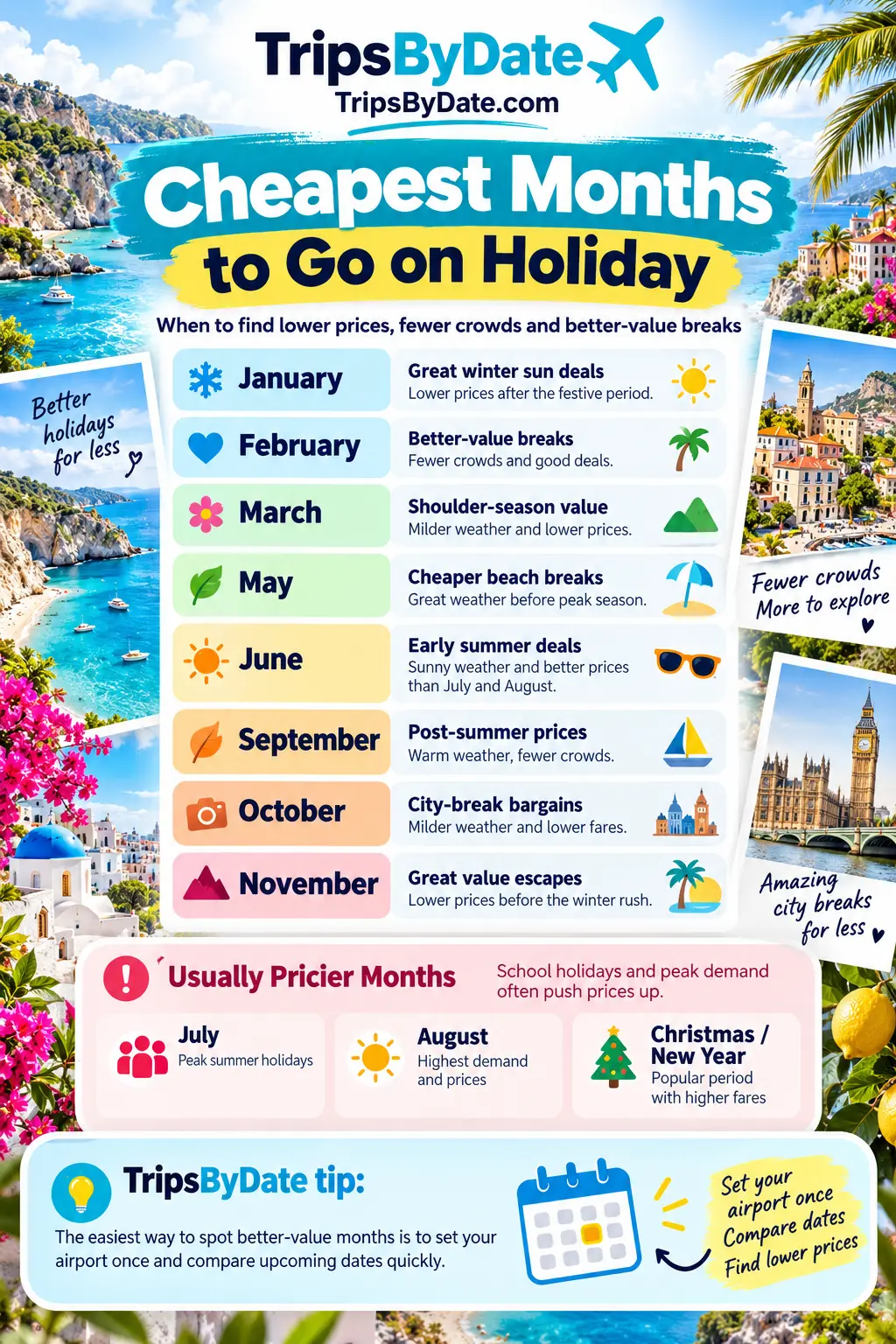
The cheapest time for a holiday is rarely as simple as choosing one month. A February week in a European beach resort can cost less than an August week, but some hotels, restaurants and attractions may be closed. September can offer an appealing mix of warm seas and better-value packages, yet demand has grown enough that a September deal is not automatic. The real goal is to find the least expensive dates that still deliver the holiday you want.
For UK travellers, school calendars, departure airports, the destination's own high season and the day you leave can matter more than the name of the month. This guide explains the strongest periods to compare, the exceptions, and a repeatable method for checking actual value rather than trusting a tempting headline price.
Quick answer: which months are often cheaper for holidays?
- January, after New Year: a useful period to compare city breaks and some winter-sun packages, but not necessarily ski trips or popular warm-weather resorts.
- February outside half-term: potential value for quieter cities and off-season destinations; ski resorts and half-term weeks may be costly.
- March: worth checking for city sightseeing, walking breaks and destinations before their main summer season.
- May: can provide good weather-to-price value for Mediterranean travel outside bank holidays and school breaks.
- Early June: a strong candidate for established beach resorts before the main UK summer holiday rush.
- September: warm seas in much of the Mediterranean and a potential drop from peak summer prices, although growing demand means savings are not guaranteed.
- October and November: worth comparing for cultural breaks and some mild-weather destinations; October half-term and popular winter-sun destinations are important exceptions.
There is no proven universal ranking of these months. The infographic is a helpful starting point, not a price index. Compare live offers for your departure airport, preferred resort and dates before concluding that one month is cheaper than another.
Explore upcoming holidays across different departure dates
These examples come from the available package-holiday listings and are varied across our guides. They are not filtered to a particular month or labelled as the cheapest deals. Use them as inspiration, then choose your airport and compare dates on TripsByDate. Advertised prices and availability can change.
Explore holidays departing on your dates
TripsByDate shows advertised package holidays across its wider inventory. The changing options below are not necessarily Christmas-week departures or packages to these five destinations. Use them as starting points, then compare your own dates and check the final price, availability and festive arrangements with the provider.


 BOH • 7 nights
 B&B · First Choice

 SEN • 7 nightsSkiworldBHX • 7 nightsSkiworld
 MAN • 7 nightslastminute.com
Why do holiday prices change so much through the year?
Holiday operators price a limited supply of aircraft seats and hotel rooms against changing demand. When many families want to travel in the same school-holiday week, that combination becomes attractive to sellers. When fewer people can travel, operators may have more reason to compete on price. However, a destination's own events, weather, availability and visitor markets all influence that picture.
ABTA's reporting shows that travel patterns are changing, rather than everyone travelling only in August. Its 2026 travel-trends research identified rising interest in September, which helps explain why a pleasant shoulder-season month cannot simply be assumed cheap. Read ABTA's September travel-demand findings.
It also matters what kind of holiday you mean. European resort hotels can be less appealing in the depths of winter, while a January ski holiday may be within a resort's main operating season. A weekend city break can be affected by a festival or major event even when surrounding dates are quiet. A beach hotel can also offer a lower price because its outdoor pool is unheated or seasonal attractions are closed.
January to March: better-value possibilities, with trade-offs
January: after the festive rush
Compare departures after New Year if you can travel without children. A city break, relaxed hotel stay or mild-weather walking trip may represent better value than peak festive dates. For winter sun, look at the Canaries, but compare different islands and resort areas rather than assuming all January departures are cheap. Popular winter-sun hotels can maintain strong demand.
Trade-off: many European beach destinations will feel cool, some summer businesses are closed and daylight is shorter. The bargain is only worthwhile if you enjoy the available activities. See our January destination guide.
February: compare the precise week
February can be attractive for sightseeing and quieter city hotels. But the school half-term period, Valentine's breaks, Carnival events and popular ski destinations create their own demand spikes. A trip just outside a holiday period can be a very different proposition from one during it.
Trade-off: cold weather in cities, limited beach conditions and higher winter-sports costs. Our February guide separates mild escapes, cities and mountain holidays.
March: a useful month for flexible explorers
Consider Seville, Athens, Malta or Portugal for food, culture and sightseeing. These trips can offer a more comfortable exploring climate than summer, depending on the destination and week. March is less convincing if your priority is reliably hot weather and swimming in the sea.
Trade-off: Easter can fall in March, spring weather can be changeable and seasonal seaside businesses may not yet be running fully. Browse where to go in March.
April to June: look for the gap before peak summer
April: can work well for spring city breaks, nature and sightseeing. Prices around Easter and school holidays are a separate market from ordinary term-time dates. Some beach resorts are only beginning their main season, and sea temperatures lag behind air temperatures. Explore our April holiday advice.
May: is often worth serious comparison for people who want warmth without midsummer heat. The Algarve, Crete, Malta and parts of Spain can be appealing, but early and late May bank holidays, school breaks and local events can lift prices. Check facilities and sea conditions if you are choosing a beach holiday. See our May guide.
Early June: may be one of the most useful windows for a Mediterranean beach holiday if you are free before UK schools break up. Many summer resorts are active, days are long and temperatures are typically warmer. But some destinations are already popular, so compare the actual package total rather than expecting a universal June discount. Our June destination guide helps you choose between beaches and cities.

July and August: expensive on average does not mean bargains are impossible
UK school-holiday demand often makes popular July and August departure weeks difficult for budget-conscious families. That does not mean every late summer trip is overpriced. The destination, operator, remaining availability and when you book can produce meaningful exceptions.
For example, Which? tracked package-holiday prices for August 2026 and found late reductions across many European destinations. Its analysis showed that a last-minute booking could be cheaper for certain places, even in a peak month. But late booking also carries the risk that your ideal hotel, room configuration, flight or airport is no longer available. See Which?'s summer 2026 price research.
For families: choose a suitable hotel and room arrangement first, then compare the weeks you are actually allowed to travel. Do not gamble on last-minute availability for a particular family room or an accessible property. Use our July and August guides to identify alternatives that fit your needs.
September to November: the shoulder-season opportunity
September: warm sea, but growing demand
In many Mediterranean destinations the sea retains summer warmth, while some resorts become calmer after school terms restart. The first and last weeks can feel quite different in both weather and hotel operation. ABTA reports that September travel is increasingly popular, so shop around instead of assuming a lower price. Compare our September destination ideas.
October: compare before and during half-term
October can be excellent for a city break or a late-season escape in Cyprus, Tenerife or southern Turkey. But the same hotel may look far less attractive on a busy half-term departure. Wetter weather and closing seasonal facilities become more relevant as the month progresses. Our October guide covers those compromises.
November: affordable does not always mean suitable
Some European cities and resorts are quieter in November, while winter-sun destinations, large events and long-haul trips can remain relatively expensive. The Algarve may be tempting for peaceful coastal walks, but do not purchase it expecting summer beach conditions. If warmth is essential, research destinations with a different climate and account for the journey and overall holiday costs. See November holiday choices.
December: should be treated as two separate periods. Early-December availability may offer opportunities, while Christmas and New Year can attract substantial premiums. For festive travel and winter sun, compare the December guide.

Can you move your holiday dates?
Pick your UK departure airport, then compare available trips across different dates and destinations instead of searching one place at a time.
Compare holidays by dateHow to find a cheaper holiday: a practical five-step comparison
1. Define what the holiday must deliver
Start with non-negotiables: warm enough for the beach, family pool, direct flight, wheelchair access, a particular board basis or a short transfer. An attractively priced trip that fails your main requirement is not good value. If your dates are fixed, stay flexible about the destination; if the destination is fixed, compare more dates.
2. Compare nearby dates, not just calendar months
Look at several departures around your first choice, checking the same trip length. A Tuesday-to-Tuesday holiday might price differently from a Saturday departure, but there is no guarantee that midweek is cheapest for packages. Compare complete holidays rather than a flight fare in isolation.
3. Check your realistic airport alternatives
Compare the airport you would normally use with one or two alternatives you could comfortably reach. A flight from a different airport only saves money if the difference exceeds extra train fares, fuel, parking, accommodation and the value of your time. Avoid turning a relaxing break into a gruelling journey to save a modest amount.
4. Make the total price comparable
For each option, check the same number of travellers, nights and board basis. Add hold luggage, airport transfers, meals, resort or local taxes where applicable, travel insurance and any essential excursions. Consider hotel location: a remote self-catering hotel may create transport or restaurant costs that erase the saving.
5. Recheck the provider before paying
TripsByDate helps you discover and compare package holiday listings, but does not sell the package. Confirm current price, room availability, flight details and booking conditions on the operator's website. Check the cancellation and amendment rules. For eligible flight-inclusive packages, verify ATOL protection with the Civil Aviation Authority's ATOL holder search; ATOL protection is not a substitute for insurance.
Travelling in school holidays? Save money without missing school
Parents usually cannot choose arbitrary term-time dates. But local-authority calendars, school-specific training days and differences between UK nations can still make a difference to travel demand. Check official school-term dates and your own school before comparing dates. Do not assume that a different council's calendar applies to your child.
MoneySavingExpert has documented meaningful price differences where school holidays start on different dates and offers practical advice for families. Read its guide to reducing school-holiday travel costs.
Within permitted dates, prioritise changing the airport, accommodation location, length of stay or destination rather than relying on a last-minute price collapse. A family may save more by choosing a well-equipped apartment near an inexpensive beach than by paying a lower headline price for a hotel with expensive meals and transport.
Cheapest month to travel versus cheapest month to book
These are separate questions. Travel month describes when you depart; booking month describes when you commit to the purchase. Booking in January does not make an August trip a January-priced holiday.
There is no single best booking lead time. Which? compared package prices across different booking dates and found that later bookings sometimes won, while earlier bookings could be better when availability and choice were important. Its findings vary by year and destination, so past results should not be treated as a guarantee. Read Which?'s investigation into last-minute package prices.
Book earlier when you need specific school-holiday dates, a particular hotel, a family room, accessibility requirements or multiple travellers on the same itinerary. Consider waiting only when you can change destinations and dates freely, accept a narrower choice and are comfortable with the risk of higher prices or no suitable availability.
What makes a cheap holiday poor value?
- A closed-down resort: a low-price spring or autumn package may coincide with limited restaurants, excursions or hotel facilities.
- Bad flight timings: a late arrival and early departure can remove much of a short break.
- Unexpected extras: luggage, transfers and meals may change which package is genuinely cheaper.
- Weather that defeats your plan: a winter beach bargain may be brilliant for walking and disappointing for swimming.
- Inflexible terms: an attractive price can come with costly amendment or cancellation rules.
A smart comparison considers cost per usable holiday day, not merely cost per person. Two nights with unfavourable flights might give you less time away than a slightly more expensive three-night option. Better value is often the trip that works in practice, not the one with the smallest number on the screen.
Frequently asked questions about cheap holiday months
What is the single cheapest month to go on holiday from the UK?
There is no reliably cheapest month across all destinations and holiday types. January after New Year, March, May, early June, September and November are sensible periods to compare for certain trips. Your specific airport, destination, dates and hotel requirements determine the actual result.
Are holidays cheaper in September than August?
They can be, especially if you can travel outside school holidays, but not universally. September is growing in popularity and some highly sought-after resorts retain strong prices. Compare equivalent hotels and dates instead of relying on a general rule.
Is it cheaper to book a holiday in January?
Not always. New Year sales may contain attractive offers, but research into package-holiday prices has found cheaper booking windows at other times for some routes and destinations. Check the final price and whether the offer really suits your dates.
Are midweek departures always cheaper?
No. They are worth comparing, but tour-operator flight schedules and hotel changeover patterns differ. Test several start days while keeping trip duration, passengers and inclusions comparable.
Which months offer the best value for a beach holiday?
May, June and September can offer a worthwhile mix of weather, operating resorts and potential value in parts of the Mediterranean. The answer varies substantially with how warm you need the sea to be, whether you have school-age children and the destination. See our June and September guides for concrete trade-offs.
Does last-minute booking save money?
Sometimes. Operators can discount unsold holidays, and independent price tracking has documented such reductions. But prices can also rise and the suitable options may sell out. Last-minute travel is more sensible for flexible adults than for families who require very specific rooms or flights.
More planning help from TripsByDate
For destination-specific choices, start with our Holidays by Month hub and work forward from the month you can travel. If you're planning around school holidays, compare the practical options in our April, July and August guides. Skiing is a different seasonal market, so use our ski holiday money-saving guide rather than assuming the same months or pricing patterns apply.
The best-value holiday date is personal. Find the weather, facilities and experience you need, then compare the complete cost on several feasible dates. That is far more dependable than assuming one month must always be cheapest.
‹ BACK TO HOLIDAYS BY MONTHKnow when you can travel?
Start with your departure airport and dates, then compare available holidays across destinations without searching them one by one.
Find holidays by date