

Best Months for Winter Sun
When should you escape the British winter, and how warm will it actually be? A practical month-by-month guide to finding the right winter-sun holiday.
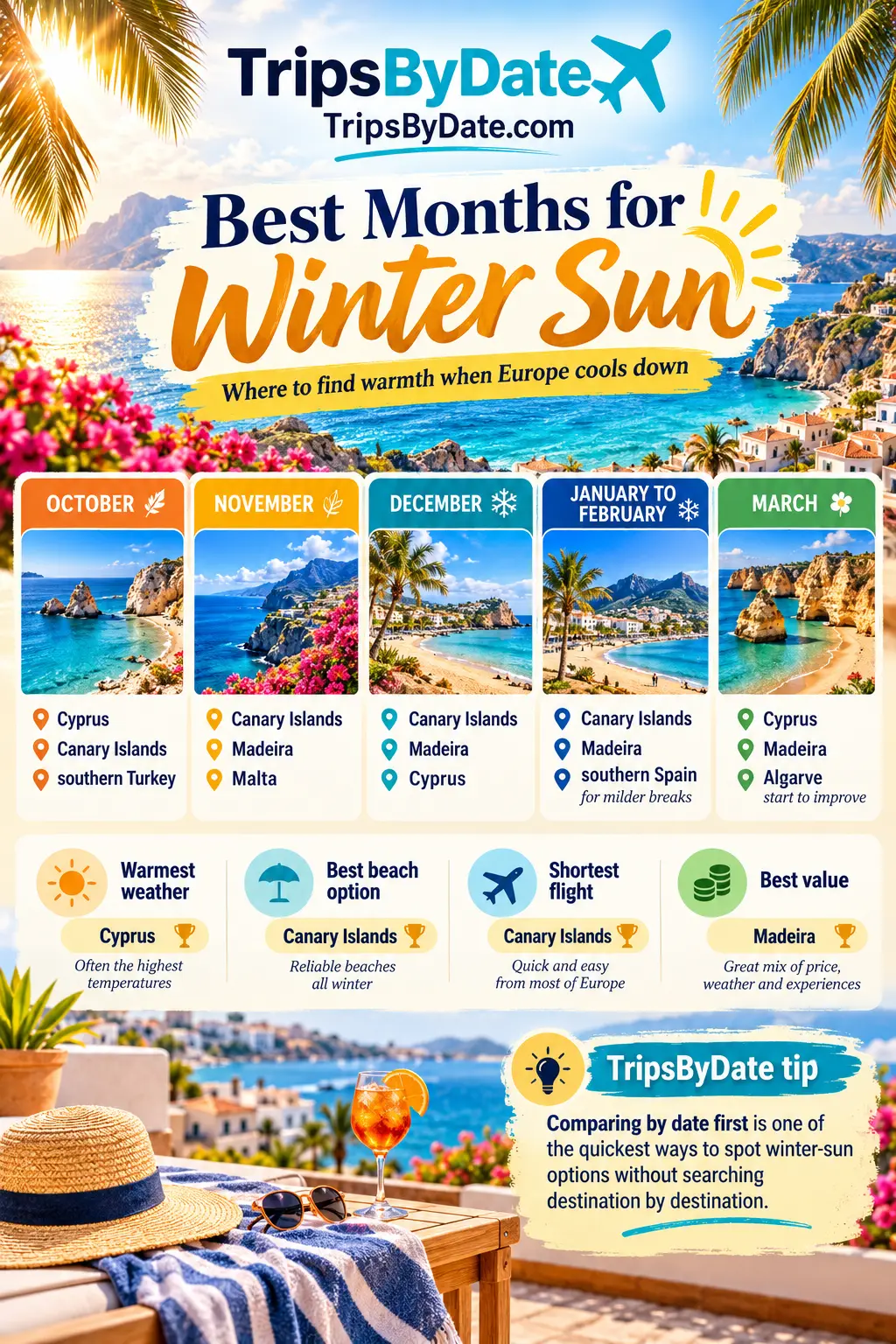
October and November offer some of the most appealing late-season warmth around the Mediterranean, while December to February are generally better for the Canary Islands or destinations farther south. March brings longer days and improving spring weather, but it is not automatically a hot beach month in southern Europe.
The key is knowing what you mean by winter sun. Do you want to sit outside with a coffee, walk by the sea in a T-shirt, spend afternoons around a heated hotel pool, or swim comfortably in the ocean? Those are four different holidays, and the best month and destination change with your answer.
Best months for winter sun at a glance
- October: an excellent time to investigate Cyprus, the Canary Islands and southern Turkey if you want to extend the beach season. Early and late October can feel different.
- November: consider the Canary Islands for outdoor warmth, Madeira for walking and Malta for sightseeing. The eastern Mediterranean becomes less reliable for classic beach days.
- December: the Canaries remain a strong short-haul option, while Madeira adds festive atmosphere. Expect higher demand around Christmas and New Year.
- January and February: the Canary Islands are among the more dependable nearby choices for mild-to-warm days, but swimming pools, wind and individual resort location matter.
- March: the Canaries remain attractive; Madeira, Cyprus and the Algarve are better approached as spring walking or sightseeing possibilities than guaranteed hot-beach breaks.
The bottom line: if warm air and actual beach swimming are essential in the middle of winter, compare farther-afield destinations as well as the Mediterranean. If a shorter journey matters more, adjust expectations rather than expecting July weather in January.
Browse upcoming winter-sun holiday ideas
Below are four current package-holiday listings selected across our available inventory. They are varied examples, not filtered to winter dates or warm-weather destinations. Check the actual departure date, location, weather expectations and full package details before booking.

 SEN • 7 nights
 Skiworld

 SEN • 7 nightsSkiworld


 GLA • 7 nightsHB · Skiline
 STN • 7 nightsSkiline
October: the final stretch of Mediterranean beach season
October has an advantage that January does not: much of the Mediterranean has retained warmth from summer. Cyprus is an especially interesting choice if swimming is high on your list. Its official tourist information describes a long dry season extending into mid-October, while sea temperatures can remain inviting into autumn. Visit Cyprus explains the seasonal climate and sea temperatures.
Southern Turkey is worth comparing too, particularly around Antalya, although resort facilities and individual weather conditions change as the month goes on. The Canary Islands offer a different kind of holiday: volcanic scenery, established resorts and conditions that tend to remain favourable after the Mediterranean cools.
Booking tip: compare the first and last weeks of October separately. An October half-term departure may cost more than nearby school-term dates. A coastal resort that is lively in early October may be much quieter at the end of the month. Our October holiday guide explores those choices in more detail.
November: switch from summer beaches to winter-friendly destinations
November is when destination choice starts to make a real difference. Tenerife and Gran Canaria offer established beach-resort infrastructure, but the weather can vary between north and south, sheltered and exposed beaches, and morning and afternoon. If you want a hotel-based holiday, research the individual resort rather than relying on one island-wide temperature.
Madeira is a different proposition. The island is superb for coastal viewpoints, gardens, food and hikes, but should not be marketed as a hot, consistently sunny winter beach destination. Madeira’s official weather guide describes its microclimates: the south coast, north coast and mountains can experience very different conditions on the same day.
Malta may be better for Valletta, historic towns and relaxed sightseeing than for poolside sunbathing. For travellers who value outdoor lunches and interesting day trips more than sea swimming, that can be an advantage rather than a compromise. See our November destination guide for alternatives and practical trade-offs.
December: choose between sunshine, scenery and festive atmosphere
The Canary Islands remain one of the most practical winter-sun comparisons from the UK. Tenerife South Airport's historical December average daily maximum is 22.8°C, according to Spain's meteorological agency AEMET. That is a climate average for one location, not a promise of 22.8°C every day or at every resort. See the official Tenerife South monthly climate normals.
Madeira is particularly tempting at Christmas and New Year for its Funchal celebrations, scenery and atmosphere. But December is also a month when demand can be driven by a specific event, not just warm weather. Choose your dates deliberately. If sunshine is the priority, compare ordinary early-December weeks against festive departures; if fireworks or Christmas events are the priority, confirm the event programme first.
For more reliable hot weather than much of nearby Europe can deliver, look farther south or towards the Middle East. That comes with longer flying time, different entry requirements and sometimes a higher overall budget. The December guide compares winter sun with Christmas markets and snowy escapes.
January and February: why the Canary Islands often make sense
Winter in the Canaries is pleasant by European standards, but there is an important distinction between average daytime highs and the weather you personally experience. AEMET records average daytime maximum temperatures at Tenerife South Airport of 21.7°C in January and 22.0°C in February. Those figures are useful for comparing seasons, not predicting the temperature on your holiday dates.
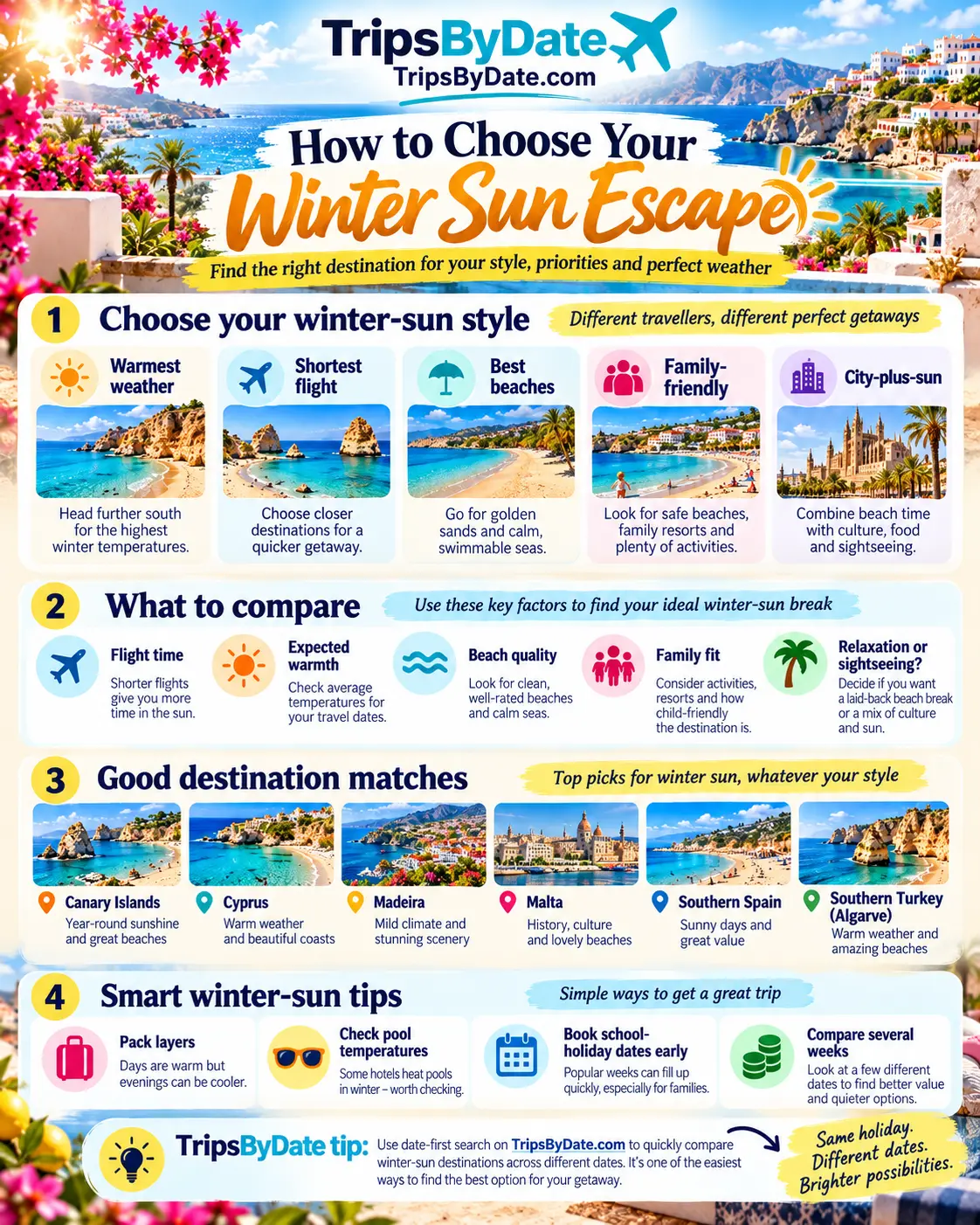
If you are choosing between Tenerife, Gran Canaria and Lanzarote, do not ask only which island is warmest. Ask whether your preferred resort is sheltered, how exposed the beach is to wind, whether your hotel has a heated pool, and whether there is enough to do on an occasional cloudier day. A sheltered pool terrace and a walkable promenade can matter more than a degree of average temperature.
Why not just book Cyprus? Its official travel planner puts average daytime temperatures at approximately 17°C in January and 18°C in February, while its tourism authority reports sea temperatures around 16–17°C during January to March. That makes it attractive for some walking and culture trips, but a very different proposition from a hot swimming holiday. Consult the official Cyprus monthly weather table.
For February half-term, available family rooms, flight times and heated pools are especially worth checking. If you can travel outside school holidays, compare neighbouring weeks instead. See January holiday ideas, February destinations and our family holiday timing guide.

Ready to swap grey skies for sunshine?
Choose your departure airport and the dates you can travel. Compare upcoming holidays without choosing just one destination first.
Find holidays by dateMarch: longer days, but not automatically beach weather
March is a transitional month. Tenerife South's historical average daytime maximum reaches 23.1°C, making it appealing for outdoor activities and relaxed beach-resort time. Madeira begins to feel more spring-like, and southern European destinations can be lovely for town walks, gardens and scenic drives.
However, the sea remains slow to warm after winter. The Algarve may look gorgeous in spring photographs but Atlantic water is a separate consideration. The same distinction applies to Cyprus and much of the Mediterranean: sunny afternoons do not necessarily translate into comfortable long swims. For travellers who want city sightseeing, walking and food, this may still be an excellent month. Read the March holiday guide.
Where should you go for genuinely hot winter weather?
If your definition of winter sun includes regularly hot afternoons and beach swimming in December, January or February, be prepared to look beyond much of Europe. Dubai and some Red Sea destinations are worth investigating, but climate averages, flight time, cultural considerations and total package costs all need checking independently. Further afield, the Caribbean or Indian Ocean may offer tropical alternatives, with very different weather patterns and travel commitments.
Do not assume the warmest option is automatically the best holiday. A family may prefer a four-hour flight and a heated pool to a longer flight with hotter weather. Equally, a couple planning to do very little beyond swimming may find a genuinely warm long-haul destination more satisfying than a mild Atlantic island.
For any destination outside your usual travel area, consult the UK government's destination-specific travel advice before paying a deposit. Consider entry requirements, travel insurance, local laws and health guidance as well as climate.
How to choose the best winter-sun resort, not just the best country
- Check the resort's actual position: an exposed north-facing coast and a sheltered south-facing resort can have very different winter experiences.
- Ask whether the hotel pool is heated: an outdoor pool shown in promotional photos may be cold or shut during your dates.
- Compare wind and swimming conditions: a warm air temperature does not guarantee calm water or an enjoyable beach day.
- Choose something to do when the sun disappears: nearby restaurants, a town, cultural attractions or walking routes make a winter break less weather-dependent.
- Check daylight and evenings: a pleasant midday high can be followed by a chilly outdoor dinner. Pack light layers.
- Price the whole holiday: compare baggage, transfers, board basis, airport transport and usable time at the destination, not simply the headline deal.
Madeira walkers have an extra practical consideration. Access to its classified walking trails now requires advance reservations, and fees can apply. Check the official trail-status and reservation guidance rather than setting off on a route because it appears in a holiday brochure.
Is winter sun cheaper outside Christmas and school holidays?
It can be, but there is no universal cheapest winter-sun month. Christmas and New Year often attract extra demand, as can February half-term. Quieter travel dates may offer more choice, while particular hotels, flights and destinations can follow their own pricing patterns. A holiday in January is not automatically cheaper than one in November.
Try comparing the same duration from two nearby airports across several departure dates. Then check whether a lower price involves less convenient flights, a less suitable hotel area or a different board basis. Our guide to the cheapest months to go on holiday explains why the right comparison matters more than a blanket claim that one month is cheapest.
Winter-sun questions, answered
Which month is best for winter sun from the UK?
For late Mediterranean warmth, consider October. For midwinter short-haul sunshine, December to February can work well in the Canary Islands. If you need hotter swimming weather, consider destinations farther south or farther away and weigh that against the journey.
Are the Canary Islands warm enough for a January beach holiday?
They can be pleasant for beach-resort time, especially in suitable sheltered areas. Tenerife South's long-term January average daytime maximum is around 22°C, but cooler, windy or rainy days are possible. If swimming is essential, check sea conditions and whether your hotel pool is heated.
Is Madeira a better winter-sun holiday than Tenerife?
It depends on your activities. Madeira is particularly attractive for scenery, gardens, towns, walking and food. Tenerife has a wider range of conventional beach-resort options. Neither has guaranteed winter sunshine, and Madeira's mountain conditions can be very different from its coast.
Is Cyprus warm in January or February?
Generally mild rather than hot. Official Cyprus tourism data puts average daytime temperatures at 17–18°C for those months. It may suit sightseeing and walking, but is not a dependable substitute for a hot summer beach holiday.
When is the sea warmest for an autumn or winter holiday?
Sea temperatures tend to lag behind air temperatures, so early autumn can provide more comfortable Mediterranean swimming than spring. Cyprus is a good example: its tourism authority says open-sea temperatures stay above 22°C from June to November, though individual conditions vary. For more detail, see our guide to the best months for a European beach holiday.
Can you get good winter sun without a long-haul flight?
Yes, if mild-to-warm outdoor weather is enough. The Canaries offer a practical option for many UK travellers, with Madeira and other southern European destinations appealing for specific kinds of trips. If you require reliably hot temperatures and warm sea swimming in January, a longer journey may be more realistic.
Explore the months in more detail
Compare our destination guides for October, November, December, January, February and March. If you are flexible on dates but not on your departure airport, compare the actual listings before settling on one location.
‹ BACK TO HOLIDAYS BY MONTHKnow when you can travel?
Pick your UK departure airport and the dates you are free, then explore package holidays across destinations. Less searching. More choosing.
Find holidays by date