

Warmest Places in Europe for Winter Sun
Where Europe keeps its sunshine, what the thermometer really means, and the places worth visiting even when swimming is off the menu.
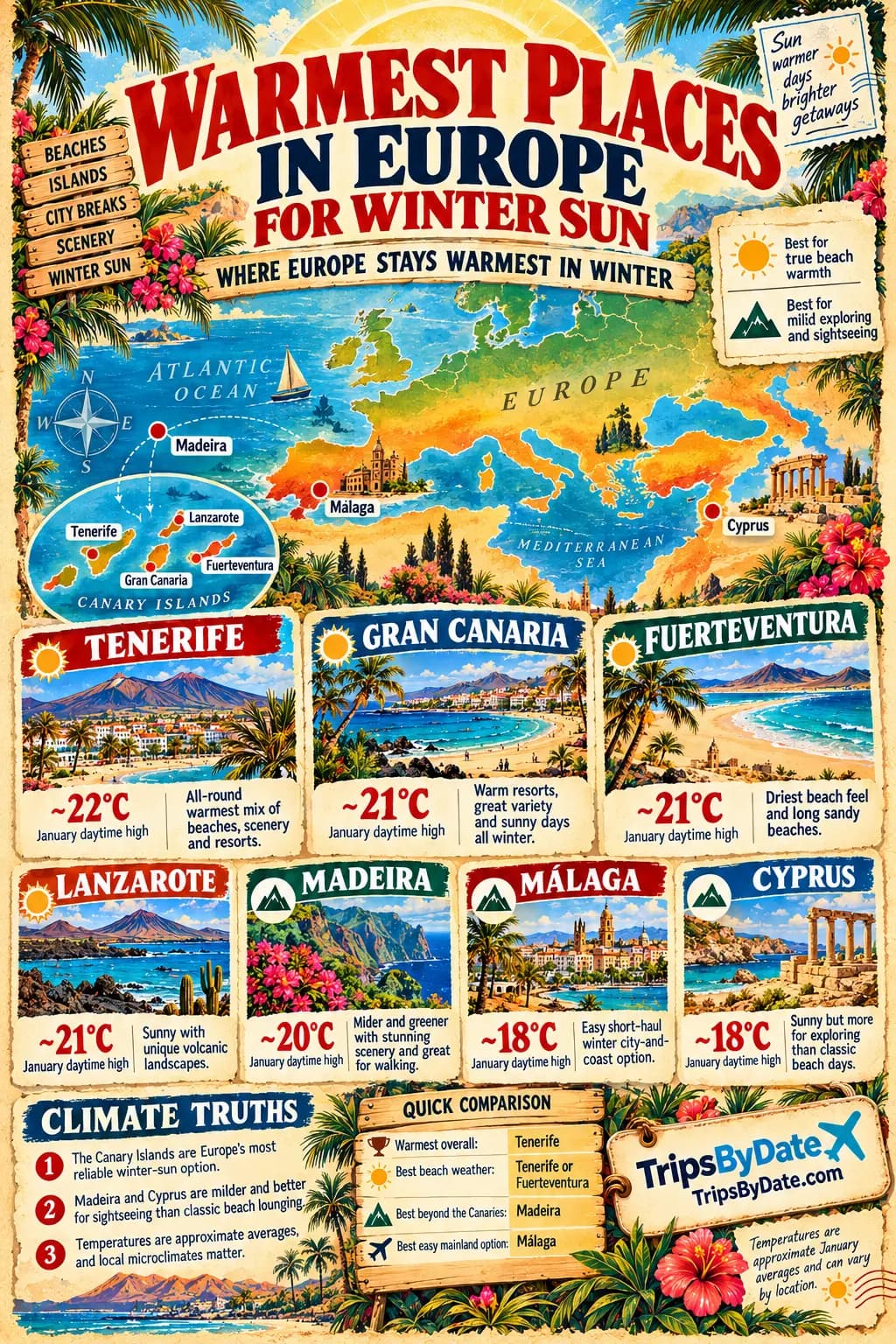
If the British winter has reduced your outdoor ambitions to sprinting between the front door and the car, Europe has some encouraging alternatives. You could be having lunch beneath a palm tree in Tenerife, following a volcanic wine trail in Lanzarote or wandering Málaga's old town without needing to defrost your hands first. But there is a catch: the warmest places in Europe in winter are not all warm in the same way. A sunny pavement café and a comfortable afternoon on a beach are two very different holiday promises.
Quick answer: for the most dependable mild-to-warm winter afternoons among popular European holiday destinations, start with the Canary Islands, particularly sheltered southern resorts in Tenerife and Gran Canaria. Fuerteventura offers huge sandy beaches but can be windy; Lanzarote brings volcanic scenery and generally mild coastal weather. Madeira is wonderful for walking and gardens, while Málaga, the Algarve, Malta and coastal Cyprus are better treated as pleasant sightseeing holidays than guaranteed winter beach escapes.
This guide is about comparing actual winter warmth and choosing the right experience, rather than repeating a general list of sunny destinations. If you are happy to look beyond Europe to places such as Egypt or Cape Verde, see our wider winter-sun destinations guide. For month-specific comparisons, our January and December weather guides go into more detail.
Where is warmest in Europe in January? The figures behind the sunshine
Let's start with the numbers, because a destination described as “22°C in winter” might actually have an average daily high around 22°C, not a temperature it maintains all day. These are historical January average daily maximum air temperatures at specific weather stations, rounded for clarity. They are not forecasts, sea temperatures or promises of sunshine.
- Tenerife South: approximately 21.7°C, according to Spain's AEMET climate normals.
- Gran Canaria Airport: approximately 20.8°C in AEMET's standard climate records; individual south-coast resorts can feel different from the airport.
- Lanzarote and Fuerteventura: around 20–21°C at coastal airport stations, but wind exposure can matter as much as a fraction of a degree.
- Funchal, Madeira: approximately 19.7°C in Portugal's IPMA Funchal 1981–2010 normals; mountain areas are often dramatically cooler.
- Málaga Airport: approximately 16.8°C according to AEMET. A lovely sunny lunchtime is possible, but that's not the same as tropical heat.
- Malta and coastal Cyprus: generally mid-teens in January. Cyprus tourism's climate guidance also notes rain in winter and snow in the Troodos Mountains.
How to read the comparison: official stations, geographic settings and reference periods differ, so this is a practical holiday guide rather than a scientifically uniform ranking. Our images show approximate figures, and individual values in an illustration should not overrule meteorological records. The most important planning decision is often which coast and resort, not which island wins by half a degree. For a broader explanation, read how to compare holiday weather before booking.
See which holiday dates could take you towards the sunshine
Here are four changing package-holiday examples from the wider TripsByDate inventory, ordered by departure date. They are not filtered to the destinations in this article, guaranteed sunny weather, or a particular winter month. Use your UK departure airport and dates to explore the wider selection, then check the actual location, nights, flights, current price and availability with the operator.


 SEN • 7 nights
 AI · easyJet holidays

 DUB • 7 nightsSC · On the Beach
 LHR • 7 nightsAI · Skiline
 GLA • 7 nightsHB · Skiline
The four Canary Islands: similar temperatures, wildly different holidays
They're all Spanish islands off the north-west African coast, so they're usually the first sensible answer to a British traveller asking for Europe's warmest winter sun. But grouping them together as “the Canaries” is a bit like telling somebody that London, Edinburgh and Brighton are all basically the same holiday because the currency matches.
1. Tenerife: choose the south for warmth, then explore an entirely different north
Best for: families who want a resort base, couples wanting beach days plus memorable outings, and friends who prefer choice rather than a single activity. Southern areas around Costa Adeje, Los Cristianos and Playa de las Américas offer plenty of places to stay and eat. If the resort forecast is a central reason for going, check the south, not a generic island-wide weather number.
The unexpected adventure: cross into the green, mistier Anaga mountains, then discover the traditional streets of San Cristóbal de La Laguna. You can go from sun loungers to cloud forest atmosphere on the same island. That's not the weather misbehaving; it's Tenerife showing off its relief and microclimates. Anaga's winding roads and walking conditions deserve proper planning, particularly after rain.
Eat something local: investigate papas arrugadas with spicy or green mojo, grilled fish and, if a suitable local restaurant offers them, Tenerife's rustic guachinche food-and-wine traditions. A guachinche isn't simply a themed tapas restaurant, and many are away from the main southern resorts. For an entirely different setting, Teide National Park gives volcanic panoramas, but it sits at high altitude where winter can mean serious cold or snow. Check official Teide visitor and cable-car information for access and operating conditions.
The honest trade-off: choose Tenerife if you want the fullest mixture of resorts and excursions. Don't assume a warm afternoon by the sea means shorts and sandals at a mountain viewpoint. A fleece is not an admission of defeat.
2. Gran Canaria: sunshine by the dunes, green ravines beyond the resort
Best for: couples who want beach time with places to wander, families looking for a sheltered southern base and travellers who love a scenic drive. Southern resorts such as Maspalomas, Meloneras and Puerto Rico are a sensible starting point for a winter beach search. Gran Canaria's varied terrain means northern towns and higher ground can have very different conditions.
Go beyond the pool: walk the marked access routes around the extraordinary Maspalomas dunes, then explore the fishing village feel and canals of Puerto de Mogán. For something more unexpected, consider the north-western town of Agaete and its valley, where local farms cultivate tropical produce and, unusually for Europe, coffee. Tours and opening arrangements differ by farm; book with an established operator rather than driving up to someone's gate.
Try at the table: ropa vieja canaria, fish dishes, mojo sauces and local cheeses. A family may be happiest with a beach-and-promenade day, while a couple can enjoy a slower drive into interior villages. Either way, leave the dunes protected: they are a fragile environment, not a giant shortcut between your hotel and the water.
The honest trade-off: the south can be excellent for relaxed winter afternoons, but heading into the island's interior changes the climate and the driving demands. If you want more detail, compare our best months for winter sun before choosing your dates.
3. Lanzarote: black lava, strange vineyards and a beach holiday from another planet
Best for: creative couples, friends who love an unusual landscape and families whose children would find volcanoes considerably more interesting than another hotel buffet. Playa Blanca, Puerto del Carmen and Costa Teguise offer different bases. Compare wind shelter, beach access and the kind of evening atmosphere you want rather than choosing on a generic temperature graphic.
The extraordinary discovery: visit the vineyards of La Geria, where vines grow in pits surrounded by low stone walls amid dark volcanic ash. The method helps shelter plants from wind and makes the landscape look as though somebody designed a vineyard for a science-fiction film. Adults can explore local wine; everyone can enjoy the scenery. Pair it with the volcanic landscapes of Timanfaya using authorised visitor routes and facilities.
Food worth seeking: Canarian goat's cheese, grilled fish, potatoes with mojo and regional wines. For an interesting cultural detour, look into artist César Manrique's work, where volcanic geology and architecture meet. His influence turns an island sightseeing day into something more memorable than “we saw a lot of rocks”.
The honest trade-off: sunshine does not eliminate wind. A sheltered hotel terrace can feel beautifully warm while an exposed beach feels much cooler. Look for your actual resort's forecast and the beach's orientation.
4. Fuerteventura: glorious beaches, steady breezes and a slower sort of escape
Best for: beach walkers, outdoorsy couples, families who like space and travellers who don't need endless nightlife. Corralejo has remarkable dunes and access to the north's beaches; Caleta de Fuste offers a different, more resort-oriented feel; and the Jandía peninsula attracts travellers for its enormous stretches of sand.
Where to wander when you've had enough sand: explore the old inland town of Betancuria and learn about the island's rural traditions. Seek out queso majorero, Fuerteventura's distinctive goat's cheese, and ask about local artisan producers. A drive through the island's stark interior is a great reminder that the scenery is as much part of the holiday as the beach.
Important beach reality: exposed stretches of coast can experience strong winds, waves and currents. A spectacular empty beach is not automatically suitable for children to swim. Check lifeguard advice and the actual conditions, and don't choose a windy sports beach when what you really want is a calm afternoon with a book that stays open by itself.
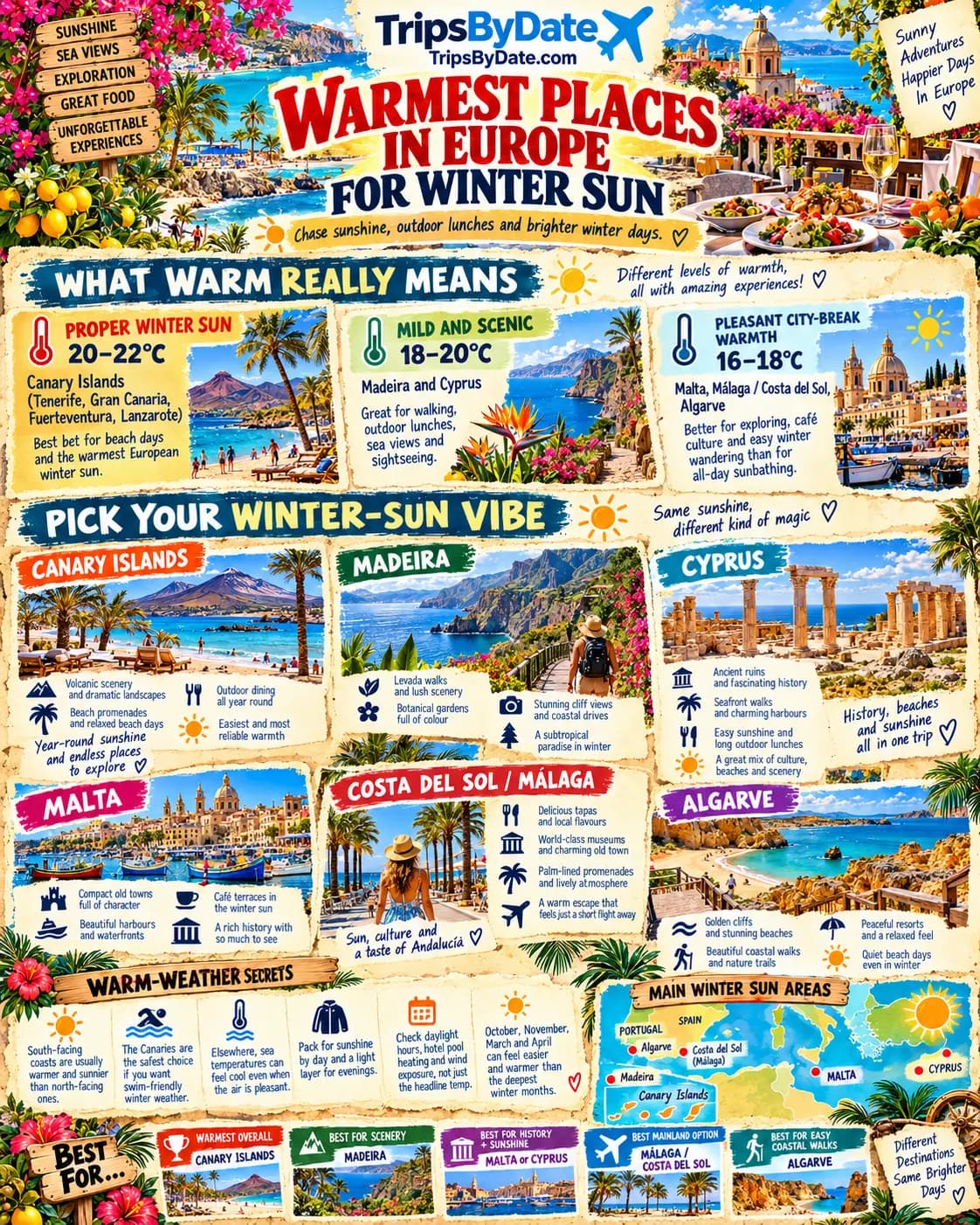
Beyond the Canaries: where mild weather makes exploring a pleasure
Our second image makes an important point: warmth isn't only about finding the hottest patch of sand. On some holidays, the joy is spending hours outside without sweating through every sightseeing stop. These places are especially attractive if beaches are part of the scenery rather than the whole itinerary.
5. Madeira: botanical colour, levada adventures and serious mountain microclimates
Best for: nature-loving couples, active friends and families who enjoy gardens, viewpoints and modest outdoor adventures. Funchal offers markets, restaurants and a convenient base. Winter can be pleasantly mild by the sea, yet conditions change dramatically as roads climb towards the mountains.
Try a delicious morning: explore Mercado dos Lavradores, the central market, for vibrant produce, flowers and fish stalls. Madeira's official tourism board describes the historic market. Browse first, check prices before buying, and then seek out regional flavours such as bolo do caco bread, espetada skewers and local passion fruit creations. If somebody offers you a mystery fruit at a very persuasive price, you're allowed to ask what it costs before agreeing to five.
The big adventure: Madeira's levadas are historic irrigation channels accompanied by walking paths, some with spectacular views. Not all are easy or open all the time. Check the official trail-status and reservation rules before setting out; closures, fees, advance reservations and mountain weather can change. Travellers preferring gentle sightseeing can choose appropriate gardens and coastal viewpoints rather than tackling a ridge walk in unsuitable conditions.
Choose Madeira over Tenerife if: lush greenery, dramatic scenery and walking interest you more than reliable beach afternoons. For all-day sunbathing, a southern Canarian resort is generally the safer starting point.
6. Málaga and the Costa del Sol: tapas, art and winter sunshine with realistic expectations
Best for: friends planning a food-focused city break, couples who enjoy art and easy wandering, and families who want activities that don't rely on swimming. Málaga combines a lively old centre, waterfront walks and cultural attractions. Its typical January high is substantially cooler than the Canaries, but a dry, sunny afternoon can feel like a welcome escape from Britain.
An excellent low-stress day: wander the Atarazanas Market area, enjoy a local lunch, pick one major attraction such as the Picasso Museum or Alcazaba, then head towards the harbour. Search for espeto de sardinas, sardines grilled on skewers, at a traditional seaside chiringuito where available. This is an Andalusian seaside food tradition, not a reason to insist on wearing swimwear in January.
A little beyond the centre: the Jardín Botánico-Histórico La Concepción offers an attractive green escape; check seasonal opening hours and access before travelling. If exploring the wider Costa del Sol, know that a holiday labelled “Málaga” may actually be based some distance along the coast. For short stays, location and transfers matter more than a glossy picture of an infinity pool.
The honest trade-off: Málaga is a strong choice for culture and café life; it is not a convincing substitute for the Canaries if your priority is several reliably warm beach days. For a broader country comparison, browse our short breaks in Spain guide.
7. Cyprus: ancient mosaics, mountain villages and two seasons in one day
Best for: history-loving couples, food-loving friends and families who prefer exploring to lying beside an unheated pool. Coastal places such as Paphos and Limassol can be mild in winter, but rain and cooler evenings are normal possibilities. Higher up, the Troodos Mountains can have snow even when the coast feels springlike.
The must-see surprise: the remarkable Roman mosaics at the Archaeological Park of Kato Paphos depict mythological scenes with extraordinary detail. The official Cyprus tourism listing explains the site and visitor arrangements. Pair the ruins with a harbour walk and a leisurely meal rather than trying to rush through an entire millennium before lunch.
Eat beyond the familiar: seek out sheftalia, regional meze, fresh halloumi dishes and seasonal village cooking. A traditional meze can involve many small courses, so arrive hungry and don't schedule an urgent departure immediately afterwards. Winter is also appealing for exploring villages and trails, provided you check conditions in the mountains.
The honest trade-off: Cyprus wins on history, cuisine and contrasting landscapes. It is not automatically a January swimming destination. Cyprus's own climate guidance describes winter rainfall and significantly colder mountain conditions.
8. Malta: tiny distances, enormous history and surprisingly good winter wandering
Best for: couples who enjoy characterful old towns, friends seeking museums and cafés, and families with curious older children. Malta's winter appeal is less about tropical weather than discovering Valletta, Mdina and the Three Cities without the most intense summer heat.
Try the unusual route: rather than making every outing a bus journey between famous monuments, take time to investigate the harbours and historic lanes of Birgu (Vittoriosa), one of the Three Cities. Explore the waterfront, watch the boats, then enjoy a slower lunch. In Mdina, an evening stroll around the fortified streets can be wonderfully atmospheric. Some small attractions and tours keep reduced winter schedules, so verify arrangements.
The snack mission: find a traditional pastizzeria and try pastizzi, usually savoury pastries with fillings such as ricotta or peas. Then discover ftira, Malta's distinctive bread, and Maltese-style rabbit dishes if they appeal. Malta's official tourism website covers its food, history and short-break attractions.
The honest trade-off: if your winter holiday fantasy requires swimming in a warm sea, Malta is probably not the strongest choice. If your fantasy is sunshine between fascinating historic stops, it's much more persuasive. See our Malta short-break guide for more ideas.
9. The Algarve: clifftop walks, fishing towns and the pleasure of an empty-ish beach
Best for: couples who want quiet coastal walks, friends who love seafood and families content with outdoor exploring rather than all-day swimming. Southern Portugal offers extraordinary rock formations and pretty towns, but winter can also bring Atlantic showers and chilly evenings.
Make the coastline the main event: look into scenic walking stretches near Carvoeiro and the Seven Hanging Valleys Trail, choosing sections that match your ability and the day's weather. Avoid cliff edges, take note of path closures and never treat a beautiful photograph as evidence that sea conditions are safe. Around Tavira, investigate the salt pans and Ria Formosa's lagoon landscape, which offers a very different Algarve from the famous golden-cliff postcards.
Food and culture: savour cataplana, a regional seafood dish named after its hinged cooking vessel, and look out for orange-based sweets and local markets. The quieter atmosphere is part of the appeal; some seasonal resort businesses may be closed. Choose accommodation near a town with year-round restaurants rather than assuming every beach resort will be lively.
The honest trade-off: choose the Algarve for peaceful coastal scenery, seafood and winter walking. Choose the Canaries if comfortably warm sunbathing is non-negotiable. For related ideas, see our Portugal short-break guide.

A little sunshine could be closer than you think
Pick your departure airport and available dates on TripsByDate, then scroll through holiday ideas across destinations. Less searching. More choosing.
Find holidays by dateSix winter-sun secrets that matter more than a temperature headline
1. A south-facing resort can beat a warmer-looking island forecast
Mountains, prevailing winds and cloud patterns create powerful local differences. Southern Tenerife and southern Gran Canaria may feel more consistently resort-friendly than greener, exposed districts on the same islands. On Madeira, a pleasant Funchal afternoon says little about an exposed mountain ridge. Always look up the town or resort, not merely the island's name.
2. Wind can steal the beach feeling without changing the thermometer
Especially on Fuerteventura and exposed coasts elsewhere, a 21°C afternoon with a breeze may feel less comfortable than a slightly cooler sheltered café terrace. When booking, investigate the bay, beach orientation, pool shelter and whether a sea-facing balcony is likely to be breezy.
3. Sea temperature and air temperature are different questions
Warm sun on your shoulders doesn't automatically mean pleasant water. In the Mediterranean, winter swimming is chilly for many people, even on bright days. If pool time matters for children, confirm that the pool is heated and actually heated during your stay. A hotel describing a pool as “outdoor” tells you nothing about whether anyone will want to get in.
4. A shorter winter day changes your itinerary
There may be enough time for a glorious lunch outside but not for three long attractions, a mountain hike and a sunset stop. Build the holiday around available daylight, your return journey and the opening hours of specific attractions. Our guide to departure and return times explains why usable holiday hours matter.
5. Coastal warmth doesn't follow you into the mountains
Teide, Madeira's high trails and Cyprus's Troodos Mountains are not extensions of the beach forecast. Carry layers and check local warnings, road conditions, route closures and equipment needs. Families should consider accessible viewpoints or shorter paths instead of relying on social-media footage of a summit.
6. A cheaper resort isn't a bargain if everything you want is elsewhere
A remote hotel can add taxis, hire-car days and awkward transfers. For a long relaxing week, that may be fine. For a three-night break, choose a base with places to eat and explore close by. Compare the total holiday experience, not just the room price. Our complete weekend-cost guide helps with the arithmetic.
Which warm European winter destination suits your kind of holiday?
- For the best chance of relaxed winter beach afternoons: southern Tenerife or Gran Canaria, choosing a suitably sheltered resort.
- For huge sandy beaches and long walks: Fuerteventura, provided you're comfortable with breezy days.
- For unusual scenery and an adventurous family break: Lanzarote, with its volcanic landscapes and distinctive vineyards.
- For scenic hiking and lush botanical colour: Madeira, checking mountain forecasts and trail access.
- For tapas, art and an easy mainland city break: Málaga, with a coat for the evenings.
- For history and a landscape that changes with altitude: Cyprus.
- For atmospheric towns, museums and great snacks: Malta.
- For quiet coastal walking and seafood: the Algarve.
For couples: think about what you want to do together after sunset, not only the daytime temperature. For friends: prioritise restaurants and walkable evening options. For families: a heated pool, manageable transfer and useful rainy-day backup often beat an extra degree of average warmth.
What about October, November, February and March?
The word “winter” hides several different holidays. October and November can feel far more summery around the Mediterranean than the middle of winter, while February and March bring changes in daylight, flowering landscapes and gradually improving conditions in some regions. The Canaries remain useful through the colder months, but the best choice for a sun-filled October half-term may differ from a January getaway.
Instead of assuming every winter month is interchangeable, investigate our November warmth guide, February comparison and March warmth guide. These existing guides focus on individual months, while this article helps you compare the destination styles across winter.
Frequently asked questions about Europe's warmest winter destinations
Where is the warmest place in Europe in January for a holiday?
Among established European package-holiday destinations, the Canary Islands are consistently among the strongest choices for mild-to-warm January afternoons. Tenerife South's historical average daily maximum is about 21.7°C. Exact weather varies, and the warmest spot on any particular day cannot be guaranteed.
Is Tenerife warmer than Lanzarote in winter?
Tenerife South's January average maximum is slightly above comparable Lanzarote coastal figures, but the difference is small. Hotel location, wind shelter, rainfall, cloud and your plans often matter more than a one-degree comparison.
Is Madeira hot enough for a winter beach holiday?
Madeira can have beautifully mild coastal weather, but it's generally better sold as a scenery, gardens and walking destination than a dependable hot beach escape. The sea and mountain conditions won't necessarily resemble a sunny Funchal terrace.
Can you sunbathe in Málaga, Malta or Cyprus in December or January?
There can be pleasant sunlit days, particularly in a sheltered spot, but none should be sold as reliably hot beach weather in midwinter. Plan a holiday you can enjoy in a light jacket and occasional rain rather than one that only works if the beach is warm.
Which warm European winter destination is best for children?
For a beach-and-pool holiday, a well-located southern Canary Islands resort with a confirmed heated pool is a strong starting point. For older children who enjoy ruins, volcanoes or outdoor adventures, consider Lanzarote, Cyprus or Madeira, matching activities and safety requirements to their ages.
Do you need to choose a destination before finding a holiday?
Not with TripsByDate. Start with the UK airport you'd like to leave from and the dates you're free, then browse changing package-holiday listings across destinations. It's a more visual, scroll-friendly way to discover possibilities, rather than filling in a traditional destination-first search form over and over.
Find a brighter escape for the dates you actually have
Beach, city or mountain scenery? Start with your departure airport and travel dates, scroll through the possibilities and discover somewhere new with TripsByDate.
Find holidays by dateEurope won't turn into the Caribbean because the UK forecast looks miserable. But it does offer something arguably more interesting: different versions of winter, from Canarian beach afternoons and Madeiran green valleys to Maltese history and Andalusian café terraces. Pick the experience first, check the local weather honestly, and let your next free dates help decide where the adventure begins.