

Where to Go on Holiday in September
Six late-summer destinations, warm-water escapes and practical ways to plan a September holiday.
September can be one of the most appealing months for a European holiday. The Mediterranean has spent the summer warming up, many coastal resorts are still fully active, and families returning to school can change the feel of popular beaches. But September is not simply August with lower prices. The first week can still be busy, autumn weather becomes more variable in some places, and the right destination depends on whether you want swimming, sightseeing or a quieter escape.
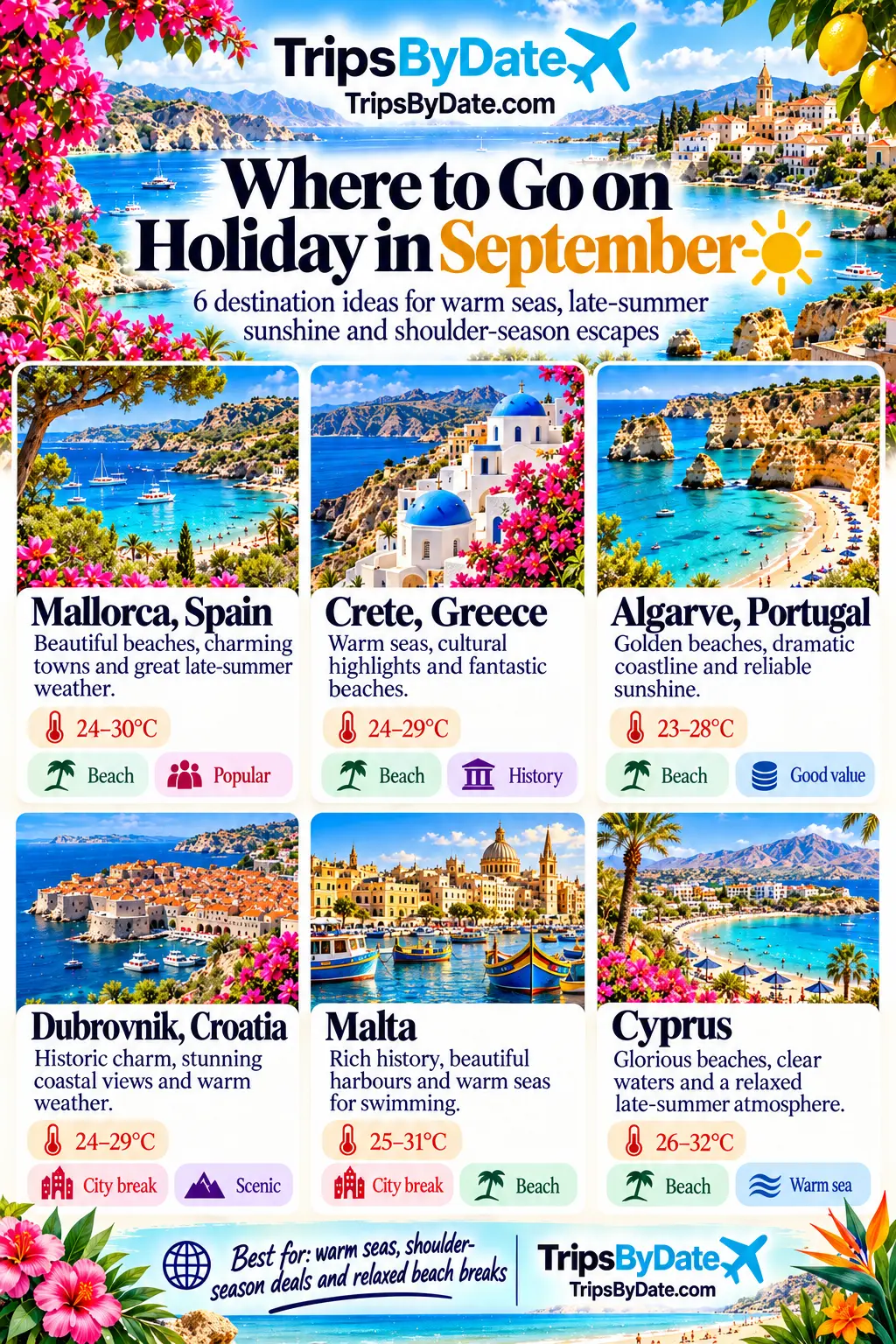
This guide looks closely at Mallorca, Crete, the Algarve, Dubrovnik, Malta and Cyprus. Rather than offering six near-identical descriptions of sunshine, it explains where each destination works best, where to stay, what to check before booking and the compromises that matter. For UK travellers, choosing the departure date carefully can be as important as choosing the country.
The temperatures on our Pinterest infographic are illustrative ranges, not guaranteed daily temperatures. Historical weather averages describe typical conditions over many years, not the forecast for your week. September can still bring intense heat, rain, wind or rough seas.
Explore holidays departing on your dates
TripsByDate shows advertised package holidays across its wider inventory. The changing options below are not necessarily Christmas-week departures or packages to these five destinations. Use them as starting points, then compare your own dates and check the final price, availability and festive arrangements with the provider.


 STN • 7 nights
 RO · Hays Travel


 BHX • 7 nightsB&B · Skiline
 GLA • 7 nightsB&B · Skiline
 GLA • 7 nightsHB · Skiline
September holiday ideas at a glance
- Mallorca: the flexible all-rounder for beaches, coves and attractive towns, with some rain risk later in the month.
- Crete: a warmer Mediterranean beach holiday with history, villages and good scope for exploring.
- Algarve: dramatic Atlantic scenery, long sandy beaches and a less intensely hot alternative to the eastern Mediterranean.
- Dubrovnik: a city-and-sea break with remarkable architecture; expect steps, cruise-ship visitors and sometimes expensive accommodation.
- Malta: a strong choice if you want sea swimming and substantial sightseeing in one trip.
- Cyprus: one of the better choices here for people who prioritise sustained heat and warm Mediterranean water.
For a warm-sea-focused holiday, start with Crete, Malta or Cyprus. For a mix of beaches and towns, compare Mallorca and the Algarve. For a memorable short break with culture in the foreground, consider Dubrovnik or Malta. The actual hotel location matters more than these broad labels.
1. Mallorca, Spain: versatile beaches and a little more breathing room
Mallorca works well in September because you can still choose between a traditional beach holiday, an active break and a smaller-town stay. Alcúdia and Playa de Muro appeal to families looking for long stretches of sand and established facilities. Palma is more suitable if restaurants, architecture and city life matter as much as the beach. Port de Sóller offers scenery and a different pace, although getting around the island takes planning.
The climate data is encouraging but not a promise. Spain's weather agency, AEMET, records a 27.9°C average daily maximum in September at Palma Airport, compared with 31.3°C in August. It also records more September rainfall than during midsummer. A week of beach weather is entirely possible, but a changeable day is not unusual, especially towards autumn. See AEMET's official Palma Airport climate averages.
Where to stay: Playa de Muro for easy sand and family hotels; Port de Pollença for a resort atmosphere with restaurants; Palma for a short city-and-coast holiday. If you are relying on public transport, check the journey between your hotel and your actual planned activities rather than assuming the island is small enough to cross easily every day.
What to watch: popular beach areas can remain busy, sea conditions vary by coastline, and the weather is not identical across the island. September is not a guaranteed low-price month.
Best for: mixed groups, families and travellers who want a beach holiday without spending the entire trip at one resort.
2. Crete, Greece: warm seas, Greek food and plenty beyond the beach
Crete is particularly rewarding if you want to combine beach days with a real sense of place. It is a large island, so choosing the right base is essential. Chania has an atmospheric old town and harbour; Rethymno combines a historic centre with a long coastline; the north coast has numerous established resort areas. For a quieter trip or more remote southern beaches, allow extra time for driving.
September often retains a summer feel, with the sea having warmed through the preceding months. That makes it attractive for swimming, although wind, waves and local conditions still determine whether individual beaches are suitable on a particular day. The Greek national tourism organisation highlights Crete's extensive coastline, Venetian-era towns, archaeology and food culture. Explore the official Visit Greece guide to Crete.
Where to stay: Chania or nearby coastal areas for sightseeing and western-Crete day trips; Rethymno for a mix of beach and town; an established north-coast resort for a hotel-focused family holiday. Flying into an airport close to your chosen region can save a lot of road time.
What to watch: tempting attractions on a map may be several hours apart. Boat trips can be affected by wind, some famous beaches need careful access planning, and a hire car may be useful if you want more than the immediate resort. Do not choose a hotel purely because the island name sounds right.
Best for: beach lovers who also want villages, history, good food and opportunities to explore.
3. Algarve, Portugal: golden cliffs and Atlantic beach days
The Algarve is an excellent alternative for people who want late-summer warmth without assuming that hotter is always better. Its spectacular cliffs, wide beaches, coastal walks and whitewashed towns make a holiday worthwhile even when you are not in the water. The Atlantic sea is often cooler than the Mediterranean, which matters if swimming is your main priority.
Where you stay changes the experience significantly. Lagos gives you a walkable town, restaurants and access to dramatic coves. Albufeira has substantial resort infrastructure and nightlife in some districts. Tavira suits people who prefer a more relaxed town atmosphere, with beaches reached through the Ria Formosa area. Portugal's official tourism website explains the great variety of beaches along the coast, from rocky bays to extensive stretches of sand. Read Visit Portugal's official Algarve beach guide.
IPMA, Portugal's national meteorological institute, publishes station-based September climate normals for Faro and other locations. Use these to understand seasonal conditions, rather than treating the highest number in a weather graphic as the typical temperature. Check Portugal's official climate normals.
Where to stay: Lagos for scenery and independent restaurants; Albufeira for extensive tourist facilities; Tavira for a quieter, town-led break. Check beach access carefully: a hotel overlooking the ocean may still be a steep walk or a drive from the sand.
What to watch: exposed beaches can be windy, Atlantic water may feel cool, and the most photogenic coves can be small and crowded. It is not automatically the cheapest choice in September, especially around popular resorts.
Best for: scenery, relaxed coastal towns, walking, beaches and a holiday that is not entirely about intense heat.
4. Dubrovnik, Croatia: an unforgettable old town beside the Adriatic
Dubrovnik is not best understood as an ordinary resort holiday. Its biggest attraction is the walled old town, with narrow lanes, historic buildings, dramatic sea views and easy access to coastal excursions. September can make walking around more comfortable than the hottest summer days, but the old town can still feel busy, particularly when cruise ships are in port.
Think carefully about your accommodation. Staying close to the historic centre can save travel time, but accommodation may cost more and access can involve steps. Lapad works for people who want more of a beach-and-hotel setting. Cavtat offers a smaller coastal-town alternative if you are happy to travel into Dubrovnik when you want the city itself. The regional tourism authority describes the historic town together with nearby coastal settlements, islands and excursions. See the official Dubrovnik tourism guide.
What to watch: steep streets and steps, crowded city walls, cruise arrivals and potentially high restaurant or hotel costs near the historic core. Set aside time for a slower day by the water rather than packing every sightseeing attraction into one afternoon. For a shorter break, choose a base with straightforward airport and old-town connections.
Best for: couples, city-break travellers and anyone who wants history and sea views in the same trip.
5. Malta: warm swimming water with a remarkable amount of history
Malta is one of the strongest September choices for people who cannot decide between beach and city break. Spend one day exploring Valletta and the harbour, another visiting Mdina and smaller towns, and another enjoying a beach or a boat trip. You do not need to spend your entire holiday moving between hotels to get variety.
The official Malta tourism organisation highlights the islands' swimming spots, diving, heritage and food. September generally remains well suited to the sea, but the weather can still be hot for walking in full sun and occasional storms can disrupt boat departures. Explore the official Visit Malta visitor guide.
Where to stay: Valletta for a historic city-focused trip, though beach access is not the main attraction; Sliema for transport links and dining; Mellieħa if larger sandy beaches are a priority. Consider Gozo if a slower island pace matters more than being close to Malta's main urban areas.
What to watch: Malta's shoreline is not one continuous sandy beach, and some of the best swimming locations are rocky. Traffic and journey times can be frustrating despite the island's size. Cruise visitors and popular boat excursions also mean not every September attraction is quiet. Check ferry and boat operators' schedules before building your entire itinerary around one crossing.
Best for: travellers who want genuine sightseeing, swimming, restaurants and history rather than a week centred exclusively on a resort pool.
6. Cyprus: sustained warmth and inviting Mediterranean seas
If the main aim is to prolong summer, Cyprus makes a compelling case. The official Cyprus travellers' handbook records a September coastal average daily maximum of 29.5°C around Limassol and an average sea temperature of 24.2°C. These are historical averages, not a forecast for every resort or a promise that the weather will always be comfortable. See the official Cyprus climate and sea-temperature table.
Protaras suits travellers who want sandy beaches and a resort atmosphere; the tourism authority describes Fig Tree Bay's sand, facilities and water-sport options. Paphos is appealing for a wider mix of coastal time, archaeology and excursions. Ayia Napa may suit people seeking livelier evenings, but individual hotels can feel very different even within the same area. Read the official Fig Tree Bay beach information.
What to watch: midday sightseeing may still be uncomfortable, especially away from the coast, so plan energetic activities early or late. Match the resort to your group: a nightlife district and a quiet family hotel are not interchangeable. Look at beach type, transfer arrangements, air conditioning, and exactly what the advertised package includes.
Best for: travellers who want warmer water, a genuine late-summer beach holiday and less interest in long daytime city walks.

Know when you can travel?
Pick your departure airport and available dates first, then compare holidays that actually fit.
Find holidays by dateIs early or late September better for a holiday?
Early September often feels like the continuation of summer. The sea has had months to warm, beach businesses are usually running, and resorts remain lively. But the first days of the month can overlap with school-holiday travel patterns and popular destinations can still be expensive.
Mid-September can be a sweet spot for adults who are not tied to term dates. Demand may ease in some places, but not uniformly. If you want calm swimming conditions, choose a sheltered beach rather than relying on an island-wide weather average.
Late September can suit travellers who value quieter streets, walking and sightseeing. The trade-off is growing weather variability in some Mediterranean areas, shorter daylight hours and the possibility that particular seasonal services reduce their schedules. Cyprus generally retains stronger heat than many western Mediterranean options, but even there you should check local conditions.
Is September actually cheaper than July and August?
Sometimes, especially when demand associated with UK school holidays eases. But September is not a guaranteed discount season. ABTA reported that the proportion of people intending to take a holiday in September increased from 17% in 2023 to 24% in 2025. That growing popularity is one reason not to assume that every September departure is a bargain. Read ABTA's September travel-trends report.
The meaningful comparison is the total package cost for a comparable holiday. Check the same departure airport, number of nights, board basis, baggage and transfer arrangements, hotel standard and approximate location. A cheaper room far from the sea or a flight that loses most of your first day may not be better value. A half-board package can be good value for one family and poor value for travellers who want to eat out every evening.
Try more than one departure date where possible, including weekdays rather than automatically selecting Saturday. Check package inclusions and cancellation conditions. TripsByDate helps you compare the dates you are actually free, but advertised prices and availability can change and must be confirmed with the booking provider.
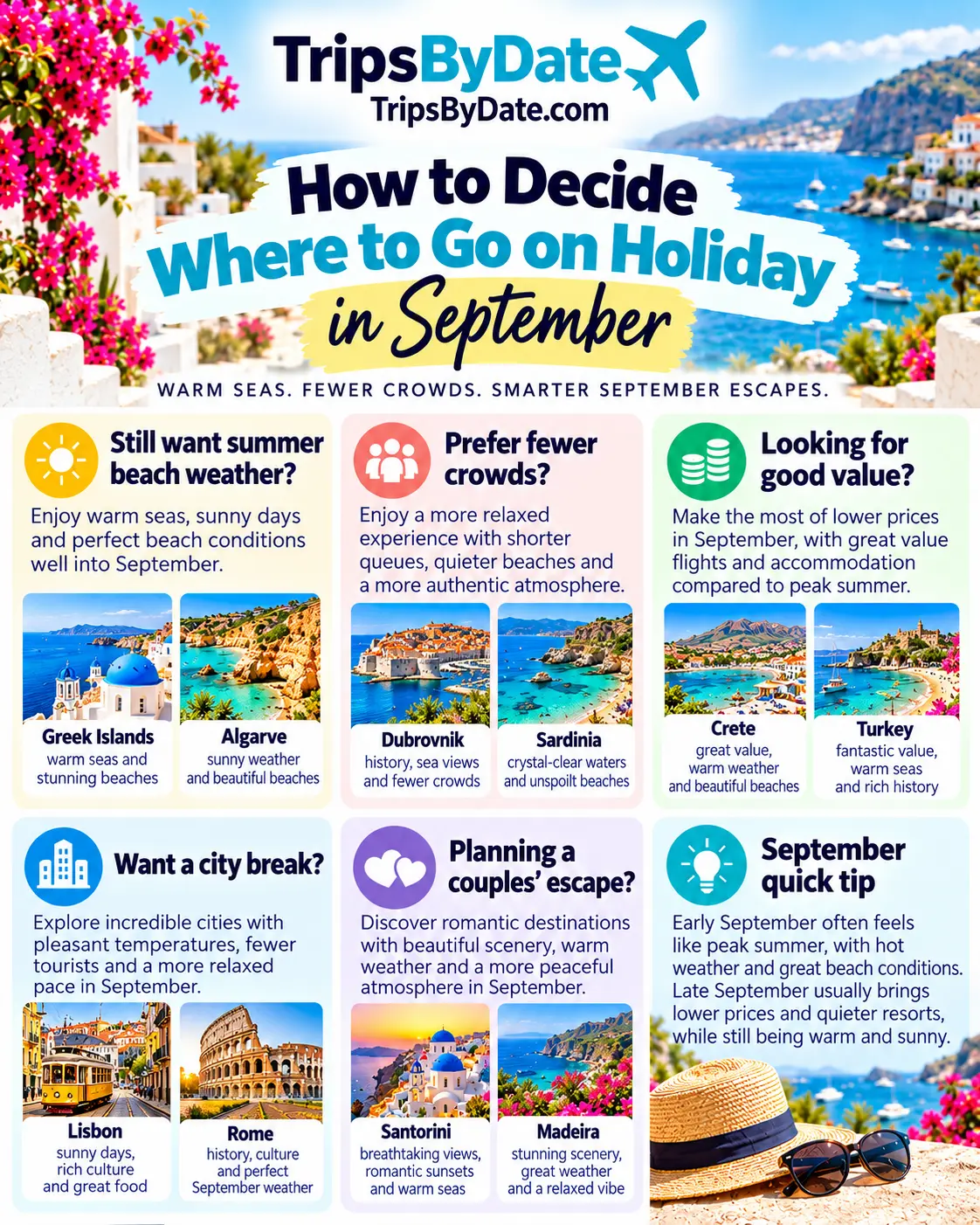
Which September destination should you choose?
- For the warmest sea: Cyprus is a particularly good starting point; Malta and Crete also merit comparison.
- For young families: choose a suitable resort area in Mallorca, Crete or Cyprus, then compare transfers, pools and the actual beach.
- For culture and swimming: Malta offers a strong balance; Dubrovnik is excellent if history takes priority over resort facilities.
- For scenic beaches and coastal walks: compare the Algarve and Mallorca, remembering the Algarve's Atlantic water can feel cooler.
- For a couples' break: a smaller Crete resort, Dubrovnik, or an atmospheric town in Mallorca may be more appealing than a large family complex.
- For hot weather later in the month: Cyprus is a sensible first comparison, but still check the actual forecast near departure.
There is no objective single winner. A relaxed hotel beside the beach may be far more enjoyable than an iconic destination with an inconvenient transfer and nowhere comfortable to sit outside. Pick your preferred type of holiday first, then compare the destinations that fit.
September holiday booking checklist
- Departure airport: compare the total cost and time of reaching the airport, not just the headline holiday price.
- Exact dates: check school-term boundaries, local events and whether your chosen resort stays fully operational later in the month.
- Beach access: confirm whether the beach is sandy, rocky, steep or reached by shuttle or stairs.
- Flight and transfer times: a late arrival and early return can substantially reduce a short holiday.
- Hotel facilities: check pool opening times, air conditioning, accessibility and whether advertised restaurants or kids' clubs operate on your dates.
- Sea and weather: use climate normals as context, then consult local weather, swimming warnings and marine conditions nearer departure.
- Final package price: inspect baggage, transfers, meals, tourist taxes and booking terms before paying.
- Travel documents and cover: verify passport and entry rules for your nationality, and arrange suitable insurance for activities and medical needs.
Frequently asked questions about September holidays
Where is hot in Europe in September?
Cyprus often has particularly strong late-summer heat, and Crete and Malta can remain warm. Mallorca and the Algarve can also have lovely beach weather, but averages vary by location and year. Do not equate a destination's hottest possible day with its normal September weather.
Can you swim in the sea in September?
Often yes, especially around Cyprus, Malta and Crete. Water temperatures differ across coastlines, however, and the Atlantic around the Algarve can feel notably cooler. Always take wind, currents, flags and local safety information seriously.
Is September too late for Greek islands?
Not generally. Crete remains a strong September choice for beaches and exploring, but check the specific resort and excursions you want. Weather and services may differ between early and late September and between islands.
Is September a good time for Dubrovnik?
Yes, particularly if you want history, coastal views and opportunities to swim without planning every activity in midsummer heat. The old town can remain crowded, so visit popular sights early and avoid assuming September means empty streets.
Should I book September holidays at the last minute?
Only if you are genuinely flexible. Last-minute options can be attractive, but there is no rule that they are cheapest. Travellers needing a particular airport, family room, hotel or accessible accommodation have good reasons to book earlier.
What if I want a quieter holiday rather than beach clubs?
Choose a smaller resort or coastal town within your preferred destination, and investigate the hotel's immediate surroundings. A quiet base in Mallorca or Crete can feel very different from a central nightlife resort on the same island.
Keep exploring holidays by month
For peak-season comparisons, read where to go in August. If you have more freedom later in autumn, explore the Holidays by Month hub as October guides are added. For broader inspiration, visit our Travel Guides or browse Girls' Trip Ideas.
Final thought: September's real advantage is choice. You can still look for summer sea temperatures, but you can also prioritise walking, culture, better flight times or a hotel you genuinely want to stay in. Compare the whole holiday, not only the weather icon or starting price.
‹ BACK TO HOLIDAYS BY MONTHKnow when you can travel?
Select your airport and dates, then see holidays that fit. Less searching. More choosing.
Find holidays by date