

Best Short Breaks in Poland
Storybook squares, remarkable history, brilliant food and a few very mischievous statues.
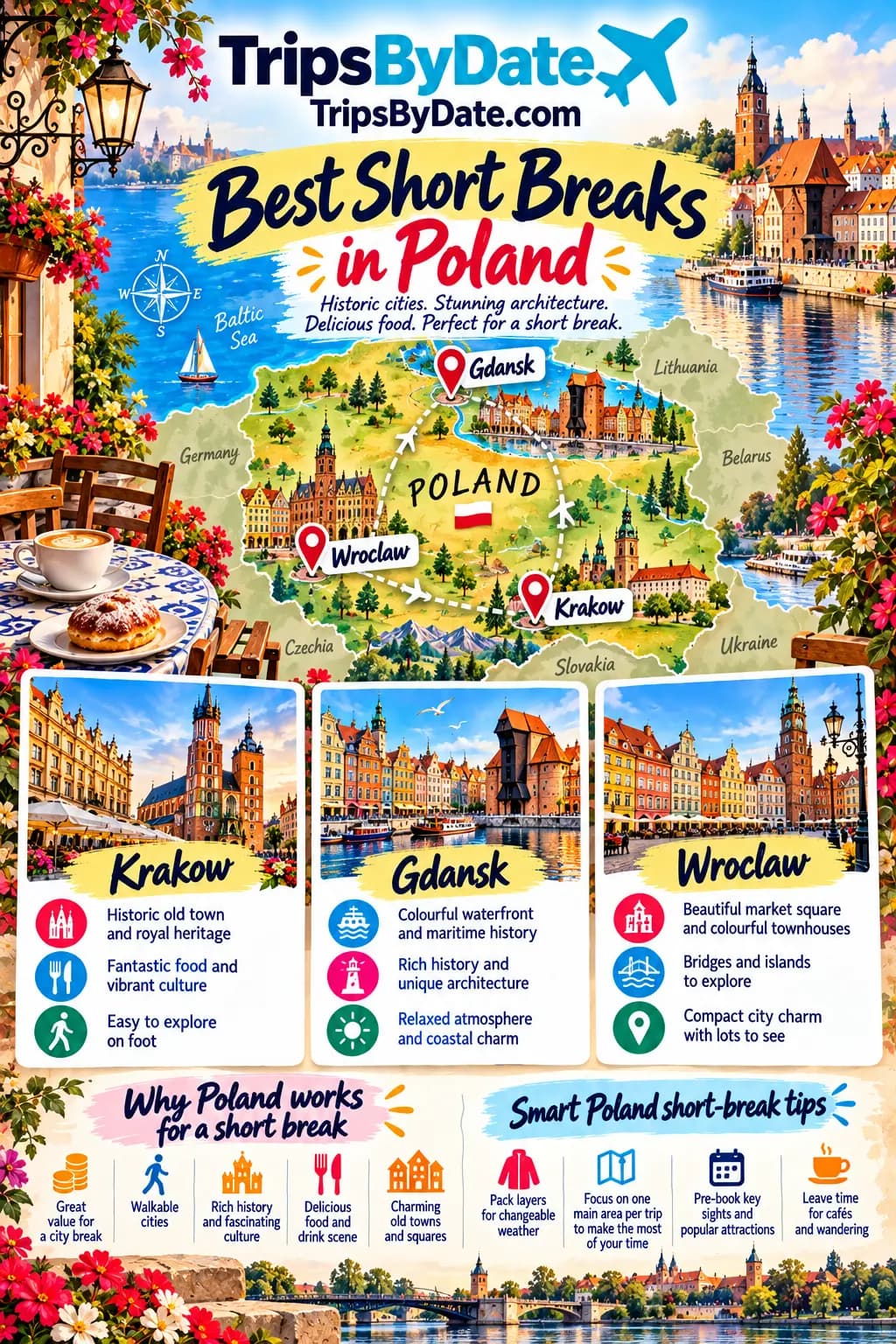
Poland is excellent at catching first-time visitors off guard. You arrive expecting an inexpensive city break and find medieval streets worthy of a film set, inventive restaurants, lakeside gardens, shipyard history, Baltic beaches and an alarming number of tiny bronze dwarfs. The best part? Many of the most memorable experiences begin with a walk, a local snack and a little curiosity rather than an expensive ticket. The best short breaks in Poland make room for both the famous attractions and the stories you had no idea you were coming to find.
Quick answer: choose Kraków for royal history, atmospheric food streets and a first visit; Gdańsk for colourful waterfronts, maritime stories and Baltic air; Wrocław for bridges, islands and a wonderfully playful dwarf hunt; Warsaw for museums, modern energy and parks; Poznań for handsome squares and food traditions; or Toruń for gingerbread, astronomy and preserved medieval architecture. Which city is best depends on your UK departure airport, the weather and how many usable hours you have on the ground.
Poland rewards travellers who look a little beyond the cheapest fare. One good hotel base, a sensible airport connection and a relaxed evening can make a two-night trip feel far more special than a complicated four-city expedition. For the wider picture, see our European weekend inspiration, best-value destination guide and three-day holiday planning advice.
Which Polish city is right for your short break?
- First visit and classic sightseeing: Kraków, with a large historic centre and plenty to explore on foot.
- Waterfront wandering and sea air: Gdańsk, with the option of extending towards Sopot if your schedule allows.
- Couples who like beautiful squares and local discoveries: Wrocław or Kraków, each with a very different atmosphere.
- Friends who want food, nightlife and culture: Kraków's Kazimierz, Warsaw's neighbourhoods or lively Wrocław.
- Families: Wrocław's dwarf hunt, Kraków's dragon or Warsaw's interactive science attractions.
- Something more unexpected: Poznań for noon-time goats or Toruń for hands-on gingerbread history.
One important reality check: Polish cities can offer good local value, but a bargain flight does not guarantee a bargain holiday. Add airport transfers, baggage, accommodation, local transport and the time consumed by flight schedules. Poland also has cold winters and sometimes hot summer days, so compare the experience you actually want, not an imaginary year-round version of spring. Our cheap three-night city-break guide explains how to do the full comparison.
Find a short break that fits your free dates
These are four changing examples from TripsByDate's wider package-holiday inventory, shown in departure-date order. They are not necessarily holidays to Poland, the cities in this guide or a specific short-break duration. Choose your UK airport and travel dates on the homepage, then check actual nights, flight times, transfers, luggage, availability and final prices with the operator.
 STN • 7 nights
 B&B · TUI


 BHX • 7 nightsB&B · On the Beach
 MAN • 7 nightsAI · Ski Line
 LPL • 7 nightsB&B · Thomas Cook
1. Kraków: royal history, a fire-breathing dragon and legendary snacks
Kraków is an ideal introduction to Poland because its historic centre gives you so much within a manageable area. Walk from the old city walls through Floriańska Street into the immense Main Market Square, where church towers, the Cloth Hall and cafés share the spotlight. Nearby Planty Park follows the line of the former walls, making it an enjoyable green route when your feet demand a break from cobbles.
The city has a soundtrack: every hour, a trumpeter plays the hejnał from St Mary's Basilica, and the tune stops abruptly. The traditional legend explains that a medieval watchman was interrupted while warning the city of an attack. Whether you arrive at noon or catch it while enjoying a morning coffee, it is a charmingly strange little ritual. Poland's official Kraków city-break guide offers useful background and practical ideas.
Make time for Wawel Hill, the royal castle area overlooking the Vistula. Below it is a dragon statue that breathes real fire at intervals. It is a wonderfully theatrical reward for children, and for adults who still consider a fire-breathing dragon a reasonable holiday attraction. Check the official Wawel attractions and ticket information before booking rooms or seasonal exhibitions, because some areas have separate admission and limited schedules.
Go beyond the centre: Kazimierz has layered Jewish heritage, historic synagogues, independent cafés, creative bars and neighbourhood streets best explored at an unhurried pace. Try zapiekanka, a long, toasted open-faced sandwich, around Plac Nowy. Then pick up an obwarzanek, Kraków's braided bread ring, from a street stall. No, it is not simply a bagel that got lost on the way to New York. If you have more time, the Nowa Huta district tells a very different story through socialist-era planning, architecture and local life.
For couples: spend a full evening in Kazimierz rather than squeezing in another museum. For friends: mix a history-focused afternoon with a local food crawl. For families: choose the dragon, the trumpet and one engaging museum rather than an exhausting sequence of ticket queues. Kraków also offers opportunities for serious reflection on the history of Jewish Poland; treat such visits thoughtfully rather than as casual entertainment.
2. Gdańsk: Baltic beauty with an unexpectedly powerful backstory
Gdańsk is where colour, water and history come together. Its long streets and ornate façades have a distinctive maritime flavour, while the Motława waterfront offers old cranes, boat trips, amber shops and atmospheric evening walks. The iconic medieval Crane and richly decorated merchants' buildings deserve attention, but the city becomes more interesting when you remember that the pretty streets are only part of the story.
The free view with a real story behind it: the European Solidarity Centre rooftop observation deck looks across the historic shipyards where the Solidarity movement helped reshape modern Poland. Access is free when open, but the outdoor deck is weather-dependent. This is not merely another panoramic photograph: the cranes and industrial landscape connect directly to one of Europe's most important modern democratic movements. The European Solidarity Centre exhibitions add the background for visitors who want to understand it.
A tiny treasure to hunt: Baltic amber has long been part of Gdańsk's identity. Explore the amber shops and museum collections, compare handcrafted pieces, and ask about provenance before buying a costly souvenir. If you enjoy design, look past the most polished tourist displays to independent artisans. For another city perspective, wander streets away from the busiest waterfront and discover how cafés and everyday neighbourhood life differ from the main sights.
City or seaside? A Gdańsk break can include Baltic coastal time around Sopot or other nearby beaches, but it is worth checking the actual train journey, station location and weather rather than assuming every stretch of sand is minutes from your hotel. A windy Baltic beach in spring can be wonderful for a walk and decidedly less wonderful for the swim you promised everyone. For travellers who love a city-and-sea combination, compare our affordable beach-weekend guide.
Best for: history-loving couples, friends interested in food and independent shops, and families who enjoy boats, waterfront walks and museum experiences. If you have just two nights, base yourself where you can walk into the historic centre instead of changing hotels in pursuit of a seaside day.
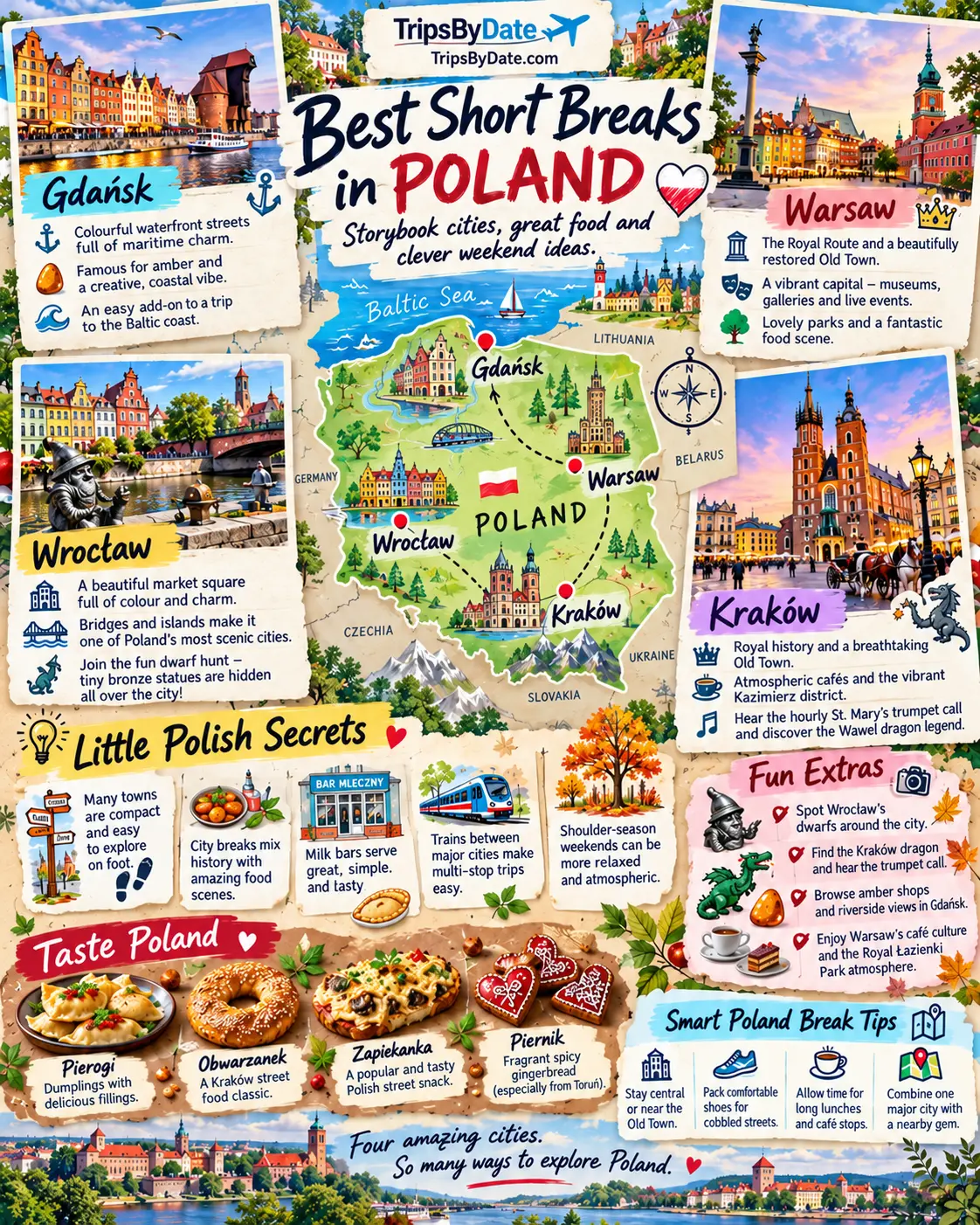
3. Wrocław: gorgeous bridges and a city-wide dwarf conspiracy
Wrocław is one of those cities that makes people ask why it was not higher on their travel wish list. The Market Square is a colourful collection of townhouses and historic architecture, while the Oder River branches around islands and bridges that make wandering particularly rewarding. Cathedral Island, known as Ostrów Tumski, offers a quieter and older-feeling contrast to the busy centre.
But the city's most irresistible detail is its army of small bronze dwarfs. They are scattered across squares, doorways, pavements and less obvious corners, turning a normal sightseeing walk into an increasingly competitive treasure hunt. Their origin is linked to the Orange Alternative, an anti-communist protest movement that used absurdist humour and dwarf imagery. The joke has become an affectionate city symbol. Browse the official Wrocław visitor website for current attractions and walking ideas.
For families: agree a dwarf-spotting target, let the children navigate a neighbourhood and finish with a warm café stop. For couples: take a slow evening walk across the islands, then explore the Market Square after its façades light up. For friends: turn the dwarf hunt into a light-hearted photography challenge, with the very serious prize of choosing the next cake shop.
Wrocław also offers Panorama Racławicka, an immense circular painting that gives visitors an immersive experience of a historic battle, and the Centennial Hall area with parkland and the seasonal multimedia fountain. These attractions are not all clustered together, so group your day by neighbourhood. For a calmer afternoon, visit Szczytnicki Park, or wander along the riverside without a timetable.
The clever small-city advantage: you can often spend one day on the historic centre and islands, then choose either a museum, park or food-led second day without feeling you've missed the entire city. Wrocław is a strong candidate for a two-night European break when suitable flights line up.
4. Warsaw: restored history, inventive culture and a remarkably green capital
Warsaw rewards visitors who enjoy contrasts. Its Old Town looks historic, yet much of it was painstakingly reconstructed after devastating wartime destruction. The story behind that rebuilding is a powerful part of the experience, and the city's modern avenues, museums and creative neighbourhoods show that Warsaw is about much more than a picture-perfect market square.
Start around the Royal Route and Old Town, then spend time in Łazienki Park, with elegant gardens, a palace on an island and opportunities for unhurried wandering. In the warmer season, outdoor Chopin concerts have traditionally taken place on Sundays, but always check the calendar. The official Warsaw city-break guide outlines the city's parks, museums and neighbourhoods.
A delightfully odd musical detail: Warsaw has installed Chopin benches at places associated with the composer, allowing pedestrians to hear fragments of his music. Another interesting contrast is the Praga district across the Vistula, where pre-war buildings, hidden courtyard shrines and contemporary cultural venues sit close together. You can also explore the university library rooftop garden when it is open, but seasonal access means you should check before making a special journey. Poland Travel's Warsaw guide covers several of these discoveries.
For families: the Copernicus Science Centre is a popular interactive choice, with timed-ticket planning sensible at busy periods. For friends: explore Praga's food and design scene before an evening out. For couples: combine a neighbourhood walk, riverside time and a memorable Polish dinner. Milk bars, called bar mleczny, are another tradition worth trying: straightforward canteen-style Polish dishes can be a delicious alternative to polished tourist restaurants.
The Warsaw trap: the capital is spread out. A central hotel does not make every attraction walkable, and the Royal Route is longer than it appears on a small map. Pick an area for each half-day, use public transport intelligently and resist the temptation to commute back and forth to admire yet another café you've seen online.

Start with your free dates, not a fixed destination
Kraków, Gdańsk, Wrocław or somewhere unexpected? Set your UK airport and the dates you can travel on TripsByDate, explore upcoming holiday options, and check full arrangements with the operator.
Find holidays by date5. Poznań: the city where the clock has two goats
If you like unusual traditions and handsome town squares, Poznań deserves serious consideration. Its colourful old centre and Renaissance Town Hall provide an impressive setting for café stops and history, but the most famous residents are two mechanical goats that emerge from the tower at noon and butt heads. It is gloriously ridiculous and genuinely part of the city's identity, not a tourist prank devised last Tuesday.
The official Poznań city-break guide explains the town-hall legend and local delicacies. Among the best is St Martin's croissant, a distinctive pastry associated with the city. The Croissant Museum offers entertaining demonstrations and background; check operating arrangements and language options for your visit.
Poznań works for couples seeking a quieter city, food-loving friends who enjoy a walkable centre and families who find a moving clock more exciting than their seventh museum. It can also be useful as a base for an additional rail trip if you have more than a weekend. As always, verify direct flights or ground-transport connections before treating a destination as convenient.
6. Toruń: medieval streets with a serious gingerbread obsession
Toruń is a beautiful medieval city with Gothic architecture, riverside scenery and a rather delicious claim to fame: gingerbread. It's also closely connected with Nicolaus Copernicus, the astronomer who transformed our understanding of the solar system. Here, a historic city walk can include both medieval merchants and the idea that Earth is not, inconveniently, the centre of everything.
The official Toruń visitor feature highlights gingerbread-making experiences, Copernicus heritage and the preserved old quarter. Booking a workshop can be a lovely family activity; check whether demonstrations are suitable for your preferred language and the ages of your group. Toruń is particularly rewarding for travellers who have already tried Poland's headline destinations and want a smaller, distinctive alternative.
A practical caution: not every attractive Polish city has the same direct UK flight options. Toruń may make more sense as part of a longer trip based around an appropriately connected airport rather than a rushed two-night break involving several transfers. A good destination is only a good short break when getting there leaves enough time to enjoy it.
Polish food: what should you try on a short break?
One of the pleasures of Poland is how satisfying a food-led weekend can be, especially when you go beyond the first international restaurant beside the main square. Don't assume everything is identical from city to city; regional specialities are part of the adventure.
- Pierogi: dumplings with fillings ranging from potato and cheese to meat, mushrooms or fruit. Find a place that makes them properly and leave enough time to enjoy lunch.
- Żurek: a tangy rye-based soup, sometimes served in a bread bowl. Excellent comfort food when the weather is determined to impersonate winter.
- Obwarzanek: Kraków's characteristic braided bread snack, perfect between sights.
- Zapiekanka: an open-faced toasted baguette topped with mushrooms, cheese and other fillings, often found around Kraków's Plac Nowy.
- Bar mleczny: traditional milk-bar canteens serving simple meals, useful for visitors who want local flavours without paying for a dramatic dining-room chandelier.
- Piernik: Toruń's famous spiced gingerbread, including decorative versions that are as interesting to give as gifts as to eat.
- Rogal świętomarciński: Poznań's rich St Martin's croissant, a memorable pastry for travellers with a healthy respect for second breakfasts.
Small budget trick: compare lunch menus, neighbourhood bakeries and local canteens rather than assuming the most prominent tourist-square restaurant represents Polish dining. But do not turn a holiday into a contest to spend the smallest amount possible. Sometimes the regional cake, market experience or carefully chosen dinner is the reason the trip becomes memorable. For more ideas, read our weekend-budget planning guide.
Beyond the city: beaches, castles and countryside without overplanning
Poland is not just a collection of historic squares. The Baltic coast around Gdańsk offers wide beaches and coastal towns. Southern Poland has mountain landscapes around the Tatras, while Lower Silesia includes dramatic castles and outdoor areas. These can be excellent additions if you have four or five nights, but they are not always sensible detours on a Saturday-to-Monday city break.
Beach-minded travellers: use Gdańsk as a practical starting point for Baltic coast ideas, but remember that sea temperature, wind and seasonal services matter. Outdoor enthusiasts: consider extending a Kraków stay towards mountain areas only after checking transfer times and weather. History lovers: focus on the city itself before booking distant excursions; its layers often deserve more than a rushed afternoon.
For a fuller stay, explore our four-night holiday ideas. If your goal is a quick change of scene, a central hotel and one well-chosen day out are often a much better combination.
How to plan an excellent two- or three-night Polish getaway
Arrival day: travel with sensible luggage, check in or leave bags at the hotel, then explore a small area near your accommodation. Find a square, riverside walk or atmospheric café. Save your most complicated admission for the following day, unless your flight makes a specific evening plan realistic.
Full day: visit one headline attraction in the morning, enjoy a relaxed Polish lunch and devote the afternoon to a contrasting neighbourhood or an unusual discovery, such as Wrocław's dwarfs or Gdańsk's shipyard viewpoint. A great city break needs a change of pace, not ten continuous hours on a guided tour.
Final morning: choose a market, bakery, park or last short walk that fits the actual check-out and airport transfer. Don't schedule a museum an hour from the airport just because the map looked deceptively compact on your phone. For a useful timing framework, see how to make the most of three days and using annual leave for a longer break.
Poland tips that save time, money and disappointment
- Check total trip cost: compare the hotel, return journey, transfers and baggage, not just the attractive headline flight fare.
- Use Polish currency wisely: Poland uses the złoty, not the euro. Check your payment provider's fees and choose local-currency billing when appropriate rather than accepting a poor card-terminal conversion.
- Confirm ticket rules: local buses and trams may have ticket-validation requirements that vary by operator and ticket type. Check official guidance for your actual city.
- Check attraction opening days: some museums have reduced days or limited admission; Mondays are not automatically ideal for museum-heavy itineraries.
- Pack for the season: Baltic breezes, winter temperatures and summer heat can all change what makes a comfortable day outdoors.
- Keep one neighbourhood evening free: the cafés, local bars and street details you discover unexpectedly can be the highlight of the trip.
- Check entry guidance: UK visitors should consult GOV.UK's Poland entry requirements before travel, especially for passport validity and any current border procedures.
- Consider package protection: where applicable, confirm what is included and check CAA ATOL protection guidance instead of assuming every travel arrangement has identical safeguards.
Best Polish short breaks for couples, friends and families
Couples: Kraków's evening streets and Kazimierz cafés, Gdańsk's waterside atmosphere or Wrocław's bridges and charming centre are all persuasive choices. Book one memorable experience, then leave room for a slow dinner and unplanned wandering. For more inspiration, see our couples' weekend ideas.
Friends: choose the city around your shared interests. Kraków has lively neighbourhoods and a strong food scene; Warsaw offers museums, nightlife and larger-city energy; Wrocław makes group exploring unusually entertaining. Agree the budget and sleeping arrangements before anyone assumes six people will all enjoy sharing one tiny apartment with one bathroom. Our friends' weekend guide covers the planning side.
Families: give children a story to follow. Find the Wawel Dragon, listen for the Kraków trumpet, hunt Wrocław's dwarfs or watch Poznań's mechanical goats. Plan one indoor option for wet weather, check children's admission and avoid accommodation that requires a long journey home after every activity.
Frequently asked questions about short breaks in Poland
Is Poland good for a weekend break from the UK?
Yes. Kraków, Gdańsk, Wrocław and Warsaw can each offer a rewarding city break, especially with convenient flights and a centrally located hotel. Compare your actual departure airport and flight times before selecting a destination.
Which is better for a first trip, Kraków or Warsaw?
Kraków is often the simpler first choice for visitors seeking a concentrated historic centre and classic architecture. Warsaw is excellent for those interested in modern Polish history, museums, parks, reconstructed heritage and a larger capital-city atmosphere.
Is Gdańsk worth visiting for just two nights?
Absolutely, if your travel times are sensible. Its historic centre, waterfront and shipyard heritage provide plenty for a short stay. Keep Baltic coast excursions optional rather than trying to cover every nearby town.
Where is the best Polish city break for families?
Wrocław's dwarf hunt and Kraków's dragon traditions are particularly memorable, while Warsaw has interactive cultural attractions. Choose based on the children's ages, the weather and convenient transfers.
Is Poland cheaper than other European short-break destinations?
Some restaurants, activities and accommodation may offer good value, but prices vary considerably by city, season, travel dates and location. An expensive flight or long airport transfer can cancel out savings, so compare the complete trip.
Can you explore Polish cities without hiring a car?
Yes, central Kraków, Gdańsk and Wrocław are particularly rewarding on foot, and Warsaw has extensive public transport. For outlying attractions or regional trips, check official train, bus and tram routes.
What food should I try on a Polish city break?
Start with pierogi, żurek and local bakery snacks. In Kraków try obwarzanek and zapiekanka; in Toruń seek out gingerbread; in Poznań look for the traditional St Martin's croissant.
When is the best time to visit Poland for a short break?
Spring and autumn can be comfortable for sightseeing, while summer offers longer days and Baltic coast possibilities. Winter can be atmospheric but cold. Check seasonal opening times, weather and holiday events before booking.
Is it practical to visit several Polish cities in three days?
Usually not if you want a relaxed holiday. Even with rail connections, travel consumes sightseeing hours. Stay in one base and choose a single nearby excursion if your itinerary allows.
Do I need euros in Poland?
Poland uses the Polish złoty. Cards are common in many visitor areas, but keep appropriate payment options and check exchange fees. Don't assume euros will be accepted at every shop or attraction.
Are Polish Christmas markets a reason to visit in winter?
They can be wonderful, particularly in historic squares, but programmes and opening dates change every year. Check official city calendars and compare our Christmas market weekend guide before making a festive booking.
Find a Polish adventure that fits your dates
Poland is best experienced with curiosity and a little restraint. Choose one city that suits your interests, plan around real flight times, book the essential attraction where necessary and let the rest of the weekend unfold. A dragon, an amber shop, a harbour crane or a dwarf hiding beside a doorway can turn a straightforward getaway into a very good story.
That is where TripsByDate comes in. Instead of filling out endless destination-first search forms, you can begin with your UK departure airport and the dates you are free, then browse available package-holiday possibilities. The changing listings are not a promise of Polish availability or a fixed deal: always check destination, duration, included services and final details with the operator. But it's a simple way to discover an exciting escape you might not have thought to search for.
Less searching. More choosing.
Find your next short break by the dates you have free and your UK departure airport. Explore new destinations, then check prices and availability with the provider.
Find holidays by date