

Best Weekend Breaks Under £300
More room to choose, less reason to waste it. Find a European weekend that feels special without treating £300 as an invitation to spend every penny.

There is a delicious moment in holiday planning when your budget goes from "can we afford to go anywhere?" to "which place would we actually love?" A £300 weekend budget can open up choices, particularly if you can share a room and travel outside the busiest dates. But it can also be swallowed by a surprisingly expensive airport taxi, the wrong hotel or a suitcase with a more extravagant lifestyle than its owner.
Quick answer: Budapest, Málaga and Palermo are three excellent candidates to price-check for a short European break from the UK. Budapest offers river views and memorable city experiences; Málaga combines Spanish city life with beaches and art; Palermo excels at food, markets and layered history. None is guaranteed to be available for under £300. Your actual price depends on dates, airport, travellers, nights, baggage and the operator's final offer.
This guide assumes £300 per person for return flights and two nights of accommodation as the comparison starting point, commonly on a room-sharing basis. We'll also explain how to plan if £300 must cover the whole trip. Unlike our under-£200 weekend guide, the focus here is on spending the extra flexibility wisely: an easier flight, a more convenient hotel or one unforgettable experience, not automatically more expensive dinners.
What does a weekend break under £300 actually mean?
Before choosing the prettiest flight-and-hotel advert, pin down what the advertised figure includes. A family of four, two friends sharing a twin room and a solo traveller all face different costs. The headline "from" price may apply to specific dates and occupancy, not your weekend.
- Under £300 per person for flights and hotel: the clearest way to compare package offers, but you still need money for transfers, meals and experiences.
- Under £300 per person for everything: a stricter ceiling. Deduct travel to the UK airport, local transport, food, insurance and any activities before deciding what you can spend on the booking.
- Under £300 for a couple in total: a different and much harder target. Compare nearby UK breaks or different trip lengths rather than assuming a European two-night flight package will fit.
- Under £300 per family member: the total adds up quickly. Check room capacity, child ages, luggage and school-holiday premiums rather than multiplying an adults-sharing headline price.
A useful test: imagine two deals. One has a lower headline price but lands very late and stays far from town; the other costs a little more but gives you two proper evenings in a walkable neighbourhood. There is no universal winner, yet for a two-night break the second may buy more of the thing you actually wanted: time away. Our full weekend cost guide helps you compare them properly.
Explore upcoming holidays by departure date
These four examples come from TripsByDate's wider, changing package-holiday inventory. They have not been filtered to under £300, two nights or the cities in this article. Treat them as inspiration, then choose your own UK airport and available dates and check the final operator price, duration, baggage and inclusions.



 EWR • 4 nights
 AI · CheapCaribbean

 LGW • 3 nightsAI · TUI
 STN • 3 nightsAI · TUI
 STN • 7 nightsSC · Thomas Cook
Three European cities worth checking for a £300 weekend
1. Budapest, Hungary: a grand-looking break without a grand itinerary
Best for: couples who want a romantic cityscape, friends who like food and lively evenings, and travellers who would rather discover a city than queue for tickets all weekend.
Budapest knows how to make an evening feel cinematic. Walk beside the Danube as the Parliament building lights up, look across to Buda Castle and explore Pest's cafés and neighbourhood streets. Many of the iconic exterior views cost nothing at all. The first clever £300 decision is therefore not "which attractions should we pay for?" but "where do we want to be when the lights come on?"
The airport detail that can undo a bargain: Budapest Airport's official transport guidance explains two very different public routes. The direct 100E Airport Express requires its own special ticket, while the 200E connects with the wider network. Compare the route to your actual hotel, not just the ticket price. The city transport operator also explains ticket validation and when time-based tickets or travelcards make sense.
A free-feeling half-day: take a relaxed walk on Margaret Island in the Danube. Parks, paths and a break from traffic create a real change of mood after the busy city. Some facilities and seasonal attractions there cost extra or have restricted hours, but the green space itself is a lovely reason to slow down. If you want one paid experience, decide whether a museum, a boat trip or a bath appeals most, then price it into your personal budget before booking.
Something unusual to try: hunt for a traditional rétes pastry or Hungarian lángos from a reputable bakery or food counter, rather than making every meal an expensive river-view occasion. For an atmospheric walk, explore the Palace District's streets and squares away from the main waterfront. The interesting buildings are free to admire, and finding an excellent neighbourhood bakery often makes a better story than paying for another generic sightseeing bus.
Couple's tip: choose an evening viewpoint and a nice dessert, not necessarily an elaborate dinner cruise. Friends' tip: agree on your maximum group spend before adding transport, bar tabs and activities. Family tip: do not assume all thermal baths accept young children; individual spas have their own age and access rules. See our couples' short-break ideas for more ways to make a little escape special.
When Budapest may not fit: holiday weekends, major events, unusually expensive flights or solo room rates can push the total up. It is a promising place to investigate, not a permanent low-price promise.
2. Málaga, Spain: beach, history and art without a complicated transfer
Best for: couples who want cafés and sea air, families mixing outdoor time with culture, and friends who cannot agree between a city weekend and a beach escape.
Málaga's little superpower is that its old-town streets, the Roman Theatre, port promenade and Malagueta beach can sit within one compact weekend. You don't need to hire a car just to experience the city. Airport operator Aena lists a C1 commuter train to the centre, with Málaga Centro Alameda around twelve minutes from the airport by train. That's station-to-station travel, not the total journey to your hotel, but it illustrates why the final transfer deserves as much attention as the flight.
The remarkably useful Sunday trick: the city-operated Alcazaba and Gibralfaro monuments currently offer free public entry on Sundays from 2pm. This can be a genuinely useful budget advantage if your weekend and opening hours align. Check the official site before travel, allow time for queues and remember that Gibralfaro's uphill approach is not everyone's idea of a relaxing Sunday. If your return flight is early, this trick is worth precisely nothing, which is why checking your schedule comes first.
A better-than-a-souvenir experience: start at the Roman Theatre area, wander through the old town, pause at a market or bakery and finish by the water. Málaga is famous for seafood, but there is no law requiring you to order the priciest restaurant's largest fish. Look for neighbourhood tapas, local specialities and an honest menu with prices displayed before sitting down.
The tiny museum-versus-beach decision: on a warm day, combine one indoor cultural stop with a long waterfront walk; on a rainy day, switch the order. You don't need to buy three museum tickets to prove you appreciated the art. In summer, begin outdoor sightseeing early and keep shaded time for lunch. In cooler months, treat the beach as somewhere beautiful to walk rather than promising yourself swimming weather.
Family-friendly idea: make the Roman Theatre and fortress exterior a mini-history adventure, then head towards the port or beach for downtime. Friends' idea: try a food-sharing lunch, then take a self-guided wander through Soho's street-art streets. And for couples, a sunset stroll can deliver romance without a restaurant bill that requires a small personal loan.
For more options that blend culture and coast, see our weekend beach holidays guide and the flight-time comparison guide.
3. Palermo, Sicily: eat your way through history
Best for: friends who love food, couples who enjoy atmospheric streets and curious travellers happiest when a city's most memorable attraction isn't behind a ticket barrier.
Palermo is gloriously complicated in the best possible way. Arabic, Norman and later influences appear in its architecture, food, markets and street life. Start with the historic centre, where walking between Palermo Cathedral, Quattro Canti and lively market streets can provide more than enough sightseeing for a weekend. The city rewards curiosity and comfortable shoes much more than it rewards an itinerary with twelve timed appointments.
The local soundtrack: Palermo's official tourism website describes the market traders' animated cries as abbanniata. At Ballarò Market, the noise and colour are part of the experience, not evidence that you have taken a wrong turn. The municipality lists regular market activity during the week and mainly mornings on Sundays. Go earlier for the food-market atmosphere rather than arriving late expecting every stall to still be open.
The small-food strategy: build a lunch from a few local specialities instead of assuming value means the biggest restaurant portion. Visit Sicily explains dishes such as panelle (chickpea fritters), arancine (stuffed rice snacks) and sfincione (Sicilian-style thick pizza). Try something familiar first, then something you can't immediately identify from the menu. Ask what is in it if you have allergies, dietary preferences or limited appetite for culinary bravery.
A wonderfully odd cultural detour: Sicily has a long tradition of puppet theatre, and Palermo's official cultural itinerary highlights its international puppet museum alongside the markets and other historic traditions. A performance or museum visit can be a distinctive family memory, but check opening times and language arrangements rather than assuming there is a suitable show during your particular weekend.
Budget mistake to avoid: do not treat Sicily as one small attraction. A popular day trip on the other side of the island can consume the whole weekend in transport. Palermo itself offers plenty of food, historic buildings and neighbourhood wandering. See our guide to reducing wasted transfer time and protect your limited hours.
For couples: explore a quieter piazza near sunset and choose one atmospheric dinner. For friends: agree on a small food budget each and try different market treats. For families: pair market exploring with an open space, an accessible museum or a child-friendly activity rather than a continuous march through busy streets. Check pavements and accessible routes if travelling with pushchairs or mobility needs.
What an extra £100 of flexibility should actually buy you
The smartest difference between a £200 search and a £300 search is not that you suddenly need a fancier hotel. It is that you may be able to fix the worst compromises. Check these improvements in order, rather than spending automatically:
- A better flight time: arriving in time for an enjoyable first evening may be worth more than a slightly cheaper flight that lands after midnight. Count the real hours on the ground.
- A more useful hotel location: a room near a straightforward public transport route can save two taxi fares and repeated backtracking. The absolute centre isn't essential if the neighbourhood works.
- A comfortable room configuration: two friends may benefit more from a confirmed twin room than from an attractive headline based on a double bed. Couples may value a quieter room; families need realistic beds and space.
- One important experience: a specialist food walk, archaeological entry or harbour boat can become the highlight if it's genuinely your thing. Don't buy an activity because your budget technically allows it.
- Less travel friction: included luggage that you need, a later hotel checkout or a simpler transfer can be useful. Check what you get rather than paying for a bundle of extras you won't use.
Counterintuitive tip: the best use of a bigger budget can be spending less than your ceiling. Save the difference for a better dinner, an unexpected museum or the next escape. A budget is a boundary, not an instruction from your bank to empty itself.
The £300 test: calculate your real weekend without a fantasy price table
Forget illustrative tables pretending that flights will always cost a fixed amount. Instead, use the real offer you find and work backwards:
- 1. Choose the budget basis. Is £300 for each traveller's flight and hotel, or does it need to cover the complete trip? If the latter, reserve room for all other costs before looking at packages.
- 2. Confirm occupancy. Recalculate the per-person cost for solo travel, two adults sharing, three friends or a family room. Different bed layouts can produce very different totals.
- 3. Check the airport at both ends. Add the journey from home to your UK departure airport, plus the correct arrival-airport-to-hotel transfer. A very cheap flight with a long taxi ride is a classic false economy.
- 4. Price the baggage you will actually carry. A personal item, large cabin case and checked bag are not interchangeable allowances.
- 5. Protect food and everyday transport money. Even an inexpensive city is not free to eat in. Make sure your budget leaves you able to enjoy being there.
- 6. Decide on one paid highlight. Put that cost in before booking instead of hoping the holiday magically becomes free once you land.
- 7. Keep a buffer. Insurance, visitor taxes, disruption or a last-minute transfer change can all affect the final spend.
If the total exceeds your limit, change one variable at a time: travel one weekend later, try a different UK airport, switch a room type or choose another destination. You will learn which change actually helps, rather than getting lost in a blizzard of browser tabs. For a deeper comparison, see how to compare the total cost of a weekend.

£300 to work with? Start with your dates.
TripsByDate lets you browse upcoming package holidays from your UK airport by departure date, across destinations. Find an option worth investigating, then compare the real price and inclusions with the operator.
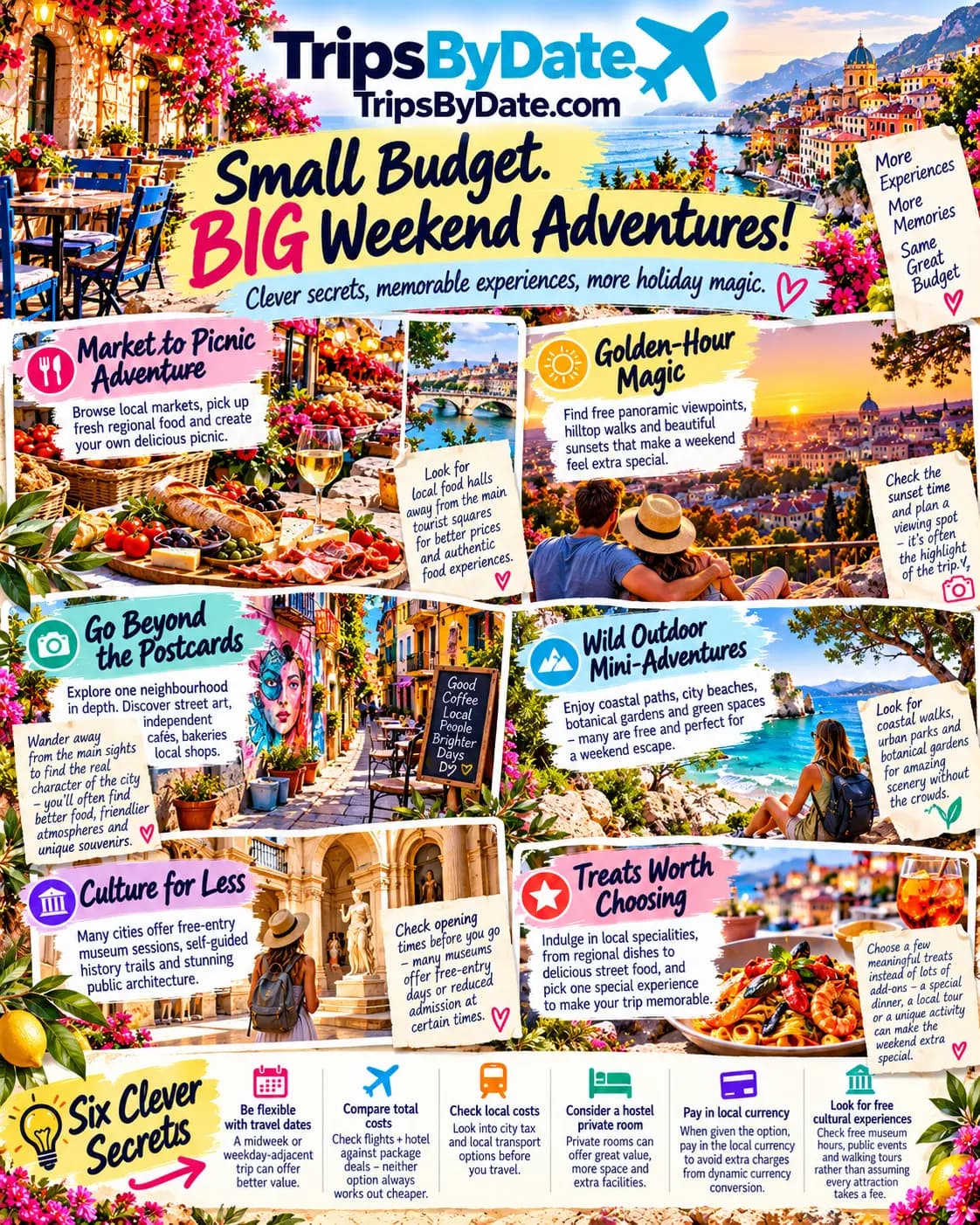
Find holidays by dateSix unusual ways to make an inexpensive weekend memorable
Make the market your lunch plan, not just a photograph
Visit a working food market, pick one or two local specialities and enjoy a picnic where permitted. Look for a public garden or waterside bench, respect local rules on alcohol and litter, and buy from traders whose food looks well handled. A picnic can turn a simple lunch into a proper local experience. A supermarket sandwich is fine too, but a market picnic has the advantage of being a story.
Pay for the experience you can't recreate at home
Ask yourself whether a paid activity is truly distinctive. A historic fortress, local performance or specialist food tasting might be worth the money; a generic "VIP city experience" offering a plastic lanyard and an average biscuit perhaps isn't. Choose one highlight and give yourself time to enjoy it properly.
Follow one street beyond the postcard
Walk away from the main square and find a residential café, independent bookshop, mural, bakery or interesting architectural detail. The best budget souvenir is often a photograph or a conversation. Check local safety advice, stay aware of your surroundings and avoid treating people's homes as a theme park.
Use sunset as your big evening event
Check the actual sunset time for your travel date and find an accessible viewpoint. The golden-hour experience doesn't need an expensive rooftop bar attached to it. Make sure you can return safely afterward, especially if transport becomes less frequent after dark.
Search for free culture, but read the small print
Some museums and historic sites offer free-entry slots, reduced evenings or family concessions. These vary widely, often require reservations and can attract queues. Málaga's fortress Sunday window is a useful example; it isn't a reason to schedule your entire weekend around a free ticket that happens after your flight leaves. Check official times first.
Leave the last hour unplanned
One spontaneous coffee, a surprise independent shop or a second walk down your favourite street can be better than squeezing in a paid attraction. A weekend break isn't a test of how efficiently you can herd yourselves through Europe.
For couples, friends and families: different people, different £300 decisions
Couples: choose one shared moment
Spend on a quieter, better-located room if sleep and evenings together matter. Arrange one lovely moment, perhaps a river walk followed by local food, and keep the rest relaxed. Rather than the biggest restaurant bill, look for somewhere that feels genuinely local. Our couples' weekend guide offers more ideas.
Friends: prevent the shared-budget mystery
Decide before paying whether the budget includes luggage, airport transport and eating out. If one person wants museums and another wants long lunches, split for a couple of hours and meet later. Confirm room layout, especially twin beds, and don't assume a four-person apartment will be cheaper once cleaning charges and travel into the centre are included. See weekend breaks for friends.
Families: put comfort and flexibility before the bargain badge
Look at the complete family price and actual room occupancy. An apartment kitchen can help with snacks and breakfasts, but may not be better value if it's far from the attractions and adds lengthy transfers. Check lift access, pushchair routes, child fares, museum eligibility and nearby play spaces. For a short escape, an uncomplicated lunch and park can be a triumph. A three-hour queue with hungry children rarely is.
Family budget secret: choose accommodation near one easy "reset" activity such as a waterfront, public park or pedestrian square. It provides a no-pressure option whenever everyone's energy collapses, usually around the precise moment you thought sightseeing was going beautifully.
When should you look for a sub-£300 weekend?
There is no permanently cheapest weekend, but these comparisons can improve your chances:
- Friday to Sunday versus Saturday to Monday: compare both if your work schedule allows it. The second may offer a different price and flight pattern, although Monday closures can affect attractions.
- Immediately after a major event: some cities have sharp demand peaks around festivals, conferences or big sporting weekends. Check the event calendar, then compare nearby dates.
- Outside UK school holidays: this can widen your choice if you are free to travel, but it is no guarantee of a cheaper trip.
- Different UK departure airports: a nearby alternative can create more options, but only after adding rail, fuel, parking or hotel costs at the departure end. Our nearby-airport comparison guide explains the trade-off.
- Shoulder-season travel: some cities may offer a useful balance of mild weather and lower demand, while others have events that make a particular weekend expensive. Check rather than assume.
- Trips with less rigid destination preferences: being happy with Budapest, Málaga or somewhere you hadn't previously considered can be more useful than repeatedly searching one famous city for exactly the same weekend.
This is where TripsByDate's date-first approach becomes useful. If your airport and free dates are fixed but your destination isn't, you can quickly browse packages across places instead of repeatedly re-entering the same dates on different destination-first websites. Our guide to searching without a destination explains the method.
Package or separate booking: which is actually better under £300?
Neither wins automatically. A flight-and-hotel package can simplify planning and may deliver a competitive combination, but separate flights and accommodation might offer better timings or a hotel in a more useful location. Compare like for like: traveller numbers, nights, room type, baggage, transfers and total price. Read our package-versus-separate booking guide before deciding.
Protection also matters. The UK Civil Aviation Authority explains ATOL protection for qualifying flight-inclusive packages, and the official ATOL site provides guidance for checking cover. An ATOL Certificate and travel insurance serve different purposes. Verify exactly what you're booking and with whom. TripsByDate helps you discover operator offers; it is not the holiday booking agent.
One practical warning: a flight-and-hotel bundle is not automatically a legally protected package just because those words appear together. Check the actual sales arrangement and documents instead of assuming protection from the screen layout.
A £300-conscious two-night plan that feels like a real holiday
Arrival day: useful flight, easy transfer, good local dinner
Travel straight to the area where you are staying, leave bags securely and explore nearby streets. Choose a modest local dinner and take a short evening walk. Don't pay to criss-cross town just because an influencer called a restaurant "unmissable". Its carbonara can probably live without you.
Full day: one main sight, one delicious food stop, one slow adventure
Visit your chosen attraction early, then explore its surrounding neighbourhood on foot. Eat a local speciality, take time for a park, harbour or riverside view, and finish somewhere convenient for the evening. Keep the itinerary compact. The money saved on repeated taxis can become a much nicer meal or next day's breakfast.
Return day: one gentle final experience
Visit a bakery, viewpoint or nearby market if its actual opening hours fit. Work backwards from the time you must be at the airport. A late checkout or luggage storage can help, but check whether either comes with a fee. A final leisurely coffee is a much better holiday memory than a missed flight.
Small traps that can make a £300 weekend surprisingly expensive
- Different arrival airports: check the full airport name and route into town, particularly when a city has multiple airports.
- One expensive transfer: late arrivals or missed public transport can change the trip economics. Research a safe backup route.
- Room occupancy assumptions: a "per person" offer for two sharing cannot simply be divided in half for a solo traveller.
- Baggage upselling: know your included personal item dimensions and whether a wheeled cabin bag costs extra.
- Breakfast that arrives after you leave: a hotel breakfast inclusion has limited value before an early airport departure.
- Short-lived travel passes: compare the actual number of journeys you'll take before buying an unlimited transport product.
- Free attractions that aren't open: some markets close Sunday afternoons; museums can close Mondays; selected free hours might clash with your flight.
- Foreign-currency card conversions: check your bank fees and ask to pay in local currency when appropriate rather than accepting an unfavourable terminal conversion automatically.
- Tourist taxes and apartment fees: inspect the final booking terms, cleaning charges and local amounts due on arrival.
- Trips too ambitious for two nights: a full-day excursion isn't free in time even when the bus fare looks affordable.
The goal isn't to eliminate every little indulgence. It's to stop paying for things you didn't want. The best weekend budget makes room for the things you did want, including a second pastry.
Frequently asked questions about weekend breaks under £300
Can I get flights and a hotel for under £300 per person?
Sometimes, depending on the departure airport, dates, destination, occupancy, number of nights and current offers. Treat £300 as a search ceiling, not evidence that a specific package is bookable today. Verify the final operator price.
Does under £300 mean everything is included?
No. A headline package price might cover flights and accommodation but not checked bags, transfers, food, sightseeing, insurance or local tourist taxes. Check exactly what the operator includes.
Which European destinations are worth checking first?
Budapest, Málaga and Palermo offer contrasting, rewarding weekend experiences with plenty to do beyond paid attractions. None is guaranteed to be the cheapest for your airport and dates. Compare several destinations rather than relying on reputation.
Is £300 enough for a couple's weekend?
£300 per person is a different budget from £300 for two travellers combined. A room-sharing offer may work for the former on some dates; the latter requires more restrictive choices and may suit a closer-to-home break.
Can a family take a European weekend break for £300?
Clarify whether £300 means per person or the entire family. Total cost varies substantially with children's ages, room occupancy, baggage and school-holiday travel. Check family pricing rather than assuming an adults-sharing headline offer applies.
Is it cheaper to book a weekend package or arrange flights and accommodation separately?
Either can be better for a particular trip. Compare final prices for the same dates, room type, travellers, baggage and contractual protections. Packages can be convenient, but they are not inherently the cheapest.
Are Saturday-to-Monday weekends cheaper than Friday-to-Sunday?
They can be, but not consistently. Flight schedules, events, public holidays and accommodation demand all matter. Compare both patterns and check Monday opening hours before booking.
Is hand luggage enough for two nights?
Often it can be, depending on the season, traveller and airline. Check the actual dimensions and the fare's included allowance; a large cabin case might be an additional purchase.
How can I save on attractions without missing out?
Prioritise one meaningful paid attraction, then explore public squares, street art, parks, markets and viewpoints. Look for official free-entry periods and check the opening hours against your flight times.
What is the best way to compare flight times for a short break?
Work out when you will actually reach your hotel and when you must leave for the return airport. A cheaper fare can provide fewer useful hours, particularly when transfers take a long time.
How can TripsByDate help me find a weekend break under £300?
Start with your UK airport and the dates you're free, browse upcoming holiday offers across destinations and click through to the operator to check live pricing. The example listings in this article are not specially filtered to the £300 limit.
Explore more ways to plan a great-value weekend
If your ceiling is tighter, compare weekend breaks under £200. If you want to compare longer stays and what they offer, explore four-night breaks in Europe. For the practical side, read weekends with flights and hotel included, cheap three-night packages or cheap weekend breaks from the UK.
A £300 limit should encourage smart choices, not turn the weekend into an accounting exam. Pick dates that work, decide what matters most and spend the money on a trip you'll enjoy. Less searching. More choosing.
‹ BACK TO SHORT BREAKSA weekend away starts with your free dates.
Choose your UK departure airport and dates on TripsByDate. Browse upcoming package holidays across destinations, then verify the real total and trip details with the operator. Your next great escape might not be the city you expected.
Find holidays by date