

How to Make the Most of a 3-Day Holiday
Three days, fewer queues, better food and the kind of memories that make a little escape feel much longer.
A three-day holiday sounds tiny until you realise how much of everyday life you can escape in three days. Breakfast in another country, an afternoon discovering streets you cannot pronounce, a brilliant dinner and the pleasing sensation of not having to put the bins out. The trick is not doing more things. It is protecting the hours you have, then spending them on experiences you will actually remember.
Quick answer: choose a destination with a straightforward journey from your UK airport, book flights around usable time on the ground, stay in the right neighbourhood, pre-book only the attraction you cannot miss and give each day one clear purpose. Keep the rest flexible. A well-planned three-day break should feel like a holiday, not a competitive sport involving twelve museums and a spreadsheet.
This is a how-to guide, not another ranking of destinations. For inspiration, visit our European weekend city breaks or best three-night breaks. Here we look at the decisions that make the biggest difference once your time is limited.
First, count days properly: three days is not always three days
Booking descriptions count nights; your memories are made in waking hours. A Friday night arrival and Sunday morning departure might give you one substantial sightseeing day. An early outward flight and a comfortably timed return can provide considerably more exploration. Neither schedule is automatically better: a very early departure that requires an expensive airport hotel, or a late arrival after a working day, comes with its own cost in sleep and energy.
Before booking, sketch your real timeline: home to UK airport, check-in and security, flight, border control, airport-to-hotel transfer, hotel check-in, and the reverse journey. Our guide to departure and return times explores the trade-offs, while avoiding wasted airport transfers helps you spot the less obvious traps.
A surprisingly useful question: will you be eating your first proper local meal at your destination, or staring at a vending machine while waiting for the airport shuttle? It is not glamorous, but this often says more about the quality of a short break than the flight price.
See where your free days could take you
These are four varied upcoming package-holiday examples from the TripsByDate inventory, ordered by departure date. They are not filtered to three days or to destinations mentioned here. Choose your departure airport and travel dates, then check the actual nights, flight times, transfers and inclusions for each holiday.


 MAN • 2 nights
 HB · First Choice

 NCL • 7 nightsAI · easyJet holidays
 DUB • 7 nightsB&B · On the Beach
 BRS • 7 nightsB&B · Iglu Ski
The five decisions that rescue a short European break
1. Pick the destination for the journey, not just the postcard
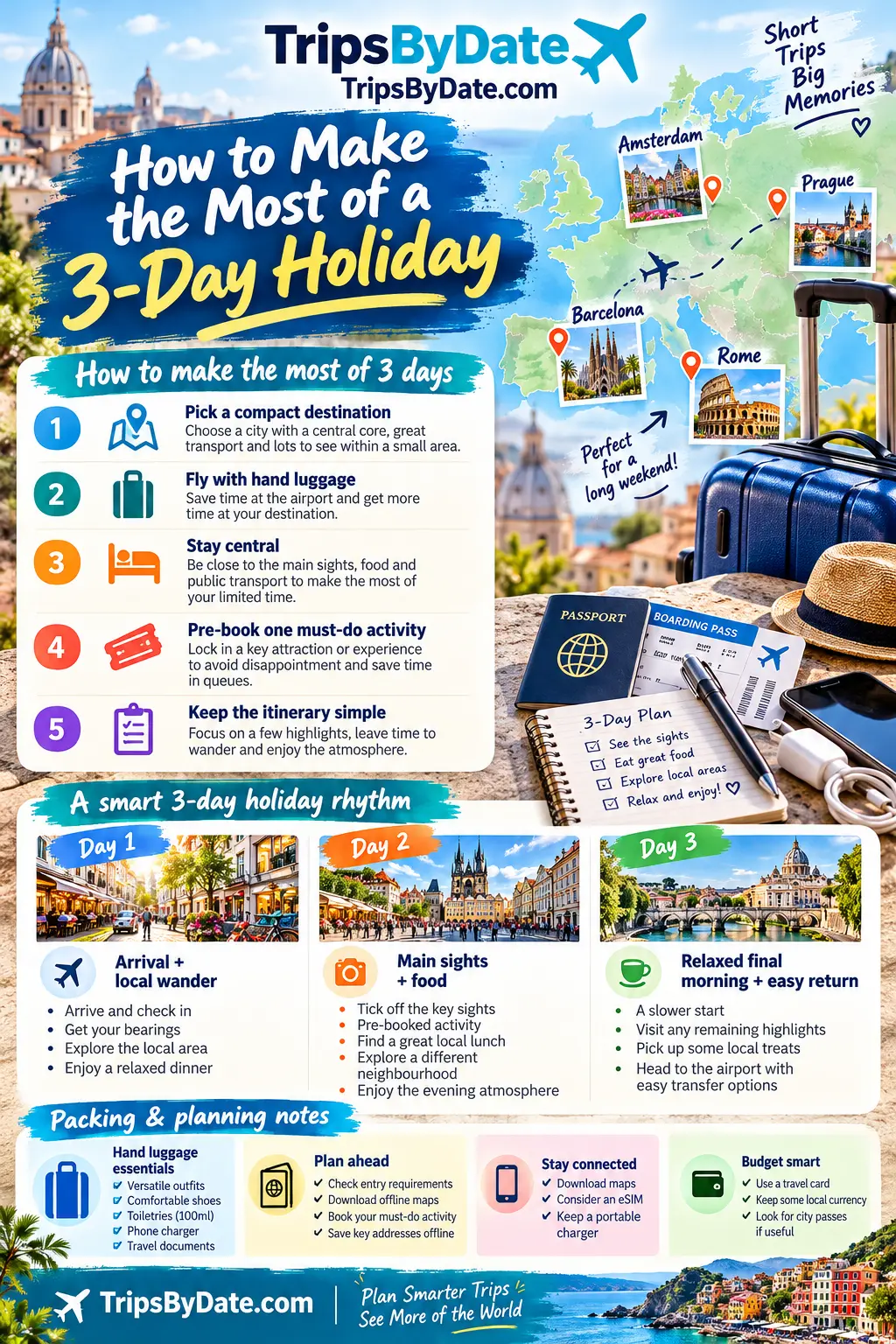
Amsterdam, Prague, Barcelona and Rome all feature in the main image, and all can be rewarding short escapes. But do not assume every flight to a well-known city leaves you equally close to your hotel. Some airports connect beautifully to the centre; others require a bus, rail change or long taxi journey. Compare the airport you actually land at, not merely the city name in a holiday advertisement.
Amsterdam is an instructive example: Schiphol's rail station is directly below the terminal, with trains to Amsterdam Centraal. The airport's official rail guidance explains the connection and ticket choices. That makes it relatively easy to plan arrival day, although queues, late flights and train disruption can still affect your journey.
Prague works differently: Václav Havel Airport describes public transport connections using a bus or trolleybus followed by the metro, as well as an Airport Express service to the main station. Check its official route guidance for the terminal, stops and current services. The best option depends on where your hotel is, not simply which route looks quickest on a map.
For an alternative approach, compare short breaks without choosing a destination first. On TripsByDate, starting with the days you are free can reveal places you had not thought about. The clever part comes next: check whether getting there is simple enough for your short holiday.
2. Book the hotel for your evening, not just your sightseeing
The best-value hotel is not always the closest to the most famous landmark. Choose somewhere you would be happy to return to after dinner, with convenient transport and a pleasant local area. A slightly less central neighbourhood can be excellent if it has restaurants, easy onward connections and a lively atmosphere without the noise directly outside your window.
Try the three-point map test: mark the arrival station, the one attraction you really want to see and the area where you expect to have dinner. If the hotel sits sensibly between them, you may be onto something. If every route takes you through the same enormous interchange, that suspiciously cheap room may have a hidden price in lost time.
Check luggage storage and check-in arrangements before booking. Arriving before your room is ready is fine if the hotel can securely hold your bag. Arriving to discover it cannot may turn your first morning into a guided tour of your own suitcase.
3. Pre-book one big thing and leave the rest breathing room
Reserve a timed-entry attraction if you would be genuinely disappointed to miss it. Then group nearby sights and cafés together. If you book every hour, a delayed metro train can turn your itinerary into a series of expensive apologies. A good rule of thumb is one anchor experience each full day, with optional stops nearby.
In Rome, an ancient-history morning might lead naturally to Monti and a relaxed evening rather than an immediate cross-city sprint. In Barcelona, a pre-booked architecture visit can be paired with time in one neighbourhood instead of collecting landmarks like supermarket loyalty points. Barcelona's tourism organisation highlights Passeig de Sant Joan as a pedestrian-friendly connection between areas such as Gràcia and the Arc de Triomf.
4. Build the itinerary in neighbourhood-sized pieces
Rather than writing a list of attractions, draw little circles around walkable areas. Give one area the morning and another the afternoon if transit makes sense. You spend less time navigating and more time noticing the things between the sights: a bakery queue full of locals, an unusual doorway, a courtyard you would never have searched for.
An Amsterdam detour that costs very little: instead of spending the whole time around the central canals, take the free ferry behind Centraal Station to Noord. I amsterdam's neighbourhood guide points to its waterside spaces, cultural venues and contrasting architecture. The ferry itself gives you a different view, and you can choose how long to explore rather than committing to a major paid excursion.
For travellers with mobility needs, verify step-free routes, distance and accessibility in advance. "Walkable" on a travel website does not always mean comfortable with a wheelchair, pushchair or tired child.
5. Reduce tiny bits of friction before you leave
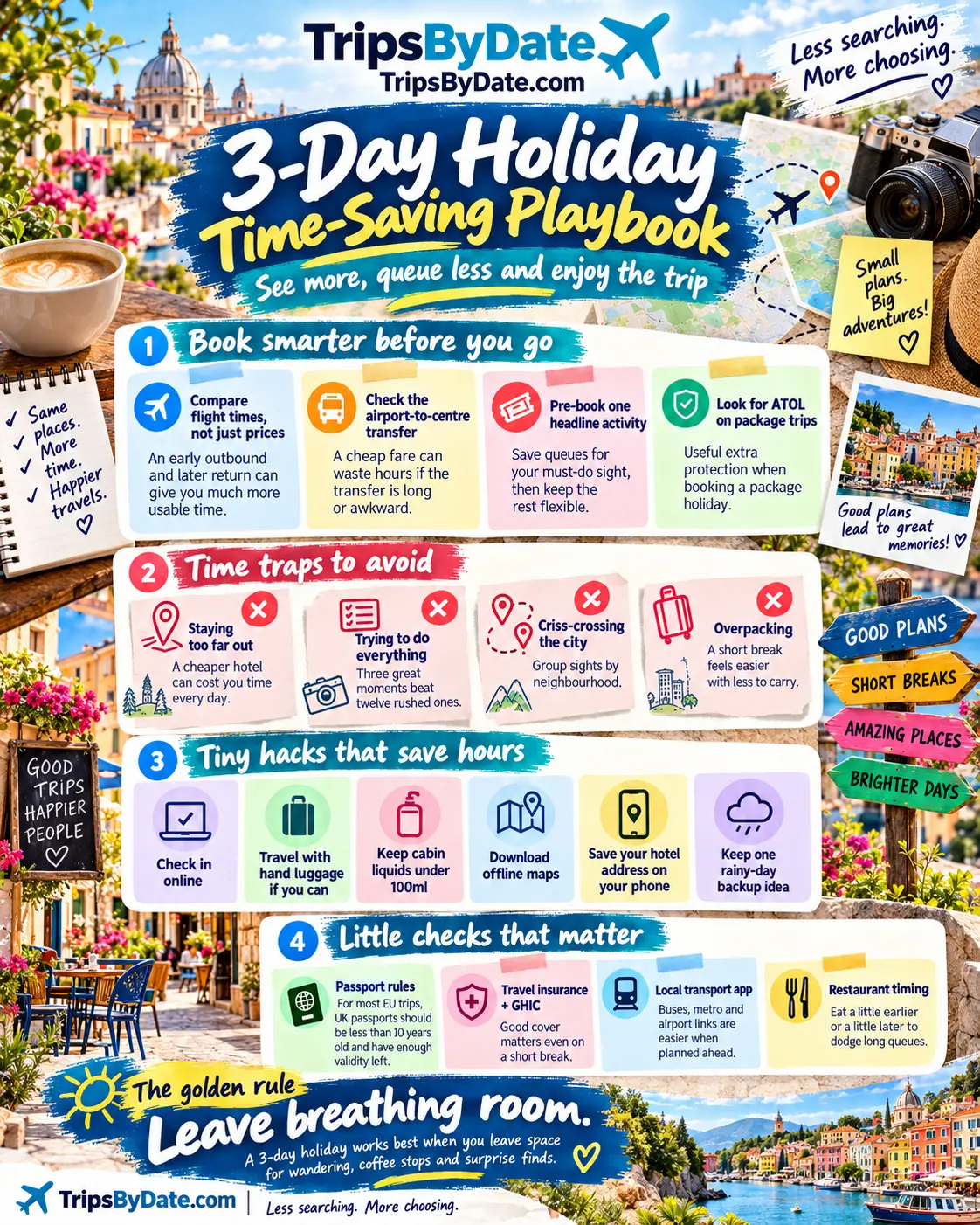
Download an offline map, save your hotel address, pin the airport transfer stop and screenshot tickets that may be awkward to find without signal. Know whether your chosen transport needs a validated ticket or contactless tap. If travelling together, put the key booking details somewhere everyone can access them. A dead phone is a remarkably efficient way to turn independent adults into confused pigeons.
Use online check-in where available, confirm your baggage dimensions with the actual airline and consider hand luggage when it suits your needs. Carry-on only may avoid waiting at baggage reclaim, but a larger cabin bag sometimes costs extra. Compare time, convenience and price, not just the number of suitcases.
The UK air travel checklist is useful for documents, airport procedures and special assistance. Airport liquid rules and screening technology can vary, so check both airports before packing. For flights through EU airports, review the EU luggage guidance rather than relying on a rule someone remembers from their last trip.
A three-day itinerary that actually feels like a holiday
Day 1: arrive, settle in and have your first little adventure
Go directly to your base, drop the bags and explore a small area around the hotel. Try a market, a riverside walk or a café with a view. Book an uncomplicated dinner close to where you are staying. This is not the moment for three museums and a heroic cross-city hike. Your mission is to start enjoying yourself as quickly as possible.
The arrival-night trick: look for an evening experience that requires minimal organisation, such as a scenic bridge, public square or waterfront promenade. You create a memorable first impression without risking a non-refundable attraction booking if the flight is late.
Day 2: one major experience, one neighbourhood, one memorable meal
Make this the centrepiece of the trip. Visit the attraction you pre-booked, have a proper lunch in the same area, then wander somewhere close by. Leave your evening flexible enough to follow a local recommendation. For a couple that might mean a rooftop view; for friends, a tasting trail; for a family, a park or hands-on activity after the headline sight.
Unusual trick: plan an "opposite" experience after the big attraction. After a museum, go outdoors. After a busy market, sit in a park. After a hectic city centre, find a quiet street. Contrast helps a short trip feel richer without adding a long journey.
Day 3: a slow finale, with no airport heroics
Choose breakfast somewhere convenient, revisit a favourite street or browse a small shop, then leave enough time to get back to the airport. If your flight leaves later, you can add another attraction, but only after checking its distance from the hotel and your departure route. A relaxed final coffee beats running through an unfamiliar station with a croissant in your mouth.
This is a framework, not a promise of three sightseeing days. A late arrival or early return means cutting it back, not trying to squeeze everything into fewer hours. For longer schedules, compare our four-night and five-night holiday guides.

Three days free? See what fits.
Choose your departure airport and available dates on TripsByDate, then browse upcoming package holidays across destinations. Check the actual duration and flights before deciding.
Explore holidays by dateLittle time-saving secrets most three-day guides miss
- Find your departure-day luggage plan: check whether your hotel will hold bags after checkout, so you do not spend the final morning hauling a case across cobblestones.
- Research the Monday problem: some museums, markets and restaurants close on certain days. Fit your must-see around actual opening hours, not the order recommended in a generic itinerary.
- Choose a café close to the first activity: breakfast in the right location can quietly save a journey and give you a much nicer start.
- Know the last useful train: your airport transfer plan needs to work at your actual arrival and departure hours, including late evenings and early mornings.
- Check the hotel breakfast clock: a breakfast included in the rate has little value if you must leave before it is served.
- Make a tiny bad-weather list: one indoor market, gallery or cosy food stop is enough to prevent a rainy afternoon becoming a search-engine marathon.
- Watch the time-zone effect: departure and arrival times are printed in local time. Compare the real journey, especially when you have only a brief stay.
- Eat near the next thing: turning lunch into a stop along your route is smarter than travelling across the city for a restaurant that happened to go viral.
- Use public transport as an experience: a scenic tram, ferry or waterfront bus can be both an efficient transfer and one of the best moments of the holiday. Just check whether it actually goes where you need.
Some of these tricks save only a few minutes individually. Together, they replace the background stress of figuring everything out with the much better problem of deciding which pastry to try next. For more detailed budgeting, see our true weekend-cost guide.
How couples, friends and families can make three days work
For couples: plan one shared moment, not an entire romantic production
Choose one thing that feels special to both of you: a waterside dinner, unusual food tasting, sunset view or live performance. Use the remaining time to wander and chat. If one person likes galleries and the other loves markets, alternate your priorities instead of making the trip one long compromise. More inspiration is in our weekend breaks for couples.
For friends: agree on three decisions before anybody pays
Set the dates, total budget and one shared must-do. Then let everyone nominate an optional stop. If the group is large, a split-up hour can work wonders: some shop, some visit a museum, some find a coffee, and everyone meets for dinner. Nobody needs to spend the entire weekend voting on where to have lunch. Our friends' weekend guide covers accommodation, shared costs and planning without group-chat warfare.
For families: the best itinerary may have the fewest transitions
With children, transfers, meals, naps and queues can matter more than the number of attractions. Choose one major family activity, then add a playground, park, aquarium or hands-on museum nearby according to age and interests. Book family-friendly accommodation for realistic bed layouts, lift access and simple transport. A hotel pool can be useful, but check the hours and whether children may actually use it.
Family secret: arrange the sightseeing around a known reset point. A park with toilets and a nearby snack stop can save an afternoon. The attraction is not ruined if your child remembers feeding ducks more vividly than the famous cathedral.
Should you book a three-day break as a package?
Sometimes. A combined flight-and-hotel deal can make comparison and budgeting easier, but it is not necessarily cheaper than buying separately. Check the full price, flight schedule, accommodation location, bags, transfers and cancellation conditions. A seemingly convenient package with a poor return flight may take away the very hours you were trying to gain.
If you buy a qualifying flight-inclusive package, check the organiser's protection and your ATOL Certificate. The Civil Aviation Authority explains ATOL protection, which is distinct from travel insurance. Our package versus separate-booking guide walks through that decision.
The TripsByDate approach: instead of deciding on a destination and repeatedly entering different dates, choose your UK airport and the time you have free, then browse upcoming holidays across destinations. It helps you discover possibilities quickly, but you should still inspect the trip length and details of the operator's offer. For practical search ideas, read finding holidays around your available dates.
Before you fly: the checks worth doing even for a short trip
Check official UK foreign travel advice for the destination, including entry rules and passport requirements. Different European countries have different rules, so do not assume one generic checklist covers them all. Obtain appropriate travel insurance and check healthcare arrangements. The FCDO foreign travel checklist also recommends keeping backup travel documents and important details accessible if your phone is lost or unavailable.
Remember that a GHIC is not a substitute for travel insurance. If a traveller needs accessibility assistance, medication, baby supplies or special documentation, arrange these properly rather than treating a short trip as an excuse to skip preparation. Fast travel starts with fewer surprises, not fewer safeguards.
Frequently asked questions about three-day holidays
Is three days enough for a holiday in Europe?
Yes, for many compact destinations, provided the transport and accommodation work for your schedule. Choose a manageable area and a few meaningful experiences rather than trying to see an entire country.
Is a three-day holiday the same as a three-night break?
No. Three calendar days can mean two nights, while a three-night break may give you two or three meaningful sightseeing days depending on travel times. Always read the actual departure and return details.
What is the biggest time-waster on a short break?
Often it is a combination of awkward airport transfers, inconvenient accommodation and criss-crossing between attractions. Fixing those can be more valuable than packing another sight into the itinerary.
Should I bring only hand luggage?
It can save time if you can pack comfortably within the airline's allowance, but bags have different size and price rules. Check the airline and airport requirements for both journeys.
How many attractions should I book for three days?
Book the essentials that genuinely require tickets, but resist filling every hour. One priority on a main sightseeing day, plus nearby optional experiences, is a good starting framework rather than a strict rule.
Are three-day holidays suitable for families?
They can be, especially with straightforward transport, flexible meals and age-appropriate activities. Plan around energy levels and breaks, not an adult sightseeing schedule.
What if the flight is delayed?
Protect your trip with an adaptable arrival plan, relevant insurance and knowledge of your transfer options. Avoid non-refundable activities immediately after your scheduled landing. Check your airline's communication and passenger rights if disruption occurs.
How can I find a three-day getaway without a fixed destination?
Use TripsByDate to browse upcoming holidays based on your airport and free dates. Then compare flight times and nights carefully, because the displayed examples are not guaranteed to match a three-day itinerary.
Explore more useful short-break guides
For destination inspiration, try best weekend breaks in Europe. For a tighter schedule, read best two-night breaks. If your top priority is reducing the price, explore cheap weekends from the UK or how to plan a weekend abroad.
The point of a three-day holiday is not to prove how much you can fit into a bag or a timetable. It is to come home with a few vivid memories, a great story and perhaps a new favourite place. Give the practical details a little attention before you leave, then spend the actual holiday enjoying it.
‹ BACK TO SHORT BREAKSMake your free days count.
Choose the dates you can travel and your UK departure airport, then discover upcoming package holidays across destinations on TripsByDate. Less searching. More choosing.
Find holidays by date