

Cheapest Family Beach Holiday Destinations: Where the Sand Comes With Better Value
From the Algarve and Menorca to lesser-known Spanish beaches and the Adriatic, discover where a family can enjoy the sea without paying for every happy moment.
The most expensive family beach isn't always the one with the fanciest hotels. Sometimes it's the gorgeous little cove reached by ninety-seven steps, followed by a taxi, four sunbed rentals and a compulsory ice cream because everybody is now cross. A better bargain might be a broad, unglamorous-looking beach with clean toilets, somewhere to buy lunch and a hotel you can walk back to before the youngest child declares the entire holiday a personal injustice. Here's how to find the right beach for your family, not just the cheapest headline price.
The quick answer: Start by comparing the Algarve, Sunny Beach and Nessebar, Menorca, Lanzarote, Costa Daurada and Cyprus for a traditional package beach holiday. Then investigate Peñíscola, Alcossebre, Mojácar, Istria, Ksamil, Las Palmas and Bečići if your family values a particular kind of beach, town or adventure. None is permanently the cheapest. Package prices change with your airport, school-holiday dates, family size and actual room availability, while the cost of meals, transport and facilities can reverse the apparent bargain.
If you're travelling with a toddler, a gently shelving beach and a toilet nearby may matter more than a giant waterpark. With teenagers, you might swap the shallow paddling cove for snorkelling, shops, cycling or a historic town. And if the grown-ups would like ten minutes to finish a coffee while it's still hot, a pleasant beachfront promenade deserves a place in the budget calculations too.
What does "cheapest" actually mean for a family beach holiday?
There are three different prices to compare. The first is the price of getting there, the second is the price of living there, and the third is what the beach itself costs you in time, money and effort.
A useful bit of real evidence: in its survey of 5,393 summer package prices for 2026, Which? found the Costa Blanca the lowest-priced destination in its comparison, with an average of £864 per person for a seven-night August package in its sample, compared with £1,133 per person for the Costa Daurada. Fuerteventura and other Spanish regions also appeared among its lower-priced options. In a separate check of 8,794 packages compared between March and July 2026, Which? found last-minute price falls in many destinations, including the Costa Daurada and several Greek and Canary Island destinations.
The catch is important: those published comparisons use packages for two people sharing a room, not a family-of-four or family-of-five quote. They are evidence about market behaviour, not a promise about what your family would pay. They also show why proclaiming one country "Europe's cheapest family holiday" for every month is misleading. The cheapest option can change before you've even found the passports.
For spending once you arrive, Eurostat's comparative European price-level data, published through Statistics Norway, show that everyday prices differ substantially between European countries. Bulgaria tends to have lower overall consumer prices than Portugal or Spain. But that doesn't tell you the cost of a particular seaside resort, and it certainly doesn't include your UK flights or a school-holiday family room. Use country-level data to choose places to investigate, not as a substitute for a real quote.
Make a genuine family price comparison
For every promising holiday, record the total for your actual party, including children's ages and a room that legally accommodates everybody. Then check the same six things: flights and bags; transfers; meals; beach access; essential equipment or facilities; and one or two activities the children really want.
A family with a buggy can spend less by paying a little more for a hotel near a suitable beach. A family with confident swimming teenagers might get far more value from a basic apartment near shops and watersports than from a distant all-inclusive resort. Cheapest isn't a personality type. It depends on what your family will actually do.
The six beach destinations I'd compare first
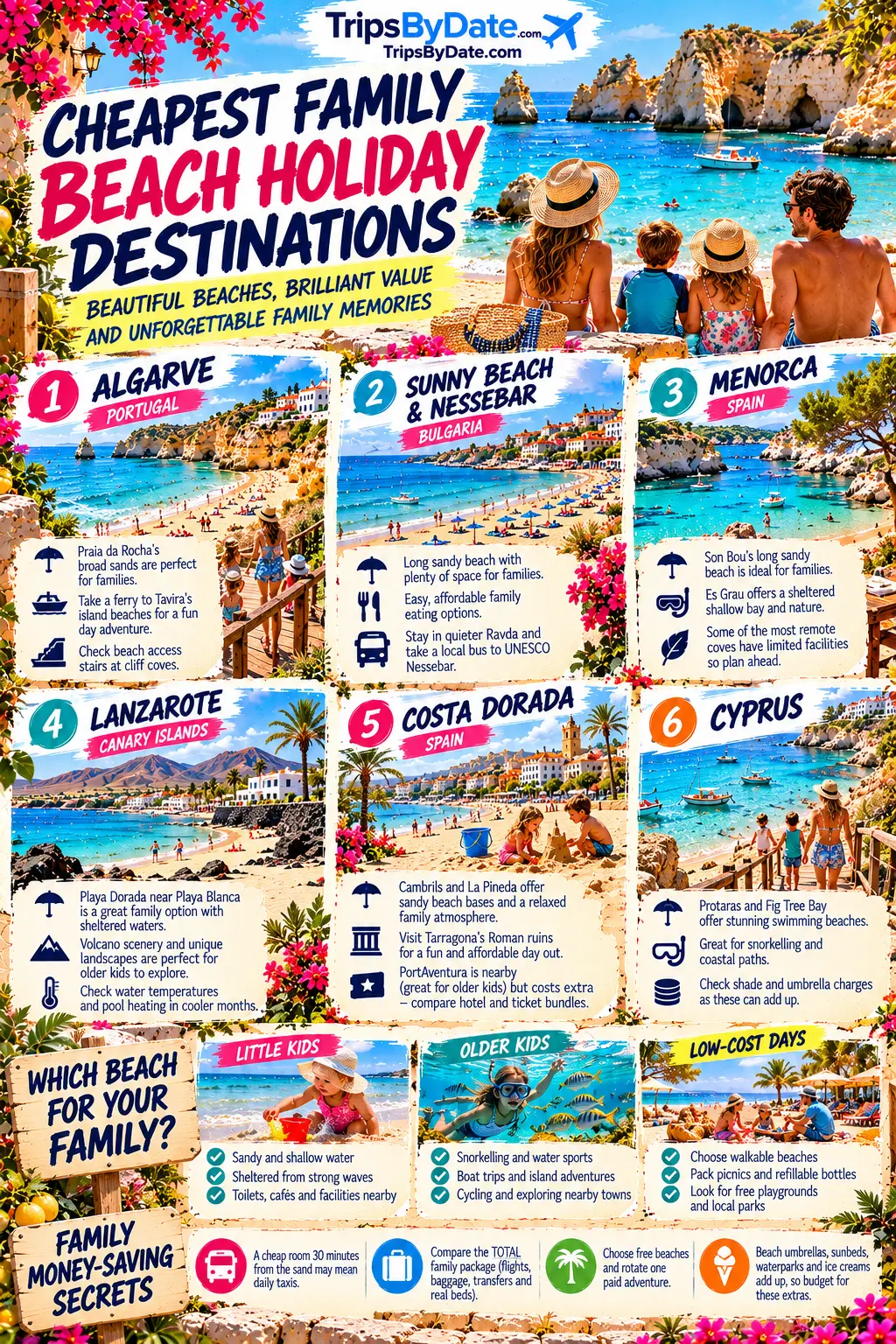
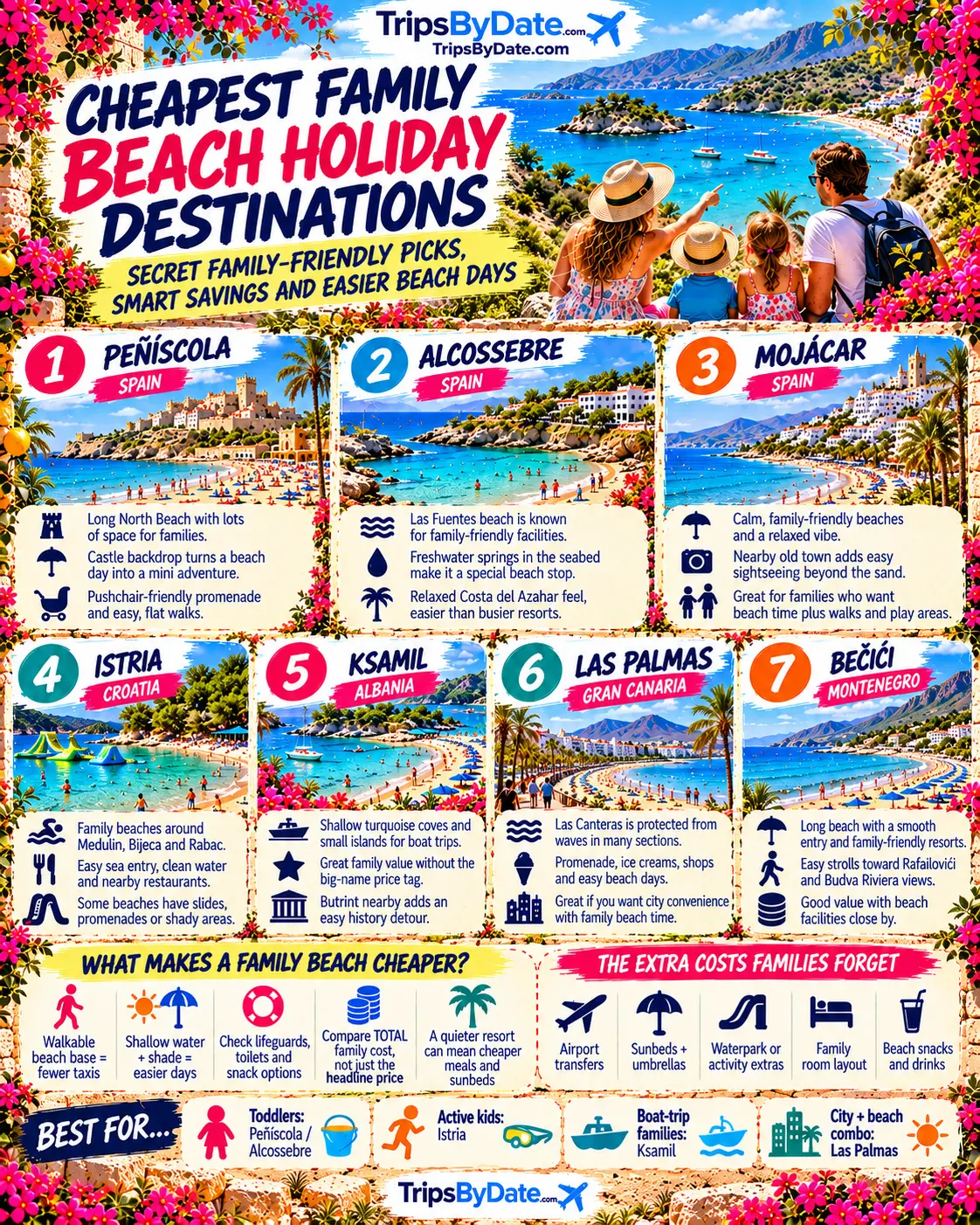
The first image highlights six established choices. Each can work brilliantly, but the specific beach and resort area are much more useful than the country name.
1. Algarve, Portugal: stunning beaches, with a warning about the stairs
Best for: families wanting a mix of sandy days, seaside towns, boat trips and memorable scenery.
The Algarve gives you everything from long open sandy beaches to smaller, spectacular coves carved into cliffs. Those coves look like they were designed to sell postcards. Unfortunately, some also come with steep steps and difficult access, which is less romantic when you're carrying two towels, a buggy and a child who has decided walking is over.
For the Praia da Rocha area, compare accommodation close enough for an easy walk to the broad beach. For something more exploratory, Tavira is an appealing base for visiting lagoon and island beaches. The Ria Formosa Natural Park is an extraordinary coastal landscape, but island beaches can require a ferry and some extra walking. Check the actual timetable, return journey and conditions before committing to a beach day with small children.
A good-value day: picnic provisions from a supermarket, a morning beach visit and an afternoon exploring town. That's more fun than spending the day chasing parking spaces and doesn't require three expensive excursions.
Budget warning: cliffside hotels described as "beach nearby" may be above the sand rather than directly accessible to it. Check the walking route, not the straight-line distance. For a wider comparison, see our Portugal budget guide.
2. Sunny Beach and Nessebar, Bulgaria: lots of beach, but choose your street
Best for: families seeking long sandy days, plenty of eating options and a historic place to explore nearby.
Sunny Beach is a substantial resort, not a single experience. Some areas offer straightforward family beach holidays; others are lively enough to keep the teenagers interested and the toddler awake until midnight. Check recent hotel reviews for noise, the precise neighbourhood, and whether the walk to the beach crosses busy roads.
The clever combination is a seaside base with a day in Nessebar, a historic old town on UNESCO's World Heritage List. It's a very different kind of entertainment: cobbled lanes, old buildings and the sort of exploring that feels like an adventure rather than an educational trip in disguise. Nearby Ravda may also be worth comparing for a different atmosphere, depending on the accommodation available.
The real savings: local eating can be good value, but daily hotel-resort prices vary. Look for a supermarket, somewhere simple to eat and a reliable way of reaching Nessebar without buying an organised tour. Bulgaria is a particularly sensible destination to investigate when on-the-ground spending matters, although low local prices won't always beat a better flight-and-hotel deal elsewhere.
Compare some real holiday possibilities by date
If the ideal holiday is "a week when the children are off, with a good beach and something interesting nearby", you don't need to swear allegiance to one resort before starting. TripsByDate lets you browse package ideas by departure date, with an optional UK departure airport, and see destinations you might otherwise miss.
Start with two possible travel weeks and a shortlist of places with the kind of beach you need. The listings below are for inspiration, not verified family-price quotes or guarantees of beach conditions. Check the provider's live offer using your exact children's ages, sleeping arrangements and inclusions.



 LGW • 7 nights
 AI · easyJet holidays

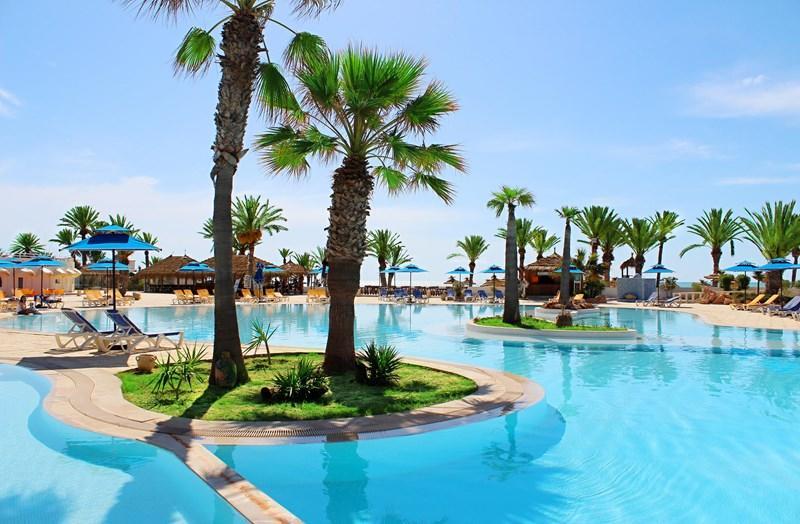 MAN • 7 nightsAI · easyJet holidays
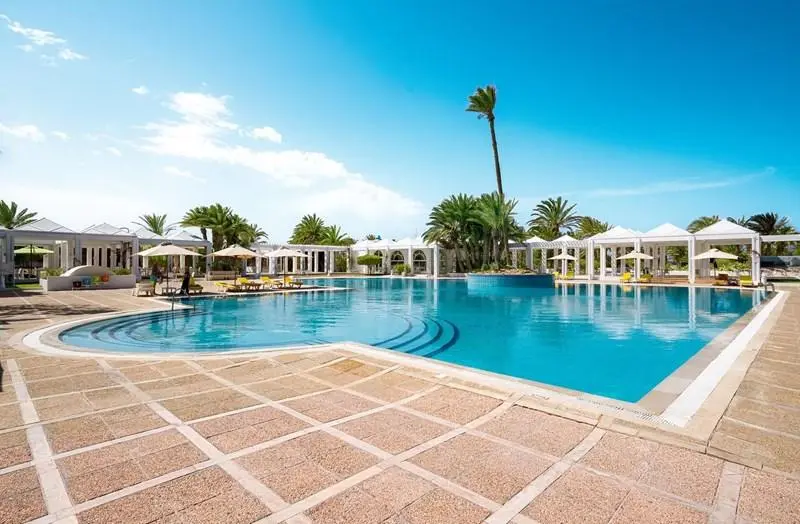 MAN • 7 nightsAI · easyJet holidays
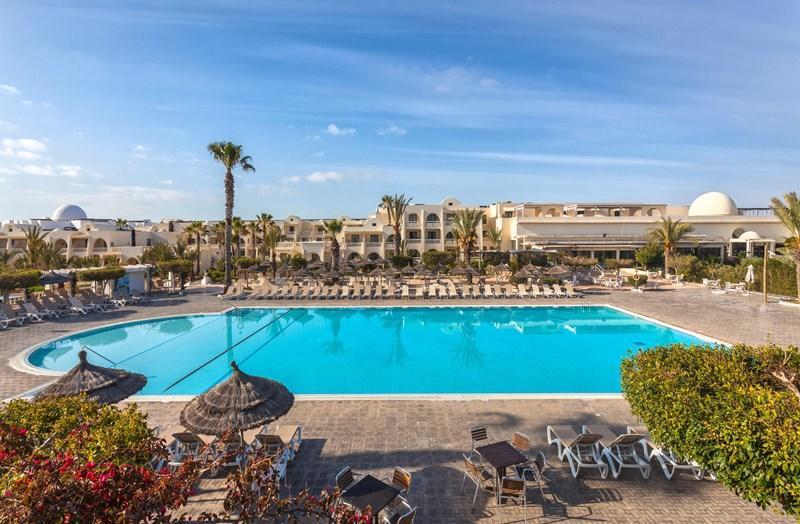 MAN • 7 nightsAI · easyJet holidays
3. Menorca, Spain: a holiday built around the right patch of sand
Best for: younger children, relaxed beach days and families happy to explore at an unhurried pace.
Son Bou is worth investigating if you want a long sandy beach and a traditional holiday base. Es Grau offers a different, more natural feeling, with a sheltered bay. Neither eliminates the need to check weather, depth and supervision on the day. And the island's tiny picture-perfect coves are not all ideal for buggies: some involve walks, rough paths or limited facilities.
Here's a useful distinction. A family whose children love making sandcastles may be happier with a long beach that has toilets and food nearby than with an Instagram-famous cala requiring a morning expedition. Older children might relish an occasional trip to a beautiful cove, provided everybody understands there may be a walk involved.
The budget decision: Menorca shouldn't be assumed cheaper than mainland Spain or Bulgaria. Compare the actual package and whether a hire car is necessary for your plans. If you mainly want one good sandy beach, paying for a vehicle every day may add little value. Keep a weather-proof alternative such as a village visit or simple harbour stroll in your pocket.
4. Lanzarote, Canary Islands: beach days with a side of volcano
Best for: families who want something to explore besides the sand, including trips beyond the main summer period.
For the first swimming location, compare Playa Dorada in the Playa Blanca area with the beach nearest any hotel you're considering. Resort beaches vary: some are more sheltered, while others are exposed to wind or waves. Don't confuse a sunny afternoon with a sea that's necessarily comfortable for young swimmers.
Lanzarote's greatest family freebie may be its strange scenery. A short, sensible walk through a volcanic landscape or a visit to a whitewashed village can make children feel as though they've landed on another planet. Paid attractions can be memorable too, but compare admission prices and any transport needed before building your week around them.
Check before booking: pools may not be heated, especially at cheaper hotels. A pool displayed in a photograph is not proof of warm swimming water in February, March or November. Compare the best months for a European beach break with your children's willingness to swim in cooler water.
5. Costa Daurada, Spain: the beach-and-adventure combination
Best for: families with children of different ages who want easy seaside days and optional bigger outings.
Cambrils and La Pineda are worth comparing as family bases. You can spend ordinary days on sand, in cafés or on waterfront walks, and occasionally swap the beach for something more energetic. Nearby Tarragona has impressive Roman heritage, and the wider area is home to PortAventura World, which should be treated as an extra expense, not a free benefit of booking a Costa Daurada hotel.
The smart approach is to decide before booking whether your family genuinely wants a theme-park day. If yes, price the entrance tickets and transport for everyone. If not, don't pay a premium to stay near it just because the brochure says it's nearby. A beach, a historic town and some gelato can deliver a perfectly good holiday without a rollercoaster budget.
The price clue: the Costa Daurada appeared in Which?'s published 2026 package comparisons, but that doesn't mean every family-sized room will be low-cost. Compare it against the Costa Blanca and other Spanish coasts on identical dates. Our Spanish budget destination guide gives more alternatives.
6. Cyprus: excellent beach facilities if you pick the right bay
Best for: families who want a warm-weather beach break with places to explore beyond the hotel.
Rather than booking "Cyprus" as if it's one enormous beach, compare Protaras, particularly Fig Tree Bay, with the Paphos area and Coral Bay. The official Cyprus tourism website lists toilets, changing facilities, umbrellas, food options, access arrangements and seasonal lifeguard provision for Fig Tree Bay. Its Coral Bay guide describes a bay with calm, shallow water and useful facilities.
Those details matter. An accessible beach with changing facilities can make a holiday work for toddlers, grandparents and families with additional mobility needs. But published lifeguard seasons are not proof of cover on your particular day; check locally, particularly at the beginning and end of the season.
Cyprus can be a great beach-and-history holiday, but the full package may be higher than some mainland destinations. Compare shoulder-season dates if you can travel then, and use our Cyprus budget guide to explore other areas.
A good beach is more than clean-looking water
It's tempting to ask "Which beach is safest in Europe?" There isn't a defensible permanent winner. A calm-looking sea can develop dangerous conditions, and a beautifully coloured beach may have poor access or no lifeguard on duty. Safety belongs to the actual beach, date and conditions, not a country's marketing slogan.
Use three different checks, not one badge
- Bathing water quality: The European Environment Agency's bathing-water viewer and reports help you check monitored locations. Its 2025 assessment found that around 88% of EU coastal bathing sites had excellent water quality. That measures particular indicators of pollution, not wave safety or suitability for toddlers.
- Beach management and facilities: Blue Flag's published criteria cover areas including water quality, facilities, information and safety arrangements. However, Blue Flag does not mean a lifeguard is necessarily patrolling every hour. Some qualifying beaches use appropriate rescue equipment instead.
- Today's conditions: Lifeguard coverage, currents, wind, tides and local flags are what matter when the family actually enters the water. The RNLI's beach-safety explanations are a useful refresher, including why red flags mean stay out of the sea.
A beach with excellent water quality, convenient toilets, shade and a lifeguarded swimming area is a much stronger family candidate than somewhere chosen for its turquoise appearance alone. No beach, however, removes the need to supervise children closely.
The beach-facility check nobody puts on the postcard
Before booking, check whether you can find a toilet, drinking water, shade, a place to change, a safe access route, reasonable food and a way home without waiting an hour in the heat. Find out whether loungers occupy most of the sand, whether there's room for your own towel, and whether parking or a shuttle bus is needed.
For some families, accessibility is not optional. An official beach access ramp or a beach wheelchair programme may make a real difference, but availability, staffing and the route from your accommodation need confirming directly. A hotel described as "accessible" doesn't automatically mean the path between it and the water is.
Seven alternatives that deserve a closer look
Peñíscola, Spain: castle views, sand and a strollable seafront
Best for: families with younger children who appreciate space and straightforward facilities.
Peñíscola's North Beach runs beside a substantial promenade, with the castle anchoring one end. Spain's official tourism website specifically highlights its access walkways, surveillance service and family suitability. The beach is more useful to many parents than a secluded cove because you can divide the day into short, comfortable trips.
Make a miniature adventure out of spotting the castle, then return to the sand. Children who have had enough swimming can still enjoy an old-town wander, while parents don't have to negotiate a remote beach car park. The official beach profile also lists showers, play areas and other facilities. Verify seasonal operation before relying on them.
The catch: airport access is less simple than arriving at a resort directly beside a major international airport. Spain's tourism site identifies Valencia and Reus as possible gateways, both some distance away. A cheap flight only helps if the onward journey still makes sense for your party.
Alcossebre, Spain: the clever alternative for a simple family day
Best for: families wanting comfortable sandy beaches and a calmer pace than a major resort.
Las Fuentes is an unusual beach because of its freshwater springs. The Castellón tourism beach listing describes sand, accessibility arrangements, a seafront walkway, toilets and other visitor facilities. Nearby beaches and the surrounding coast give families more than one place to explore.
One particularly good idea is a beach morning followed by a gentle stroll along the waterfront. For older kids, cycling or a coastal walk offers a different activity without automatically buying an attraction ticket. Spain's official family destination guide also notes nearby routes and excursions.
The catch: the transfers deserve close attention. A lower-priced apartment in Alcossebre can stop looking cheap if you need an expensive airport transfer and daily taxis. Check the route and compare the convenience against more familiar resorts before booking.
Mojácar, Spain: one destination, two very different afternoons
Best for: beach-loving families who also enjoy beautiful streets and exploring.
Mojácar has a striking white hilltop town and a separate coastal area. That makes it particularly attractive to families who want something to do when beach fatigue sets in. Spain's family coastal destination guide identifies a number of well-equipped beaches around Mojácar and mentions children's facilities and water activities.
The trick is to stay near the beach you'll use most. The old town is a wonderful visit, but Mojácar Pueblo isn't the same as Mojácar Playa. Check the actual distance and slope. A family that enjoys a morning swim and an evening wander can get a lot from this combination, provided the transport is manageable.
The catch: some stretches are more convenient or better equipped than others. Ask about seasonal beach services and don't assume a pretty photograph tells you anything about currents, water temperature or the cost of parking.
Istria, Croatia: coves, old towns and the question of beach shoes
Best for: active families who like swimming, exploring historic towns and having a different outing each day.
Istria's coast offers attractive swimming spots around places such as Medulin, Bijeca and Rabac, with charming old-town trips available elsewhere along the peninsula. But don't arrive assuming every Croatian beach is a vast sandy playground. Some popular stretches are pebbly, rocky or have concrete bathing platforms.
That's not necessarily bad news. Older children often love clear-water swimming, snorkelling and scrambling along a carefully chosen shore. For toddlers who want to dig holes and crawl along soft sand, however, the exact beach surface could decide whether the week is delightful or an extended negotiation about footwear.
Budget move: compare an apartment with a usable kitchen and beach access against a seafront hotel. If you'll need a hire car to visit several different coves, add parking, child seats and fuel to the calculation. The best value may be a slightly less scenic base where you can simply walk to the water.
Ksamil, Albania: gorgeous scenery, with extra homework before booking
Best for: families comfortable planning more independently, particularly with older children.
Ksamil is famous for its attractive coves, turquoise-looking water and small offshore islands. That makes it tempting when you're looking beyond the big Mediterranean names. However, a beautiful beach photograph is not an infrastructure report. Busy areas can have privately operated beach furniture, limited free space or seasonal services, and you need to check which arrangements apply to the exact stretch of shore you plan to use.
The European Environment Agency's coastal bathing-water comparison is useful context: Albania's monitored coastal sites had a lower share classed as excellent in the 2025 assessment than most countries in the dataset. That is not a claim that every Ksamil beach is unsafe, but it is a good reason to look for the most recent site-specific information rather than rely on adjectives such as "pristine". Water monitoring and lifeguard coverage are separate checks.
The practical warning: calculate flights, road transfer, beach access and food together. Check the latest UK government advice for Albania before travelling. For a family that wants a turnkey resort holiday with little planning, a more established package destination may be the better buy.
Las Palmas, Gran Canaria: a proper city that happens to have a beach
Best for: families who want food, shops, museums and beach days without hiring a car.
Las Canteras might be one of the most useful alternatives for a family that tires of purpose-built resorts. It's a large urban beach backed by a promenade, shops and places to eat. Gran Canaria's official tourism guide explains how the offshore reef known as La Barra helps shelter parts of the shoreline. Other stretches have surf conditions, so choose the actual place to swim rather than assuming the whole beach is equally calm.
The advantage is a full family day without a complicated plan: beach in the morning, lunch somewhere simple, browsing shops in the afternoon, then back to the sea for a sunset walk. There are no compulsory excursions and the children can have different kinds of fun within the same neighbourhood.
The price trap: this is a real city, with different accommodation categories and a potentially busy urban atmosphere. Compare hotel location, noise and walking distance to your preferred section of beach. It may be ideal for a mixed-age family, even if it's not the absolute cheapest package on your dates.
Bečići, Montenegro: a spacious-feeling beach near Budva
Best for: families looking for seaside facilities with other towns nearby to explore.
Bečići offers a beach-focused stay near Budva and Rafailovići. Montenegro's official family beach guide identifies Bečići and other stretches of the Budva Riviera among family options, noting activities such as sports and waterslides in the wider selection.
The appeal is being able to choose between an ordinary lazy beach day and an outing to another part of the coast. Older children may enjoy boat trips and watersports where suitable, while smaller ones may be happiest with a straightforward seaside routine.
The catch: not every stretch is sandy in the same way, and sunbeds or activities can carry charges. Ask whether your accommodation includes a beach area, compare the cost of beach furniture and read the Montenegro travel advice before booking. A family package with easier flights and transfers elsewhere might prove better value.
Find a beach break that fits your family
Browse TripsByDate by departure date and explore package holidays across destinations you might not have considered. Choose the beach experience first, then check the actual room, ages, flights and final family price with the travel provider.
Find holidays by dateWhen in the school holidays is a family beach break cheapest?
There is no universal winning week. And anyone promising "the last week of August is always cheaper" is overlooking how different school calendars, flight schedules and package availability interact.
The beginning of summer versus the end
- Early summer holiday weeks: Some UK schools finish earlier than others. Depending on your airport and destination, the first available week after your school's term ends may face less or more demand than later weeks. It's worth checking, but there is no price guarantee.
- Peak summer weeks: Popular family-room types and convenient flights can be in heavy demand. If you need adjoining rooms, a particular kids' club or a short transfer, having a choice of accommodation may matter more than waiting for a late discount.
- Later summer holiday weeks: Prices can change as some UK and European schools return, but different regions go back on different dates. Compare the actual departing week, return week and airport rather than treating August as one price block.
The research offers a particularly useful warning against certainty. Which?'s summer 2026 price tracking found that prices had fallen for a number of August destinations as departure approached. But those results were historical, not a reliable forecast, and the research wasn't based on families needing specific room types. A last-minute deal with two adult seats and one double room available is no help to a family of five.
Check your own school's term dates through the government school calendar service. If you can travel legally outside the busiest periods because you have preschool children, or your circumstances allow greater flexibility, compare May, June and September. For school-age children, don't treat unauthorised term-time absence as a budget hack. Our guide to holidays outside school breaks explains the distinction.
The best weather isn't necessarily the best family weather
A blazing afternoon is fantastic until nobody can walk on the sand barefoot. For tiny children, extremely hot high-season conditions may be less comfortable than a milder late-spring or early-autumn break. On the other hand, out-of-season sea temperatures, wind and closed facilities may disappoint a family whose entire plan is swimming.
Make the decision from three conditions together: the likely air temperature, the sea or pool temperature, and what's actually operating at the resort on your travel dates. Then check the holiday weather comparison advice. A warm photograph taken in July doesn't predict a comfortable pool day in March.
How to save money on the beach without sacrificing the fun
This is where families can make surprising savings, not through tricks involving booking at 3 am, but by avoiding the expenses that repeat every single day.
1. Choose a beach you can visit twice a day
A nearby beach lets you split the day into a morning swim and a later return after lunch or a nap. That's particularly useful with small children, and it means you can eat at the accommodation without paying for a whole day's seaside catering. The luxury isn't the poolside cocktail. It's being able to nip back for a forgotten hat without hiring transport.
2. Plan for shade, not just sunshine
Compare the price of beach umbrellas and loungers against bringing suitable shade equipment, where permitted. A beach where the only shelter costs extra may be poor value for a week-long holiday, especially with toddlers. Check whether local beach rules restrict umbrellas or require certain areas to remain clear.
3. Buy breakfast in the town, if the numbers work
Self-catering can be brilliant when there is a proper kitchen and a nearby shop. But it stops being a bargain if the apartment has no practical cooking facilities and everybody ends up buying three restaurant meals a day. For some families, breakfast included or half-board is worth paying for. Compare food costs based on how your children actually eat, not how the brochure imagines they eat.
4. Give every child a "big thing" rather than buying a big thing daily
Ask each child what one memorable activity they'd love: a boat trip, snorkelling lesson, castle, cycling adventure or waterpark. Price those before travel. Then build the remaining days around free beaches, markets, parks, promenades and picnics. The memories can be more varied and the budget easier to manage.
5. Treat the beach bag like a financial tool
Reusable bottles, snacks, hats, sun cream, a lightweight towel and a spare dry layer can prevent repeated purchases. An emergency trip to a seafront shop for a sunhat tends to happen at exactly the moment you have the least interest in comparing prices.
6. Don't pay every day for the same "convenience"
A beach club chair, taxi, parking space, ice cream and rental toy might each seem modest. Multiply daily spending by the number of people and days, and suddenly a slightly dearer hotel near a walkable beach looks very attractive. Do the simple comparison before booking.
7. Investigate the cost of getting there before falling in love with the photo
A lesser-known beach can be fantastic, but add the airport transfer, possible hire car and parking. An advertised cheap apartment 40 minutes from the nearest useful beach may be a worse deal than a package hotel by the sand. If you have several airports available, see how airport travel costs affect holiday value.
8. Check what children's activities really include
Kids' clubs may have minimum ages, registration requirements, limited places and seasonal opening times. Waterparks may charge separately, even within a resort. If you're paying more for a hotel because of one attraction, obtain the actual terms, age or height restrictions and opening dates first.
Which beach holiday is right for your children's ages?
Babies and toddlers: Focus on soft sand, a short transfer, accessible toilets, easy shade and somewhere to return for a nap. Peñíscola, Alcossebre and particular resort beaches in Menorca are worth investigating, provided you verify the actual accommodation and swimming conditions. A tiny secluded cove might be gorgeous and still be wrong for this holiday.
Primary-school children: Space to run, a reliable swimming spot, a playground and one or two exciting day trips often matter most. Compare the Algarve, Costa Daurada, Sunny Beach/Nessebar and selected Cyprus resorts. Give children a little responsibility, such as choosing a picnic or spotting buildings on an old-town walk. Suddenly sightseeing is a mission, not a punishment.
Teenagers: Look for activities worth telling friends about: snorkelling, cycling, guided watersports, larger towns, shopping or a theme park that truly interests them. Istria, Lanzarote, the Costa Daurada and Las Palmas can provide a good mix. But check age limits, whether activities need pre-booking and whether your teens actually want that kind of holiday. A five-hour coach trip to an attraction nobody requested is character-building in the least desirable sense.
Different ages together: Avoid trying to make every day a full-family adventure. Choose a base where one adult can do something energetic with older kids while another relaxes close to the beach with a younger child, and switch the next day. A walkable beach, cafés and a nearby town make this much easier than an isolated resort.
The deals that are worth comparing, and the ones to question
Free child places and occupancy rules
A "free child" promotion can be valuable, but check the final group price. Age bands, minimum paying adults, qualifying hotels, room configuration and flights can affect eligibility. A family of five may face a different room requirement from a family of four. A single-parent family can face different terms again. Compare the actual final bill, not the banner.
All-inclusive against an apartment
All-inclusive works well when your family loves pools, eats frequently at the hotel and will use included facilities. An apartment works well when a beach, shops and plenty of local eating options are nearby. The poor-value combination is paying for all-inclusive and then eating out daily anyway. If you want help deciding, our budget all-inclusive family guide goes into the real inclusions.
Packages versus individual bookings
A flight-plus-hotel package can sometimes beat separate bookings, and it can provide important protections depending on the booking arrangement. But don't assume every "bundle" has the same financial and contractual protection. Check what is included and the booking terms. Most importantly, compare the total after baggage, transfers, required seating and accommodation for all your children.
Useful practical test: if one package is cheaper by a modest amount but requires a very late landing, long transfer and expensive daily transport, don't call it the winner until you've valued the time as well as the money. The same applies to swapping airports. The full family booking checklist offers further things to verify.
A family beach holiday doesn't need an exhausting itinerary
The best cheap week is often a rhythm rather than a schedule. Try beach morning, simple lunch, rest, then one small local discovery. A fishing harbour, an old castle wall, a market, a little ferry crossing, a promenade at sunset. This can feel more adventurous than repeatedly getting everybody into a hired car.
Give the children some say in the daily choices, and set a limit for paid extras before you arrive. One bigger outing and several genuinely good free days usually give you something to look forward to without turning every breakfast into a budget meeting.
And give the adults a chance to enjoy it too. A resort where parents can sit comfortably, find decent food and walk everywhere can be more valuable than one with twenty thrilling facilities you spend the whole week supervising. A holiday that leaves the grown-ups more tired than when they arrived may need a rethink.
Frequently asked questions
Which European country has the cheapest family beach holidays?
There isn't a permanently cheapest country for every UK family. Bulgaria is worth comparing because its general consumer price level can be relatively low, while Spanish coasts and the Canary Islands have appeared competitively in published package-price comparisons. But flights, school dates, room occupancy and board basis can easily change the order. Compare actual quotes for the same family, dates and inclusions.
Are the safest family beaches the ones with Blue Flags?
Blue Flag is a useful quality and management indicator, but not a guarantee of safe swimming at every moment. Check current water quality, the exact section of beach, lifeguard hours, flags, currents and weather. A child-friendly beach needs suitable access and facilities as well as good water-quality results.
Is it cheaper to go at the beginning or end of the school summer holidays?
Neither period is consistently cheapest. Prices depend on departures, capacity, regional school calendars and when family rooms are available. Check several departure days in each eligible week rather than assuming the end of August will win. Late reductions can happen, but they are unpredictable for specific family configurations.
Are all-inclusive family holidays cheaper than self-catering?
Either can win. Compare the whole holiday based on how your family eats and spends time. Include snacks, drinks, restaurant meals, supermarket access, paid facilities and the value of an easy-to-use kitchen. Self-catering without a usable kitchen isn't a clever saving.
Which beach destinations are best for toddlers?
Investigate Peñíscola, Alcossebre, selected Menorca beaches and sheltered resort beaches in Cyprus. The decisive features are gentle access, toilets, shade, suitable water conditions and accommodation nearby, not the destination's general reputation. Always check the exact beach and supervise children near water.
Is a lesser-known beach destination always cheaper?
No. A lesser-known resort may have cheaper accommodation but less convenient flights, longer transfers, limited supermarkets or a stronger need for a hire car. Add every part of the journey and the daily costs before deciding whether it's a bargain.
How can TripsByDate help a family choose a beach holiday?
Use it to discover package holiday ideas by the dates you can actually depart, with an optional preferred UK airport. That makes it easier to compare different destinations without repeatedly starting a new destination-first search. Once a holiday appeals, verify the live total and the exact room, facilities and beach access with the provider.
Your next great beach day starts with the right dates
Use TripsByDate to browse package holidays by departure date and discover destinations beyond your usual shortlist. Compare possibilities, then check live prices, family occupancy, beach access and all extras directly with the provider.
Find holidays by date