

Cheap Holidays Outside School Holidays: Find the Calendar Gaps
A holiday can change dramatically when the school calendar changes. Here's how to find the quieter gaps, understand who can use them and avoid a bargain that disappears at checkout.
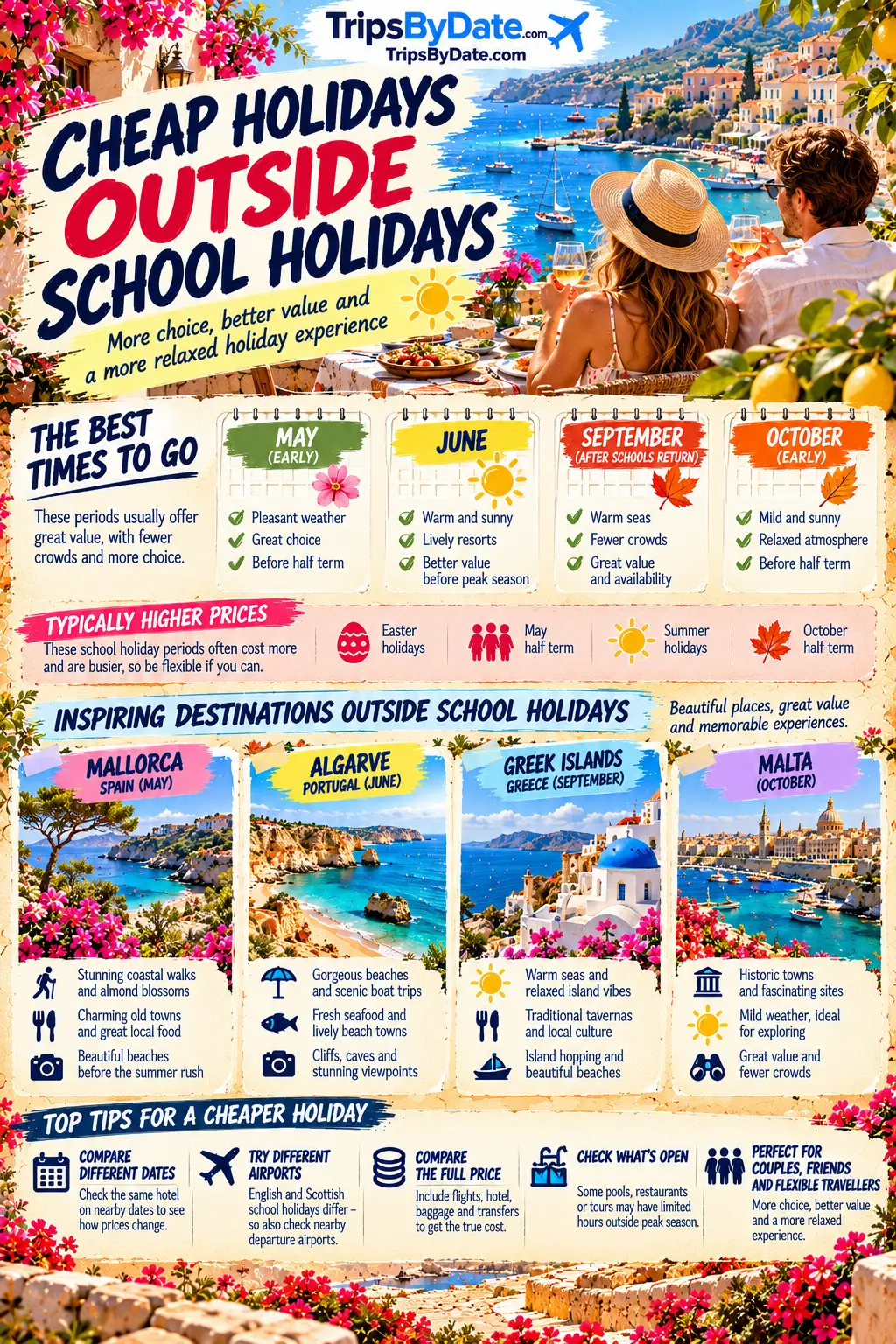
The same beach, the same hotel and the same little balcony can feel like two entirely different holidays depending on who else is on the plane. One week, the pool is an inflatable-unicorn traffic jam. Another, you can actually hear the sea. Travelling outside school holidays can mean more choice, a calmer experience and sometimes a considerably better package price. But the magic is not in a particular date: it is in understanding which calendars affect your journey, which facilities will be open, and who can travel without missing school. Let's find the gaps that are worth investigating.
The short answer: For UK travellers who can choose their dates, May outside half-term, much of June, September after local schools return, and early October before half-term are sensible starting points. They are not guaranteed to be cheapest: Easter moves, Scottish and English term dates differ, continental European holidays differ again, and local festivals can fill hotels independently of schools. For children of compulsory school age, an ordinary cheaper holiday is generally not a valid reason for term-time absence. Always check the individual school and the rules that apply to you.
First, what does “outside school holidays” actually mean?
It usually means travelling while most school-age children in your departure area are attending school, rather than during the main Christmas, Easter and summer breaks or half-term weeks. That is useful shorthand, not a single national calendar.
The GOV.UK school term-date finder sends families in England and Wales towards their local council's dates. Scotland's Parentzone term-date guidance confirms that its councils set their own calendars. Northern Ireland's Department of Education holiday guidance publishes its own schedule, with some individual school discretion.
Even within an area, an academy, independent school or school with inset days might not follow every date on the council's website. If you have school-age children, your actual school's published calendar matters more than a search-result snippet announcing the holiday dates for an entire country.
The four calendars that can change a holiday price
- Your departure area: What matters around a Manchester flight may not be identical to what matters around an Edinburgh or Belfast flight.
- The destination's school calendar: Spanish, French, German and other European families travel too. A UK term-time week can overlap a regional holiday abroad.
- Hotel and flight operating seasons: Resorts do not all open or close together, and some airline routes are seasonal.
- Events and festivals: A city can be full of visitors even with every school in class. A concert, sporting event or annual celebration does not check your half-term spreadsheet first.
The European Commission's Eurydice school-calendar research is an especially good reality check: European countries organise holidays differently, sometimes by region. School holidays are not identical across Europe. That is why “everyone will be back at school” is a risky assumption at a Mediterranean resort.
Off-peak, shoulder season and term-time: three different ideas
Term-time describes whether school is in session. Shoulder season describes the period between peak and quieter tourism seasons. Off-peak is a commercial description, and can mean different dates to different providers. They overlap, but they are not interchangeable. Our guide to how seasonal demand affects package availability explores why. September in a beach resort might have strong weather and plenty of guests even after UK children return to school; a February city break might be inexpensive one week and expensive during a local celebration.
A better question than “When is off-peak?” is “Which departures are available on the dates I can actually take, and what does the full holiday include?”
The best general year-on-year windows to investigate
May: flowers, open-air lunches and one important interruption
Why compare it: Spring sightseeing can be delightful in Mallorca, southern Portugal and parts of coastal Spain. Walking, gardens, markets and historic towns can take centre stage before the busiest summer resort weeks.
The complication: The May bank holidays and late-May school half-term can alter demand. Dates vary, so it makes more sense to compare a run of real departures than to label every May date a bargain. A hotel pool being filled does not necessarily mean it is heated, and attractions that run daily in August may still have restricted schedules.
Mallorca is a lovely example of getting timing right. Its famous almond blossom is generally a winter to very early spring spectacle, not something to promise on a May holiday. Spain's official tourism guidance describes the Balearic almond-blossom season starting much earlier. In May, go for market towns, coastal walks, cycling and warm-weather exploring rather than an impossible appointment with blossom.
June: the wonderful almost-summer, if the package adds up
Why compare it: In many Mediterranean destinations, June brings longer daylight and a livelier resort atmosphere than early spring, without necessarily having the same concentration of UK summer-school-holiday demand. It can suit couples, groups of friends and families with preschool children especially well. For a broader view of the calendar, see the cheapest months to go on holiday.
The complication: June is not a universal cheap month. Popular places can fill with other travellers, and demand around local holidays or events still matters. If you are comparing the Algarve, remember that a hot afternoon does not make the Atlantic sea as warm as the Mediterranean. Check current water conditions and whether the pool is suitable for your group.
The worthwhile trade: An apartment near restaurants in a walkable town can beat a remote inexpensive hotel once taxis, groceries and beach transport are included. The reverse can also happen for a family planning to spend most days at an all-inclusive hotel. Decide how you will spend the week before deciding which board basis is a bargain.
September: summer memories without assuming summer prices
Why compare it: This is a prime time to test Mediterranean offers from the UK after local schools return. In places such as the Greek islands and Spain, the sea may still be pleasant after a summer of warming. Adults who love swimming, food, history and long evenings often enjoy September enormously.
The complication: Early September can remain popular. Some European school holidays finish later than those in parts of the UK, while other destinations are busy with adult visitors. “September equals half price” is a nice slogan but a terrible spreadsheet formula.
The worthwhile trade: Choose a destination where your favourite activities continue into autumn. A quiet beach with open tavernas can be perfect; an empty resort where every evening requires a long taxi ride is less charming than the brochure implied.
Early October: a brilliant season for curious people
Why compare it: Those who enjoy mild weather, food, architecture and walking should inspect early-October departures to Malta, Valencia, Naples or Mediterranean coastlines. A full itinerary can be built around neighbourhoods and local places rather than an expensive succession of attractions.
The complication: October half-term dates vary around the UK, and some destinations enter their quieter operating period. Swimming, boat trips, entertainment programmes and waterparks might not be available on your particular dates.
The worthwhile trade: Choose a city with everyday life, food markets and public transport if you are happy to swap a few beach hours for a more interesting holiday. The advantage of an actual city is that it does not close when the last inflatable flamingo leaves.
Start with real departure dates, not a mythical cheapest Tuesday
One very practical way to use TripsByDate is to start with the period when you can travel, then browse packages in departure-date order and optionally choose your UK airport. You may discover that the attractive departure is to a destination you had not considered, or that moving your flight by a few days changes the combination of flights and hotel. That is an opportunity to compare, not a guarantee of savings. Always follow the offer through to the provider and confirm the live total.
The listings below are not filtered to term-time dates, and no advertised package is guaranteed to be outside school holidays or cheaper than alternatives. Check the dates, flight times, travellers, accommodation, baggage and transfers yourself.


 LGW • 7 nights
 RO · First Choice

 LTN • 3 nightsHB · Skiline
 BRS • 7 nightsHB · Iglu Ski
 BHX • 7 nightsRO · Skiline
Four destinations that reward travelling when you can choose your week
Mallorca in May: choose villages and viewpoints, not just a sunlounger
For a couple, a solo explorer or parents with a preschooler, Mallorca is more interesting than a resort-only itinerary suggests. Palma's streets, the cafés of Sóller and the dramatic Serra de Tramuntana give you alternatives if the sea has not warmed up to your liking. Pick a base that reduces the need for a car, or budget for car hire only on the days you genuinely need it.
A clever holiday can be one in which the expensive excursion is optional. Spend one day discovering a market town and another walking a signed coastal route suitable for your abilities. Enjoy local bakeries, try a Mallorcan pastry and leave the splashy boat trip for a day when the weather actually cooperates.
The trap: Some coastal resorts are still coming to life in spring. Confirm whether the hotel's dining facilities, children's entertainment and outdoor pools are operating. A package that looks cheaper than Palma could cost more once you've hired a car to find somewhere open for dinner. For destination comparisons, our budget Spain guide explores other options.
The Algarve in June: sea cliffs, ferry adventures and a good lunch
Tavira, Olhão and the Ria Formosa are worth investigating if your idea of a holiday is not exclusively suncream and a hotel wristband. Boat trips to barrier islands, markets and harbours can offer varied days, but ferries and excursion boats have schedules and costs that deserve checking before you book accommodation around them.
A couple may prefer a guesthouse within walking distance of cafés. Friends could choose somewhere with restaurants nearby and share one planned activity. A family with a toddler might reasonably prefer a shallow pool and short airport transfer over more scenic but awkward island-hopping logistics.
The trap: Cliff-top walks and Atlantic beaches demand respect. Follow signed paths, check tides and surf conditions and avoid treating closed or eroded sections as a clever shortcut. For more local ideas, look at the official Algarve tourism portal.
Greek islands in September: the lovely part of summer that comes after August
Choose between Kos, Crete and other package-friendly islands by the flights and the kind of holiday you want, not by a ranking that pretends the same island always costs least. Kos offers ancient sites and cycling possibilities in suitable places; Crete gives you old harbours, towns, archaeology and a huge variety of bases.
This is where a bit of curiosity can save money. A walkable resort with three good tavernas and a decent public beach can be more enjoyable than a secluded hotel requiring hired transport for every meal. If you love local food, spend a little time discovering where residents eat instead of assuming every beachfront menu is the same value.
The trap: September flight availability and resort operations vary by island and week. Late in the season, check return flights and the final dates of any excursions you consider essential. Our Greek island budget guide is useful when comparing the islands rather than falling for one glossy photo.
Malta in early October: history, ferries and a holiday without a hire car
For adults who enjoy culture, Valletta, Mdina and the Three Cities can fill a trip beautifully. Malta's compact scale gives visitors a chance to explore by bus, on foot and by harbour ferry, although journey times and timetables are not always as simple as they look on a map. Check the official Malta Public Transport information against your itinerary rather than buying transport passes blindly.
A memorable day could be a morning wandering fortified streets, an afternoon finding a waterfront viewpoint and an evening discussing how somewhere so small can contain so many layers of history. That leaves budget for excellent food without paying for an organised tour every day.
The trap: Malta's geography can make short distances surprisingly slow by road. Choose the location for the activities you care about and be realistic about what a day trip will actually involve. The sea may feel inviting, but autumn weather can be changeable. For more ideas, see our Cyprus budget guide if comparing warmer eastern Mediterranean alternatives.
The clever calendar gaps: where adults can outsmart the obvious weeks
The calendar advantage is not simply choosing the opposite of school holidays. It is looking for overlaps in demand that other travellers haven't checked. Think of it as finding the quiet seat on a crowded train rather than buying the cheapest ticket regardless of destination.
Compare your home airport's school calendar with another airport's
Schools in Scotland often finish the academic year earlier than those in England, and term-start dates vary. That creates a useful possibility: demand around a Glasgow departure may not follow exactly the same pattern as a flight from Manchester or Newcastle. There is no guarantee this makes one cheaper, but checking overlapping weeks could be worthwhile.
The proper test is total cost: fares to reach the alternative airport, parking, fuel, a potential airport hotel and the effect on the flight times. Driving several hours to save on the package only works if the saving survives the round trip. Our airport comparison guide explores that calculation.
Check the calendar in the country you are visiting
A French regional break, a German state holiday or a local Spanish festival can generate demand during UK school term time. Some destinations have public-holiday weekends that also affect hotel prices. The European school-calendar resource mentioned earlier is a starting point, but still look at the specific region and hotel location.
Imagine flying to Valencia in March expecting a quiet bargain, only to discover Las Fallas, a major annual festival full of parades, fireworks and visitors. It sounds magnificent, and it can be, but a busy festival is not the same as a quiet budget break. Check the official Fallas festival information before selecting dates.
Compare a Saturday departure with the surrounding days, not just one weekday
The familiar advice that “Tuesday is always cheapest” is too simple. Package prices are affected by flight schedules, hotel contracts and room availability as well as the departure day. Search a cluster of dates and compare equal trip lengths, not a five-night Tuesday package against a seven-night Saturday one. The day with the lowest total might cost more per usable night.
A first-night arrival at midnight and a last-day flight before breakfast can leave you with fewer enjoyable hours than the dates suggest. When you value a short holiday, the schedule can matter as much as the advertised discount. Our guide to departure and return times explains why.
Four less-obvious destinations for the weeks between the crowds
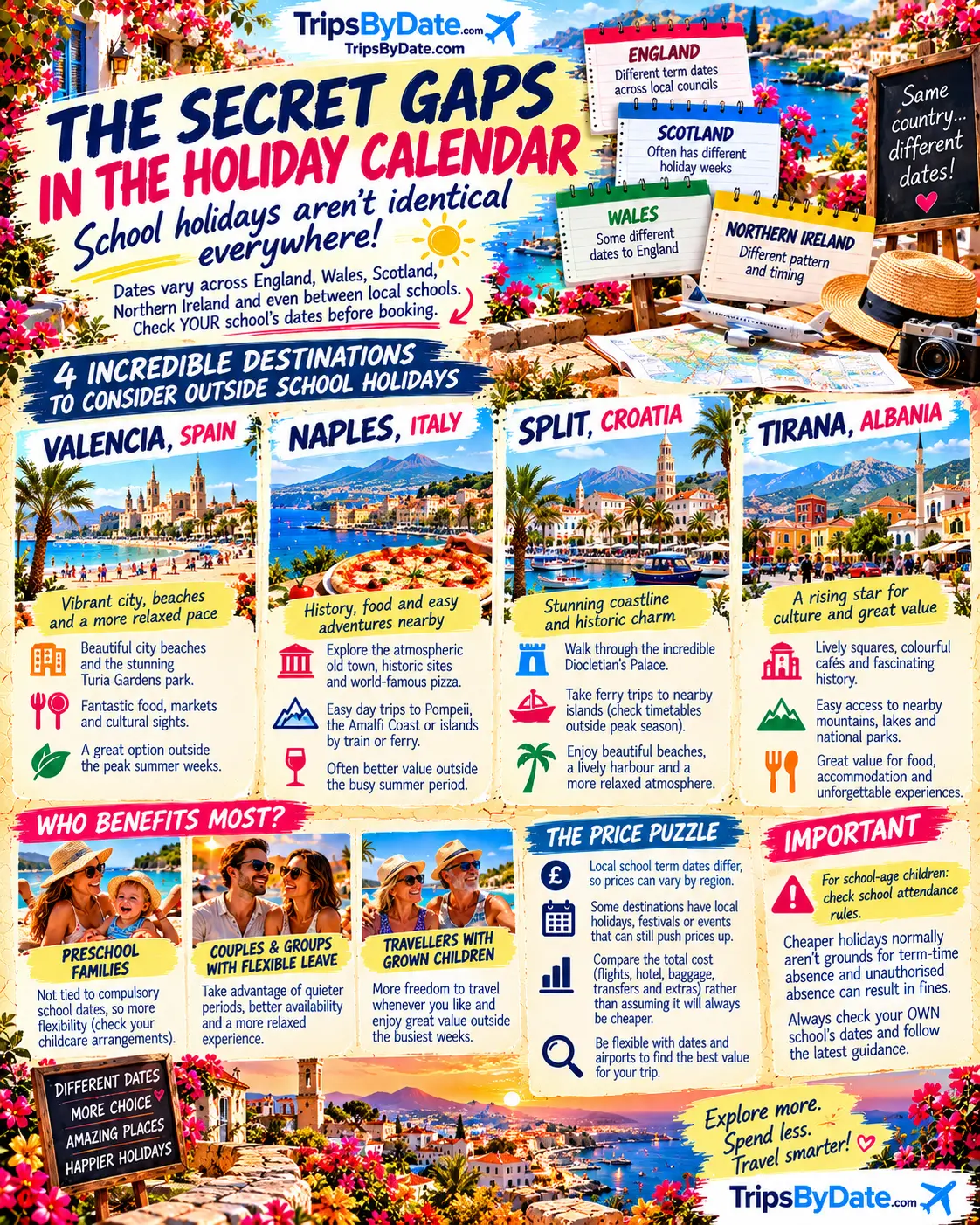
Valencia, Spain: a city beach, a vast park and an expensive surprise to avoid
Valencia makes a strong case for city plus coast. Walk the Turia Gardens, investigate its old streets and markets, then decide whether the beach is worth a few hours or a whole afternoon. That flexibility is brilliant if the weather is not determined to provide seven identical beach days.
There is a specific budget lesson here: do not assume a mid-March stay will be quiet. Las Fallas brings huge celebrations. Wonderful if that's the point of the trip; less wonderful if you booked it for a peaceful museum break and are surprised by crowds and very loud fireworks. Choose your dates according to what you want, not what a general month-by-month price chart suggests.
Naples, Italy: a pizza adventure with Roman history on the side
Naples is not a beach-resort replacement. It is a completely different holiday: markets, busy streets, a famously rich food culture and access to extraordinary history. A proper Neapolitan pizza is an occasion, but the biggest saving may come from organising excursions sensibly rather than buying the first transport-and-ticket bundle you see.
For Pompeii, look directly at the archaeological park's official visitor and ticket information. Ticket types, visiting arrangements, transport and entry rules may change. Compare the official admission and your independent travel costs with any guided tour. Neither option automatically wins: guided help is worthwhile if it adds history you want, not because the word “VIP” looks impressive in a booking box.
A less obvious win: A small-group food-focused trip can be more fun than a long list of paid attractions. Choose your favourite activity and build the rest around neighbourhoods, affordable meals and the extraordinary spectacle of ordinary Naples life.
Split, Croatia: old stone streets and ferry decisions that really matter
Walk around Diocletian's Palace, explore Split's old town, and spend time beside its waterfront. That gives you a beautiful base before you have bought a single island day-trip ticket. For couples or groups, Split can work particularly well when everyone wants a different mix of history, swimming and long lunches.
But this is an excellent example of why a late-season package needs scrutiny. Ferry frequencies and routes can be seasonal, especially services to popular islands. Check the dates on the operator's actual schedule; Krilo's official timetables show seasonal changes. If island-hopping is the whole reason for visiting, don't book a cheaper week that makes the journey impractical.
The sensible trade: Spend some days exploring Split itself and budget for one island excursion instead of promising yourself three. A holiday with one excellent boat day beats a week spent trying to catch a ferry that no longer runs.
Tirana, Albania: food, street life and mountains without a beach-resort script
Tirana suits the traveller who wants to discover something different, especially adults and friends who enjoy cafés, city streets, museums and local food more than sunloungers. It also offers access to the surrounding landscape, including Mount Dajti. You can look up the cable car's current operating days and ticket arrangements with Dajti Ekspres.
That link matters because the operator lists a regular weekly closure day, subject to exceptions. A bargain break isn't much use if the adventure you're most excited about falls on the wrong day. Check transport, accessibility and opening arrangements before travelling.
The trap: A city hotel can appear inexpensive but require extra transfers, taxis or accommodation nights to fit the flight schedule. Albania may be attractive for experiences on the ground, but compare the whole package from your airport rather than declaring it cheaper by default.

Find a quieter week worth travelling for
Start with your available dates on TripsByDate, then compare destinations and UK airports without choosing a resort first. A calendar gap can reveal a great trip, but always confirm the provider's live package price and what's included.
Find holidays by dateThe difference between a lower price and an actually better holiday
A quieter week brings opportunities that aren't all about the booking total. You may find more accommodation choices, less pressure on popular attractions and a calmer atmosphere at breakfast. Those benefits matter differently depending on who is travelling.
Couples: buy the feeling, not the hotel star rating
A well-located three-star hotel with a terrace and brilliant cafés nearby may be better for two people than a luxury-looking resort far from everywhere. Choose a place where you can walk out after dinner, discover a harbour or sit in a square watching ordinary life unfold. The location is part of your entertainment budget.
Compare a short June escape with an early-October city break if both fit your calendar. You can also use our guide to finding the cheapest weeks to travel to structure the search. One might deliver the beach; the other might give you the food-and-culture adventure you talk about for years. It is entirely acceptable to make the trip about tapas and long conversations. Those are excellent holiday activities.
Friends: a cheaper apartment isn't always a cheaper group trip
Sharing an apartment can reduce the room cost per person, but the real numbers depend on bedrooms, beds, bathrooms, cleaning fees, transport and how meals will work. A cheap property miles out of town may produce a surprisingly expensive taxi habit. Check whether everyone will be happy sharing the available space, especially if the listing says “sleeps six” and three people are expected to sleep on sofas.
Agree on one paid group activity and leave room for spontaneous exploring. A market lunch, beach volleyball, a coastal walk or a picnic can become a better memory than the expensive outing someone booked purely because there was a discount timer.
Solo travellers: the single-occupancy question comes first
An attractive “per person” package price may assume two people sharing a room. Solo travellers need to inspect the actual occupancy price before deciding that a destination is affordable. Sometimes a centrally located city hotel can work better than a beach resort designed around double occupancy, but there is no general rule.
Your reward for flexible dates is the freedom to take a short trip that fits your interests: a Naples food break, Valencia museums, Malta's history or Tirana's cafés and nearby mountains. Use the short-break planning guide to think through the trip length and arrival times.
Preschool families: freedom with a completely different packing list
Families whose children have not reached compulsory school age may have more flexibility, depending on nursery arrangements. That can open the door to quieter periods without any school-attendance issue. The important word is may: check childcare arrangements rather than assuming a nursery is free to miss.
For babies and toddlers, the lowest headline price is often not the winner. A short transfer, a cot confirmed in writing, a walkable location, safe shade, a convenient supermarket and suitable sleeping arrangements can be worth more than a hotel full of facilities a two-year-old cannot use. Also verify whether the pool is open and at a suitable temperature. The baby is not impressed by the adult infinity pool, however persuasive the photograph.
Grown-up children and adults travelling together
When your children are adults or no longer subject to compulsory schooling, the date flexibility can become a lovely advantage. Consider an adult family trip built around walking, shared food or a city you always wanted to explore together. Two nearby rooms may work better than a family suite, and splitting a short car hire or a day trip can sometimes make sense. Price it properly rather than assuming a larger party automatically receives a better deal.
What if you have children who must be at school?
This is the part where the bargain advice needs to be crystal clear. In England, ordinary family holidays in term time are generally not considered exceptional circumstances. Schools, not parents, decide whether an absence is authorised. The GOV.UK attendance guidance explains the rules and warns of penalties or other legal action for unauthorised absences.
The House of Commons Library briefing on term-time holidays explains the policy and why a desire to take a cheaper holiday is not normally an exceptional circumstance. Rules and enforcement arrangements vary between UK nations, so follow the legislation and guidance where your child attends school. Do not assume the English penalty system applies unchanged throughout the UK.
This article is not suggesting taking a child out of school to secure a discount, gambling on a fine or disguising a holiday as illness. If you need to travel during school breaks, a legitimate money-saving approach is to compare different airports, destinations, durations and board arrangements within the dates you are actually free. See our guide to affordable school-holiday packages for that separate challenge.
For independent schools or individual circumstances, check directly with the school. The relevant rules and permissions matter more than what another family says happened last year.
Nine useful ways to save that actually have a reason behind them
- Compare the full departure week, not one date. Flight seats and hotel availability differ. Keep the trip length and number of travellers constant so the comparison means something.
- Inspect the arrival time before celebrating the price. An overnight arrival and early departure can reduce the holiday you really get. An airport-hotel night or extra taxi may also erase a saving.
- Try one alternative UK airport with a pencil in hand. Add parking, rail fares, fuel and any overnight stay. The cheapest flight does not automatically make the cheapest holiday.
- Choose a walkable base. A hotel beside shops, food and local transport can reduce repeated taxi trips. Confirm the area actually suits your group and isn't simply close to a road on a map.
- Check the operating season of the one thing you care about most. Want a boat trip, waterpark, heated pool or kids' club? Verify its actual dates before paying. Off-season bargains can be real, but so can the locked gate.
- Price board basis around your real habits. All-inclusive can work for a family spending much of the time at the hotel. Room-only can work for two adults exploring markets and restaurants. Neither is universally cheaper.
- Look at local public transport before hiring a car. Malta, Valencia and city-based destinations offer options worth comparing. A car may still be sensible for rural exploring; the point is to make it an intentional cost.
- Check free or low-cost experiences first. Historic neighbourhoods, promenades, public gardens, markets and safe walking routes can fill excellent days. Keep some budget for the attraction that truly matters.
- Compare the finished package with alternatives, not just the teaser price. Include flight, hotel, baggage, transfers, seat selection where needed, resort charges and any paid activities you consider essential.
One final trick: set a maximum total trip budget before you browse. A £40 difference on the package is not a meaningful victory if you then add £150 of unnecessary extras. A holiday is supposed to be an escape, not a competition to invent new categories of baggage fees.
Places and weeks I would approach more carefully
An isolated beach resort very early in the season: Fine if you want peace and the essential facilities are open. Less fine if you imagined a lively promenade, children's entertainment and easy evening meals.
A Mediterranean island after key flight routes slow down: A cheaper hotel can be offset by awkward flight options, limited transfers or missing excursions. Check the actual dates rather than general seasonal descriptions.
A city during its signature festival: It might be an unforgettable trip, but festival demand and crowds can be very different from an ordinary term-time week. Valencia's Fallas is a particularly useful example.
A cold-weather break marketed as a beach holiday: Pleasant daytime sunshine is not a guarantee of warm water, open outdoor pools or late evenings. Choose a sightseeing holiday if that's what the season offers.
Somewhere “cheap” only because it's far from everything: Add transport time and the cost of eating and exploring. You can pay a low hotel price and spend the rest of the holiday travelling to the holiday.
A destination chosen solely because an infographic called it affordable: Departure airports, date ranges, flight supply and room occupancy can reverse any generic ranking. Treat destination lists as inspiration, not evidence of a live deal.
A ten-minute search experiment that beats a hundred tabs
Try this the next time you have a flexible week available:
- Choose three plausible departure windows, avoiding known local school breaks if that suits your circumstances.
- Pick one preferred UK airport and one alternative you could genuinely use.
- Browse TripsByDate by departure date without insisting on a specific destination. Save three different types of trip: beach, city and something unexpected.
- Open the provider offers and record the current total package price, number of nights, actual departure/return times and inclusions.
- Check the destination calendar for local school breaks and major events, plus the opening dates of the facilities that matter to you.
- Compare the usable holiday, not just the amount charged. Which trip gives you the most of the experience you're excited about?
This works because it removes two common mistakes: choosing the destination before seeing the offers available on your dates, and treating two completely different packages as comparable merely because they share a bold headline price. TripsByDate helps with discovery; the final decision still depends on current provider details.
If you're unsure what makes a fair comparison, our guide to comparing package prices across destinations takes the calculation further.
Frequently asked questions about holidays outside school holidays
What months are usually cheapest for holidays outside school holidays?
There is no universal cheapest month. May outside half-term, June, September after local schools return and early October are useful periods to compare for many UK travellers. Destination demand, flight schedules, events and hotel seasons determine whether an individual package is actually cheaper. Compare live totals.
Are holidays cheaper immediately after children return to school?
They can be, particularly where demand from school-age families falls. But early September can still attract adult holidaymakers and families from other countries whose schools have different calendars. The only reliable test is comparing live packages from your departure airport.
Do school holidays happen at the same time across England, Scotland, Wales and Northern Ireland?
No. Dates differ between nations and often local authorities, with additional school-level variations. Use the actual school calendar and the official government or council sources rather than a single UK-wide list.
Are school holidays the same throughout Europe?
No. The European Commission's Eurydice research documents differences between countries and sometimes regions. That means a resort may be busy during a UK school-term week because schools elsewhere are on holiday.
Can I take my children out of school because a holiday is cheaper?
Do not assume you can. In England, ordinary holidays do not usually qualify as exceptional circumstances for authorised term-time absence, and unauthorised absence can result in penalties or legal action. Rules vary across UK nations. Check your school and the relevant official guidance.
Are holidays outside school holidays always less crowded?
Not necessarily. Local holidays, festivals, conferences, cruises and tourist seasons can make a destination busy independently of British school dates. A quieter UK departure week does not guarantee a deserted beach or city.
Are off-peak resorts fully open?
Some are, some aren't. Check the individual hotel's pool, restaurant, kids' club and entertainment dates, and any attraction or transport services you plan to use. The words “open year-round” can describe a hotel while particular facilities are seasonal.
Are package holidays better value than booking flights and hotels separately?
It depends on the exact dates, rooms, travellers and inclusions. Compare both totals on a like-for-like basis, including transport and baggage. A flight-inclusive package may also provide important financial protection: see the UK government's air passenger guide for an explanation of ATOL.
Is June or September better for a family with a toddler?
Either can work, depending on the destination and the child. June can offer long days and a summer atmosphere; September can offer warm seas in some Mediterranean locations. The more important considerations are heat, transfer times, safe accommodation, sleeping arrangements, medical needs and whether family facilities are operating.
What is the best way to find a deal without choosing the destination first?
Start with the dates and UK airport you can use, browse a range of available packages and follow promising options through to the travel provider for live prices and details. That's the date-first approach behind TripsByDate, and it can be especially useful when your flexibility is an advantage.
Your best holiday might be in the gap nobody in your group thought to check
There is something rather lovely about visiting a place when it has room to breathe. Not because crowds are bad, and certainly not because every term-time departure is cheap, but because you can choose the experience rather than inherit the busiest week of the calendar. A market morning in Valencia, a harbour lunch in Malta, a quiet walk in Mallorca or a lively evening in Naples can feel like a proper adventure without needing a lavish itinerary.
The secret isn't one magical date. It's knowing which calendar applies, where the demand really is, what remains open and what your whole trip will cost. Get those four things right and even a modest budget can buy a memorable holiday.
Your dates could lead somewhere brilliant
Browse packages in departure-date order with TripsByDate, discover destinations you might not have searched for and compare the real inclusions with each provider. A flexible calendar is a useful advantage. Put it to work.
Find holidays by date