

Nuremberg Christmas Markets Guide
Follow the gingerbread, find the golden angels and discover why Nuremberg does Christmas with centuries of practice.
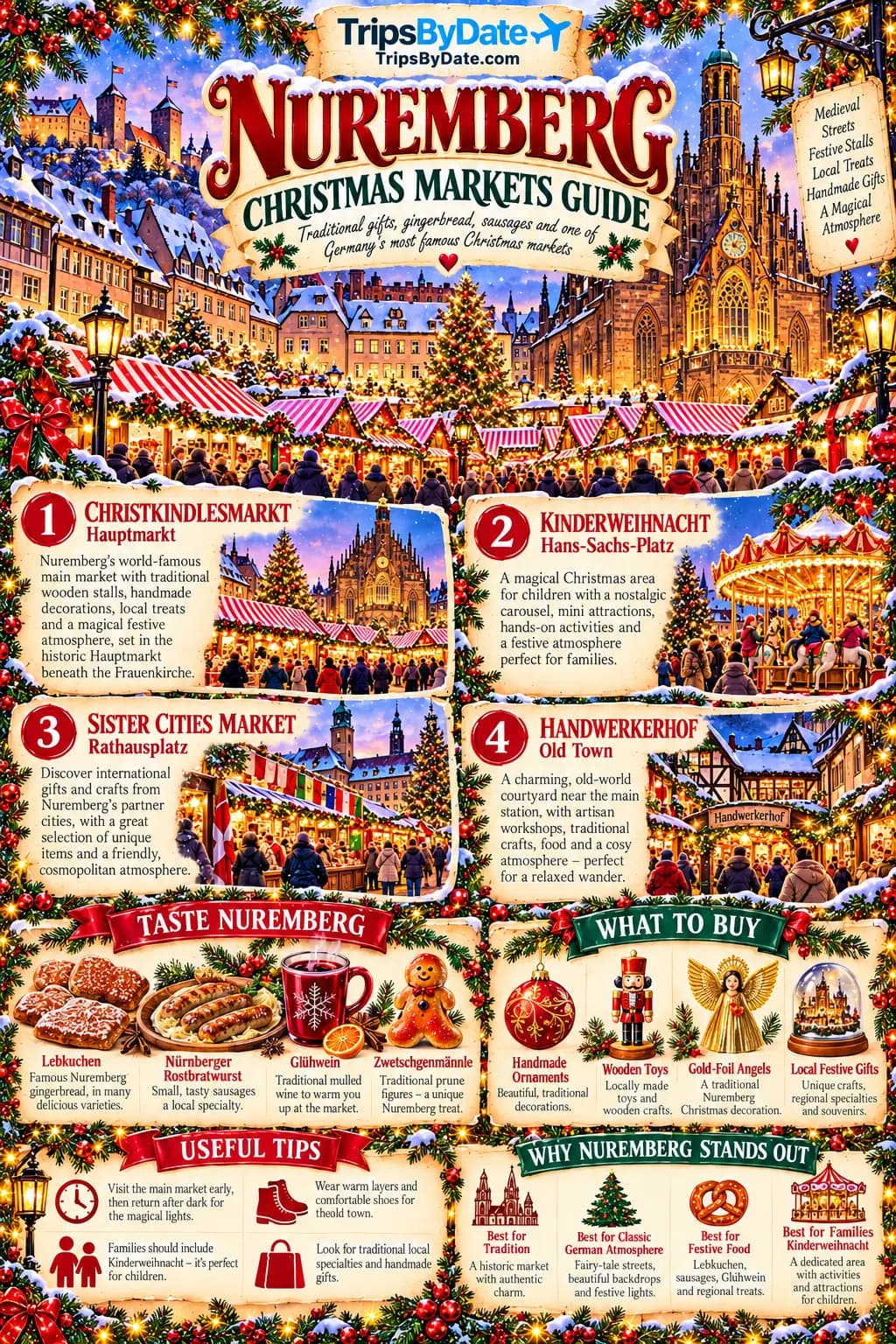
There are Christmas markets where you buy a hot drink, admire a tree and head home. And then there is Nuremberg, where the whole Old Town seems to have spent several centuries preparing for your arrival. Beneath the Gothic Church of Our Lady, red-and-white-roofed huts fill the Hauptmarkt with gingerbread, miniature sausages, handmade angels and enough festive temptation to make a carefully packed cabin bag look optimistic.
But the city's famous Christkindlesmarkt is just the beginning. A few minutes away, children can bake biscuits and post wish lists; international makers sell unusual gifts; traditional workshops occupy an old city-wall courtyard; and medieval streets lead towards an imperial castle. This guide explains which Nuremberg Christmas markets to visit, what to eat and buy, how to get around, and what makes a genuinely memorable short break.
Quick answer: start at Hauptmarkt for the classic Nuremberg Christmas Market, visit Kinderweihnacht at Hans-Sachs-Platz if travelling with children, browse the Sister Cities Market and Original Regional around Rathausplatz for different gifts, and walk through Handwerkerhof for working crafts and Franconian food. Allow time for the castle and Weißgerbergasse, not merely more stalls.
Which Nuremberg Christmas markets should you visit?
- Christkindlesmarkt, Hauptmarkt: the iconic red-and-white stalls, Christkind tradition, ornaments, gingerbread and sausages.
- Kinderweihnacht, Hans-Sachs-Platz: a dedicated children's market with nostalgic rides and practical activities.
- Sister Cities Market, Rathausplatz: international gifts, craft and food, with a charitable purpose.
- Original Regional, beside St Sebald: products from the wider Nuremberg region, including preserves, honey, wool and specialist foods.
- Handwerkerhof, near the main station: a year-round crafts courtyard in a historic city-wall setting, not simply another seasonal stall village.
For a different perspective on Germany's festive heritage, see our guide to traditional European Christmas markets. Nuremberg belongs in that conversation not because it looks old in photographs, but because its customs are still part of local life.
Explore upcoming holidays by departure date
Looking for an excuse to escape? These are varied upcoming package-holiday listings from participating operators in TripsByDate, ordered by departure date. They are not necessarily trips to Nuremberg or Christmas-market breaks. Pick your UK airport and free dates to browse possible destinations quickly, then check price, itinerary and availability with the travel provider.
 BFS • 3 nights
 FB · TUI


 LTN • 7 nightsAI · Hays Travel
 BRS • 7 nightsAI · Thomas Cook
 STN • 7 nightsRO · Hays Travel
1. Christkindlesmarkt at Hauptmarkt: the classic Christmas experience
Step into the main square and it is immediately obvious why Nuremberg's market has become famous. Rows of timber stalls wear distinctive striped canopies beneath the Frauenkirche, while the smell of grilled bratwurst competes with spices and toasted nuts. The market is nicknamed the little town of wood and cloth. That is a far more appealing description than 'large outdoor retail event'.
Browse slowly. Look past the first stall to see how different makers approach painted ornaments, handmade cribs, paper stars and the gold-foil angels. The market's history is older than many visitors realise. Official historical material records an early reference on a box dated 1628; a separate documented written reference comes from 1678. Claims about an exact founding year require caution. Read the market's official history.
Don't miss the Christkind: the ceremonial figure is not simply 'Santa with different clothes'. Nuremberg's Christkind wears a golden robe and crown and formally opens the market from the church balcony with a spoken prologue. The public ceremony normally takes place on the Friday before the first Sunday in Advent. For the current programme, use the official Christkindlesmarkt website rather than assuming last year's timetable applies.
A more useful visiting trick: explore stalls in daylight when you can inspect workmanship and read food signs. Return after dusk for photographs and the golden glow. Around opening weekend and Saturdays the square can be extremely busy. Visiting earlier in the day gives you room to stop without developing the accidental talent of eating gingerbread while walking sideways.
2. Kinderweihnacht: a Christmas market built for children
For families, Hans-Sachs-Platz is a reason to choose Nuremberg over a city with only adult-oriented shopping stalls. The dedicated Kinderweihnacht features a nostalgic carousel, miniature rides and hands-on experiences such as baking, candle making and creative workshops. This is Christmas that children can actually do, rather than admire from below waist height.
The official children's market guide explains the activities and Christkind visits. Their schedule is seasonal, so check the programme and any charges before promising a particular workshop or appearance. Some activities are paid and popular sessions may have limited spaces.
Parent tip: begin with one hands-on activity before browsing too many stalls. For toddlers, shorter outings, a nearby indoor warm-up and an easy escape route matter much more than seeing every market. For older children, let them choose one souvenir or edible treat within a set budget. It turns shopping into a small adventure and avoids ten negotiations over identical wooden whistles.
And don't miss the Sternenhaus
Near the children's market, the Sternenhaus, or House of Stars, has staged children's culture programmes including stories, theatre, music and performances. It provides something many market itineraries forget: a proper scheduled indoor experience. Programme dates, language and ticket arrangements vary, so consult the official Sternenhaus programme before adding it to your day.
3. Sister Cities Market: a little festive journey around the world
Just north of Hauptmarkt, the Rathausplatz Sister Cities Market swaps the uniformity of a conventional Christmas-market line-up for products and crafts connected to Nuremberg's international partner communities. The merchandise changes, which is precisely the attraction: you might find a gift with a story that no ordinary chain shop could provide.
There's a deeper reason to visit. Proceeds from participating stalls support charitable projects linked to the partner communities. The official Sister Cities Market information explains its international and charitable purpose.
Shopping idea: ask which community made an item, how it is used and whether the craft has a local tradition. This is where the most interesting gifts come from. Be mindful of fragile pottery, liquids and food restrictions if travelling with hand baggage.
4. Original Regional: where to shop for the less obvious Franconian gifts
At the edge of Rathausplatz, near St Sebald's Church, look for the Original Regional producers. These smaller displays put local food and craftsmanship ahead of mass-produced baubles: think regional honey, beeswax, fruit preserves, specialities made with local produce, wool and handmade products.
This is an excellent place for edible presents. A modest jar from a local producer may be a better reminder of your trip than the tenth magnet depicting the exact same cathedral. The official regional producer guide gives the location and seasonal dates. Notice that this area can close before the main Christkindlesmarkt.
5. Handwerkerhof: a crafts village hidden beside the railway station
If you arrive by train, don't rush past the old city walls. Near Königstor, the Handwerkerhof is a small enclosed crafts courtyard where workshops and traditional shops sit along cobbled lanes. It isn't a second version of the Hauptmarkt; that is why it is worth visiting.
The site began as a temporary attraction in 1971 for the 500th anniversary of Albrecht Dürer's birth and stayed because people liked it so much. Visitors may find glass painting, metalwork, leather goods, pottery, jewellery and traditional food depending on which workshops are operating. See Nuremberg Tourism's Craftsmen's Courtyard guide.
Smart route: visit on arrival or departure day because of its proximity to the central station. Check opening hours: it is a permanent craft attraction with its own trading times, not a guaranteed late-night Christmas market. Accessibility is limited in places due to historic surfaces.
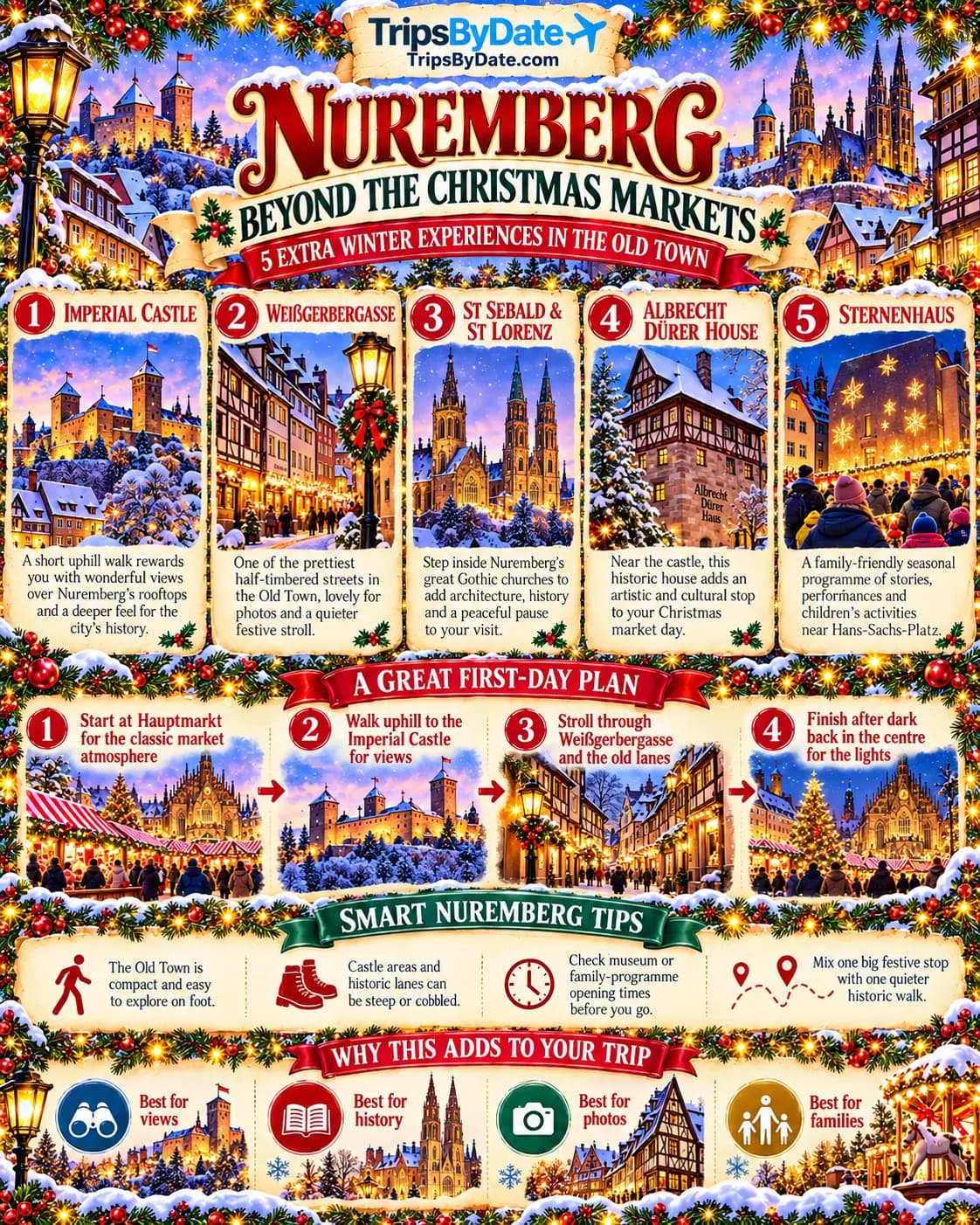
Five wonderful things to do in Nuremberg beyond the markets
1. Walk uphill to the Imperial Castle
The Kaiserburg rises above the Old Town, offering a completely different view of Nuremberg from the one you get between market huts. Its courtyards and viewpoints reveal red rooftops, church towers and the compact city beneath. The castle's roots reach back into the medieval Holy Roman Empire, and its museum, Deep Well and Sinwell Tower add worthwhile historical depth.
Check which areas require admission on the official Imperial Castle guide. The uphill cobbles can be slippery and tiring in winter. For couples, it's a lovely late-afternoon stroll; for families, it's better to approach as a short castle adventure than as an obligatory march.
2. Stroll along Weißgerbergasse, the street built by tanners
Nuremberg has picture-book streets, but Weißgerbergasse is especially interesting because its surviving half-timbered houses tell a working story. The name means Tanners' Lane, reflecting the once-prosperous leather trade. Today there are cafés, independent boutiques and craft workshops.
Find out more through Nuremberg Tourism's history of Weißgerbergasse. Come in the daylight to see the architectural details, then wander back towards the centre for the market lights. The perfect souvenir here may be a few photographs and a very good pastry.
3. Go inside St Sebald and St Lorenz
The busy Christmas streets hide two remarkable Gothic churches. St Sebald is close to the main market and adds a peaceful pause between stalls and regional producers. St Lorenz, farther south, offers dramatic medieval architecture and another reason to walk the route between the station and Hauptmarkt.
Churches are active religious spaces, not indoor waiting rooms for market visitors. Check worship times, respect photography restrictions and consider attending a scheduled concert where available. If you want a wider European market comparison, our best Christmas markets in Europe guide helps you compare settings and traditions.
4. Visit Albrecht Dürer's House and meet an artist's household
A short walk below the castle stands the historic home of Nuremberg's famous Renaissance artist Albrecht Dürer. Rather than another generic gallery, it introduces you to the rooms, workshop and techniques associated with the artist's everyday world. Some tours bring the story to life through the character of his wife, Agnes Dürer.
According to the official Albrecht Dürer House listing, the house has substantial accessibility limitations. Check tour languages and opening days before going. It's a particularly good choice for curious teenagers and couples who would rather spend an hour exploring a remarkable building than queuing for their sixth hot drink.
5. Explore the tunnels beneath the castle hill
Here's a less predictable winter activity: Nuremberg has historic rock-cut cellars beneath its streets. Dug into sandstone and used for centuries in connection with brewing, parts of this underground labyrinth can be visited on guided tours. The cool, dim spaces make an atmospheric contrast with the lights above ground.
The official cellar-tour page explains the historical beer connection and English-language tour options. Booking is advisable, and the cellars are not suitable for everyone with mobility difficulties. A brilliant conversation starter for friends: apparently the city had so much beer history that the ground itself needed organising.
What to eat at Nuremberg's Christmas markets
Don't eat lunch before visiting Hauptmarkt unless you enjoy testing your self-control. Nuremberg's festive food is unusually tied to local identity, from its protected gingerbread to its tiny sausages.
Nürnberger Rostbratwürste: three in a bun, please
These small grilled sausages are a hallmark of the city. Ask for Drei im Weggla: three bratwursts in a bread roll, often with mustard. The phrase is practically a Nuremberg souvenir you can eat. It's also more convenient than attempting a complicated plate-and-cutlery manoeuvre in a busy square.
Lebkuchen: gingerbread with a proper hometown connection
Nürnberger Lebkuchen is not just any gingerbread with a picturesque label. The name is geographically protected and associated with production in Nuremberg. Look for different nut-rich varieties, including Elisenlebkuchen, and check ingredients for nuts, egg or other allergens. Pack delicate iced versions carefully if taking them home.
Zwetschgenmännle: look, admire, but don't eat
Those cheerful little people with funny hats and expressive faces? They're Zwetschgenmännle, traditional miniature figures created from dried prunes and other materials. They're decorative souvenirs, not a snack. They make especially good conversation-piece gifts, provided their recipient understands the distinction.
Glühwein, almonds and the mug question
Mulled wine, spiced non-alcoholic drinks, roasted almonds and local sweet treats make up the supporting cast. Some stalls charge a Pfand, or refundable cup deposit. Return the mug to reclaim it, or confirm the rules if you'd like to keep the decorated mug as a souvenir. For more regional food discoveries, see our Christmas markets for food lovers guide.

Your next festive escape could be a surprise
Choose your UK departure airport and the dates you're free. Browse holiday ideas on TripsByDate without deciding on one destination first.
Discover holidays by dateHow to shop for gifts that actually feel special
Choose a small gift story rather than a huge shopping bag. A Rauschgoldengel (gold-foil angel) recalls one of Nuremberg's oldest decorative traditions. The name comes from the fine metallic material historically used for the angels; modern versions can use different materials. The official Christmas tradition walking guide even suggests where to look for them.
Wooden toys, nutcrackers, crafted ornaments, small nativity figures and glass decorations are worth inspecting closely. Ask where an item was made and whether it is handmade or simply decorated locally. At the Sister Cities stalls, ask about the community behind the product. At Original Regional, consider honey, preserves or beeswax gifts. At Handwerkerhof, watching the maker work may be the best part of buying anything.
Cabin-bag reminder: glass, liquids, jams and spreadable foods may cause luggage headaches. Check your airline's baggage rules and security restrictions, and allow space for the purchases you haven't yet fallen in love with.
Three ways to make Nuremberg an unforgettable escape
For couples: castle views, quiet streets and a warm table
Visit the market in the late afternoon, then wander up towards the castle for the change of scenery. Explore Weißgerbergasse, choose one thoughtfully made ornament together, and book a relaxed Franconian dinner away from the busiest square. Nuremberg does romance without needing to manufacture it with a horse-drawn carriage at every corner.
For families: children's market first, grown-up shopping second
Choose one hands-on activity at Kinderweihnacht, see the nostalgic rides, and check whether there is a suitable Sternenhaus performance. Build in a warm indoor stop and finish with short bursts of gift shopping. Children are far more likely to remember decorating something themselves than your heroic attempt to visit every craft stall.
For broader inspiration, see our family Christmas market recommendations.
For friends: local tastes, underground history and an evening market crawl
Try different savoury and sweet specialities at the market, explore the Sister Cities stalls, then book the rock-cut cellars tour if it interests the group. Finish with a proper sit-down meal. You will have more fun with three good stops than with a spreadsheet insisting on seventeen.
A realistic first-day walking route
- Arrive at the main station: explore Handwerkerhof first if its workshops are open, or save it for your departure.
- Walk through the Old Town to Hauptmarkt: enjoy the main Christkindlesmarkt in daylight and choose a local snack.
- Browse Rathausplatz: investigate Sister Cities and Original Regional for interesting gifts.
- Walk uphill: visit the Imperial Castle area for views, then descend through Weißgerbergasse.
- Return for the lights: spend the evening in the central market, with a restaurant reservation if the weekend is busy.
Don't force the whole loop if conditions are icy or someone in your group has limited mobility. You can enjoy the major markets with far less walking by using local transport and keeping the castle as a separate excursion.
Where to stay for a Nuremberg Christmas market weekend
Near Hauptmarkt or the central Old Town: best for easy evening returns and repeat visits to the stalls. Popular locations may cost more during Advent and can be busy.
Between the main station and the Old Town: useful for convenient arrival, airport connections and lighter luggage logistics. Check the actual walking route to your hotel, not merely its distance on a map.
Outside the walls near a U-Bahn stop: potentially practical if central accommodation is expensive, but compare the cost of transport and the last useful service against the saving. For a short weekend, convenience is often worth paying a little more for.
Getting to Nuremberg from the UK
Nuremberg's airport has a straightforward U2 underground connection to Nürnberg Hauptbahnhof, with an advertised journey time of about 12 minutes. From the main station, you can walk into the Old Town. Check the official airport transport page for the current service and fares. Direct UK flight options vary by airport and season; do not assume a route is operating on your dates.
Some visitors may find it practical to fly elsewhere and continue to Nuremberg by rail, but you need to compare the complete door-to-door time. For a two-night break, a cheaper journey with several changes may be worse value than a better-timed flight. Our total weekend-break cost guide explains the comparison.
Before booking, consult GOV.UK Germany travel advice for entry requirements and other current information, and check appropriate insurance and any package protection.
When are Nuremberg's Christmas markets open?
The main Christkindlesmarkt traditionally runs from late November to Christmas Eve, but dates vary from year to year. The Sister Cities Market and Original Regional can finish a day earlier than the main square; the children's market can have its own later programme. Handwerkerhof follows separate workshop hours. Check the official Nuremberg tourism Christmas page for the relevant season and each specific attraction.
Important: don't assume a Christmas market operates on Christmas Day, or that every stall will be open until the last advertised date. One of the easiest ways to ruin a festive break is to arrive after the main event has quietly packed up its reindeer.
Unexpected little details that make Nuremberg special
A tradition with a complicated history
The current opening ceremony is rooted in modern changes to the market as well as older festive customs. Its history includes difficult chapters in the twentieth century. The official city history gives a thoughtful account of those changes. Understanding that background makes the cheerful modern, inclusive welcome more meaningful.
A medieval city with an unexpectedly modern purpose
One of the best ways to understand the city is to contrast the main traditional market with the international Sister Cities Market. One celebrates enduring local craft, while the other builds relationships and supports causes far beyond Franconia. Both are part of Nuremberg's Christmas character, and both are worth your time.
A tiny educational adventure for children
Check whether the official market is offering a children's rally or trail during your visit. Past programmes have invited children to explore the stalls and discover details that adults often miss. Don't rely on a previous edition's rules; confirm any current trail with tourism staff.
Frequently asked questions
Is Nuremberg Christmas Market worth visiting?
Yes, particularly if you value traditional Christmas crafts, local food and a compact historic Old Town. It is a strong choice for families as well because of the dedicated children's market. The main caveat is how busy the best-known square can get on popular dates.
Where is the main Nuremberg Christmas Market?
The Christkindlesmarkt is at Hauptmarkt, beneath the Frauenkirche in the Old Town. The children's market is at nearby Hans-Sachs-Platz and the Sister Cities Market is at Rathausplatz.
How many days do you need in Nuremberg?
Two nights can work well for the main market, children's or regional stalls, castle area and one additional experience. Three nights give more time for museums, relaxed meals and winter exploring without rushing.
Is Nuremberg Christmas Market good for children?
Yes. Kinderweihnacht has child-focused rides and hands-on activities, and Sternenhaus offers an additional seasonal culture programme. Check minimum ages, charges and current schedules; plan regular warm-up breaks.
What food should you try at Nuremberg Christmas Market?
Try Nürnberger Rostbratwürste, particularly Drei im Weggla, along with traditional Nuremberg lebkuchen. Seasonal drinks, roasted almonds and regional specialities are also worth exploring. Ask about allergens and alcohol content when needed.
Are the Nuremberg Christmas markets free?
Browsing the principal outdoor markets is generally free. Food, gifts, rides, workshops, performances and attractions can cost extra. Check any individual event or venue before visiting.
Can you go to Nuremberg Christmas Market after Christmas?
The main Christkindlesmarkt normally finishes on Christmas Eve, but some related family attractions may have separate closing dates. Verify the exact season's programme rather than assuming every festive activity closes together.
Can TripsByDate help me find a Christmas market break?
TripsByDate lets you choose your UK departure airport and browse advertised package holidays by departure date across different destinations. That can help you discover possible winter escapes without searching city by city. Listings are not guaranteed Nuremberg breaks, and final availability and prices are confirmed by the provider.
More festive inspiration
For a broader shortlist, explore the best Christmas markets for a weekend break, discover why certain destinations suit first-time Christmas market visitors, or read our Christmas market value guide before comparing flights and hotels.
Our final tip: don't try to make Nuremberg a race between souvenir huts. Buy one lovely handmade thing, try something local, find a quiet old street and come back when the Christmas lights are glowing. It is the sort of city that rewards a little lingering.
‹ BACK TO CHRISTMAS MARKETSKnow when you can get away?
Choose your airport, browse departure dates and discover holiday possibilities with TripsByDate. Less searching. More choosing.
Find holidays by date