

Best Christmas Markets for First-Time Visitors
Your first festive city break should feel like stepping into a Christmas film, not sitting an exam in European transport. Here is where to go, what to expect and how to get the magic without the mayhem.
You follow the smell of cinnamon through a cobbled square. There is a Christmas tree taller than your house, somebody is playing carols, and a stallholder hands over something warm in a mug you rather want to keep. That is the lovely bit of a first European Christmas market holiday. The less lovely bit can be discovering that your hotel is an hour away, the market closes tomorrow or the “free” festive attraction actually needs a paid ticket.
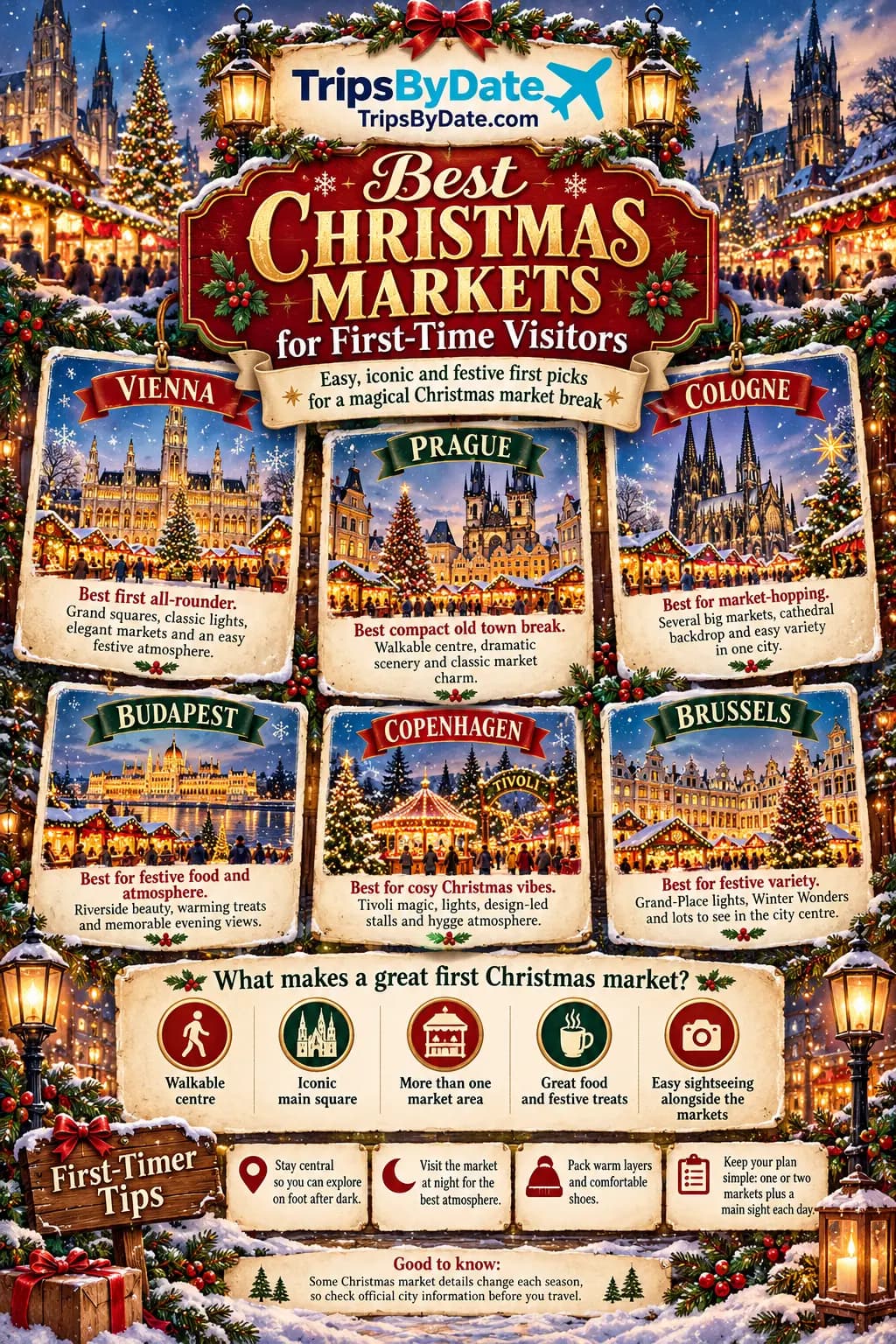
This guide is for people doing it for the first time. Instead of claiming there is one objectively best market, we compare six different ways to have a brilliant first trip: Vienna for variety, Prague for old-town atmosphere, Cologne for easy market-hopping, Budapest for food and illuminated sights, Copenhagen for an organised festive spectacle, and Brussels for a city-wide celebration. We will also show you the details that surprise beginners, including mug deposits, evening crowds and how to spend your first few hours.
Which Christmas market should you visit first?
- Vienna: a reassuring all-round choice if you want grand markets, smaller atmospheric lanes, museums and cafés.
- Prague: a memorable first market scene in Old Town Square, with a compact central sightseeing route.
- Cologne: different festive worlds close together, from the cathedral to the Old Town elves and skating.
- Budapest: warming food, basilica lights and a spectacular Danube backdrop alongside the stalls.
- Copenhagen: Tivoli Gardens' curated light displays and rides, ideal if you accept the admission cost.
- Brussels: an urban festive trail with Grand-Place illuminations, food stalls and attractions across several squares.
If you want the wider inspiration list first, explore our best Christmas markets in Europe guide. But for your very first visit, choose based on how easy the whole break feels, not how many times a city appears in a photo gallery.
See what holidays are coming up on your dates
Not sure where to go yet? That is exactly where TripsByDate comes in. Pick your UK departure airport and browse upcoming advertised holiday packages by departure date, without starting six separate destination searches. These are general holiday examples, not necessarily Christmas market trips or offers for the cities in this guide. Check final prices, what is included and availability with the provider before booking.
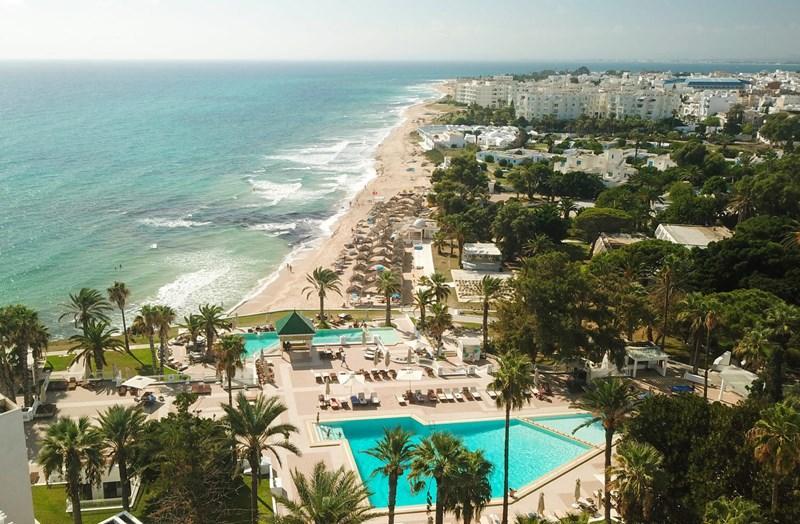


 NCL • 7 nights
 AI · easyJet holidays

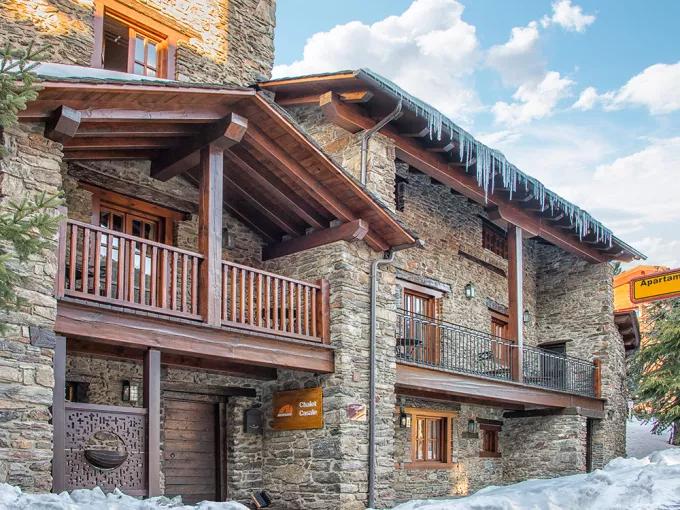 LGW • 7 nightsNeilson
 GLA • 7 nightsHB · Skiline
 LGW • 7 nightsHB · Skiline
1. Vienna: the first Christmas market trip with a little of everything
Why beginners love it: Vienna gives you several different market personalities in one city. The enormous Rathausplatz market provides the grand entrance: lights, timber stalls and City Hall as the backdrop. But your best surprise may come afterwards, when you discover that not every Viennese market is trying to be enormous.
Your first evening: begin with the Rathaus market as twilight falls. Then, if you still have energy, look at the smaller lanes of Spittelberg, where stalls occupy streets rather than one open square. The City of Vienna specifically highlights Spittelberg for its Biedermeier-period lanes, while also pointing visitors towards art-focused Karlsplatz and markets at historic palaces. Compare Vienna's markets on the official city website.
A useful first-timer trick: pick one big market and one contrasting small one. A first evening spent charging between five markets will mainly teach you how Vienna's transport ticketing works. A slower evening lets you notice the glass ornaments, warm punch aromas and the difference between a craft stall and a souvenir stall.
If the weather turns: make a café or museum your afternoon plan and save the outdoor lights for after dark. A market holiday need not require six consecutive hours in the cold. Vienna is especially rewarding when the markets form part of a wider city break; our guide to beautiful Christmas markets explores the visual side in more detail.
2. Prague: the big fairy-tale moment without a complicated itinerary
Prague offers one of the most satisfying first impressions in Europe. Step into Old Town Square and the Christmas tree, Gothic Church of Our Lady before Týn and historic façades do much of the work. You do not need a long attraction list: sometimes a cup of something warm, the tree and a few unhurried circuits of the stalls are enough.
Your first evening: arrive while it is still light so you can see the square's architecture, then watch the lights take over. Leave time to browse crafts rather than heading straight to the busiest food counter. Prague City Tourism notes that stalls sell items including glass and straw ornaments, woodwork and traditional nativity decorations, and that the main market runs cultural programmes. Read the official Old Town Square market information.
The detail many first-timers miss: Old Town Square and Wenceslas Square are separate experiences. Wenceslas Square is a long, busy boulevard rather than a second postcard-perfect medieval square. Treat it as another neighbourhood to explore, not an identical market. If you have time, step beyond the most crowded photographic spots for a quieter street or café.
Reality check: Prague's historic streets can be slippery, uneven and packed in the evening. Comfortable, grippy shoes are a much better investment than a complicated new Christmas outfit. Check Prague's official seasonal market listings for your actual dates, since smaller markets can have different opening periods.
3. Cologne: the best introduction to different market styles
Cologne is a brilliant first choice for someone who asks, “What actually happens at Christmas markets?” because the answer changes between squares. Start with the market at the foot of Cologne Cathedral, where a huge tree and canopy of lights make the first arrival feel properly theatrical. The tourism authority also highlights a programme of free stage events. See the official cathedral market guide.
Your first evening: admire the cathedral setting, try one regional snack, then walk through the centre towards the Old Town. At Heinzels Winter Fairytale around Alter Markt and Heumarkt, the theme is the city's legendary little house elves, the Heinzelmännchen. It feels like entering a different Christmas story. The Heumarkt ice rink is a paid extra, not automatically included with free market entry. Find the official Old Town market details.
Unexpectedly good idea: compare markets by what they do, not by size. One may have particularly attractive crafts, another entertainment, another a riverside setting. If your visit is short, choose two different experiences rather than ticking off every named market in Cologne. For a more time-focused comparison, see our Christmas market weekend breaks guide.
4. Budapest: festive food, a glowing basilica and something extra
Budapest makes a charming first trip because you can build an evening around the Christmas market and still enjoy one of Europe's great city skylines. The market at St Stephen's Basilica has stalls, crafts and illuminated architecture. Its organisers highlight Hungarian makers and seasonal light displays: a genuinely strong reason to visit after dark. See the official Advent Basilica information.
Your first evening: browse the basilica market, choose a hot dinner rather than attempting a whole succession of snacks, then wander towards the centre's other festive streets if the current market programme allows. Save a separate slot for the Danube riverfront and the illuminated Parliament views. The point is variety: food and festive stalls first, city scenery second.
A common misunderstanding: Budapest is often pitched as an automatically cheap Christmas holiday. Your trip may be good value, but a famous central stall can charge tourist-area prices and thermal baths are a substantial extra. Compare your overall costs, including tickets, transfers and meals, using our Christmas markets on a budget guide.
Bonus experience: a thermal bath can be a lovely break from outdoor sightseeing, but check opening hours, prices, age rules and suitability before travelling. Do not schedule it as an assumed included perk of a market holiday.
5. Copenhagen: your first Christmas market as a festive spectacle
For a first trip that feels organised, luminous and theatrical, Christmas at Tivoli Gardens has an obvious appeal. This is not merely a row of stalls. The gardens fill with lights, seasonal food, performances and rides, and the atmosphere is as much about the setting as the shopping.
Know before you go: Tivoli charges admission. Rides and some experiences may cost extra depending on the ticket. This makes it very different from the commonly free-to-enter markets in cities such as Cologne or Brussels. Copenhagen's official visitor service sets out admission information and highlights Danish treats including æbleskiver, marzipan and roast pork sandwiches. Check the official Tivoli Christmas listing and tickets.
Your first evening: let Tivoli be the main event, rather than paying for entry and then trying to fit in three other markets. Wander through the illuminated gardens, enjoy one local festive speciality and decide in advance whether rides are part of the budget. If you would rather spend less, investigate Copenhagen's other seasonal markets through official city tourism information.
The less obvious reason to choose it: beginners who dislike getting lost between scattered market squares may enjoy having one clearly defined festive destination. The trade-off is the ticket and potentially higher overall costs. It is brilliant for the right visitor, not an automatic value recommendation.
6. Brussels: your first market adventure in several connected squares
Brussels is often described as one big Christmas market, but its Winter Wonders celebration actually spreads across central locations. The City of Brussels lists stalls, a tree and light show in Grand-Place, attractions and market areas around Sainte-Catherine and the fish market quarter. That means your evening is more of a festive walking trail than a single-square visit. Explore the official Winter Wonders programme.
Your first evening: start at Grand-Place to take in the buildings and lights, then follow the official event map towards Sainte-Catherine and the food stalls. Do not assume the main square contains the entire Christmas market. If you enjoy chocolate, waffles or Belgian savoury snacks, this is a fine city in which to turn market browsing into an edible treasure hunt.
Look twice before paying: browsing the public celebrations may be free, but rides, skating, food and other attractions are not necessarily so. On a busy evening, agree with your travelling companion on one paid treat beforehand. That leaves room for an impulsive purchase without turning your bank statement into a festive horror story.
Practical bonus: Brussels can work well for people who prefer train travel, depending on their UK starting point and ticket availability. Compare the real door-to-door journey with flying, not just a headline travel duration.

Know when your first festive escape could be?
Choose your departure airport and browse holidays by date on TripsByDate. Discover a destination you might never have thought to search for.
Find holidays by dateYour first Christmas market game plan: the little things nobody explains
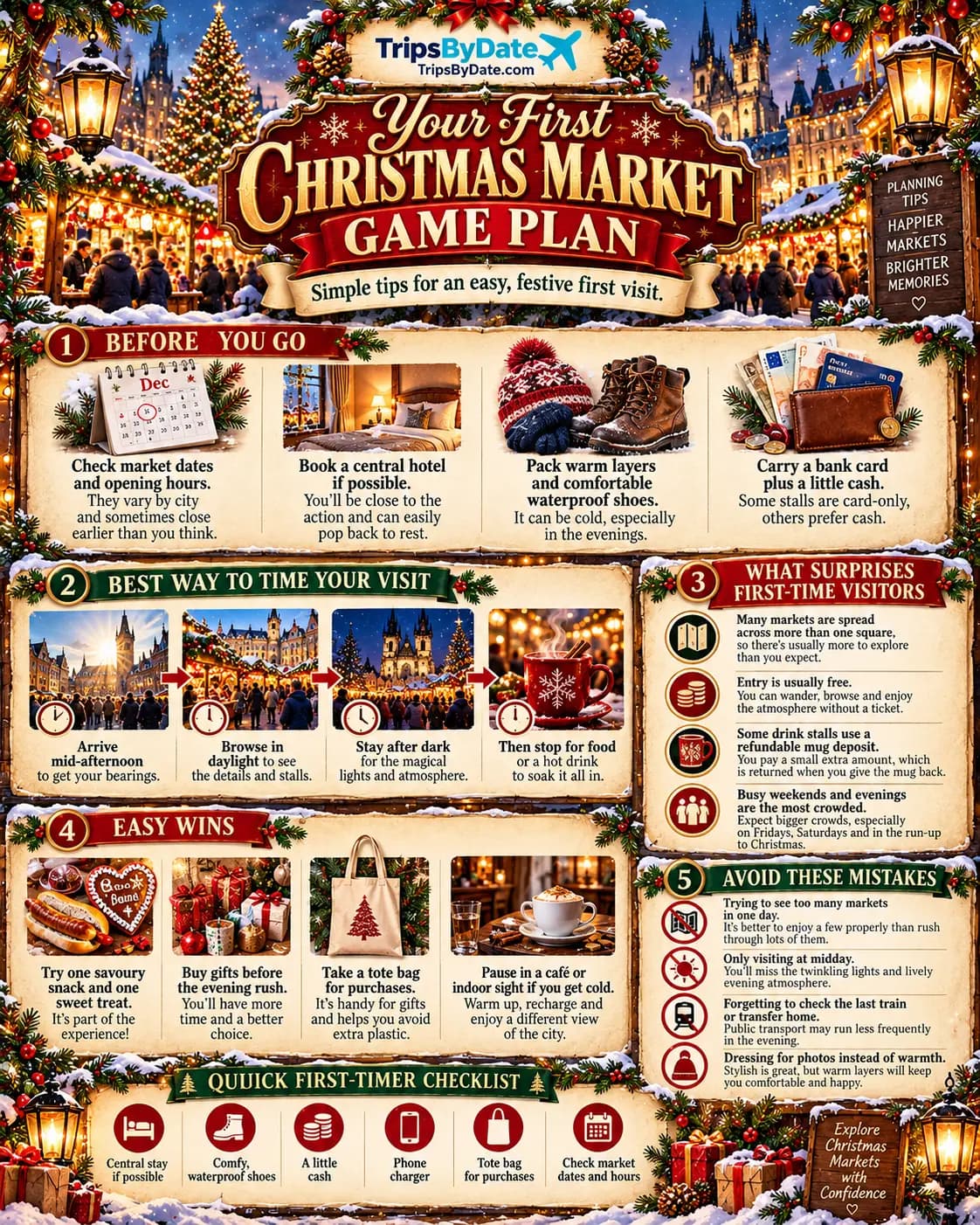
1. Arrive in daylight, but do not leave before dark
A good first market has two moods. In daylight you can actually inspect handmade goods and read stall menus. After sunset the same streets become a lantern-lit maze. Plan a relaxed afternoon arrival if transport allows, have a warming café break, then return for the evening glow. You do not need to be outside for five freezing hours to experience both.
2. The mug might be a souvenir, or you might have paid a deposit
Some markets add a refundable mug deposit (often called Pfand in Germany) to hot drinks. Take the mug back to the appropriate stall or collection point to reclaim it, subject to the market's current rules. You may also be able to keep a souvenir mug and forfeit the deposit. Do not mistake the combined first payment for the permanent price of every refill. Not every country or vendor uses the same system.
3. Markets are often free to enter, not free to enjoy in every possible way
In many cities you can wander between stalls without paying admission, while food, gifts, skating and rides cost extra. But paid-entry experiences such as Tivoli are a notable exception. Check the actual market rather than assuming a rule applies across Europe. Budget for the things that will genuinely make the trip special, not every attraction visible in the photographs.
4. Look at the map before choosing a hotel
A city may advertise “multiple Christmas markets” that span several neighbourhoods. Pin the two you care about most, check the walking route and see whether your hotel provides a sensible base for evenings. A slightly less glamorous hotel that lets you nip back for warm socks can be worth more than a distant luxury room. Check practical journeys on the actual route, especially for anyone with limited mobility.
5. Your cosy market outfit needs proper feet
Warm layers, gloves and a weather-resistant coat matter, but comfortable, water-resistant shoes with decent grip may be your most important purchase. Markets combine cold pavement, standing around and occasional rain or slush. Fashion boots that are fine for a restaurant dinner can be miserable after three hours on cobbles. Bring a small tote for gifts, a charged phone and a little cash for stalls where card options are limited.
6. Buy the delicate decoration before you lose your energy
If you fall in love with a hand-painted ornament, ask about packaging and whether the maker can protect it for travel. Fragile gifts and cramped hand luggage are an awkward combination. Carry a soft protective layer or buy something less delicate. For more on the craft traditions, see our traditional Christmas markets guide.
7. Pick one local speciality rather than six familiar snacks
Try a Czech festive pastry or craft product in Prague, Danish æbleskiver in Copenhagen, or regional warm food in Budapest. Ask the vendor what is typical of that region rather than defaulting to the food you recognise from every British Christmas market. Check allergens and dietary ingredients before buying; seasonal sweets and hot drinks can contain nuts, dairy or alcohol.
A simple first-timer itinerary for two nights
Arrival day: one market, one dinner, absolutely no race
Check in, leave your bag, and walk to the market you most want to see. Spend time noticing the atmosphere before deciding what to buy. Have a proper dinner rather than relying entirely on snacks if that suits you, then finish with the lights. If your flight lands late, swap this for a nearby meal and save the markets for tomorrow.
Full day: daytime discoveries, warm-up break, evening magic
In the morning, visit one landmark, museum or interesting neighbourhood. Return to the markets around lunchtime for crafts and browsing. Take a mid-afternoon warm-up break so your evening feels exciting rather than exhausting. Then enjoy a second market, music or a distinctive light display. For practical advice on preserving your actual holiday time, see how to compare weekend flight timings.
Departure day: gifts, breakfast and a sensible airport buffer
Do one short nearby activity, collect your luggage and head home without a stressful last-minute dash. Check whether markets actually open on your departure morning; not every one starts early. Your final souvenir should be an ornament, not a taxi receipt for missing the train.
When should you go for your first Christmas market break?
There is no single opening day across Europe. Some markets start during November; others open later, and some close before Christmas while others continue into the new year. For a first trip, choose the destination only after checking the actual market dates for your intended stay. Avoid copying last year's schedule from a travel article. The official market websites linked above are the place to confirm your particular visit.
Weekend evenings can be spectacular but crowded. A weekday visit may allow more relaxed browsing, though programmes and transport options vary. Check Christmas Eve, Christmas Day and New Year's opening hours especially carefully. Be realistic about snow too: a festive-looking city does not guarantee a white Christmas.
How to book your first Christmas market break without overcomplicating it
Start with the dates you can actually travel and the UK airport you would realistically use. With TripsByDate's date-first holiday discovery, you can browse advertised packages across destinations rather than completing a long destination-first search repeatedly. It is particularly useful if you would enjoy Vienna but would be equally happy discovering Prague, Budapest or somewhere less obvious.
Then confirm the essentials directly with the provider: destination, length of stay, flights, baggage, hotel location, transfer arrangements and total price. TripsByDate helps you discover offers; it is not the holiday booking agent and does not guarantee that every Christmas market destination is represented. A city-break package also does not automatically include market tickets, festive events or airport transfers.
Compare package and separate-booking costs fairly. Our guide to short package holidays versus booking separately explains what to look for. Before departure, consult official UK guidance for travel to the EU and Schengen area, plus the relevant country's current entry rules, and arrange appropriate travel insurance.
Frequently asked questions
What is the best Christmas market in Europe for a beginner?
Vienna is a versatile first choice because it offers a famous grand market, smaller neighbourhood markets and plenty of indoor sightseeing. Prague may suit someone who wants a compact historic setting, while Cologne excels at experiencing different styles of market. The best choice depends on your journey, dates and interests.
Are European Christmas markets free to enter?
Many public city markets are free to browse. You pay for food, drinks, shopping and paid activities. Some distinctive experiences, notably Christmas at Tivoli Gardens in Copenhagen, charge admission, so check before booking.
How many nights do you need for a first Christmas market trip?
Two or three nights can be plenty if you stay close to your chosen market and your travel arrangements leave useful time on the ground. Aim for two memorable market visits and one other city experience, not an attempt to cover every stall in the destination.
Can you visit Christmas markets during the day?
Yes, and daytime can be better for inspecting crafts and browsing with less distraction. The lights and atmosphere are often at their most striking after dark, so combining both gives a fuller experience.
Do you need cash at Christmas markets?
Cards are accepted by many vendors, but payment arrangements vary by city and stall. A bank card plus a little local currency can provide a useful backup. Check the currency used in your destination and avoid assuming every city uses euros.
Are Christmas markets suitable for children?
Many are, particularly where there are rides, performances or family events. However, crowds, cold weather, loud music and uneven paving can be tiring. Choose a manageable visit, identify toilets and indoor breaks, and check the age limits and cost of activities before promising them.
How can I find a Christmas market city break from my nearest airport?
Choose your airport and departure dates in TripsByDate to browse available advertised package holidays, then check which destinations have active markets during your visit. Compare the full itinerary and confirm all offers with the operator before booking.
Where should your first festive adventure begin?
There is no prize for visiting the most stalls. The wonderful part of a first Christmas market holiday is discovering what makes a city feel festive: Vienna's quiet lanes after the big square, Prague's historic buildings, Cologne's mischievous elves, Budapest's illuminated basilica, Copenhagen's dazzling gardens or Brussels' winding trail of lights. Choose one you can enjoy comfortably, leave room for a surprise, and make it your own.
For broader inspiration, explore the best European Christmas markets, or if you only have a little time off, browse our European city-break ideas. Your first festive trip should begin with excitement, not endless searching.
‹ BACK TO CHRISTMAS MARKETSKnow when you can travel?
Pick your UK departure airport and free dates. Browse upcoming holidays on TripsByDate and discover where your first Christmas market break could take you.
Find holidays by date