

Best Christmas Markets for Food Lovers
Follow the cinnamon, forget the diet spreadsheet and bring your curiosity. This is a delicious tour of Europe's festive stalls, bakery secrets and foods worth travelling for.
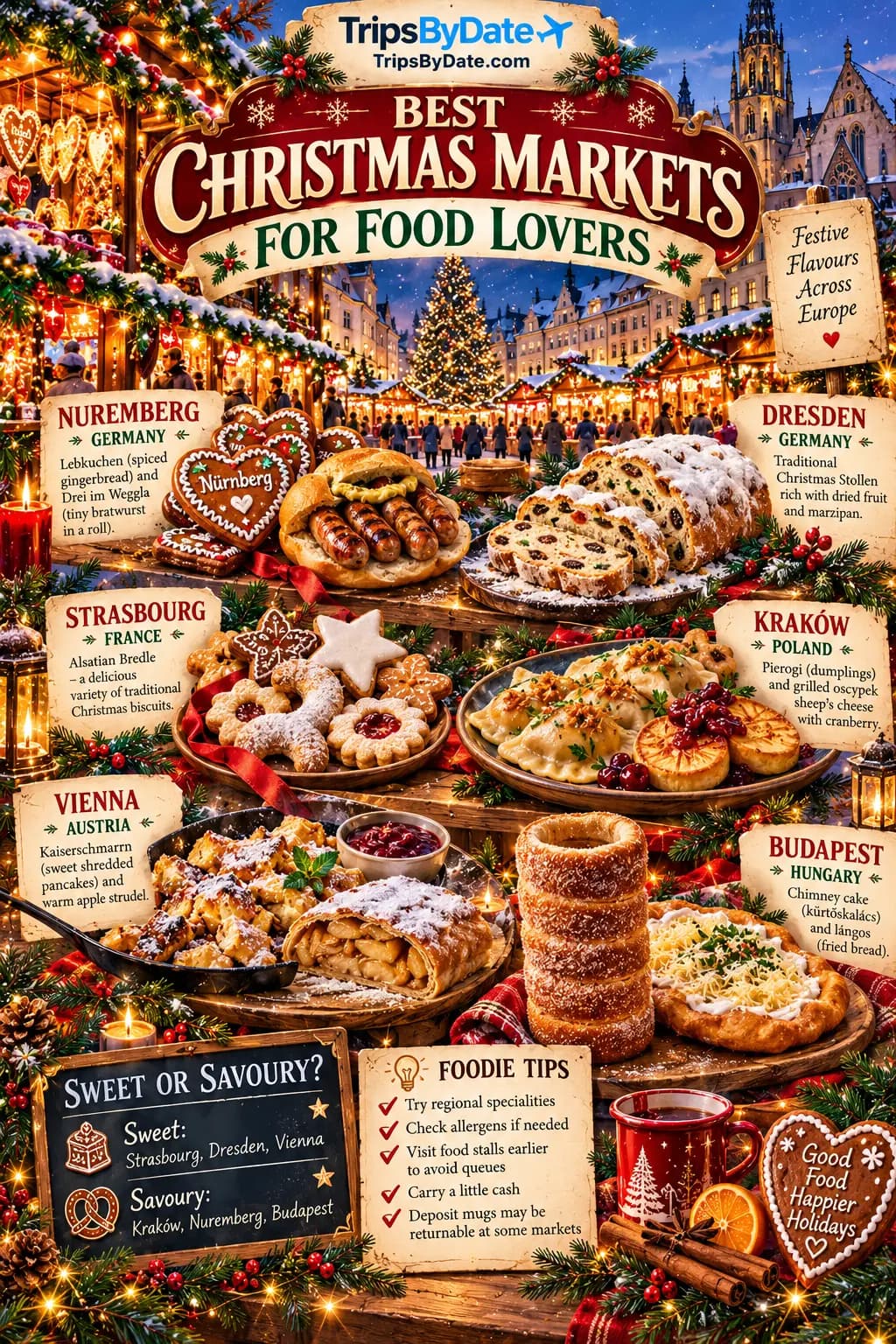
There are two kinds of Christmas market visitor. One arrives with a careful shopping list. The other follows the smell of something sizzling until they find themselves holding a pastry the size of their face. If you belong to the second group, welcome. Europe's best Christmas markets for food lovers are as much about regional recipes and bakery traditions as baubles and fairy lights.
Here's the delicious twist: the best food isn't always the most photogenic thing on the stall. The simplest sausage roll in Nuremberg has a whole local identity; an unassuming Alsatian biscuit comes in dozens of family variations; and the Christmas cake you take home from Dresden has a story that stretches far beyond the market itself. We researched the foods shown in both infographics, then went looking for additional regional specialities, better places to taste them and the little traps that can spoil a hungry afternoon.
Our featured cities are Nuremberg, Dresden, Strasbourg, Kraków, Vienna and Budapest. They are six excellent culinary choices, not a scientifically ranked competition. Seasonal menus and individual stalls change, so think of these as dishes to seek out rather than promises that a particular vendor will be selling them on your dates.
Quick picks: which Christmas market should you visit for food?
- Nuremberg, Germany: best for small grilled sausages, proper Lebkuchen and wonderfully specific Franconian recipes.
- Dresden, Germany: best for stollen, Christmas baking and taking a traditional cake home.
- Strasbourg, France: best for Alsatian biscuits, flammekueche, regional bakery discoveries and gourmet stalls.
- Kraków, Poland: best for hearty savoury food, pierogi, grilled cheese and market-square grazing.
- Vienna, Austria: best for sweet bakery stops, coffeehouse culture, warm punch and grand festive settings.
- Budapest, Hungary: best for smoky fried dough, chimney cake, paprika-rich flavours and generous comfort food.
If the food is only one part of your festive wishlist, start with our guide to Europe's favourite Christmas markets. Otherwise, we have some serious eating to do.
Explore your next holiday by departure date
One of the nicest ways to plan a foodie city break is to start with the dates you can actually travel. On TripsByDate, choose your UK departure airport and browse upcoming advertised package holidays by departure date, without searching every destination individually. These are general holiday examples, not guaranteed Christmas market trips or packages to the cities below. Check the provider's prices, availability, dates and hotel location before booking.

 LGW • 7 nights
 Skiworld


 GLA • 7 nightsB&B · Iglu Ski
 GLA • 7 nightsHB · Skiline
 LGW • 7 nightsSkiline
1. Nuremberg: the city with a very specific sausage order
It's easy to get distracted by Nuremberg's heart-shaped gingerbread and forget that this is also a brilliant destination for savoury eaters. The local speciality is the petite Nürnberger Rostbratwurst, traditionally fragrant with marjoram. Rather than ordering one enormous bratwurst, ask for Drei im Weggla: three little sausages tucked into a bread roll, normally with mustard. Small enough to eat while exploring, substantial enough to prevent an emergency cake-for-dinner situation.
That tiny sausage has serious credentials. Nuremberg Tourism explains that the protected local sausage must meet particular production rules, while its Lebkuchen gingerbread also has a protected geographical identity. The official market food guide even points out another speciality worth finding: Baggers, Franconian potato pancakes, traditionally crisp and comforting in winter. See Nuremberg's official market-food guide.
Try the local comparison: buy a freshly grilled Drei im Weggla as your savoury course, then sample a traditional nut-rich Elisenlebkuchen rather than automatically choosing the largest iced gingerbread heart. Those decorated hearts are charming souvenirs, but the softer, richer gingerbread is the more interesting culinary lesson. Check nut ingredients carefully if you have allergies.
The surprising extra: the city also celebrates a giant Feuerzangenbowle experience, a dramatic hot punch traditionally involving flaming rum-soaked sugar. It is very much an alcoholic spectacle, not a children's drink. You can happily enjoy the atmosphere with a non-alcoholic alternative. Explore Nuremberg's regional food traditions.
Best foodie trick: visit a proper sausage kitchen near the market if you want a sit-down meal, then return to the stalls for one sweet treat. Grazing is wonderful, but buying six separate snacks while still hungry can turn into the world's most expensive standing-up dinner. For the craft-and-tradition side, our traditional Christmas markets guide explores the city's Christkind heritage too.
2. Dresden: where Christmas cake is practically a cultural institution
Dresden is dangerous territory for anyone who says, "I'll only have a small slice." Its famous Christstollen is a rich, fruit-filled festive loaf associated with butter, spices, dried fruit and a snowfall of icing sugar. It is less of an airy sponge and more of a celebratory edible parcel. The city's Striezelmarkt takes its very name from a historic word associated with this style of festive baking.
Don't just buy the biggest loaf: seek out a bakery or specialist seller offering genuine Dresdner Christstollen. Compare ingredient descriptions and portion sizes, and ask whether a smaller piece is available to taste. Dresden's official visitor information highlights its famous stollen alongside local wooden crafts and other market traditions. Read the official Striezelmarkt guide.
Look beyond the postcard cake: Saxony's festive food scene also includes baked pastries, hot apple punch and the wonderfully odd Pflaumentoffel, a little chimney-sweep figure made from prunes. It is more of a traditional decorative good-luck curiosity than something you should mistake for a fresh dessert. Ask sellers what each item is used for before nibbling on a souvenir with a hat.
A better souvenir strategy: if you want to bring stollen back to the UK, buy it near the end of your trip, check the package and storage guidance, and make sure it fits your hand luggage allowance. A securely packed small loaf may be more satisfying than a suitcase full of fragile baubles. Dresden visitor services also describe the Frauenkirche stollen market, which is worth considering if you want a more focused bakery stop than the general market. Explore official Dresden visitor information.
And if fruitcake simply isn't your thing? That's fine. Dresden has not appointed a stollen inspector to follow you around the city. Take a walk through the market, enjoy its carved-wood traditions and find the sweet that actually appeals to you.
3. Strasbourg: follow the biscuit trail, not just the big Christmas tree
Strasbourg is one of Europe's most exciting food-first Christmas destinations because Alsace has a distinct regional kitchen. Its bredle (bredele) biscuits are a proper Christmas tradition, made in numerous shapes and recipes: buttery, spiced, almond-rich, anise-flavoured and more. The best part is that a mixed selection becomes its own miniature tasting tour. You could buy a single packet and conduct a spirited debate about which biscuit deserves the final cup of tea.
Better still, Strasbourg's official Christmas programme has featured a dedicated gourmet zone around the Terrasse Rohan and Place du Marché-aux-Poissons, with regional bakers and speciality producers. Don't just drift between the same generic pretzel stalls: check the current market map for its food-focused spaces. Discover Strasbourg's official gourmet market.
Start savoury: look for flammekueche or tarte flambée, the thin, crisp Alsatian flatbread commonly associated with cream, onions and bacon. It is great for sharing while still hot; toppings vary, and vegetarian versions may be available. Then consider spaetzle, a soft egg-based speciality, if you want something more filling than snacks. Strasbourg's official market pages specifically reference flammekueche, spaetzle and regional baked goods. Check the city's official food and market information.
The less obvious sweet: look for berewecke, a dense Alsatian festive fruit bread featuring dried pears, nuts and other fruit, or a little maennele, the person-shaped brioche traditionally linked with St Nicholas celebrations. The tourism office also mentions dampfnudle, a soft, steamed or pan-cooked dough speciality sometimes served with fruit accompaniment. Read Strasbourg Tourism's regional tasting list.
Make it a proper afternoon: eat the savoury food first, visit the gourmet area for a biscuit assortment, then linger by the illuminated cathedral or riverside as the lights come on. You needn't queue for a meal every hour. For more ideas about spectacular market settings, see our most beautiful European Christmas markets guide.
4. Kraków: pierogi, smoky cheese and a proper Polish winter appetite
Kraków is for anyone who thinks a Christmas market meal should involve real plates, substantial portions and the feeling that you will never need to eat again. Around the main square, seasonal food stalls frequently offer pierogi, Polish soups, grilled meats and bread piled with savoury toppings. It is street food designed for people wearing thick coats and walking in cold weather, not a delicate tasting spoon followed by disappointment.
Go beyond the usual dumpling order: try comparing savoury pierogi fillings, such as potato-and-cheese or cabbage-and-mushroom, rather than ordering the first variety you see. One market stall may serve small tasting portions; another may offer a full meal. Ask before committing. And look for grilled oscypek-style sheep's cheese, often served with cranberry sauce. Authentic protected oscypek is a specific regional product, so don't assume that every grilled cheese sold under a loose description has the same provenance.
One local idea worth trying: a generous slice of bread with savoury toppings, sometimes called pajda, can be a more interesting lunch than a generic sausage. For sweet teeth, bakeries around Kraków's centre can provide a very different experience from market-only desserts. A locally focused guide to Kraków's market describes pierogi, grilled cheese, soups and these substantial open sandwiches among typical food offerings. Explore Kraków's festive-food guide.
A useful detour: don't judge Kraków's entire food scene by the busiest stalls on Rynek Główny. Consider a proper Polish restaurant or a milk bar for a sit-down lunch, checking menus and current opening hours. A warming bowl of soup indoors can give you a welcome break from queuing and may make more sense if travelling with children.
For a less rushed day: eat a savoury meal away from the peak evening rush, then come back for the lights and one standout treat. That way you get to enjoy the square twice without spending every minute in a queue. See our Christmas market value guide for comparing the complete cost of a city break, not just snack prices.

Hungry for a festive escape?
Choose your UK airport and travel dates on TripsByDate, then browse upcoming package holidays across destinations. Find a possible city break without filling out endless destination-first forms.
Discover holidays by date5. Vienna: cakes, coffeehouses and the art of the winter pause
Vienna is an exceptional food destination even when its Christmas markets are taking a well-earned rest. The city combines festive stalls with a celebrated coffeehouse and pastry culture, which means you can plan your day around both outdoor grazing and a beautifully civilised warm-up. The main image features Kaiserschmarrn, a fluffy, torn pancake dish often served with powdered sugar and fruit compote, and Apfelstrudel, a thin pastry wrapped around spiced apple filling.
The delicious decision: do you want a bustling market snack or a proper café dessert? Try both, but on different occasions. Market stalls can be wonderful for roasted almonds, sweet pastries and hot drinks; a café gives you the pleasure of sitting down, removing several layers and eating something from a plate. Vienna Tourism highlights the seasonal scents of baking, punch and toasted almonds across its Christmas markets. See Vienna's official Christmas market guide.
Try this unexpected comparison: taste your favourite sweet at a market, then visit a traditional café to compare the textures and presentation of a classic Viennese dessert. This is an excellent excuse for a museum or palace visit between courses. The market becomes part of your food journey rather than the only location in it.
Don't overlook the drinks: Christmas punch stalls may offer a wide choice, including fruit-based and alcohol-free versions. Ask exactly what you are ordering; the word Punsch does not by itself tell you whether a drink contains alcohol. And watch for reusable cups or mug deposits before assuming the price on a sign is the total cost.
One final Vienna tip: enormous, famous market squares are magical at night, but busy lines can be a poor place to savour a delicate pastry. If you want to concentrate on the flavour rather than juggling gloves, napkins and a camera, take a proper afternoon café break and keep the evening for festive atmosphere.
6. Budapest: where the pastry curls and the bread gets fried
Budapest's headline Christmas sweet is kürtőskalács, or chimney cake: strips of sweet dough wound around a cylinder and baked so the outside develops a caramelised crust. It is wonderful fresh and warm, and the smell has a remarkable ability to make a recently fed person suddenly hungry again. But sweet chimney cake is only half the story.
For savoury lovers, find lángos: fried flatbread commonly topped with garlic, sour cream and grated cheese. It's magnificent comfort food, though not exactly the snack you'd order before running a marathon. The Hungarian national tourism site explicitly highlights both lángos and chimney cake, along with other Hungarian street-food favourites. Explore Hungary's official Budapest food guide.
Beyond the tourist-market classics: ask about goulash soup, paprika-seasoned dishes and regional sausages. If you are extending your trip, explore traditional Hungarian festive pastries such as bejgli, the rolled cake often filled with walnuts or poppy seeds. Not every Christmas stall sells every dish, so treat the official food list as inspiration for markets, bakeries and restaurants combined. Find traditional Hungarian Christmas dishes on Budapest's official visitor site.
Pick your eating location carefully: central markets at Vörösmarty Square and beside St Stephen's Basilica are spectacular but can become crowded. Hungary's official tourism information also highlights festive events and food outside those two most recognisable locations. Checking a neighbourhood market or a local restaurant may give you a different flavour of the city. Browse the city's wider festive experiences.
One delicious warning: chimney cakes are best enjoyed fresh. A towering version covered in several sugary toppings might photograph beautifully, but a simple freshly baked one can be more satisfying. Share if you want to try more things later. No one wins an award for eating their entire holiday food budget at the first stall.
Three tasty Christmas market discoveries beyond the featured six
Copenhagen: æbleskiver and a very cosy Danish December
Despite the name's apple association, traditional æbleskiver are small round Danish pancake-like treats, typically enjoyed with jam and powdered sugar. Copenhagen's official tourism board pairs them with gløgg as quintessential Christmas tastes. You may find them at festive attractions or bakeries, but don't assume they are sold at every market, or that all attractions are free to enter. See Copenhagen's official Christmas traditions.
Alsace's smaller towns: turn a Strasbourg trip into a bakery discovery
If you have more than two nights, investigate the smaller Alsatian towns and villages known for their festive atmosphere. Look for regional bakeries and markets where you can compare local bredle selections and gingerbread with what you found in Strasbourg. Don't assume a day trip is straightforward just because two places look close on a map: check public transport, opening days and return services first.
Back home: recreate a mini European Christmas tasting night
Bring back a legally permitted, shelf-stable speciality with suitable packaging, such as commercially packed biscuits or stollen, and invite friends to try it with something savoury you've made at home. Check current UK rules before importing foods, especially items containing meat or dairy. The best souvenir isn't always another ornament: sometimes it's the recipe you learn or the flavour you try to reproduce.
The Christmas market foodie field guide: eat smarter, enjoy more
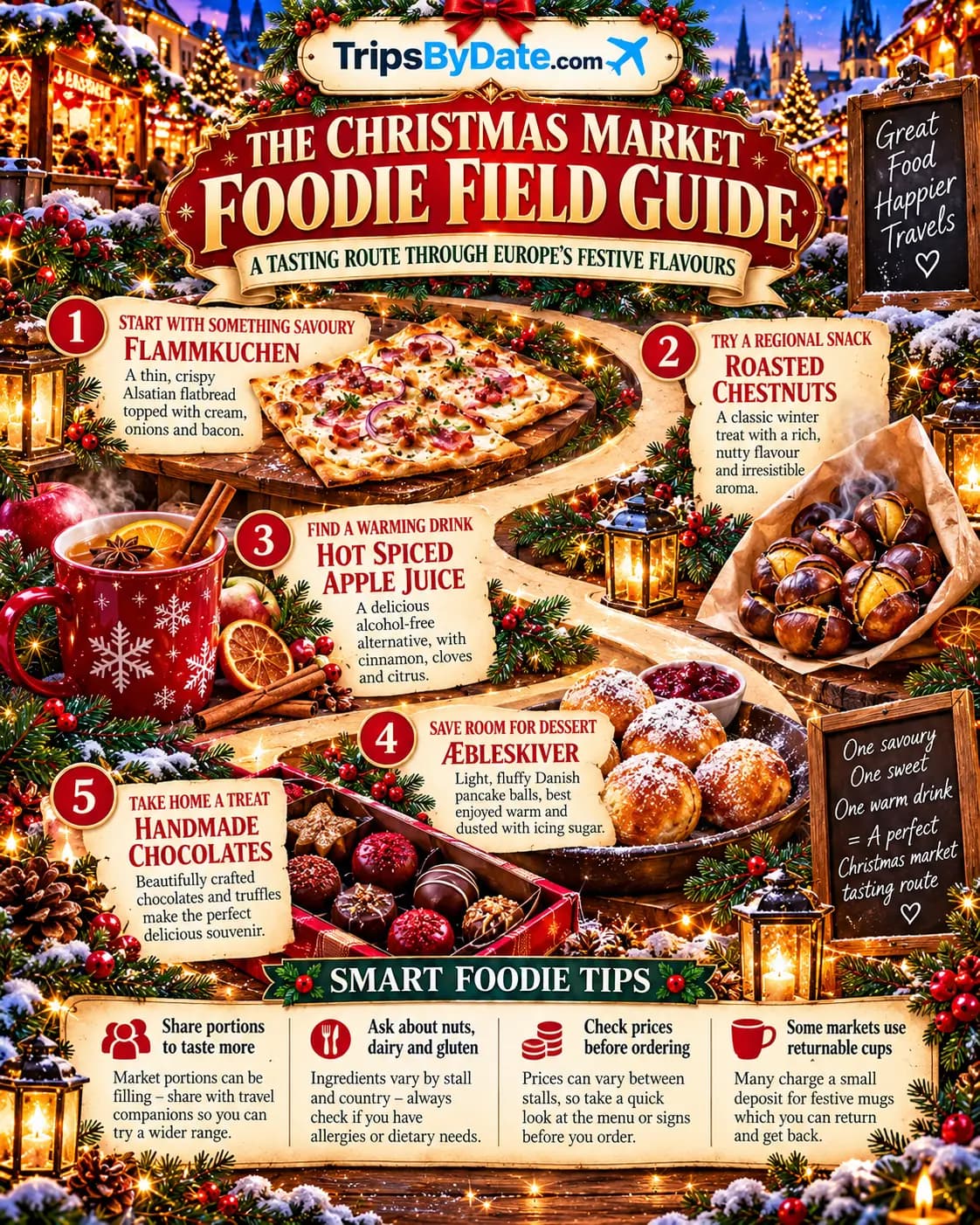
Our second infographic shows a fun tasting route through flammekueche, roasted chestnuts, hot spiced apple juice, Danish æbleskiver and handmade chocolates. It is a cross-Europe tasting inspiration, not a claim that you can find all five at every market. Here's how to make a real food crawl work.
Start with one savoury dish before the sugar avalanche
Choose one proper savoury speciality that belongs to the destination. In Nuremberg that might mean sausages or Baggers; in Kraków, pierogi; in Strasbourg, flammekueche; in Budapest, lángos. Once you've eaten something substantial, you'll make much better decisions about desserts. Suddenly every pastry won't seem like an emergency.
Try a regional drink that isn't necessarily mulled wine
Hot spiced apple juice, fruit punch, tea and cocoa can all be lovely options, especially for children or anyone avoiding alcohol. Ask what's in the drink and whether the cup price includes a refundable deposit. Some markets use different mugs for different stalls or areas, so check where returns are accepted.
Find one treat you have never heard of
This is where the fun really starts. Have you tried Berewecke, Dampfnudle, a Polish poppy-seed pastry or authentic Elisenlebkuchen? Ask a seller what makes their version special and where the ingredients come from. Regional food can tell you more about a place than yet another generic ornament stall.
Use the bakery as a second market
The busiest chalets don't own the entire festive food scene. A city bakery, café or covered market may offer regional specialities that aren't available among the wooden huts. This is particularly useful if you want breakfast or a sheltered lunch rather than standing outside for every meal.
Share deliberately, not accidentally
Some festive portions are substantial. Two people sharing a savoury item and choosing separate sweets may discover more than two people each ordering an enormous meal at the first stall. That isn't a promise of lower prices or permission to ignore dietary needs: simply plan your tasting as a series of interesting little decisions.
How to spot a worthwhile food stall
- Look at what is being cooked: freshly prepared food can be appealing, but a visible cooking process does not prove hygiene or food quality.
- Read the full menu and prices: ask whether toppings, sides, sauces or deposits cost extra before placing an order.
- Watch the queues sensibly: a busy stall can be popular for good reasons, but a long queue is not proof that the food is best.
- Ask about regional origin: a stall selling genuine local specialities should be able to explain the product. Don't assume an attractive traditional-looking chalet guarantees artisanal production.
- Check the temperature: hot food should be served hot and perishable ingredients handled safely. Choose another vendor if food appears poorly stored or managed.
- Carry a small amount of local currency where useful: payment methods vary and a few stalls may not accept cards. Check the current arrangements for your destination.
Food allergies need proper planning, not guesswork. Nuts, dairy, gluten, eggs and other allergens appear in many festive dishes, sometimes in unexpected places. If you have an allergy, tell vendors clearly, ask about ingredients and cross-contact, and use a translated allergy card when appropriate. If a stall can't establish whether something is safe, skip it. The UK Food Standards Agency's research on travelling with food allergies discusses the value of language preparation and advance planning.
A delicious two-night Christmas market itinerary
Arrival evening: check into a hotel with easy access to the market, take a gentle first walk, then order one local savoury favourite and a warming drink. You will get a sense of the layout and save the serious tasting for tomorrow.
Full day, morning: find a bakery or indoor food market and have a regional breakfast. Explore one cultural attraction or neighbourhood so the trip feels like a city break, not an extended queue.
Full day, afternoon: make your main Christmas market tasting tour. Try two or three things that genuinely interest you, compare a traditional bakery speciality, and buy any edible souvenirs you can carry safely.
After dark: return for the lights, music and atmosphere. Have a proper dinner somewhere comfortable if grazing has not been enough. Many cities offer a memorable Christmas market experience even if you buy nothing at all in the evening.
Departure day: enjoy one last café or bakery stop only if the airport schedule allows. Don't plan your entire return journey around a pastry shop that may be closed on Sundays. For better short-trip planning, see our guide to comparing the total cost of a weekend break.
Find a foodie getaway faster with TripsByDate
You might dream of eating Lebkuchen in Nuremberg, but discover that your available days and local UK airport make another destination a more sensible option. That is exactly why TripsByDate's date-first holiday discovery is useful: choose the airport and dates you can travel, then quickly browse upcoming advertised packages across destinations. It feels more like exploring possibilities than endlessly filling in destination-first forms.
Take a few minutes to browse, come back another day, and see whether a festive city, winter escape or completely unexpected break catches your attention. The inventory depends on participating operators, so it doesn't include every holiday, and a listing is not evidence that a particular Christmas market will be open during that trip. Always check official market dates, hotel location, inclusions, the provider's live price and availability. TripsByDate helps you discover; the provider handles booking.
Travelling from the UK? Check the official destination travel advice, passport requirements and suitable travel insurance before paying. For ideas about smaller breaks, explore our best weekend breaks in Europe guide.
Frequently asked questions
Which European Christmas market is best for food lovers?
It depends on your appetite. Nuremberg is especially appealing for grilled sausages and Lebkuchen, Dresden for stollen, Strasbourg for Alsatian biscuits and savoury specialities, Kraków for pierogi, Vienna for pastries and coffeehouse culture, and Budapest for lángos and chimney cake.
What food should I try at a German Christmas market?
Try a genuinely regional speciality rather than relying on the same menu everywhere. Nuremberg is known for its small sausages in a roll and gingerbread, while Dresden is closely associated with Christmas stollen. Roasted nuts, potato pancakes and seasonal pastries are also worth seeking out.
Are Christmas market food stalls expensive?
Prices vary by city, stall, dish and season. Compare clearly displayed menus, check toppings and mug deposits, and include the cost of drinks and meals in your overall holiday budget. A flight bargain is not automatically a cheap food break.
Can I visit Christmas markets if I don't drink alcohol?
Yes. Many markets offer hot chocolate, tea, fruit punch and alcohol-free spiced drinks. Always confirm ingredients rather than assuming a drink described as punch or mulled automatically contains or excludes alcohol.
Do Christmas markets have vegetarian, vegan or gluten-free food?
Options exist, but their availability depends on the destination and vendor. Strasbourg's official market information mentions choices for various dietary preferences. Always check ingredients and preparation methods, especially for allergies or coeliac disease; never assume a dish is safe from its appearance.
What are the best edible souvenirs from a Christmas market?
Packaged regional biscuits, gingerbread, stollen and chocolates can be memorable choices if suitable for transport and permitted under current UK import rules. Check ingredients, storage requirements, packaging and baggage allowances before purchasing.
Can TripsByDate help me find a Christmas market food holiday?
TripsByDate lets you choose your UK departure airport and travel dates to browse upcoming advertised package holidays across destinations. It is a discovery tool rather than a specialist food-tour booking service, so check the operator's destination, dates and inclusions, plus official market opening information, before deciding.
One last bite
A wonderful Christmas market isn't necessarily the one with the biggest tree or the longest row of chalets. Sometimes it's the place where you discover a soft almond biscuit, share a plate of steaming dumplings or learn why a whole city is proud of three sausages in a roll. Follow the local flavours and the stories behind them, and you'll come home with much better memories than another generic souvenir.
For more festive inspiration, try our underrated Christmas markets or best Christmas market weekend breaks. Then see which dates work for you on TripsByDate. Your next favourite dish might be in a city you hadn't considered at all.
‹ BACK TO CHRISTMAS MARKETSKnow when you can travel?
Choose your UK airport and dates, then browse upcoming package holidays across destinations with TripsByDate. Less searching, more discovering and perhaps one very good pastry.
Find holidays by date