

Best Traditional Christmas Markets in Europe
Prune people, golden angels, candle-powered pyramids and the Christmas cake that needed a pope: six festive cities where traditions tell the best stories.
A Christmas market can be lovely because of its lights. But the ones that stay with you tend to have something else: a ritual, a recipe or an object with a story attached. A tiny chimney sweep made from dried fruit. A wooden carousel that turns without a motor. A choir singing in a square where people have gathered for generations. This is the sort of festive magic you can take home without fitting an entire Christmas tree into your suitcase.
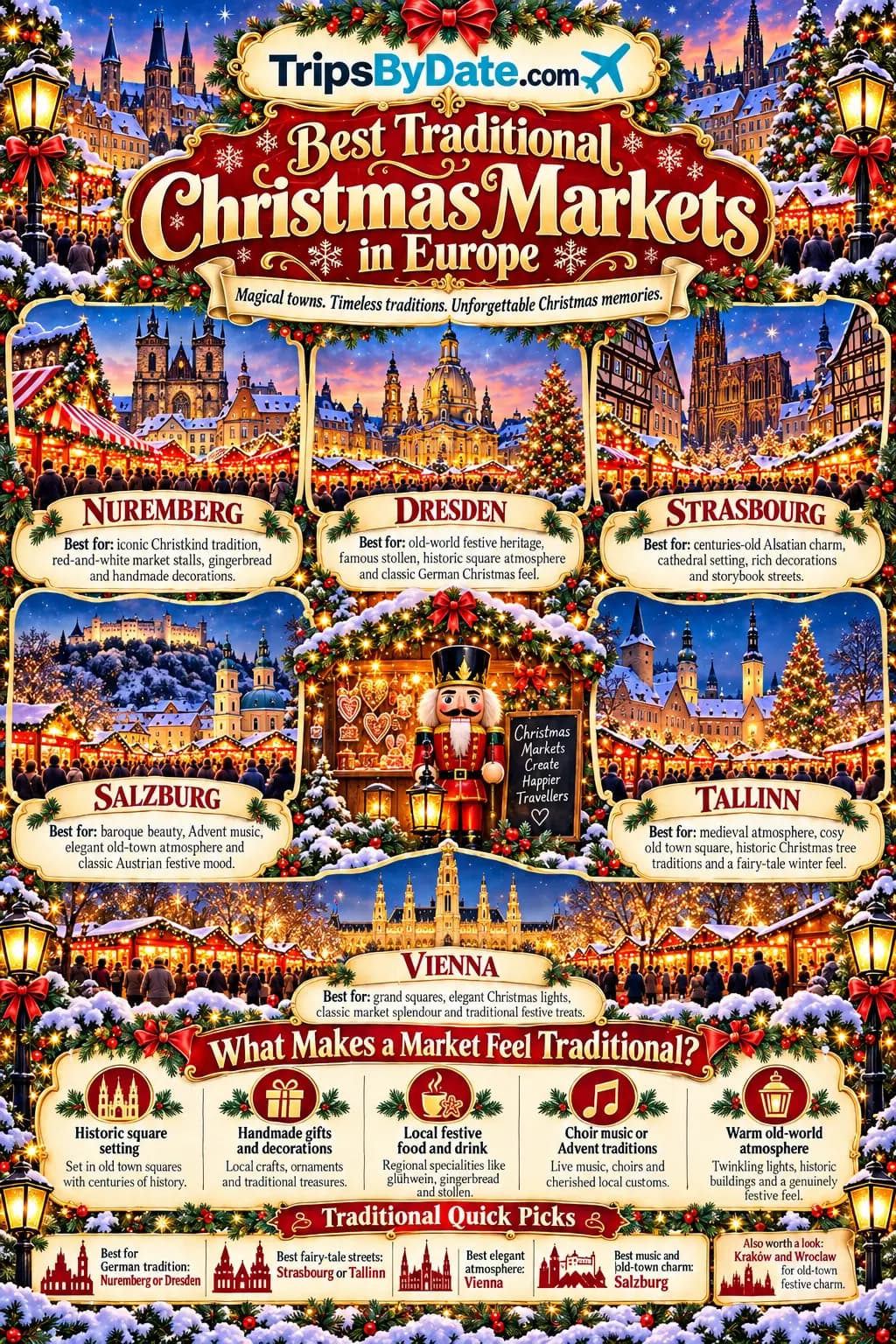
Where are the best traditional Christmas markets in Europe? For a journey into distinctive customs, explore Nuremberg, Dresden, Strasbourg, Salzburg, Tallinn and Vienna. They are not interchangeable. Nuremberg is known for its Christkind and whimsical prune figures; Dresden for Saxon woodcraft and its famous stollen; Strasbourg for Alsatian baking; Salzburg for Advent music; Tallinn for a remarkable public-tree tradition; and Vienna for contrasting historic market settings. This is an editorial shortlist, not a claim that other cities lack traditions.
Unlike our guide to the most beautiful Christmas markets, this one is about what people do, make, eat and pass down. Look beyond the fairy lights and you start to understand why Christmas markets matter. If you have a free weekend but haven't decided which city to visit, TripsByDate makes it easy to browse upcoming advertised holidays by departure date first, instead of endlessly entering one destination after another.
Choose a market for its traditions, not just its photographs
- Nuremberg, Germany: Christkind opening ceremony, striped stalls, gingerbread, Rauschgold angels and curious little prune people.
- Dresden, Germany: the historic Striezelmarkt, Saxon stollen, Erzgebirge woodcraft, candle arches and miniature Christmas pyramids.
- Strasbourg, France: the Christkindelsmärik, Alsatian bredle biscuits, decorated timber-framed streets and regional producers.
- Salzburg, Austria: brass music, choirs, cathedral-square atmosphere and local Advent customs.
- Tallinn, Estonia: medieval Town Hall Square, an extraordinarily old public Christmas-tree tradition and Estonian festive food.
- Vienna, Austria: centuries of markets, traditional handicrafts, historic squares and wonderfully different neighbourhood experiences.
Our best tip: before you buy your first souvenir, choose one local custom to seek out. It gives your visit a little treasure-hunt quality. You may come home with a story about a cake and a pope rather than another identical bauble.
Discover a festive break by the dates you can travel
One of the hardest parts of planning a Christmas market trip is making the dates fit your time off. On TripsByDate, choose your departure airport and browse upcoming advertised package holidays in date order, without picking a destination first. The examples below come from our wider operator inventory: they are not necessarily Christmas market holidays and could include beach trips. That's intentional. Use them for inspiration, then confirm the destination, actual market opening dates, inclusions, price and availability with the provider.


 MAN • 2 nights
 HB · First Choice

 STN • 7 nightsRO · Hays Travel
 BHX • 7 nightsB&B · Skiline
 GLA • 7 nightsHB · Skiline
1. Nuremberg: the Christmas market where the decorations have personalities
Nuremberg's Christkindlesmarkt is a superb place to start because so much of its heritage can be seen at once. The main market in the Hauptmarkt is famous for wooden stalls covered in red-and-white-striped cloth. Its traditional opening features the Christkind, an angelic Christmas figure, delivering a ceremonial prologue from the Church of Our Lady balcony. The Nuremberg tourism office describes the market as a “little town of wood and cloth”, a much more evocative image than another generic row of huts. Read the official Nuremberg market guide.
Meet the Zwetschgenmännle, little people made of prunes
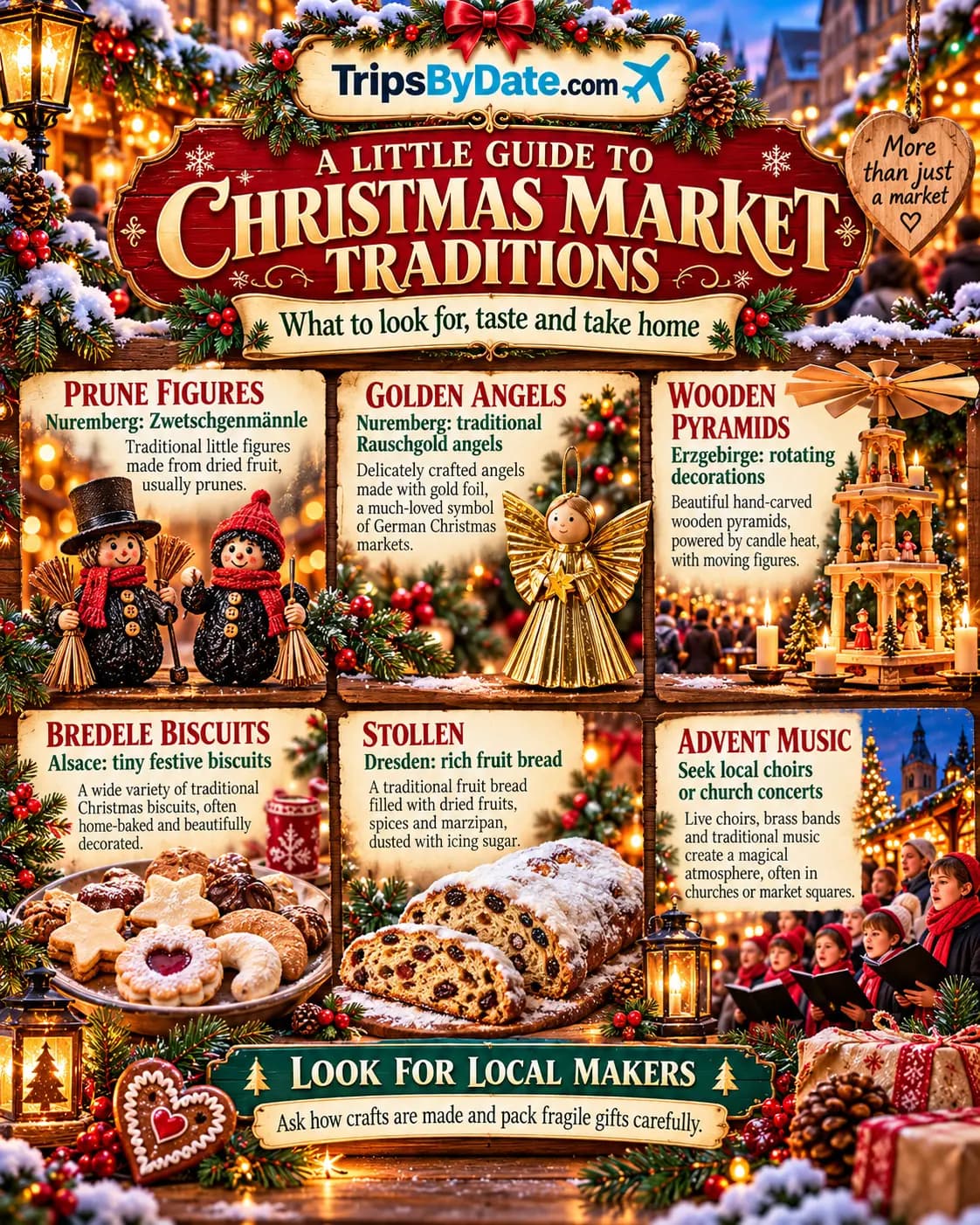
Look for shelves crowded with tiny characters assembled from dried fruit, often dressed as tradespeople, musicians or chimney sweeps. They are called Zwetschgenmännle, and the official market shopping guide describes hundreds of imaginative designs. The figures are ornaments, not snacks. Here's a good festive argument to have over a hot drink: Nuremberg and Dresden both have claims around the origin of these dried-fruit figures, so don't confidently repeat a single “invented here” story. See the official guide to Nuremberg crafts and souvenirs.
The golden Rauschgoldengel is another classic: a shimmering angel connected with Nuremberg's Christmas decoration tradition. For a gift with a local story, compare these with mass-produced ornaments and ask stallholders about their materials and maker. You might find one exquisitely made decoration worth more to you than six anonymous trinkets.
Make it a proper experience: explore the main market, then look for the Sister Cities Market, where Nuremberg's international connections appear through crafts and goods. Families can investigate the separate Children's Christmas activities, subject to the seasonal programme. Try traditional Lebkuchen gingerbread and Nuremberg sausages, checking ingredients if you have allergies or dietary restrictions. For a trip primarily about the craft tradition, a weekday daytime visit may leave more room to examine the stalls closely.
Important timing: don't assume the classic German market remains open through New Year. Nuremberg's main Christkindlesmarkt traditionally finishes on Christmas Eve; check the latest official dates before booking your hotel. If you want other German Christmas inspiration, our European favourites guide offers different styles of market trip.
2. Dresden: follow the cake crumbs into Saxon history
Dresden's Striezelmarkt on Altmarkt is the sort of market where the souvenirs and snacks are practically a history lesson. Its documented origins reach back to 1434, when the original market was a far more functional pre-Christmas trading event. The area is famous for carved Erzgebirge decorations, stars, traditional wooden figures and its great Christmas pyramid. Explore Dresden tourism's Striezelmarkt guide.
Stollen and the surprising tale of the butter permission
The market's name is linked to an older form of the pastry that became Dresden's celebrated Christstollen. Here is a fact that sounds invented but is documented by the European Commission: in the late Middle Ages, Advent fasting rules restricted the use of butter. Saxon rulers petitioned Rome, and a papal dispensation in 1490 eventually allowed butter in stollen baking. That is quite an origin story for a rich, sugary fruit loaf. Read the European Commission's history of Dresdner Christstollen.
Try this: buy a small portion of genuine Dresden stollen from a reputable baker, then compare it with an ordinary fruit cake. Real Dresdner Christstollen has protected geographical-indication status, which helps you distinguish the regional product from any cake carrying a festive label. If you want one edible souvenir to share back home, this is a strong contender; check packaging, shelf life and baggage allowances first.
Why is a wooden pyramid turning above the stalls?
Christmas pyramids from the Erzgebirge, or Ore Mountains, use tiers of carved figures beneath a rotating fan. Traditional small versions turn because warm air rises from candles, rather than because somebody hid a battery in the base. Craftsmanship from the mining region also shaped Schwibbögen, illuminated candle arches, and nutcrackers. Dresden's enormous market pyramid draws on this miniature tradition. When shopping, ask whether a piece was made in the region or simply styled to resemble its handicrafts. A beautiful design does not automatically prove local manufacture.
An overlooked connection: Dresden has its own dried-plum chimney-sweep figure, the Pflaumentoffel. It makes a fun comparison with Nuremberg's prune people, although their histories are not identical and origin claims are contested. More importantly, a simple “lucky charm” souvenir opens a window into older working lives and the development of these markets.
3. Strasbourg: a Christmas tradition you can taste by the biscuit
Strasbourg's historic Chrìstkìndelsmärik, first established in 1570, is rooted in Alsatian Christmas culture. But what makes it special is not merely the age of the market. It is the way festive life spreads across decorated streets, family food traditions and different neighbourhoods rather than staying inside one fenced-off attraction. The historic market is associated with Place Broglie; other festive areas lie around the cathedral, Place Kléber and beyond. Read Strasbourg's history of the Chrìstkìndelsmärik.
The biscuit box that tells you more than a souvenir magnet
One of the loveliest Alsatian customs is baking bredle: small Christmas biscuits made in numerous family variations. The local tourism office describes butter varieties, almond-and-cinnamon versions and aniseed biscuits. Rather than treating every stall's gingerbread as interchangeable, ask for two contrasting types and try to identify the spices. It's a delicious little lesson in regional baking. Explore ten traditional Strasbourg market specialities.
Look beyond the headline stall: Strasbourg's official market guide identifies local producers, a gourmet area and the historic market in different squares. Walk from Place Broglie towards the cathedral, then detour to the Quai des Délices area for Alsatian food specialities. If you prefer the people and craft stories to the largest crowds, investigate the small-producer markets as well. Use Strasbourg's official market-area guide.
Unusual local taste: Alsatian Christmas menus go well beyond mulled wine and biscuits. Keep an eye out for maennele, little human-shaped brioche figures associated with St Nicholas traditions, or berewecke, a dense fruit-and-nut Christmas bread. Ask about ingredients before buying: speciality baked goods may contain nuts, gluten, milk or alcohol.
For a different angle on visiting, see our guide to Europe's beautiful Christmas market settings, which focuses on walks and viewpoints rather than their cultural backstories.
4. Salzburg: a city where the soundtrack matters
Some Christmas markets are remembered for what you buy. Salzburg is especially rewarding for what you hear. Its historic Christkindlmarkt around Domplatz and Residenzplatz sits in a UNESCO-listed old-town setting, with Salzburg Cathedral as a striking backdrop. Official tourism information lists choirs, traditional tower brass music, the Christkind and other seasonal performances among the festivities. They form part of a programme, not activities guaranteed at every visit. Explore Salzburg's Christmas market information.
Listen for Turmblasen, not just the loudest Christmas playlist
Turmblasen means tower brass playing. Hearing live brass drift across historic squares feels very different from hearing the same recorded carols while queuing for a sausage. Check the city's official programme before you travel and build the evening around a performance you actually want to hear. A small choir or brass ensemble may be the experience you talk about long after the photographs are forgotten.
Salzburg's wider Advent traditions also include figures such as Krampus and Perchten, which appear in certain processions and seasonal customs. These can involve elaborate, sometimes frightening masks and noise. Fascinating for some visitors, potentially too intense for young children or anyone expecting nothing but jolly reindeer. Check the event description, route and suitability before attending, rather than assuming every performance is child-friendly.
Try a calmer plan: arrive early enough to explore the old town in daylight, then return to the cathedral squares after dark when a scheduled musical event is on. Leave yourself time for a warm café, a bakery stop and a walk away from the main stalls. Salzburg isn't just a stage set; the architecture and musical heritage remain worth enjoying outside the market hours.

Fancy discovering a Christmas tradition of your own?
Choose your UK airport and free departure dates with TripsByDate. Browse upcoming holiday ideas quickly, without choosing the destination before you start.
Discover holidays by date5. Tallinn: beneath a Christmas tree with a very long story
Tallinn's Christmas market fills Raekoja plats, the Town Hall Square in its medieval old town. Visit Tallinn traces the public Christmas-tree tradition here to 1441, when the Brotherhood of Black Heads is associated with the tree's appearance in the square. Historians still debate broad claims about where the Christmas-tree custom itself began, so it is more accurate to say Tallinn has an exceptionally early documented public-tree tradition than to say it invented every Christmas tree. Read Visit Tallinn's account of the Christmas tree.
What to look for besides the famous tree? Stalls offering Estonian handicrafts, warming drinks, woollen items and local festive food. Official tourism descriptions include black pudding, sour cabbage and gingerbread among the seasonal specialities. If you've only encountered central European Christmas markets before, these dishes are a wonderful reminder that Christmas isn't celebrated identically across the continent. See Visit Tallinn's current market information.
A good small challenge: choose one locally made wool item or Estonian design piece, and ask what the material and care instructions are. A pair of properly warm socks has a better chance of being used in January than a novelty Christmas hat. Because Tallinn can be cold, a warm café break is part of sensible planning, not a failure to embrace winter.
Think beyond the postcard: explore the medieval lanes in daylight to appreciate their detail, then revisit the square when the tree lights are on. Snow looks lovely in pictures but is not guaranteed. Wet pavements, ice and wind are good reasons to choose grippy waterproof footwear rather than brand-new fashion boots.
6. Vienna: tradition on a grand scale and down a quiet side street
Vienna is more than its huge festive market outside the Rathaus. That display is spectacular, but if you are looking for an older or more intimate experience, compare several markets. Vienna's official tourism information identifies the Old Viennese Christmas Market at Freyung, with a market tradition dating to the 18th century, plus craft-oriented locations around Am Hof, Spittelberg and Karlsplatz. The different settings make Vienna a particularly good choice for a market-themed walking day rather than spending the entire afternoon at one square. Explore Vienna's official market guide.
Try this contrasting pair: look at ceramics, glass decorations or other crafts at the Old Viennese market, then wander the narrower streets around Spittelberg for a more intimate atmosphere. Spittelberg is set among historic lanes, and the City of Vienna highlights handicrafts, punch and regional food. This isn't proof that every item on every stall is handmade locally, so ask about provenance if that matters to you. Compare Vienna's Christmas market neighbourhoods.
Make a café part of the tradition: take a proper break for coffee and a slice of cake rather than trying to sustain an entire day on market snacks. Vienna's indoor cafés make a useful winter retreat, especially for older visitors or anyone who finds long hours standing outside tiring. For music, check whether a choir or Advent concert appeals to you and whether tickets are required.
The practical catch: Vienna's different markets have different opening and closing dates, often extending beyond or ending before Christmas depending on the venue. Do not assume a large city-wide holiday programme means your favourite craft market will be open on your actual dates.
Three more places for travellers who love old-world customs
Kraków, Poland: the Main Market Square offers a grand setting for folk craft, regional food and seasonal performances. It is worth researching traditional Polish Christmas customs alongside the stalls rather than treating the trip as a generic market shopping session. Our Christmas market value guide has ideas for assessing the cost of a Kraków break.
Wrocław, Poland: combine its colourful market-square setting with an exploration of the city's distinctive character. There is more to the trip than the hot-drink stalls; look for Polish crafts and independent businesses off the main square.
Cologne, Germany: choose a traditional cathedral-backdrop visit, but don't assume all its Christmas markets have the same identity. Cologne's range of settings makes it useful if one visitor wants classic craft stalls and another wants a livelier seasonal city break. For a short stay, our Christmas market weekend guide compares the logistics of several cities.
How to tell a genuine traditional craft from a generic souvenir
“Traditional” gets printed on an awful lot of things. You can make a more interesting purchase by asking a few simple questions:
- Who made it? A stallholder who can name the maker, workshop or region gives you more information than a label saying “European-style”.
- How was it produced? Hand-painted, hand-carved and machine-finished are different descriptions. None is automatically bad, but don't pay artisan prices for a factory souvenir without knowing.
- Does it have a local connection? A wooden pyramid from the Ore Mountains, bredle from an Alsatian bakery or a regionally made textile carries more cultural meaning than a decoration that could come from anywhere.
- Can you transport it safely? Fragile glass, long wooden pieces, liquid gifts and food may present baggage or customs issues. Think about the return journey before buying.
- Will you enjoy owning it? A tiny ornament or excellent local biscuits may beat a heavy statement piece you have nowhere to display.
For wooden decorations, check whether a rotating pyramid needs real candles, a heat source or electrical power. These mechanisms differ. If it uses naked flames, follow the maker's instructions and never leave it burning unattended. Pack breakables carefully and check airline restrictions for candles, liquids and sharp implements.
Five unexpectedly lovely traditions to seek out
1. A lucky chimney sweep you cannot eat
Compare Nuremberg's Zwetschgenmännle with Dresden's Pflaumentoffel. The little dark fruit figures have a completely different personality from a polished glass bauble, and their debated origins are part of the charm.
2. A wooden ornament that moves because of warm air
Look closely at a genuine candle-driven Christmas pyramid and the way its fan turns. Ask about its origin, materials and safe use. It's a small engineering lesson disguised as festive decoration.
3. A Christmas biscuit with a family recipe behind it
In Strasbourg, try several varieties of bredle and ask which spices define them. One good bakery conversation is more memorable than buying the first shrink-wrapped assortment in sight.
4. Live music in an old square
In Salzburg or Vienna, investigate the official Advent programme. Music can change the entire mood of an evening, but schedules and venues vary, and some concerts require tickets.
5. A tree with a story older than your great-grandparents
Stand in Tallinn's Town Hall Square and reflect on the centuries-long connection with public Christmas trees. It's a rare attraction where knowing the history genuinely changes how you see the scene.
How to plan a traditional Christmas market break without losing the magic
Choose your “anchor tradition” first. It might be Nuremberg's opening ceremony, a Salzburg performance, Dresden's crafts or a bread-and-biscuit tasting in Alsace. Check when that experience is available. A city may have weeks of markets but only a handful of performances of a particular tradition.
Spend your first hour walking, not shopping. Browse the full market before buying gifts. You'll learn which stalls appear to offer regional specialities and which sell identical mass-market stock. Return later for the things you genuinely want.
Use one daytime visit and one after-dark visit. Daytime is excellent for examining crafts, reading labels and chatting to makers; darkness brings the music and glowing atmosphere. For a two-night break, that is often more satisfying than cramming in three distant cities.
Be precise about your travel dates. Some historic German and French markets close around Christmas Eve, while individual winter markets elsewhere may run longer. The phrase “Christmas market season” is not a booking guarantee. Check the official market calendar, individual performances, public-holiday hours and airport or rail connections before paying.
Compare the total holiday, not just the fare. The cheapest advertised journey might require a long transfer, early check-out or a hotel far from the historic centre. Consider return transport, baggage, accommodation, breakfast and realistic time at the markets. Our guide to comparing weekend break costs explains a more reliable way to judge value.
Find the right festive destination with TripsByDate
Traditional Christmas markets offer an unusual problem: you may love several destinations equally, but only have a specific weekend available. Rather than filling in forms for Vienna, Nuremberg, Tallinn and Salzburg separately, TripsByDate lets you choose your departure airport and browse holiday listings in departure-date order. The listings come from participating travel providers, and the site is for discovering options, not making the booking.
That means your initial shortlist can be based on what is advertised for your available days, with your favourite market traditions guiding the final choice. TripsByDate does not list every possible holiday or guarantee the lowest price. Always check the provider's final details, and independently verify the event dates and local transport for the city you select.
Frequently asked questions
Which is the most traditional Christmas market in Europe?
There is no objective winner. Nuremberg is an excellent choice for German Christkind traditions and characteristic crafts; Dresden for its long-documented Striezelmarkt and Saxon handmade decorations; Strasbourg for Alsatian Christmas culture; and Salzburg for Advent music. The best choice depends on which traditions you want to experience.
What is the difference between a Christkindlesmarkt and a Christmas market?
Christkindlesmarkt is a German-language name associated with the Christkind, the traditional gift-bringing Christmas figure in parts of German-speaking Europe. It is not a universal guarantee of stricter authenticity or a particular stall mix.
Are traditional Christmas markets free to enter?
Many classic open-air town-square markets are free to browse, but paid attractions, rides, concerts, food and shopping cost extra. Special indoor events may have admission charges. Check the official information for your chosen site.
What is the best traditional Christmas market souvenir?
Consider a Nuremberg Rauschgold angel, a dried-fruit figure, an Ore Mountains woodcraft item or an Alsatian edible speciality, depending on the city. Ask about origin and craftsmanship, then consider size, durability, restrictions and whether you'll actually enjoy it at home.
Why do German Christmas markets sell wooden pyramids?
They connect with woodcraft traditions from the Erzgebirge region. Traditional candle-driven examples use rising warm air to turn a fan above rotating carved figures, although modern versions may use electrical mechanisms. Follow product-specific safety directions.
Do traditional Christmas markets stay open after Christmas?
Not necessarily. Some close on or before Christmas Eve, while certain other markets or winter attractions continue later. The dates vary by city and even between markets within one city, so always check official calendars for the precise year of travel.
Can TripsByDate find Christmas market breaks from my airport?
TripsByDate lets you choose a departure airport and browse upcoming advertised package holidays by date. Those listings aren't restricted to festive destinations; once you spot an interesting city, verify the exact trip, the market dates and the operator's final price before booking.
Keep exploring Europe's festive side
Start with our overall European Christmas markets guide, compare a short festive getaway, or explore good-value Christmas market ideas. You can also discover broader seasonal inspiration in our guide to Christmas holiday destinations.
One final thought: the best traditional market trip isn't about buying the most things. It's about discovering why people have been making the same cakes, carving the same figures and meeting in the same squares for generations. Go home with one story you didn't know when you arrived, and the trip has already been worth taking.
‹ BACK TO CHRISTMAS MARKETSKnow when you can travel?
Choose your departure airport and free dates, then browse advertised holiday ideas from participating providers with TripsByDate. Less searching, more discovering.
Find holidays by date