

Most Beautiful Christmas Markets in Europe
Half-timbered streets, candlelit squares and reflections dancing on canals: six festive cities where the setting is just as memorable as the stalls.
You turn a corner and there it is: a golden square full of wooden stalls, a cathedral disappearing into the dark and the scent of spiced biscuits drifting across the cobbles. Some European cities are beautiful at Christmas because of their decorations. Others were beautiful to begin with, then someone added a few thousand fairy lights and made the whole thing completely unfair on everywhere else.
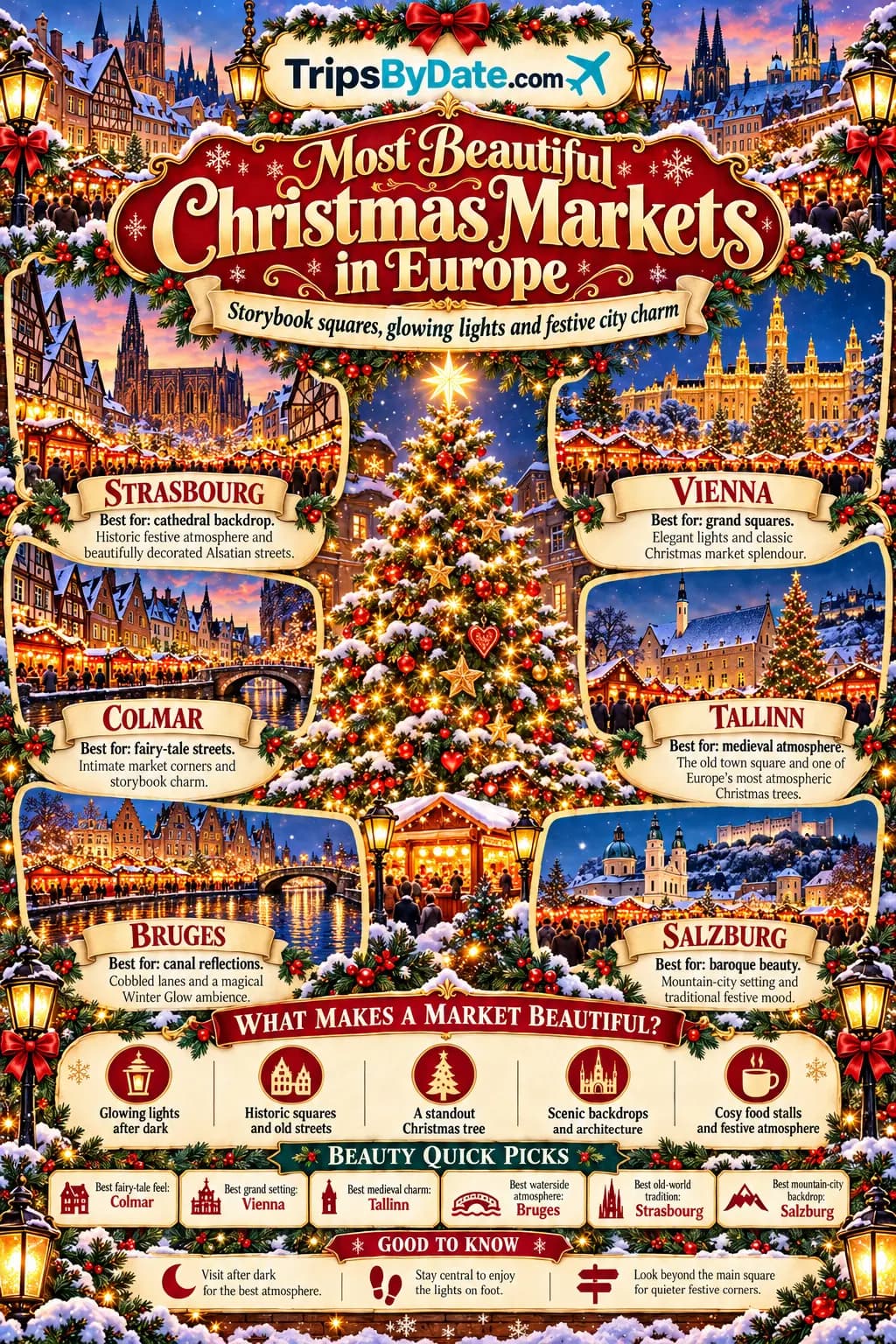
What are the most beautiful Christmas markets in Europe? For an especially memorable setting, start with Strasbourg, Vienna, Colmar, Tallinn, Bruges and Salzburg. Each offers a very different kind of beauty: Gothic architecture, imperial grandeur, half-timbered lanes, medieval squares, canal reflections or Alpine-city views. This is an editorial selection, not a scientific beauty ranking, and the loveliest place for you will depend on whether you prefer big spectacle or quiet details.
This guide is deliberately different from our overall best Christmas markets guide. Rather than simply asking which market has the most stalls or the liveliest atmosphere, we'll help you find where to stand, what to look for, when to explore and what not to miss. And if you're still choosing where to spend your festive days off, TripsByDate makes it easy to start with your airport and available dates rather than deciding on a destination before you've seen any holiday options.
Which beautiful Christmas market matches your dream trip?
- Strasbourg, France: for a spectacular Christmas tree, richly decorated Alsatian streets and a cathedral that owns the skyline.
- Vienna, Austria: for grand illuminated squares, palace backdrops and a glamorous city-wide festive experience.
- Colmar, France: for small-scale fairytale streets, coloured façades and little discoveries around every bend.
- Tallinn, Estonia: for a striking medieval town square, a much-loved public Christmas tree and atmospheric old stone lanes.
- Bruges, Belgium: for glistening canals, beautifully lit historic buildings and romantic evening walks.
- Salzburg, Austria: for Baroque architecture beneath a fortress, with the added chance of seeing the old town from above.
The secret: don't make your entire visit a race between market stalls. In the most beautiful cities, some of the best moments happen on the way between them. A lane with a decorated doorway or a bridge with reflected lights can be every bit as special as the headline market.
Find your next festive escape by departure date
TripsByDate displays varied upcoming package-holiday listings from participating operators, ordered by departure date. The examples below are not necessarily Christmas market trips or holidays to these six cities; they may include sunny escapes too. That's part of the appeal: choose your departure airport and the days you're free, browse possible getaways quickly and see somewhere you might never have thought to search for. Always check the operator's latest prices, availability and package details before booking.


 EDI • 7 nights
 AI · Thomas Cook

 STN • 3 nightsAI · TUI
 STN • 7 nightsSC · Thomas Cook
 STN • 7 nightsB&B · Hays Travel
1. Strasbourg: the beauty is in the whole city, not just one square
Strasbourg doesn't put on Christmas as a single attraction. Its historic centre becomes a journey through decorations, timber-framed buildings, lantern-lit streets and several distinct market areas. The city's Christmas market heritage goes back to 1570, while Place Kléber is famed for its giant decorated tree. The cathedral brings all that delicate glowing detail into dramatic perspective. Explore Strasbourg's official Christmas information.
The beautiful route: begin near the cathedral while you can still appreciate the stonework, wander the surrounding market squares, then head towards Place Kléber when the lights are at their most appealing. Continue towards Petite France for half-timbered houses and waterways. Strasbourg's official Christmas website identifies areas including Place Broglie, the cathedral squares, Place Kléber and Petite France, so you can design a walk rather than endlessly circling the same stalls. See the official guide to the market locations.
Look closer: the decorated windows and façades of the Carré d'Or area are a good reason to lift your eyes away from the merchandise. In a city like this, the details above street level can be the highlight. Try one slow circuit in daylight to spot the architecture and another after dark for the lights.
Don't make this mistake: market dates are not interchangeable with the wider city decorations. Strasbourg's central market traditionally concludes by Christmas Eve; always check the organiser's published calendar before booking a post-Christmas visit. And while snow looks lovely in the infographic, it is not guaranteed.
2. Vienna: grand buildings make even the smallest cup of punch feel cinematic
In Vienna, you're choosing between different kinds of grandeur. Rathausplatz puts festive stalls against the imposing City Hall; the market at Schönbrunn Palace uses a royal courtyard backdrop; Belvedere adds Baroque elegance and waterside garden scenery; and Spittelberg swaps monumental architecture for cosy, narrow streets. The City of Vienna's Christmas-market guide confirms these very different settings.
Make it a three-scene story: visit the big City Hall market for the dazzling first impression, choose one palace setting for dramatic symmetry, then finish with the more intimate Spittelberg area. Three different moods make a better memory than three repetitions of the same crowd photograph.
A less obvious view: at the Christmas Village on Maria-Theresien-Platz, look at how the stalls sit between two grand museums. If you like architecture, this feels very different from Rathausplatz without requiring another city. Vienna's official tourism board explains the varied historical-market locations and which are better for crafts and quieter wandering.
Practical choice: Vienna's Christmas markets are spread out. Instead of booking every market on your list, choose two or three that offer different experiences, and compare your accommodation with public transport stops. A beautiful palace market may be a wonderful outing, but it isn't next door to every central hotel.
3. Colmar: a storybook town you should explore slowly
Colmar is the answer for anyone who wants little lanes and decorated shopfronts rather than a giant open square. The town's colourful Alsatian houses and canal-side Petite Venise neighbourhood give it the distinctive picture-book character shown in the main image. Importantly, the famous canals are part of the town's scenery, not a claim that every market stall sits beside the water.
Follow the pretty details: start with a wander through the historic centre, look out for decorated façades and courtyards, then make your way to Petite Venise when the light is soft. The tourist office identifies a children's Christmas market at Place des Six Montagnes Noires near Petite Venise, with its own stalls and attractions. Check the official Petite Venise market information.
A useful photography trick: water reflections often look better from a bridge or towpath than from directly beside a stall. Walk a little further, turn around and include a small part of the surrounding buildings. The town is the subject, not just the string of lights.
The important trade-off: Colmar is a smaller city, so hotel availability can tighten around popular festive weekends. Check rail arrival plans and the actual walking route to your accommodation. Strasbourg and Colmar can be paired on some trips, but don't promise yourself both in one frantic afternoon; save enough time for Colmar after dark.
4. Tallinn: medieval stone, a historic Christmas tree and winter-blue skies
Tallinn's Town Hall Square has a beauty that needs very little decoration. The medieval buildings form a natural stage, while a central spruce and timber stalls create a compact festive scene. The city's tourism office traces its public Christmas-tree tradition to 1441, though claims about the world's very first Christmas tree depend on what counts as a public display. Read the fascinating history from Visit Tallinn.
Where to wander: enjoy the market at Raekoja plats, then explore nearby medieval lanes before returning when the square is illuminated. A church spire framed between old buildings, warm light against limestone and a cobbled side street with hardly anyone in it can be more atmospheric than another wide shot of the main tree.
Unexpected little detail: the festive food is distinctly Estonian. Rather than assuming every market offers the same German sausage-and-mulled-wine menu, look out for local gingerbread, warming drinks and traditional dishes. The official Tallinn market listing also describes handicrafts and seasonal entertainment.
Reality check: Tallinn can be very cold and winter daylight is limited. That can be brilliant for glowing evening photographs but requires proper boots and a warm indoor break. Snow may enhance the scene, but the town is worth visiting without it. Check the market's official dates carefully if travelling after Christmas.

Know when you can travel for a little Christmas magic?
Choose your departure airport and free dates on TripsByDate. Browse upcoming package holidays without searching every festive city separately, then explore the places that fit.
Discover holidays by date5. Bruges: the prettiest view might be around the next canal bend
Bruges shines because its streets, bridges and waterways already form a gorgeous historic setting. At Christmas, illuminated façades and the city's Winter Glow atmosphere add another layer. There are two main central Christmas market locations, the Markt and Simon Stevinplein. It's worth knowing that distinction: the canals you see in dreamy photographs are a wider Bruges experience, not the setting of every market stall. See the official Christmas market guide.
A simple evening route: explore the Markt while the historic buildings catch the last daylight, continue through smaller lanes and then seek out a safe canal viewpoint when the streetlights begin to reflect on the water. The view changes when the water is still, when it rains and when pedestrians pass through the scene. You don't need a boat trip to enjoy it.
Go beyond the huts: the city's broader Winter Glow programme can include festive lighting, winter activities, skating and other seasonal experiences. They have their own opening dates and sometimes separate charges, so check what is actually running when you travel.
One mistake to avoid: don't assume an impressive photograph of an older attraction means it still happens. The Bruges tourism office specifically warns that older online claims about an ice sculpture festival can be out of date. Use its Winter Glow FAQ to verify the current programme.
6. Salzburg: Christmas markets beneath a fortress, with views from above
Salzburg's beauty feels almost theatrical. Domplatz and Residenzplatz sit among imposing Baroque buildings, while Hohensalzburg Fortress crowns the hillside above the old town. The central Christkindlmarkt has roots in a long trading tradition, and the official tourism website describes the current setting as part of Salzburg's UNESCO-listed historic centre. Read the Salzburg market story.
Turn your visit into a little adventure: explore the cathedral squares first, then allow time to see the city from a different perspective. Salzburg tourism publishes an Advent city walk that connects churches, historic courtyards, riverside streets and a fortress-side finale. It is a useful inspiration for those who want more than an hour wandering stalls.
A genuinely special extra: Hohensalzburg also hosts its own Fortress Advent market on selected Advent days. The official page describes illuminated stars on the approach, crafts, local treats and a view over the city lights. The uphill footpath to the market has been offered as a free entry route, while the funicular and interior visits can cost extra; confirm the current rules and accessibility before setting off. Check Fortress Advent details.
Don't rely on the mountain postcard: the Alps create a magnificent setting, but clear views and snow are weather-dependent. The fortress itself is uphill, so anyone with mobility concerns should research the funicular and avoid treating it as an effortless extension of the central market stroll.
Four beautiful Christmas market photo trails to try
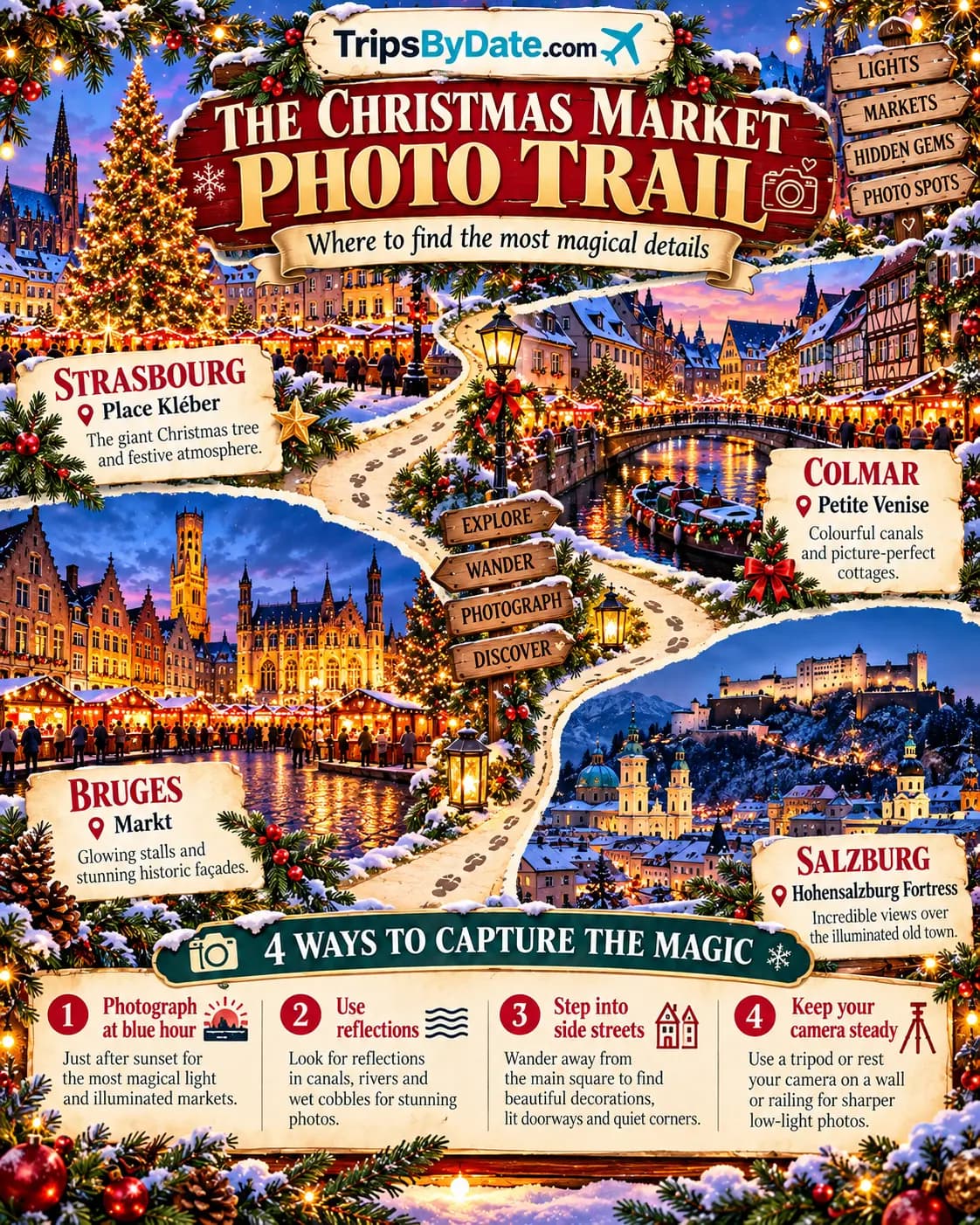
The extra infographic highlights four excellent photographic starting points. Here's how to use them to make an actual little exploration, even with an ordinary phone camera.
Strasbourg: Place Kléber and the streets around it
Photograph the giant tree from a little distance so the neighbouring buildings give it scale. Then put your phone away for a few minutes and wander towards a smaller decorated street. The contrast between huge spectacle and intimate details tells a much nicer story than twenty near-identical tree photographs.
Colmar: reflections near Petite Venise
Try a canal viewpoint during blue hour, shortly after sunset, when some colour remains in the sky. Keep the camera still against a firm railing without obstructing pedestrians or leaning dangerously over the water. Remember the actual Christmas market stalls are in designated areas, so allow time to walk between the market and the canals.
Bruges: the Markt, then a canal bridge
First capture the grand buildings and festive activity at the Markt. Later, use the reflection of streetlights in the canals as your second image. A rainy evening can produce beautiful glistening cobbles, even if it isn't the weather you ordered.
Salzburg: the old town and a fortress perspective
Begin among the stalls below the cathedral, then look for the fortress rising above the roofs. If the Fortress Advent market is operating and accessible for your visit, a higher vantage point can give you a completely different impression of the same city.
How to photograph Christmas markets beautifully without annoying everyone
- Use blue hour: arrive before it becomes completely dark. The remaining colour in the sky helps separate architecture from blackness.
- Look for layers: a glowing stall in front, historic buildings in the middle and a spire or fortress beyond can produce a much more memorable composition.
- Use puddles and canals: reflections can turn an ordinary street into a magical scene, but watch where you're walking.
- Do not assume snow: all six cities can be beautiful without it. Frost, wet cobbles and warm window light are worthwhile winter subjects too.
- Be considerate: don't block traders, photograph strangers intrusively, use flash in faces or plant a tripod across a narrow crowded street.
- Warm the camera, then warm yourself: spare battery charge is useful in cold conditions. Let a phone acclimatise gradually when moving between very cold streets and hot cafés to reduce condensation issues.
There is also a useful alternative to photographing everything: spend one market visit deliberately without a camera. Choose a local snack, listen to a choir if one is performing and browse decorations at normal walking speed. You'll probably remember that evening more clearly than the 173 pictures of glowing mugs.
How to choose the prettiest trip for the dates you can actually go
The most beautiful place on Instagram is not automatically the best booking. A spectacular market that closes the day before you arrive is not much of a Christmas market holiday. Some cities, including Strasbourg, traditionally wrap up their market by Christmas Eve; other cities, such as Tallinn, may continue into the New Year. The dates can differ even within a city: Vienna's markets have distinct calendars. Check the official venue for the specific market you want, rather than trusting a generic 'Christmas in Vienna' date range.
Think in usable evenings. A flight that lands late might mean you miss your only chance to experience the lights. Compare both directions of travel, winter transfer options and hotel location. For short breaks, our guide to choosing departure and return times helps you see why a slightly higher fare may be a better use of your weekend.
Pick a walkable base, not necessarily the prettiest hotel photograph. A centrally located room may cost more but save transport time and make it easier to retreat for a warm drink or change of clothes. For the full-cost comparison, see how to compare a weekend break's total cost. Vienna is more spread out than compact Tallinn or Colmar, so the best transport decision differs by city.
Leave room for the weather. Winter daylight is short, rain is possible and snow is never guaranteed. Waterproof shoes with grip, gloves that work with your phone and an indoor café or museum option can transform your experience. Before travelling, consult GOV.UK's destination-specific advice for entry and travel requirements.
A relaxed two-night itinerary for a beautiful festive city
Arrival evening: make one glowing square your reward
After checking in, go straight to one central market and stay long enough to enjoy it. Eat something seasonal rather than trying to book three attractions. If the streets are beautiful, the stroll back to your hotel is part of the evening.
Full day: old streets, warm cafés and the lights twice
Explore architecture and quieter neighbourhoods in daylight, stop for a proper local lunch, then revisit your favourite area as the lights appear. Book only one special paid experience, such as a museum, palace, skating session or accessible viewpoint, if it genuinely appeals.
Final morning: choose one distinctive detail
Return for a handmade gift, take a canal walk, visit a bakery or admire the cathedral without the evening crowds. Then leave enough time for a calm trip to the airport or station. A last-minute sprint carrying a fragile ornament is not festive magic.
For itineraries tailored specifically to a short stay, our best Christmas markets for a weekend break guide looks at the trade-offs between compact destinations and bigger cities.
Frequently asked questions
What is the most beautiful Christmas market in Europe?
Beauty is subjective. Strasbourg is particularly striking for its decorations and huge tree, Vienna for imperial architecture, Colmar for storybook lanes, Tallinn for its medieval square, Bruges for canal-side atmosphere and Salzburg for Baroque buildings beneath a fortress.
Which Christmas market is most like a fairytale?
Colmar and Tallinn are strong choices if your idea of a fairytale involves compact old streets and historic buildings. Strasbourg offers a richer, city-wide spectacle, while Salzburg brings dramatic fortress views.
Which Christmas market is best for photography?
Colmar and Bruges are rewarding for reflections; Strasbourg for its tree and decorated streets; Vienna for dramatic architecture; Salzburg for elevated perspectives; and Tallinn for a medieval square. Plan both daylight and blue-hour walks rather than relying entirely on night shots.
Do Europe's Christmas markets have snow?
Some occasionally do, but snow is not guaranteed at any of these locations. Don't book purely on an expectation of snow; choose a place you'll love in rain, frost or clear weather as well.
Are the most beautiful Christmas markets free to visit?
Many traditional outdoor markets are free to browse, though food, shopping, rides and certain attractions cost extra. Check specific venue rules. Salzburg's fortress experience is a good example of why the access route and paid activities must be distinguished.
Is it better to visit during the day or at night?
Ideally both. Daylight helps you appreciate historic buildings and quieter details; the period around sunset and early evening brings the magical lights. An overnight stay is an advantage because you needn't squeeze everything into one crowded afternoon.
Can I find a Christmas market holiday by date on TripsByDate?
TripsByDate lets you choose a UK departure airport and browse advertised package holidays by departure date, without searching one destination at a time. Listings are not specifically filtered to Christmas markets, so check the destination, market dates, package inclusions and current price with the operator before booking.
More festive inspiration
Explore the full Christmas Markets collection, see our broader favourite European Christmas markets or look for a more economical break in Christmas market cities worth checking for value. If you fancy the freedom to discover somewhere unexpected, simply visit TripsByDate, choose your dates and see what's coming up.
One final thought: the most beautiful Christmas market might not be the one with the biggest tree. It could be the small square you stumble into on the way back from dinner, with a softly lit window, a choir in the distance and nowhere else you need to be.
‹ BACK TO CHRISTMAS MARKETSKnow when you can travel?
Start with your departure airport and dates. Browse real advertised holiday options on TripsByDate and find your next magical winter city escape without the usual endless searching.
Find holidays by date