

Ski Hair Survival Guide
How to protect your hair from cold, wind, dry air, helmets and everyday ski-holiday styling.
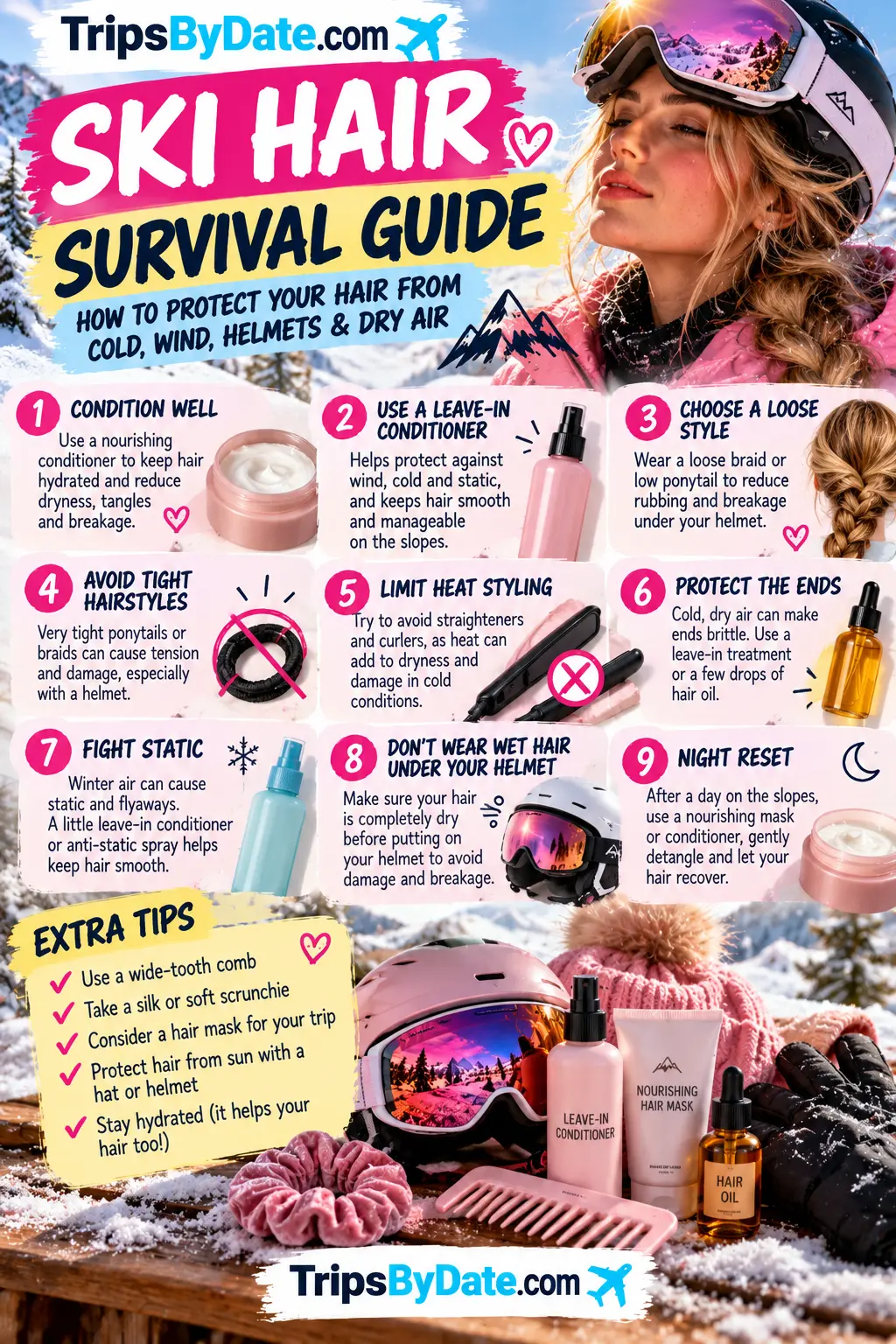
Ski holidays are great for mountains, snow and après-ski. They are not always so kind to your hair.
Cold outdoor air, dry heated rooms, helmets, static, wind and repeated styling can all leave hair feeling drier, rougher or more difficult to manage.
The good news is that you do not need a complicated ski-hair routine. Most of the useful advice comes down to reducing friction, avoiding unnecessary heat and tension, and keeping hair conditioned.
Explore Upcoming Ski Holidays
Looking for your next ski trip? Here are some upcoming ski holidays from specialist operators, ordered by departure date.

 LGW • 7 nights
 SC · Ski Line


 BRS • 7 nightsHB · Iglu Ski
 CWL • 7 nightsSC · Iglu SkiLGW • 7 nightsSC · Iglu Ski
Condition your hair properly before and during your trip
Conditioner helps smooth the hair shaft, reduce friction and make hair easier to detangle. That can be particularly useful when your hair is being exposed to cold air, helmets and repeated brushing during a ski holiday.
If your hair is naturally dry, curly, colour-treated or prone to tangling, regular conditioning becomes even more useful.
Dermatology guidance also supports using conditioner after washing because it can reduce friction, frizz and breakage.
Use a leave-in conditioner if your hair needs extra help
A leave-in conditioner can be useful if your hair tends to become dry or static in winter.
You do not need to coat your hair heavily. A small amount through the lengths and ends may be enough to make the hair easier to manage and reduce friction.
If your hair is fine, use less product and concentrate mainly on the ends so it does not become weighed down.
Choose a loose hairstyle under your helmet
Tight hairstyles can put unnecessary tension on the hair and scalp. Dermatologists specifically warn that repeatedly wearing tight ponytails, braids and other styles that pull on the hair can contribute to breakage and, over time, traction-related hair loss.
For skiing, a loose low ponytail or loose braid can be easier to fit under a helmet without creating as much tension.
The aim is simple: secure your hair without pulling it tightly against your scalp.
Avoid very tight ponytails and braids
If your hairstyle feels uncomfortable, painful or tightly stretched, loosen it.
Tight styles combined with a helmet can increase pressure and friction in exactly the places where the hair is already being compressed.
A soft fabric hair tie or scrunchie may also be gentler than a tight rubber band.
Limit straighteners, curling irons and excessive heat
Ski holidays often mean washing your hair, blow-drying it and then styling it again before going out in the evening.
That can add a lot of heat exposure over the course of a week. Excessive heat can weaken hair and make it more prone to dryness and breakage.
If possible, reduce how often you use straighteners and curling irons, and use lower heat settings on hairdryers.
Protect the ends of your hair
The ends are usually the oldest and most weathered part of your hair, so they can be particularly prone to dryness, tangling and splitting.
Conditioner, leave-in conditioner or a small amount of hair oil can help keep the ends smoother and easier to detangle.
You do not need to apply products heavily. Start with a small amount and add more only if your hair needs it.
Expect more static in dry winter air
Static hair is common in winter because cold weather and indoor heating can leave the surrounding air much drier.
Keeping your hair conditioned can help, and using a small amount of leave-in conditioner may make flyaways easier to manage.
Static is annoying rather than dangerous, so the goal is simply to make the hair easier to control rather than trying to eliminate it completely.
Be careful with wet hair
Hair is more vulnerable when it is wet and can break more easily when aggressively brushed, stretched or pulled into tight styles.
If your hair is straight, dermatologists generally recommend allowing it to dry slightly before gently detangling with a wide-tooth comb. Hair type matters, though: tightly curled or textured hair may be easier to detangle while damp or wet.
What matters most is being gentle and avoiding unnecessary pulling.
Should you ski with wet hair under your helmet?
It is better to start the day with dry hair if possible.
Wet hair is more fragile, and putting damp hair into a helmet adds friction and compression. It can also be uncomfortable once you are outside in cold conditions.
If you need to dry your hair quickly, use a lower heat setting rather than blasting it repeatedly with very high heat.
Use a wide-tooth comb and detangle gently
Tugging through tangles is one of the easiest ways to create unnecessary breakage.
Start at the ends of the hair and gradually work upwards rather than trying to drag a brush from the roots through every knot at once.
A wide-tooth comb can be useful because it creates less pulling than aggressive brushing.
Do you need a hair mask on a ski holiday?
Not necessarily, but it can be useful if your hair is already dry, chemically treated or prone to tangling.
A nourishing conditioner may be enough for many people. If you already use a hair mask at home and know your hair responds well to it, taking a small amount with you can make sense.
A ski holiday is probably not the best time to experiment with lots of completely new products.
Does the sun affect your hair when skiing?
UV exposure can affect the hair shaft as well as the skin. Dermatology guidance notes that ultraviolet light can contribute to dryness, brittleness and colour changes in hair.
Your helmet already covers much of your hair while skiing, but exposed lengths can still receive sunlight during the day.
Protecting your scalp and skin from UV remains more important, but hair can also benefit from reducing unnecessary sun exposure.
Know when you can travel?
Pick your departure airport and the dates you are free, then see the ski holidays that actually fit.
Find ski holidays by dateWhat should you do after skiing?
You do not need to wash your hair after every day on the slopes unless your hair or scalp actually needs it.
If your hair feels tangled, gently detangle it. If it feels dry, use conditioner or your normal moisturising hair product.
The goal is to avoid turning every ski day into a cycle of washing, high-heat drying and aggressive restyling.
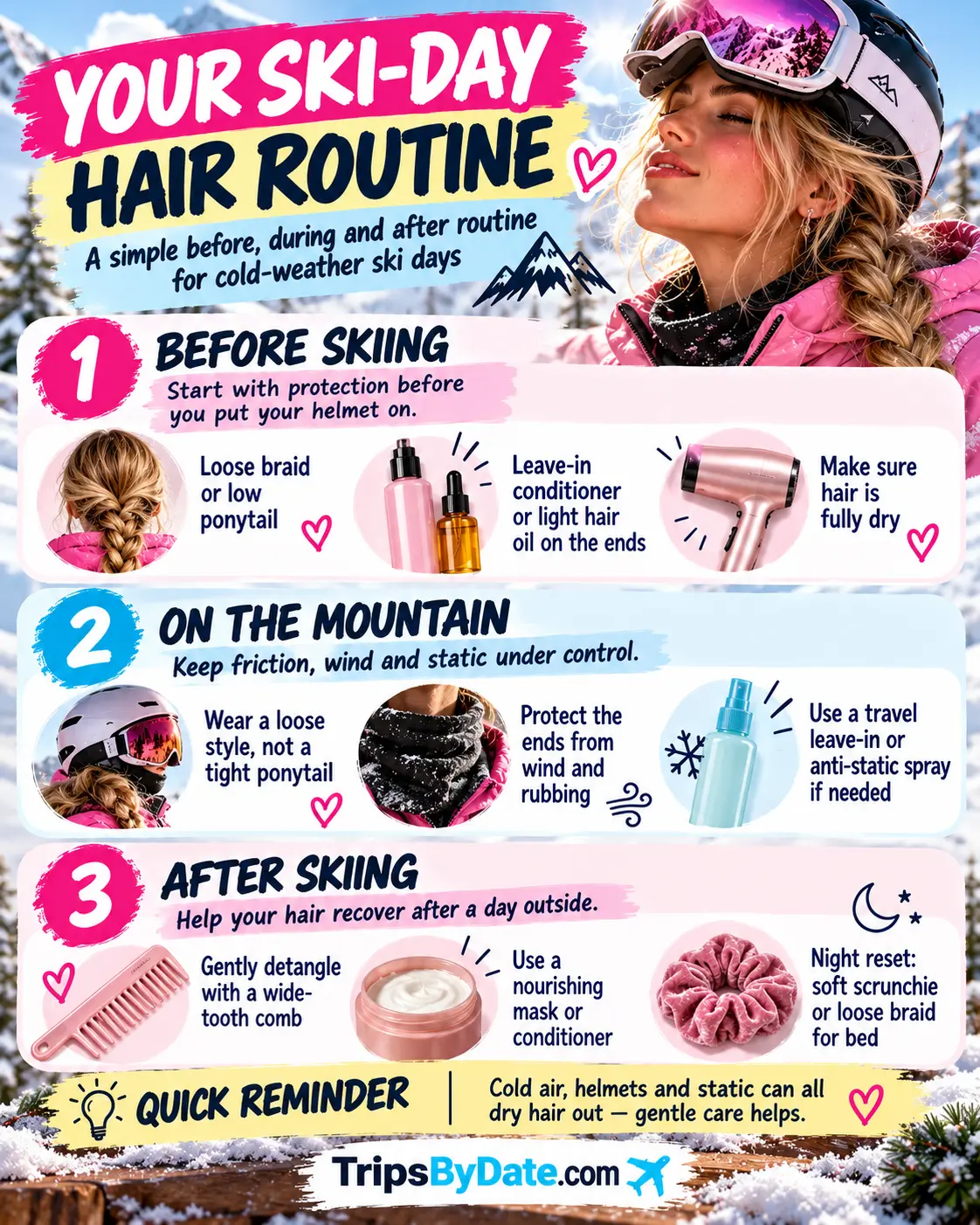
A simple ski hair routine
Before skiing: make sure your hair is dry, detangle gently and choose a comfortable loose style under your helmet.
During the day: leave your hair alone as much as possible rather than constantly tightening and restyling it.
After skiing: gently detangle, condition when needed and minimise unnecessary high-heat styling.
Reliable hair-care guidance
The American Academy of Dermatology provides practical advice on preventing hair damage, including limiting excessive heat, handling wet hair gently and avoiding tight hairstyles.
American Academy of Dermatology: hair styling without damage
Gloucestershire Hospitals NHS Foundation Trust also advises conditioning regularly, using a wide-tooth comb, avoiding tight styles and limiting excessive heat.
Cleveland Clinic also discusses winter hair dryness, static, gentle brushing and limiting heat styling during colder months.
Cleveland Clinic: winter hair care
More help for your ski holiday
Ski Skin Survival Guide · Ski Slope Dos & Don'ts · Best Ski Resorts for Beginners
‹BACK TO SKIING
Know when you can travel?
TripsByDate works the other way around. Pick your departure airport and the dates you are free, then see the holidays that actually fit.
Find holidays by date