

Best 7-Night Holidays Under £750 | Week-Long Package Holiday Ideas
Seven nights, one sensible budget and a whole week to make the memories count. Here's where to look, what to compare and how to spend wisely.
A week away should feel like a proper escape, not seven nights of arguing with a spreadsheet. With £750 per person for a seven-night package holiday, the interesting question is no longer simply, "Can we get on a plane?" It is, "Could we have a lovely hotel, genuinely enjoyable days and perhaps one experience we'll still be talking about next winter?" Sometimes yes, on the right departure dates. Sometimes the pretty headline falls apart as soon as you add a suitcase, a family room or an airport transfer. This guide is about telling the difference, then making the week brilliant.
Quick answer: For seven-night package holidays under £750 per person, investigate the Costa Daurada in Spain, Kefalonia in Greece, Gran Canaria, and selected Turkish and Cypriot resorts. These are places to compare, not verified offers at that price. The winning choice depends on your UK airport, travel dates, number of travellers, board basis and whether you'd rather spend on the hotel or on the world outside it.
Here's the easiest place to start: TripsByDate lets you browse upcoming package holidays by UK departure airport and date, without insisting you choose a destination first. Drop in when you have a moment, see what appears on the days you're free, and investigate the holidays that catch your eye. It's a much more enjoyable starting point than falling in love with one island and spending a week trying to persuade its flights to become cheaper.
What does a £750 budget actually change for a seven-night holiday?
Compared with a particularly tight seven-night holiday under £500, a ceiling of £750 can give you more room to compare location, board basis, flight times and accommodation quality. It does not automatically buy a luxurious hotel or an all-inclusive week in peak school holidays. Think of the extra breathing room as a chance to buy fewer compromises, not a licence to stop checking the details.
A useful way to choose is to ask what you'd regret most: being miles from the town, having no money left for exploring, eating every meal in the same dining room, or landing so late that the first evening disappears. Different people will give different answers, which is exactly why the "best" seven-night package is not necessarily the one with the most stars beside the hotel name.
Try the three-pot test: divide your real holiday spending into (1) the flight-and-hotel package, (2) unavoidable extras such as airport travel and meals not included, and (3) the fun fund for a boat trip, historic site or extraordinary dinner. If your £750 is the whole holiday budget, all three pots need to fit inside it. If £750 is your package-only limit, decide in advance how much you're comfortable spending on top. The distinction matters more than almost any discount badge.
Browse the dates first, then get excited about the destination
If you have a week off, check departures on adjacent days rather than assuming a Saturday-to-Saturday package is the natural law of holidays. Search for the same seven-night duration from different feasible UK airports. Look carefully at the provider's live total: packages sometimes behave differently from the flight-only prices you may have seen.
A practical search order is airport → departure date → seven nights → destination possibilities → actual hotel and inclusions. TripsByDate is designed for that discovery stage. Once you spot an interesting option, confirm the current price, exact room, transport and terms with the holiday seller. The changing listings below are examples from the wider TripsByDate inventory, not guaranteed seven-night holidays under £750.
See where your next seven nights could take you
These rotating packages are there to spark ideas. They are not filtered to this article's budget, duration or destinations. Check each provider's actual offer before making plans.

 BFS • 3 nights
 B&B · TUI


 BHX • 7 nightsB&B · Iglu Ski
 GLA • 7 nightsB&B · Skiline
 LGW • 7 nightsSC · Olympic Holidays
Three very different ways to spend a week
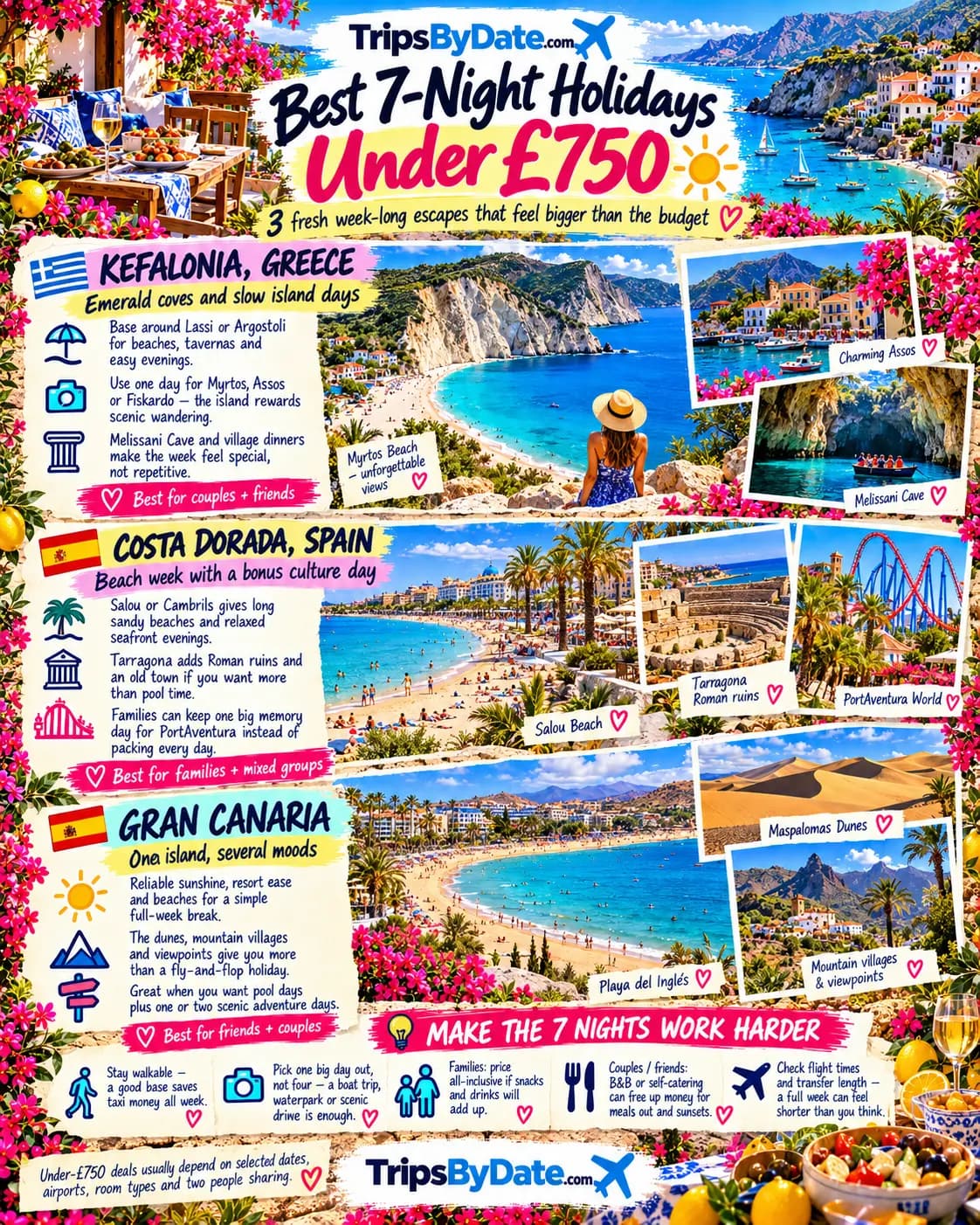
The images for this guide suggest Kefalonia, Costa Daurada and Gran Canaria. That's a useful combination because they answer three quite different questions. Do you want an island to explore, a beach base with a major cultural day out, or warmer-weather options with dramatic scenery?
1. Kefalonia: a Greek island for people who want to discover something new each day
Kefalonia's appeal is not that a week here needs an elaborate itinerary. It's that one lovely beach day can lead naturally into the next day's harbour lunch, then a hillside drive, a cave visit or a memorable sunset. Lassi can be convenient for beaches and access to Argostoli, while Argostoli makes a practical base for restaurants and everyday life. Other parts of the island suit quieter holidays, though the transport question becomes more important.
Make the week special: visit the colourful waterfront of Assos, explore the harbour at Fiskardo, and see Myrtos Beach from a safe viewpoint even if the conditions don't suit swimming. Melissani Cave is a spectacular natural attraction, but entry, queues, opening arrangements and transport need checking. It is an excursion, not a free secret beach. Allow breathing room between sights. A holiday spent racing from viewpoint to viewpoint can turn the Greek island dream into a surprisingly hot logistics exercise.
The value question: if you're staying somewhere remote, a low hotel price may be cancelled out by a hire car and fuel. Check whether your accommodation offers useful bus connections or whether organised excursions would suit you better. If you do hire a vehicle, investigate insurance excess, deposits, parking and road suitability before treating the headline rental quote as your final cost. For a more island-wide perspective, see our guide to the best months to visit Greece.
Great for: couples wanting beaches and tavernas, friends who enjoy different small outings, and families willing to plan transport carefully. Less ideal for: travellers who expect every cove and village to be reachable on foot from one bargain hotel.
2. Costa Daurada: the clever beach-and-Roman-history combination
Spain's Costa Daurada can deliver a proper resort week without restricting you to seven nearly identical days beside the pool. Salou has beaches, promenades and entertainment; Cambrils offers a different seaside atmosphere with a strong food focus. Both can be worth investigating for package availability, but compare actual hotel locations rather than assuming every property is within an easy stroll of the coast.
The real wildcard is Tarragona. Its Roman archaeological ensemble has UNESCO World Heritage status. There are ancient walls, a circus and an amphitheatre associated with one of Roman Spain's great cities. Even wandering the streets around those remains can make for a fascinating change from swimming and suncream. Check entry tickets, combined passes and transport for the sites you actually want to enter. You don't need to buy an expensive guided excursion simply because the hotel has a colourful poster of a Roman soldier in reception.
For families: the area's major theme park, PortAventura World, may be a real highlight, but treat the tickets, food, transport and possible extras as a separate budget decision. Check its official opening calendar and ticket options for your dates rather than assuming every attraction operates daily throughout the year. One big adventure day can be wonderful. Buying every premium extra because someone's seen it on TikTok is where the wallet quietly leaves the building.
The value question: a walkable base with nearby restaurants, beach and transport may beat a fancier property that needs taxis. Compare hotel distance from both the beach and the transport you plan to use. Our guide to Spain's best visiting months can help you weigh weather and timing.
Great for: mixed-age families, friends wanting beach days and lively evenings, and couples who enjoy a good culture-and-coast split.
3. Gran Canaria: one island, several completely different holidays
If you're craving sunshine, Gran Canaria deserves a look because the island offers resort life in the south, historic neighbourhoods, spectacular inland landscapes and a lively capital. Maspalomas and Playa del Inglés offer very different hotel and nightlife options from a stay around Puerto de Mogán or Las Palmas. These bases aren't interchangeable: the cheapest hotel in one may put you farther from the activities you actually want.
The unexpected reward: the huge Maspalomas dunes feel like a different world from the beachfront. They are a protected natural area, so follow permitted routes and environmental guidance rather than wandering wherever the best photograph appears to be. In Las Palmas, spend time in Vegueta, the historic quarter, or explore local food markets where opening hours allow. The island's mountain villages are another reason to come, but don't plan a mountain day as though its weather and journey times will match those at the beach.
An insider planning detail: the famous Roque Nublo trail has controlled access arrangements. The official Gran Canaria tourism website describes advance reservations and transport restrictions on the main approach. Check the current rules before turning up in a hire car. That is a much better story to learn before departure than after finding a full car park and a closed access point.
The value question: if you expect to spend most of the week poolside, a resort with convenient facilities may be the best choice. If you want to explore both north and south, compare public transport, excursions and the realistic cost of getting around. Don't pay for an expensive island tour just because the coach promises to show you fourteen wonders before lunch. See our winter sun guide collection for more ideas about matching destinations to the season.
Great for: couples wanting both beach and scenery, groups with mixed interests, and travellers who dislike spending a whole week doing the same thing.
Three less obvious seven-night alternatives worth checking
A £750 ceiling can also be a reason to consider places that don't dominate the first page of generic holiday search results. These are search ideas, not promises that a package will meet your limit.
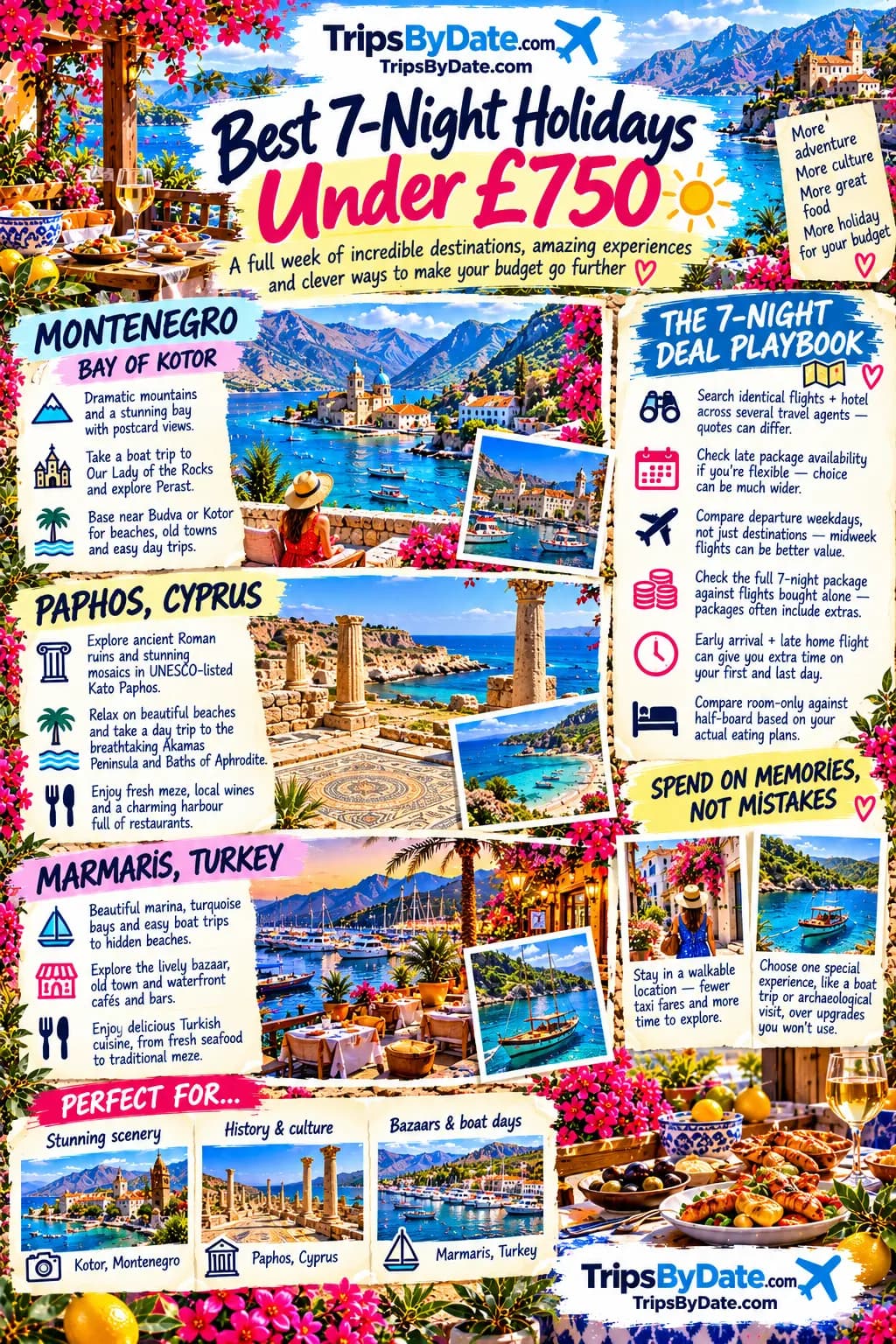
Paphos, Cyprus: stay longer and make the archaeology part of the holiday
Paphos is particularly appealing if you love a waterfront walk and a bit of history between meals. The archaeological park's mosaics and the Tombs of the Kings are genuine reasons to leave your sunlounger. You can make a holiday of beach mornings, harbour evenings and carefully chosen cultural outings without filling every day with expensive tours. Check the entry fees and times at official sites and don't confuse winter's mild sightseeing weather with guaranteed hot swimming conditions.
Marmaris and İçmeler, Türkiye: decide whether you want energy or escape
A seven-night Turkish coast package can mean busy waterfront evenings, a quieter base, boat trips or a little of all three. Marmaris is useful for people who want plenty happening nearby; İçmeler can suit a different mood. Compare beach access, evening noise and your hotel-to-town route. Shared boat excursions may offer a memorable day on the water, but inspect what's actually included, especially transfers, drinks and optional stops. Ask about group size and safety rather than buying whichever trip has the most enthusiastic street seller.
The local food angle is a pleasure in its own right. Find a good lokanta for everyday Turkish dishes, explore a market where appropriate, and reserve one evening for something special instead of upgrading every meal. Read our Turkey visiting-month guide for seasonal context.
Montenegro: spectacular scenery, but watch the transfer-and-transport maths
The Bay of Kotor is a tempting wildcard for walkers, photographers and travellers who like dramatic mountains dropping into the sea. Kotor has a beautiful walled old town; Perast feels different again. But this is exactly the place to test whether a "cheap" package is actually convenient. A remote hotel with poor links to the places you want to see can consume your savings in taxis. Also check the season, local transport and any additional fees for boats, attractions or hikes. A week's holiday should contain actual exploration, not seven days admiring distant mountains through a taxi window.
Is £750 per person enough for a family of four?
Possibly for selected dates and configurations, but £750 per person is not £750 for the entire family. A quoted adult price may assume two sharing one room. Children of different ages may be priced differently, and a family room, extra baggage or specific sleeping arrangement can change the result dramatically. Enter the real ages and party composition on the booking provider's site before getting attached to the headline price.
For families, compare a supposedly superior hotel against one with a short transfer, safe sleeping arrangements, suitable pools and restaurants you can reach easily. A well-run three-star family property can be more enjoyable than a four-star hotel with nothing open for children during your travel week. Ask which facilities are actually available on your dates. Free-child-place offers may appear, but they have conditions, limited allocations and different pricing rules. Never treat them as automatic.
If your week coincides with school holidays, availability can tighten. Which? has tracked substantial differences between early and late package prices, but the results varied by destination. A limited family room is not something I'd gamble on just to chase a hoped-for last-minute bargain. For date-specific inspiration, explore family holidays by the best month.
Couples and friends: when a cheaper hotel buys a better week
For couples, spending slightly less on the room may pay for the experience you'll remember: an afternoon exploring Tarragona's old streets, a beautiful Kefalonian village lunch, or an organised island outing. If you'd rather have a quiet room and a good balcony, that's valid too. Just identify what matters to both of you before one person books the world's least romantic bargain room over a late-night nightclub.
For groups of friends, a lower headline per-person rate can disguise a complicated room split. Compare the actual bed configuration, the price for three or five travellers, and what happens if one person drops out. Agree on spending expectations: one friend may want a boat trip, another an all-inclusive sunlounger and another a week-long quest to find the best local bakery. The best base lets you separate for a morning without turning every outing into a group negotiation.
For solo travellers, calculate the single-occupancy price first. Many package headline prices assume two adults sharing. Compare centrally located hotels where you can walk to evening restaurants and transport. A solo supplement isn't always avoidable, and pretending otherwise is not helpful.

Your best holiday might be a destination you haven't searched yet
Start with your UK airport and the seven nights you can travel. Browse TripsByDate for fresh ideas, then check the exact details with the holiday provider.
Find holidays by dateSix ways a £750 week can look cheap and still cost too much
1. The seven-night, five-day illusion
Seven nights does not mean seven full days at the beach. Land near midnight, transfer for an hour, then fly home before breakfast at the end and two of your calendar days are mostly travel. Compare usable holiday hours, not just the number seven in the search result. A slightly more expensive package with useful flight times can be better value.
2. The bargain room that requires a second holiday budget for taxis
Read the map. A hotel can advertise a resort name while sitting well beyond the area you actually want to visit. Work out how you'll get to the beach, cafés, supermarket and evening activities. A daily taxi becomes a recurring subscription you never meant to buy.
3. The all-inclusive deal you barely use
If you plan four full-day excursions and dinners in town, all-inclusive may be poor value. But if you're travelling with hungry children, plan pool days and expect to use included meals and drinks, it may be worth paying for. Compare the actual package difference with realistic food spending, not a fantasy week in which everyone drinks only tap water and orders one bread roll.
Consumer group Which? has found that all-inclusive offers differ significantly in what they actually include. Check à la carte restaurants, drinks brands, snacks, opening times and whether the promoted activities cost extra.
4. The theme park or boat excursion that arrives with a family-sized bill
One expensive experience can be excellent value if it is the reason you chose the holiday. The danger is assuming it sits inside the £750 package price. Add tickets, transfers, food, equipment and any optional extras before deciding. For boat trips, look for safety information, insurance and a clear explanation of what's included.
5. The same package with a very different final price
Travel agents can sometimes quote differently for equivalent trips. MoneySavingExpert explains why comparing like-for-like package offers and asking another agent for a quote can help. Match flights, departure times, hotel, room category, board basis, luggage, transfers and booking terms. A cheaper price for a different room isn't a win unless you actually prefer that room.
6. The deal that doesn't include what the headline implied
Check luggage, transfers, local taxes, payable resort facilities, seat selection if important, cancellation conditions and the final total for all travellers. For relevant UK flight-inclusive packages, understand the protection and obtain the proper documentation. The Civil Aviation Authority explains ATOL protection. ATOL is financial protection against organiser failure, not a substitute for suitable travel insurance or a promise against holiday disappointment.
The £750 weekly budget test: compare three holidays properly
Here's a genuinely useful exercise. Shortlist three seven-night options for your dates. Give each one a score for (a) what the package includes, (b) usable time, (c) access to the experiences you want, and (d) total likely cost. You don't need a complicated spreadsheet. A few sensible notes will reveal whether you are choosing a holiday or being hypnotised by a promotional photograph.
Imagine Holiday A has the fanciest hotel but a remote location and awkward flights. Holiday B has a simpler, walkable hotel in a lively town and leaves you money for a big day out. Holiday C is all-inclusive near a lovely beach, but most of the local restaurants and excursions you want are outside the resort. The best option depends on your actual plans, not the hotel-star count. It is perfectly possible for B to be the winner even when A looks better on a booking card.
One more useful trick: ask yourself, "Would I still choose this hotel if there were no discount banner?" If not, you may be chasing a discount rather than buying a week you'll enjoy.
A seven-night plan that feels full without costing a fortune
A holiday that includes no paid excursions can be delightful. So can one with a memorable splurge. The trick is not to turn every morning into a competition for the most expensive possible activity.
- Arrival day: settle in, find the nearest supermarket or bakery, and take an easy orientation walk. Don't schedule a paid tour after an exhausting transfer.
- First full day: enjoy the beach or pool you chose the destination for. This is not laziness. This is the point.
- Second full day: explore a nearby historic quarter, fishing village or market. Eat something local rather than defaulting to the same international menu.
- Third full day: make this the big adventure. A boat trip, impressive archaeological site or mountain excursion can give the week a story.
- Fourth full day: slow down. Swim, read, wander, revisit the café that surprised you.
- Fifth full day: try an alternative side of the destination. In Gran Canaria it might be a historic neighbourhood; on Kefalonia, a different coastal village; in Costa Daurada, a Roman heritage day.
- Final full day: return to your favourite place. A familiar sunset often beats one more frantic excursion.
This is a flexible rhythm, not a rigid timetable. If it rains, switch the order. If the local bus doesn't run, don't invent a timetable. If you discover an extraordinary beach, give yourself permission to spend another day there.
Food, drink and little treats: how to spend less without making the holiday miserable
The expensive mistake is not necessarily a fine dinner. It's seven unplanned, overpriced meals because you never checked where the hotel was. Before booking, see whether you can walk to cafés, bakeries, supermarkets and restaurants you'll actually want to use. In Greece, a simple taverna lunch can be a wonderful part of the trip. In Spain, look beyond the most tourist-heavy waterfront and try local dishes. In Türkiye, a neighbourhood lokanta can be far more interesting than another international buffet.
Consider breakfast included if it frees up your mornings and you really will use it. But if you're the sort of person who wakes late and enjoys coffee in different cafés, paying extra for breakfast may make no sense. Similarly, a kitchenette can be an excellent money saver for families, but only if you are content to use it. Nobody dreams of travelling abroad to spend every evening washing saucepans, unless perhaps they have an unusually passionate relationship with washing-up liquid.
A simple spending rule works remarkably well: pick one treat you genuinely want, rather than buying a parade of tiny extras you barely remember. A lovely meal, a guided walk or a boat trip you can afford is more satisfying than a week of accidental overspending.
Book early, book late, or keep checking?
There is no magic day that always delivers the cheapest seven-night package. The evidence is mixed. In its price tracking, Which? found that earlier booking often won for some destinations, while late deals appeared elsewhere. More recent Which? comparisons also found meaningful late reductions in selected European destinations. Those were measured snapshots, not universal rules or a promise of any specific fare today.
If you need a family room, accessible facilities, a particular school-holiday week or a specific hotel, start looking earlier. If you can choose between several airports, countries and departure days, you have more scope to investigate late opportunities. Browse regularly on TripsByDate because the possibilities are changing, then make a sensible decision when the complete offer works for you. Don't wait for an imagined bargain if you already have a holiday you love at a price you can afford.
Frequently asked questions about seven-night holidays under £750
Can I really get a seven-night package holiday for under £750 per person?
It is possible on selected departures, but there is no guarantee. The actual price depends on dates, UK airport, destination, room occupancy, board basis and availability. Treat this article's destinations as places to search, not advertised offers.
Does £750 include flights and accommodation?
For this guide, the target is a flight-and-accommodation package priced under £750 per person. Exactly what else is included varies. Airport transfers, checked baggage, meals and local charges may be extra. Always inspect the actual booking details.
Is a seven-night package better value than booking flight and hotel separately?
Sometimes. Package operators may have different arrangements and prices from separately sold flights and rooms. Compare the exact same dates, luggage, accommodation, transfers and protection before choosing. A package can be cheaper, but it isn't guaranteed to be.
Is Costa Daurada or Kefalonia better for a family week?
Costa Daurada may suit families who want a beach resort with entertainment and a possible theme-park day, subject to the cost and opening arrangements. Kefalonia may suit families who love beaches, scenery and slower exploring, especially if they can plan local transport. Compare transfer time, hotel facilities and room arrangements before deciding.
Is Gran Canaria a good choice outside peak summer?
It can be a good destination to investigate for mild or warm-weather experiences and a mix of coast and inland scenery, but weather varies with season, altitude and location. Sea and pool temperatures also differ. Check conditions for your exact travel dates and resort rather than assuming every day will be hot.
Should I choose half-board or all-inclusive for seven nights?
Pick based on how you intend to spend the week. All-inclusive can make sense for hotel-focused days if the included food and drinks meet your needs. Half-board or bed-and-breakfast may offer more freedom when you want to explore and eat out. Calculate the full difference using realistic behaviour.
How do I find seven nights under £750 without choosing a country first?
Start at TripsByDate, select your UK departure airport and browse the dates you're free. Open interesting packages and verify the seven-night duration, total price and hotel details with the provider. Be flexible on destination, not on the things you actually need.
Make the seven nights the star of the show
The best under-£750 holiday could be a slow Greek island week, a Spanish beach escape with an ancient Roman city on the side, or a Gran Canaria break where volcanic landscapes replace yet another afternoon beside the pool. None of those experiences needs the most expensive room in the resort.
Start with your week, not a predetermined destination. Browse TripsByDate when you have a few minutes, discover places you hadn't considered, and compare real offers before you commit. For another approach, look at our general package holiday guide under £750 or the holidays by budget collection. A little flexibility can turn seven ordinary calendar nights into a very memorable week.
Find a week that feels worth every penny
Choose your UK airport, browse departure dates on TripsByDate and discover seven-night holiday possibilities without deciding the destination first.
Find holidays by date