

Strasbourg Christmas Markets Guide
Eight festive market areas, a giant Christmas tree, an extraordinary cathedral and enough Alsatian biscuits to make the journey home a serious test of suitcase space.
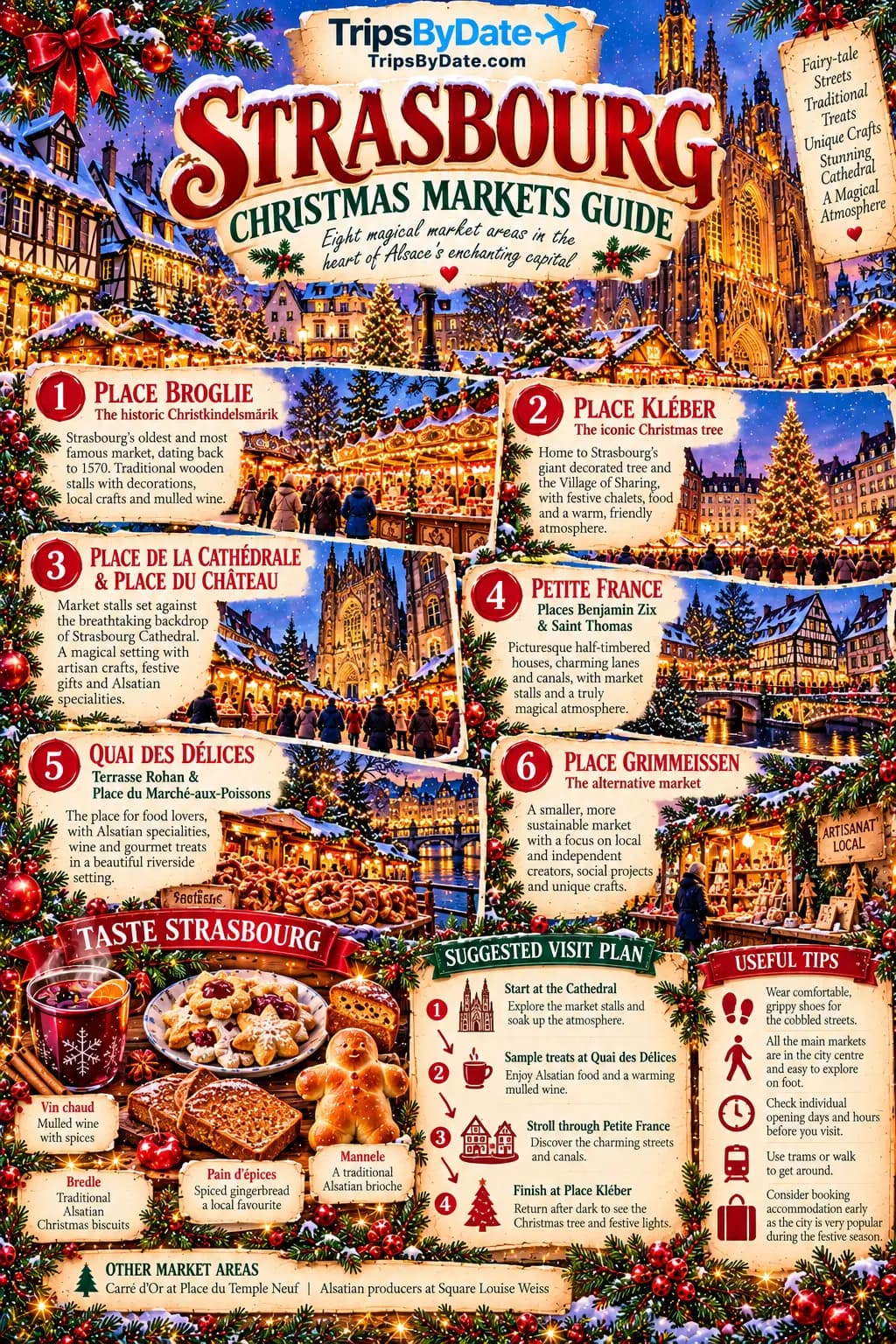
Strasbourg is not one giant Christmas market. It is a beautiful old city in Alsace where eight market areas spread across squares, cathedral lanes and canals. One minute you are admiring a huge tree; the next you are deciding whether another bag of tiny Christmas biscuits counts as a sensible purchase. (It does.)
Strasbourg's Christkindelsmärik dates back to 1570, making it one of Europe's great historic Christmas traditions. But the reason to visit today is the remarkable variety: long-established wooden stalls, independent artists, riverside food producers, neighbourhood character and a genuinely different ethical market. This guide explains exactly where to go, what to try, how to connect the areas on foot and what to check before booking. For the official overview and annual updates, use Strasbourg's market directory.
Which Strasbourg Christmas market should you visit?
- Place Broglie: the historic Christkindelsmärik, for wooden chalets and the classic market atmosphere.
- Place Kléber: the enormous Grand Sapin Christmas tree and the charitable Village du Partage.
- Cathedral Square and Place du Château: dramatic Gothic architecture, traditional stalls and unforgettable views.
- Petite France: half-timbered streets, water and picturesque little market corners around Benjamin Zix and Saint-Thomas.
- Quai des Délices: Alsatian food, bakers and local producers beside the river.
- Place Grimmeissen: the OFF Market, with second-hand discoveries, reuse, local design and social-enterprise projects.
- Place du Temple Neuf: Carré d'Or, a particularly atmospheric stop among the illuminated shopping streets.
- Square Louise Weiss: small Alsatian producers and a good reason to venture farther into Petite France.
Those are the eight official market areas, not eight completely isolated venues. Several include multiple neighbouring squares. This is why the city's own market map is more useful than choosing just one pin on a map. If you are choosing between several countries, our guide to Europe's best Christmas markets provides a wider comparison.
Discover upcoming holidays by departure date
Know when you can escape but haven't settled on where? TripsByDate lets you pick a UK departure airport and browse advertised package holidays by departure date, without completing another destination-first search for every city. The examples below come from the broader inventory; they are not necessarily Strasbourg trips or Christmas market breaks. Check prices, availability, dates and what's included with the travel provider.
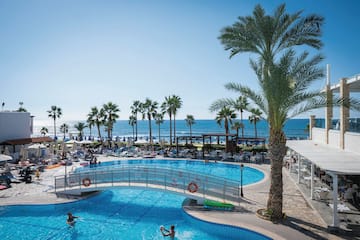
 STN • 7 nights
 B&B · TUI


 EMA • 2 nightslastminute.com
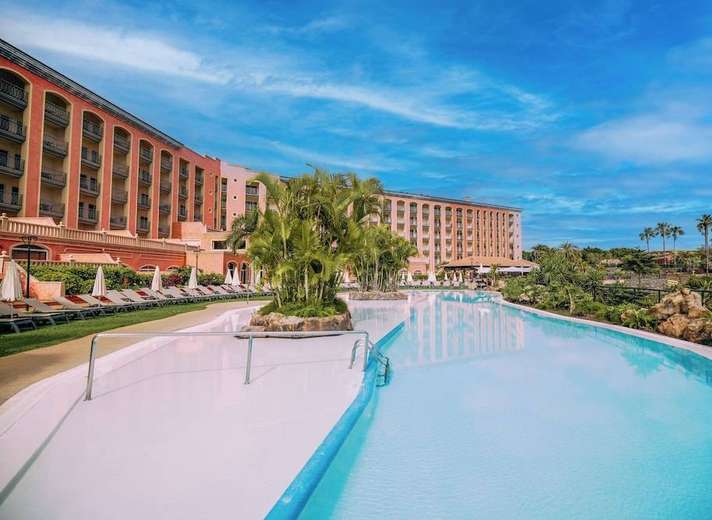 BHX • 2 nightslastminute.com
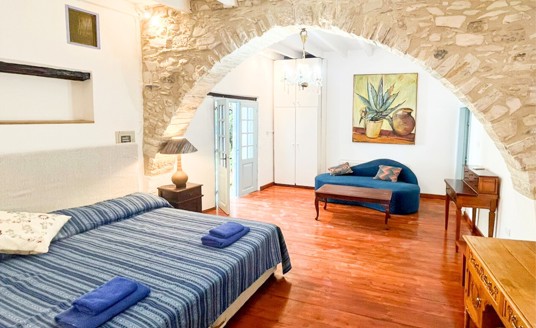 LGW • 7 nightsSC · Olympic Holidays
1. Place Broglie: meet the original Christkindelsmärik
Start where the story started. Strasbourg's centuries-old Christmas market tradition is closely associated with Place Broglie, where long rows of stalls feel satisfyingly old-fashioned. It is the place to browse candles, decorations and small gifts while trying to remember which way you entered. The city's official Christmas highlights recommend its entrance arch as a photo stop.
Look more closely: the Alsatian name Christkindelsmärik translates roughly as Christ Child's market. This isn't just a German-style market transported into France; Alsace has a distinct history of Germanic and French influences. Pick up a regional biscuit, then look at the decorations and signs around you. The local identity is part of the experience.
Good strategy: do one slow circuit in daylight to see the wares and return later for illuminated chalets. Rather than buying the first identical-looking ornament, ask a seller where it was made. A pretty stall and a locally made gift are not always the same thing.
2. Place Kléber: the Grand Sapin and Strasbourg's generous side
The giant Christmas tree is the centrepiece of Place Kléber. You will probably photograph it. Then photograph it again after dark, because apparently the first five photos were not sufficiently festive. Yet there is more here than lights: the Village du Partage brings charities and associations into the heart of the celebrations.
A lovely local discovery: look for Soupe Étoilée, the Starred Soup initiative associated with regional chefs and local solidarity projects. It gives visitors an opportunity to support good causes while enjoying something warming. Exact participating stalls and menus change; check the official Place Kléber programme before treating it as a guaranteed meal plan.
For families: Kléber makes an easy meeting point and a memorable big-tree moment. Explain to children in advance that not everything here is a fairground ride: choosing a charity-made gift or spotting the different tree decorations can be a little Christmas treasure hunt of its own.
3. Cathedral Square and Place du Château: the dramatic heart of Christmas
Strasbourg Cathedral does not really need Christmas decorations to make an entrance. Its single soaring spire, intricate stone façade and surrounding historic buildings are already a spectacle. Add wooden stalls and warm lights and you have the part of town that makes everyone stop in the middle of the pavement to stare upwards.
Go beyond the stalls: step inside the cathedral when access permits. Strasbourg Tourism describes the astronomical clock, the elevated viewing platform and historic tapestries that are traditionally displayed during Advent. The clock's automaton presentation has specific days, admission arrangements and service restrictions; check the cathedral visitor guidance before planning a timed visit.
Interesting alternative: instead of standing at the same postcard angle as everyone else, explore the adjoining Place du Château and quieter streets around the cathedral to see how the building changes from one side to another. Avoid blocking entrances or queues just for a photograph.
4. Petite France: canals, half-timbering and quieter festive corners
Petite France is where Strasbourg's streets appear to have been designed by someone who loves crooked roofs, reflections and charming windows. Market areas around Place Benjamin Zix and Place Saint-Thomas complement the district's canals and half-timbered houses. You may find yourself spending more time gazing at the buildings than at the stalls. That's perfectly acceptable.
Make the walk count: cross the charming bridges, look for reflections near the water and continue towards Square Louise Weiss, where the market of independent Alsatian producers gives a more directly local flavour. The city suggests visiting these places together; see its Petite France recommendations.
For couples: visit as dusk approaches, then find a cosy restaurant or café away from the busiest paths. For photographers: wet paving stones and canal reflections can be just as beautiful as snow, which Strasbourg cannot promise to arrange for you.
5. Quai des Délices: make room for an Alsatian tasting expedition
The name means the quay of delights, and it is not advertising an austere portion of lettuce. Around the Terrasse Rohan and Place du Marché-aux-Poissons, the emphasis is on regional producers, bakery specialities and food. This is a genuinely useful distinction from more souvenir-focused market areas.
A little food-secret: the city's official gourmet market guide describes a pop-up bakery specialising in Alsatian treats and a distinctive option of mulled white Alsatian wine. Nearby the illuminated Promenade of Stars traces a waterside route, so you can combine a food stop with lovely evening views.
Do it properly: buy a selection of bredle biscuits to compare later, rather than demolishing your entire souvenir supply before leaving the square. Ask about nuts, dairy and other allergens directly; a traditional recipe is not a reliable substitute for ingredient information.
6. Place Grimmeissen: an OFF Market with a different idea of Christmas
There is something refreshing about a Christmas market that does not insist you need to purchase eleven new decorations. The OFF Market champions social enterprises and more sustainable shopping: upcycled clothing, vintage finds, books, second-hand toys, independent makers and responsible food. Its containers and geodesic structures also look quite different from the traditional chalets elsewhere.
One of the most valuable discoveries: the organiser describes a calmer inclusive rest area with sensory aids, as well as facilities for parents with infants in its programme. These are particularly helpful features for visitors who find large festive crowds overwhelming. Facilities can change between editions, so check the OFF Market's official information before relying on them.
Gift challenge: try finding one present with a genuine story attached: who made it, what was reused and which local project your purchase supports. That's a more memorable souvenir than a mass-produced magnet dressed as Santa.
7. Carré d'Or at Place du Temple Neuf: the glow between the streets
This market sits in the heart of the Carré d'Or area, a delightful knot of central streets known for its festive illumination and shopping. Its appeal is not necessarily a single headline attraction. It is the feeling of turning a corner and discovering another warmly lit lane.
Try a different pace: leave the cathedral square, follow the decorated side streets towards Place du Temple Neuf and browse the surrounding independent shops. Compare what is in ordinary boutiques with the seasonal stalls; that can lead to more distinctive gifts, especially if you want something made to last beyond Boxing Day.
8. Square Louise Weiss: small producers with a strong sense of place
In the western part of the historic centre, the Irréductibles Petits Producteurs d'Alsace focus on local producers. This is the market to approach with curiosity rather than a pre-written shopping list: look for regional food, locally made products and the chance to learn how something is produced.
Pair it with Petite France and a waterside walk rather than making a separate cross-city dash for one stall. For visitors who care where their gifts and treats originate, this is a particularly worthwhile stop.

Fancy a festive escape?
Choose your UK airport and free dates on TripsByDate. Browse upcoming package holidays across different destinations and discover possibilities without repeated long searches.
Find holidays by dateWhat to eat in Strasbourg at Christmas: beyond the obvious pretzel
Strasbourg is particularly good for people whose idea of sightseeing includes a bakery. But the best food discoveries are often the regional ones, not simply anything shaped like a Christmas tree.
Bredle: small biscuits, disproportionately large decisions
Bredle (also written bredele) are Alsatian Christmas biscuits made in a delightful range of varieties. Try butter-based Butterbredle, almond-and-spice Schwowebredle and anise-scented Anisbredle. Buying an assortment makes a wonderful edible present, especially if it survives the hotel room. Strasbourg Tourism's traditional-food guide explains the varieties.
Mannele, pain d'épices and the fruit-filled surprise
Mannele are little person-shaped brioche figures associated with St Nicholas traditions. Pain d'épices offers rich, aromatic gingerbread, while berewecke is a dense festive fruit bread traditionally incorporating dried pears, nuts and spices. If you want something genuinely different to take home, the last one deserves a look.
Something savoury: flammekueche and spätzle
If your personal biscuit count has reached double figures, seek out flammekueche, a thin Alsatian tart usually topped with crème fraîche, onion and bacon, or regional spätzle noodles. Vegetarians should ask about sauces and toppings instead of assuming a meat-free-looking plate is suitable.
One unusual warming option: the local tourism guide mentions mulled beer made with regional beer, spices and Vosges honey. Not every vendor sells it, and an alcohol-free hot apple drink may be a better choice for some visitors. Whatever you choose, check the price and any cup deposit first.
Three Strasbourg Christmas market routes that actually work
Route 1: the first-timer's easy festive loop
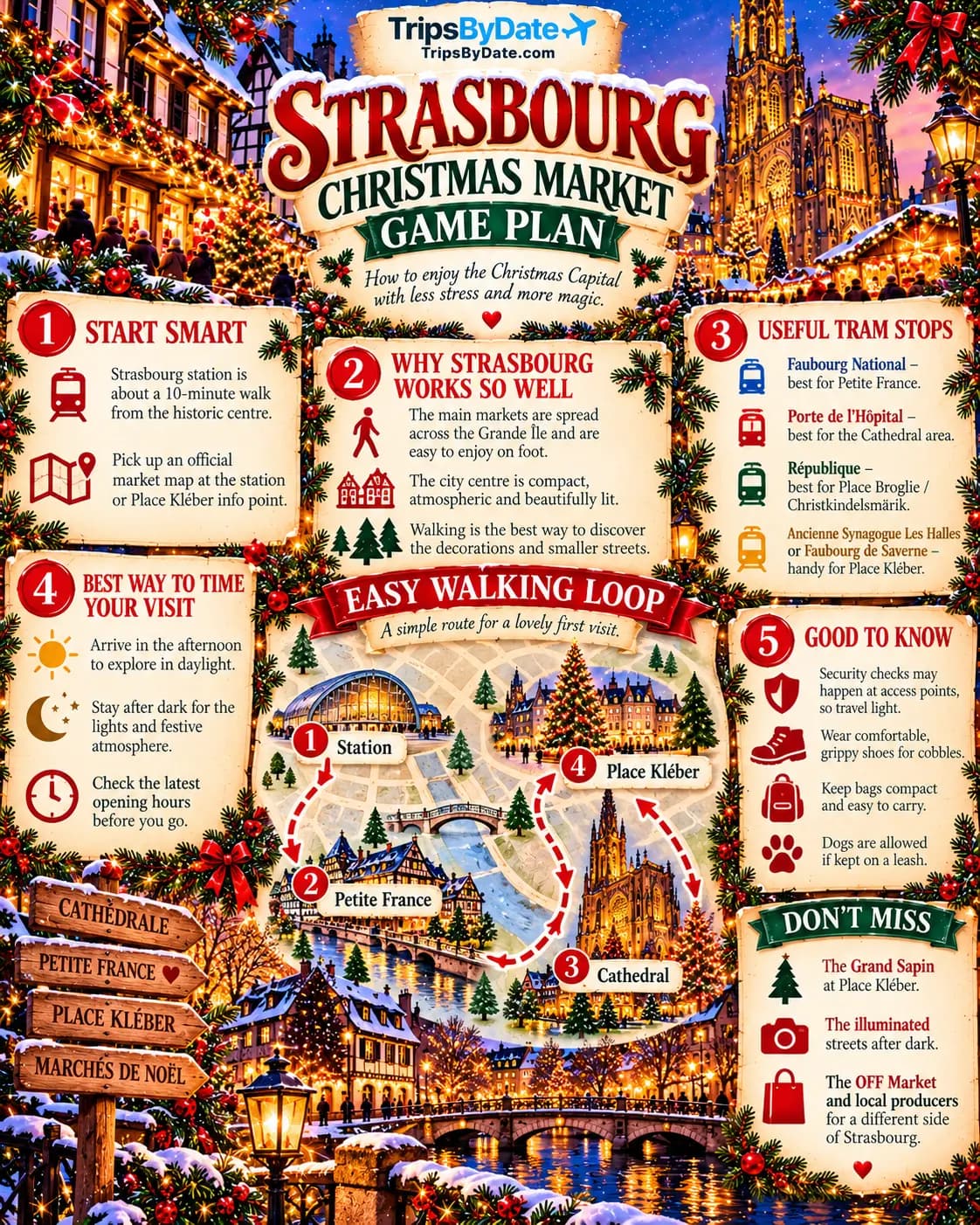
Station → Petite France → Cathedral → Place Kléber. Begin in Petite France while you can appreciate its architecture in daylight; continue towards the cathedral, stop for a proper Alsatian snack, and finish at the Grand Sapin after dark. You can fit Broglie into the loop if you have the energy. The suggested walking loop in the extra image is an inspiration, not a precise navigation map; use the current official printable map for access routes.
Route 2: a food-and-craft afternoon
Cathedral → Quai des Délices → Carré d'Or → Broglie. Sample breads or regional biscuits at the gourmet area, look at craftsmanship around Temple Neuf, then end among the traditional stalls. If you are travelling with friends, assign each person a food discovery to share. One savoury, one sweet, one surprise. The person bringing three versions of the same biscuit has misunderstood the assignment, but will still be popular.
Route 3: the thoughtful-gifts trail
Petite France → Square Louise Weiss → Place Grimmeissen → Place Kléber. Meet small Alsatian producers, browse the OFF Market's upcycled and ethical goods, then see the Village du Partage. This is a lovely alternative if you care more about meaningful gifts than collecting photos of every chalet.
Secret Strasbourg: experiences beyond the stalls
The cathedral has a surprisingly technical secret
Inside Strasbourg Cathedral, the astronomical clock combines craftsmanship, astronomy and engineering. There is a specific mechanical presentation rather than a continuously operating show. If you want to see the automata, plan around the official schedule and ticket arrangements rather than hoping they perform on demand.
Follow the stars along the river
Instead of crowding into one famous photo spot, follow the riverside illuminations near the Rohan terrace. Strasbourg's Promenade of Stars has featured hundreds of stars along part of the waterfront. It is a beautiful way to experience the decorations while seeing the old city from a different angle. Check current lighting details and allow some unplanned wandering.
Look for the city's living Christmas traditions
Ask regional makers about their work; find out which recipes families bake at home; and explore what the local Advent programme offers beyond shopping. The contrast between Broglie's centuries-old tradition and the OFF Market's modern approach is one of Strasbourg's most interesting stories. There is no need to pretend the city was frozen in the sixteenth century to enjoy it.
Choose a genuine indoor refuge
A cathedral visit, a booked cultural attraction or an unhurried café stop can rescue a cold, wet afternoon. One caution: the Alsatian Museum is currently closed for renovation, according to the tourism office. Older guides suggesting it as an easy Christmas stop are currently misleading. Check official museum opening information before setting out.
Where to stay in Strasbourg for a Christmas market break
Grande Île / cathedral area: ideal for immersing yourself in the evening atmosphere, but the prime streets can be busy and accommodation may cost more. Check pedestrian access and the route for carrying luggage through controlled entry points.
Petite France: picturesque and good for couples who want restaurants and romantic wandering. Some buildings have steep stairs, and a canal-side room is not automatically quiet.
Near Strasbourg railway station: practical for train travellers and luggage. It may give you better value while keeping much of the historic centre within walking distance. Compare the actual walking route from the hotel, not just the map's straight-line distance.
For families: prioritise room layouts, a lift if required, easy food options, realistic bedtimes and quick indoor breaks. Our family Christmas markets guide compares the experience with other cities.
Getting to Strasbourg and navigating the Christmas crowds
By air: Strasbourg Airport is linked to Strasbourg railway station by TER rail; the official Christmas guide describes the train journey itself as around eight minutes. That does not include walking, waiting or transfers to your accommodation. UK flight availability varies, so compare the full journey and check any connecting flights before booking. See the official airport access guidance.
By train: Strasbourg station is near the historic centre, which can make rail particularly appealing for a European multi-city trip. Check current operators and timetables for your precise departure. A trip involving Paris or another interchange is not necessarily simpler than a flight; compare the full door-to-door time.
By tram: the city's festive access plan can mean central tram stops are not served during market hours. Official guidance identifies alternatives such as Faubourg National for Petite France, Porte de l'Hôpital for the cathedral, République for Broglie and stops around Les Halles for Kléber. These arrangements may change; consult the official tram-stop guidance on your travel date.
Security: random checks are possible around market entrances, while large bags can receive systematic inspections. Bring a compact day bag and leave big suitcases at your hotel or appropriate luggage facilities before entering. Check the current city access rules.
When is it quietest? The city notes that Monday and Tuesday visits, especially earlier in the day, tend to be less busy than weekends. There is a lovely rhythm to arriving in daylight and staying for the lights, but don't assume sunset equals emptier lanes. If you want time to speak with makers, do it earlier.
A practical two-night Strasbourg Christmas itinerary
Arrival afternoon: drop your luggage, collect a market map and explore the cathedral and Broglie while stalls are easy to browse. Try one regional snack, then enjoy Place Kléber's tree after dark. Your first night should feel festive, not like an endurance race.
Full day: enjoy Petite France before the busiest hours, stop at Square Louise Weiss, then continue to the gourmet quay. Save the OFF Market for browsing thoughtful gifts, or book a cathedral visit if weather and opening times suit. Take a proper indoor break before the evening illuminations.
Departure morning: revisit the favourite square, buy any last-minute edible gifts, then collect luggage and leave a sensible margin for the train or airport. Do not plan a final cross-city quest for the one ornament you forgot to buy.
When do Strasbourg's Christmas markets open and close?
The festive markets usually run from late November until Christmas Eve. Unlike some European cities, Strasbourg's main stalls do not generally continue operating through New Year. Dates and daily hours are published separately for each edition; check the official current-year opening schedule before booking. The broader illuminations may remain after the market stalls have closed, which is not the same experience as visiting a live market.
For a wider choice of festive weekends, see our Christmas markets for a weekend break guide. If you can only travel on certain dates, start with those dates on TripsByDate rather than spending hours researching somewhere you cannot realistically reach.
Frequently asked questions
How many Christmas markets are there in Strasbourg?
The official programme groups the markets into eight central areas, including Broglie, Kléber, cathedral squares, Petite France, Quai des Délices, Temple Neuf, Square Louise Weiss and the OFF Market. Several areas encompass more than one square.
Which is the main Christmas market in Strasbourg?
The historic Christkindelsmärik is at Place Broglie. Place Kléber is famous for the Grand Sapin Christmas tree, while the cathedral markets offer the dramatic Gothic backdrop. Most visitors will want to see all three.
Is Strasbourg Christmas market free to enter?
The main public Christmas market areas are generally free to browse. Food, gifts, attractions and some cultural activities cost extra. Security checks or access arrangements may apply during the festive season.
Can you walk around Strasbourg's Christmas markets?
Yes. The eight areas are concentrated in and around the historic centre and are well suited to exploring on foot. Expect cobbled streets, queues and restrictions on large luggage; if mobility is limited, use official accessibility guidance and plan shorter routes.
Is one day enough for Strasbourg Christmas markets?
One day lets you enjoy the key squares and the lights. Two nights give you more time for Petite France, the food market, smaller producers and the cathedral without rushing.
Is Strasbourg good for children at Christmas?
Yes, particularly for the giant tree, lights, food and manageable central walking routes. Check the programme for age-suitable activities; plan warm indoor breaks, toilets and stroller access rather than expecting every market to have rides or a Santa's grotto.
Are the Strasbourg Christmas markets open after Christmas?
The main market stalls normally close on Christmas Eve. The city's wider winter lighting programme may continue later, but do not book a post-Christmas market holiday on that basis without checking the official calendar.
How can I find a Strasbourg Christmas market break from the UK?
Check your UK departure airport, available dates, journey time and market operating dates. On TripsByDate you can quickly browse upcoming advertised package holidays across destinations by departure date; if Strasbourg is not represented in the available listings, you may need to compare other providers or rail options directly. Always confirm the booking details with the travel provider.
More Christmas market inspiration
Explore our most beautiful Christmas markets in Europe for a photography-led comparison, our traditional Christmas markets guide for local customs, or European city-break ideas if you want to combine markets with a longer winter adventure.
Our final suggestion: Strasbourg is best enjoyed as a city of connected experiences. Don't just tick off the cathedral, tree and one square. Follow the canal, talk to an Alsatian maker, discover the alternative market and leave just enough room for one last biscuit. Actually, two.
‹ BACK TO CHRISTMAS MARKETSKnow when you can travel?
Choose your UK departure airport and dates, then browse advertised package holiday ideas across destinations. TripsByDate makes discovery quicker, simpler and more enjoyable.
Discover holidays by date