

Winter Sun Holidays in Fuerteventura
Ridiculously spacious beaches, volcanic moonscapes, traditional goat cheese and a very good reason to bring a windproof layer.
Some winter holidays are about escaping to a busy resort. Fuerteventura is more like escaping into the space around a resort. Beyond its sunny promenades are immense beaches, hills the colour of cinnamon, fishing villages, old windmills and stretches of wild Atlantic coastline where the only sensible plan is to stand still and say, “Wow.” If your ideal winter break involves fewer grey skies and more barefoot walks, this Canary Island deserves a serious look. But there is one detail the glossy photographs cannot tell you: on Fuerteventura, choosing the right beach and the right base matters almost as much as choosing the island.
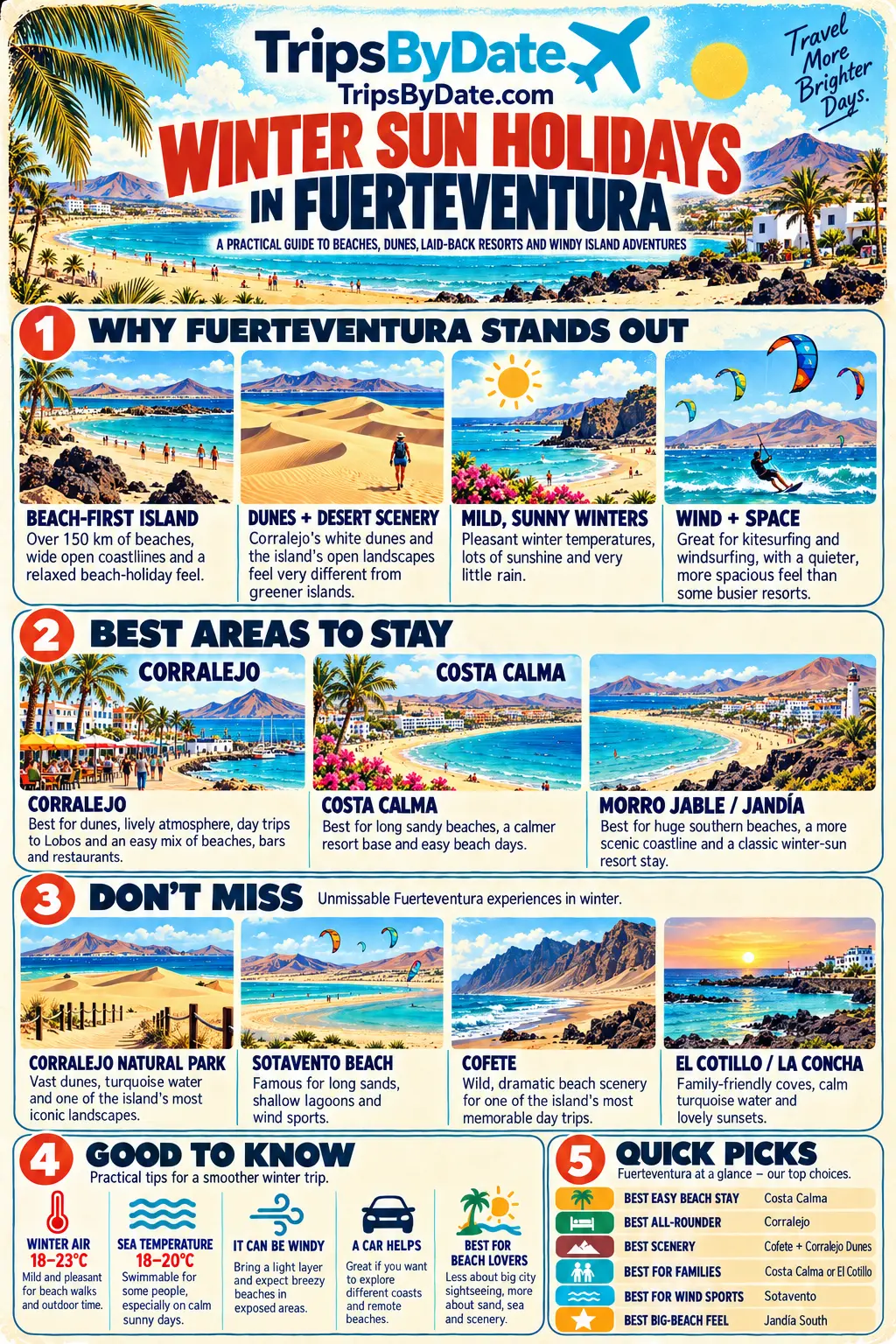
Quick answer: For a first winter visit with restaurants and excursions, try Corralejo. Choose Costa Calma for a quieter beach-focused stay, Morro Jable and Jandía for long southern beaches, or Caleta de Fuste for an accessible resort with a sheltered bay. El Cotillo suits independent travellers who love coves and sunsets. Expect pleasant daytime weather rather than tropical heat, and check wind, sea conditions and pool heating before booking.
This guide goes well beyond deciding where to put a sunlounger. We will explore ancient sea-floor rocks, a tiny island whose name recalls vanished seals, a museum dedicated to cheese, desert-like night skies and a remarkable beach where the lagoons seem to move. If you are comparing islands, our Lanzarote winter guide explains its very different volcanic character, while our Gran Canaria guide explores the city-and-mountain alternative.
Is Fuerteventura actually warm enough for a winter holiday?
Often, yes, for walks, café terraces, sightseeing and sunny afternoons on the beach. The island generally has mild winters and low rainfall by northern European standards, but sunshine is not the same thing as hot water or windless weather. The Atlantic can feel cool, especially after a breeze picks up. A sheltered terrace at lunchtime might feel glorious; an exposed promenade after sunset is a good moment to remember where you packed your jumper.
Think in terms of activities rather than one temperature: for a winter beach walk, Fuerteventura can be excellent; for swimming every day, conditions vary by beach and by visitor. For young children or anybody wanting long, comfortable swims, a confirmed heated hotel pool can make a bigger difference than a promise of “year-round sunshine.” Our winter swimming guide explains the distinction between air temperature, sea temperature and safe conditions.
The island is famously breezy, but that is also part of its appeal: wind sports flourish and the landscape feels invigorating. Winter winds and waves vary from day to day. Do not assume the most photogenic beach will be the safest place for a dip.
Find a winter escape that fits your actual dates
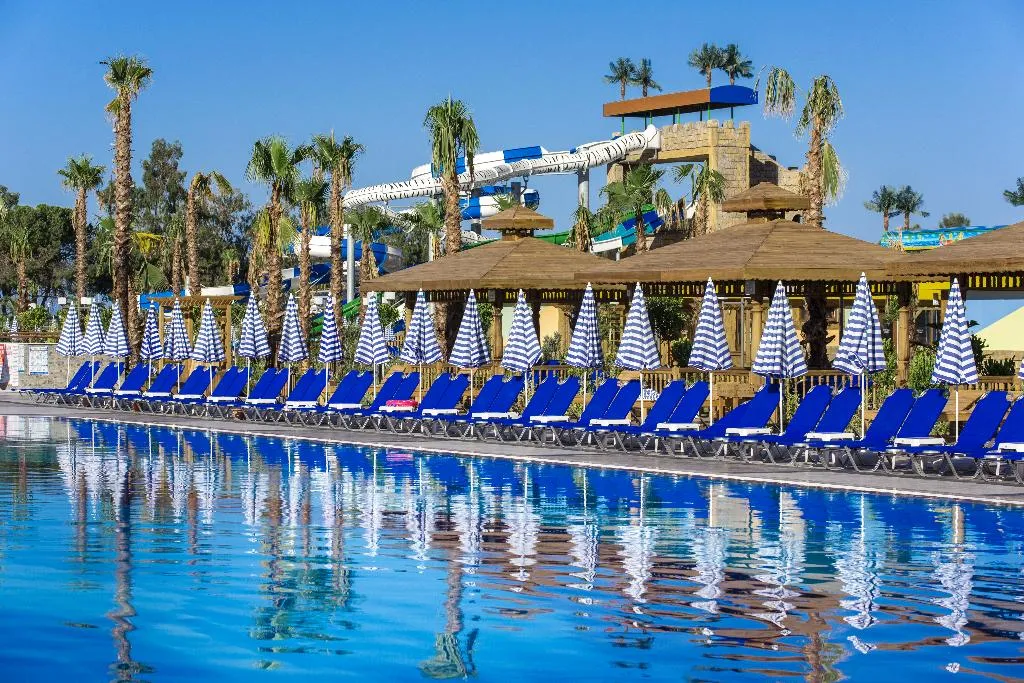
Here are four varied upcoming package-holiday examples from the wider TripsByDate inventory, ordered by departure date. They are not filtered to Fuerteventura, winter dates or any resort in this guide. Choose your UK departure airport and the days you can travel, then verify destination, nights, baggage, transfers, price and availability with the holiday provider.


 LGW • 7 nights
 SC · Broadway Travel

 LGW • 7 nightsSC · Broadway Travel
 LGW • 7 nightsB&B · Broadway Travel
 LGW • 7 nightsAI · Broadway Travel
Where to stay in Fuerteventura in winter: pick your holiday personality
Corralejo: the easiest all-round choice for first-time visitors
Up in the north, Corralejo mixes a working town, shops, restaurants, a harbour, beaches and straightforward trips to the dunes. It works well for couples who want a different restaurant each evening, friends who like some atmosphere and families who prefer not to drive everywhere. You can enjoy the town beaches one day, investigate the dunes the next and hop on a boat towards Lobos when the sea and permissions allow.
Know before booking: the beaches nearest your accommodation may feel very different from the sweeping Grandes Playas outside town. Check the map, the actual walk and whether a hotel advertised as “Corralejo” is close to the centre or farther towards the dunes. This is one of those details that saves a daily taxi bill and a mild family rebellion.
Costa Calma: the relaxed southern beach base
Costa Calma suits people who want sand, ocean views and a quieter, more resort-oriented holiday. Couples seeking downtime and families happy with hotel facilities may love its unhurried pace. Nearby Sotavento is extraordinary to look at and famous for wind sports; that does not make every stretch of its changing shoreline suitable for unsupervised swimming.
Think about evening plans before booking. If you want lively streets full of independent cafés and shops, Costa Calma is not Corralejo. If the dream is reading a book beside the sea without somebody announcing the next organised activity, its quieter atmosphere could be exactly the point.
Morro Jable and Jandía: enormous beaches and southern scenery
For the classic big-beach holiday, the Jandía area is hard to beat. Morro Jable has a local town feel alongside visitor facilities, while the wider resort area provides access to sweeping sandy shores. Great for long walks, sunset photographs, beach cafés and a slower week. Check whether your hotel sits on the beachfront, up a hill or some distance along the coast: “Jandía” covers more than one type of location.
Caleta de Fuste: convenient and family-friendly
On the east coast, Caleta de Fuste is known for its sheltered bay, family facilities, marina and relatively convenient airport access. It is a sensible choice when you are travelling with smaller children, want low-effort outings or simply dislike spending the first hours of your holiday in a transfer coach. Fuerteventura's tourism site outlines its beach and family activity options. Check your actual hotel, of course: a calm bay does not make the entire Atlantic permanently calm.
El Cotillo: little coves, seafood and magnificent sunsets
El Cotillo is for travellers who love a quieter village and would happily build a whole afternoon around a long lunch. North of the town are more protected little beaches, including La Concha, whose horseshoe-shaped reef helps shelter the water. The official La Concha beach guide even describes the corralitos, low circular walls of volcanic stone that offer a refuge when the wind gets playful. It is worth understanding the contrast: the village's open west-facing beaches can have powerful surf, while the northern coves may feel much gentler.
Which Fuerteventura beaches are actually best in winter?
- Corralejo dunes and Grandes Playas: for vast sandy views, walks and the sense you have somehow escaped to a miniature desert beside the sea.
- La Concha, El Cotillo: for an attractive, reef-sheltered cove when conditions are suitable, plus a lovely village nearby.
- Sotavento and Risco del Paso: for spectacular tidal lagoons, photography and wind sports; beach conditions can change dramatically with the tides.
- Jandía beaches: for long walks and a classic southern resort holiday.
- Cofete: for a genuinely wild landscape and an unforgettable outing, not as a casual swimming recommendation.
The official Sotavento guide describes its extraordinary lagoon, while the official Cofete page flags strong waves, lack of lifeguard supervision and difficult unpaved access. Cofete is an excellent reminder that “best beach” can mean “best scenery”, not “best place to let the children charge into the waves.” Always obey signs, flags and local safety advice.
The Fuerteventura you will remember: remarkable places beyond the resort
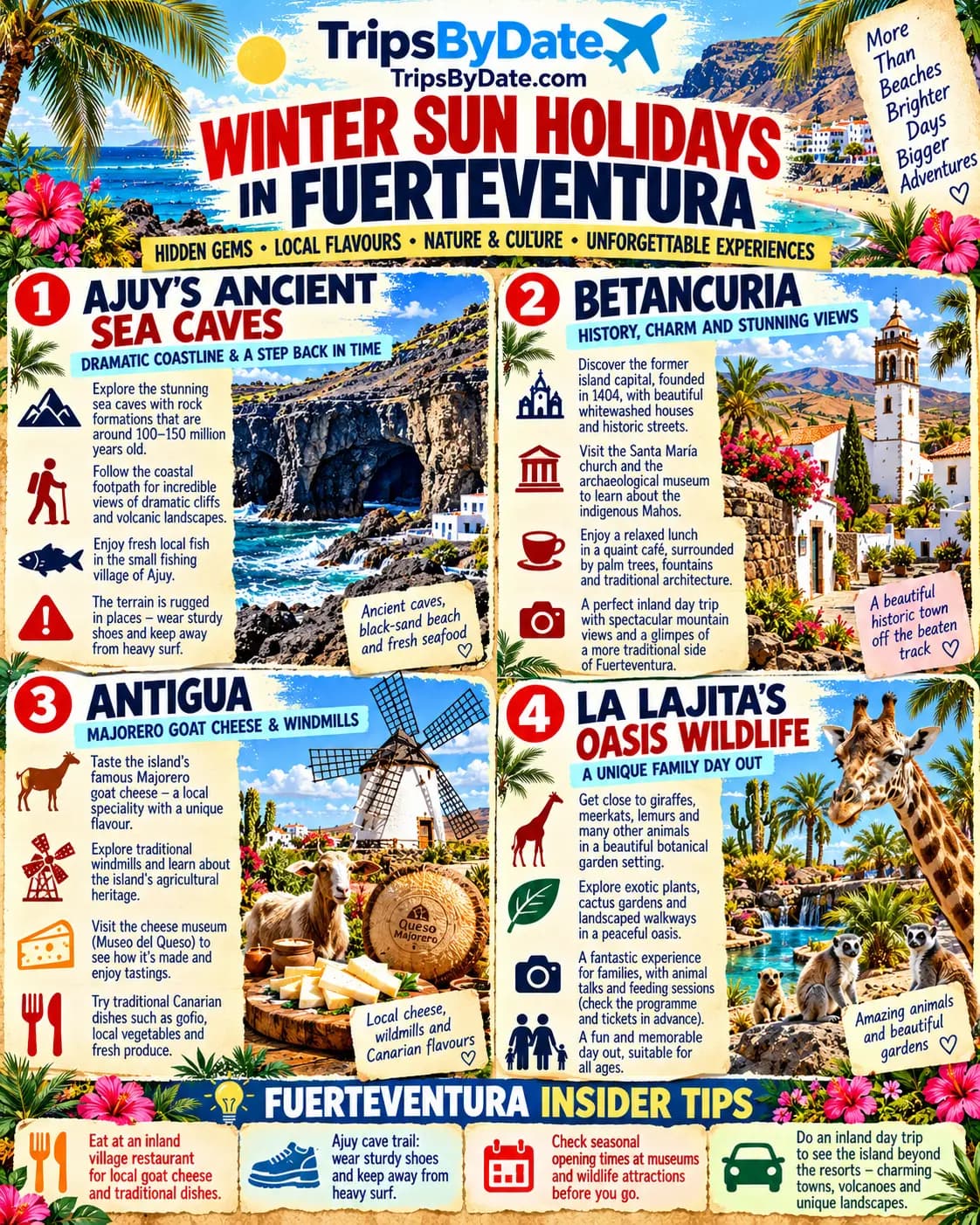
Ajuy: walk beside rocks older than the island itself
There is something wonderfully strange about telling somebody you are going to a cave to see an ancient sea floor. At Ajuy, on the west coast, exposed sedimentary rocks date back roughly 100–150 million years, while Fuerteventura itself formed much later. The official tourism guide explains the geology and the nearby fossilised dunes and old lime kilns. Read about the Ajuy caves before visiting.
Follow the signed rocky trail for dramatic views, then return to the fishing village for lunch. This is a lovely adventure for curious couples, older children and anybody bored of being told that the island's history begins with the invention of the all-inclusive wristband. Wear proper shoes, avoid rough-weather edges, and never enter the sea simply because the black-sand beach looks inviting. Conditions can be hazardous.
Betancuria: a capital hidden inland to avoid pirates
Founded in 1404, Betancuria sits in a valley away from the exposed coast. Its location was deliberately chosen to provide some protection from raiders. Today it is a peaceful place of whitewashed buildings, churches, museum exhibits and winding streets. The official guide to Betancuria explains the town's history and heritage.
Make this an unhurried inland day. Stop at viewpoints, visit a museum if it is open, and enjoy lunch rather than using the town as a five-minute photograph stop. For couples this is a lovely change of pace; for families it can become a small pirate-history expedition, minus the requirement to let anybody actually commandeer the hire car.
Antigua: a museum devoted to cheese is a surprisingly good idea
Fuerteventura takes its queso majorero seriously, and rightly so. In Antigua, a cheese museum explores traditional goat farming, the island's volcanic history and its famous local product. The historic mill and gardens make this a much more interesting stop than you might expect from the phrase “educational dairy attraction.” The tourism board's cheese museum guide explains the displays and cheese-tasting element. Check current opening details before setting out.
Try local cheese with mojo or on its own, then look for other traditional foods: papas arrugadas (wrinkled potatoes), gofio made from toasted grains, fresh grilled fish and sancocho, a traditional fish dish. A proper local meal can be a holiday highlight in an island sometimes unfairly described as just beaches and hotels.
Las Peñitas: find an oasis in a landscape that looks like Mars
Near Betancuria, Barranco de Las Peñitas reveals a surprise: greener pockets of vegetation among rugged dry hills. Its marked walking routes and viewpoints introduce a very different Fuerteventura from the postcard beaches. The official viewpoint description details the ravine and nearby walking trail. Choose a route that matches your fitness and check the weather and access. Desert-looking terrain is not an excuse to skip water or suitable footwear.
Lobos Island: a tiny volcanic world with its own rules
Across the water from Corralejo lies the protected Islote de Lobos. It has walking trails, striking shorelines, a lighthouse and an island name associated with monk seals once found here. The name is not a promise that you will meet a seal, which will disappoint certain members of the family and possibly your imaginary wildlife documentary crew.
According to the official Lobos walking guide, visits require advance authorisation, and the island has a signed route around its volcanic landscape. Check the current reservation process, ferry timetable, permitted stay and sea conditions before planning it. Take supplies, stay on trails and never count on spontaneous access. For nature-loving couples and families with children who enjoy walking, this can be the standout outing of the week.
Stargazing: exchange the beach bar for a sky full of stars
Fuerteventura's sparse settlement, dry landscapes and relatively dark rural skies can make star-watching memorable. The island's tourism board highlights Sicasumbre and other inland viewpoints as worthwhile places to look upwards. Its rural Fuerteventura guide also explains traditional farming and local culture. Pick a safe accessible viewpoint, travel with a warm layer and avoid driving unfamiliar rough roads at night. The stars are very impressive, but not sufficiently impressive to justify losing a hire-car tyre in the dark.
A Fuerteventura food trail worth leaving the hotel buffet for
Begin with something local and simple: grilled fish in an established harbour restaurant, potatoes with red or green mojo and a taste of Majorero goat's cheese. The latter may be mild and fresh or firmer and more mature, depending on how it is made. Wander around a local market and ask what produce is in season rather than assuming every stall is a traditional food market.
For a wonderfully unexpected food-and-history pairing, visit the restored windmill in Tiscamanita where the Los Molinos interpretation centre explains how gofio was traditionally produced. Suddenly a humble toasted-grain ingredient has a whole story. A memorable holiday meal does not need twenty ingredients, but a little local context goes a long way.
Fancy a winter escape beyond the usual search forms?
Choose your UK departure airport and the dates you are free. Browse holiday possibilities across destinations on TripsByDate, then follow the ones that catch your eye.
Find holidays by dateWhich Fuerteventura experiences suit your holiday?
For couples: sunsets, secret coves and a slow island rhythm
Stay in El Cotillo if you like village evenings, or choose a comfortable southern hotel and plan one inland escape. Spend the day exploring Betancuria, take a long lunch and finish with sunset on the coast. The romantic trick here is not expensive extras; it is making enough room in your itinerary to enjoy where you are.
For friends: surfing, road trips and food stops
Corralejo makes a flexible base for dinners and days out. Consider a properly instructed surf lesson, an organised wind-sport experience where conditions permit or a day combining dunes and northern villages. Explore Famara in Lanzarote only if a separate island outing genuinely fits your time; Fuerteventura already has enough beaches to keep the group occupied for weeks. For ideas closer to home, see our weekend breaks for friends.
For families: sheltered bays, animals and something educational that is secretly fun
Caleta de Fuste, suitable parts of Corralejo or a family hotel around Costa Calma may work depending on your children's ages. Confirm pool heating, room configuration and walkable food options. The botanical gardens and animals at Oasis Wildlife Fuerteventura offer an alternative to another beach day, although families should make their own judgement about animal attractions and check programmes and welfare information. Betancuria's museums or Antigua's cheese displays also provide lower-key options.
Family beach rule: aim for sheltered, supervised swimming areas and check conditions that day. An empty, dramatic beach may be perfect for a picnic or walk but completely unsuitable for children in the water.
Seven winter booking decisions that matter more than a beautiful beach photo
- Choose the base for your daily routine. Do you want a walkable town, a quiet resort or a car-based adventure? These are different holidays.
- Check the wind exposure. Ask where the pool and terrace sit, and whether your chosen beach is sheltered.
- Confirm pool heating explicitly. “Outdoor pool” does not mean comfortably warm in January.
- Investigate the real beach conditions. Tide, currents, surf, lifeguards and sea temperature matter more than the shade of turquoise in a brochure.
- Decide whether you genuinely need a car. Great for inland villages and remote viewpoints, unnecessary if all you want is a relaxing resort week. Check hire-company restrictions before attempting unpaved roads.
- Compare the whole package. Baggage, meals, airport transfers, flight times and hotel location can change what initially looks like the cheaper choice. Our package-comparison guide helps with the arithmetic.
- Check official travel information. British passport holders should confirm entry requirements and travel insurance using GOV.UK's Spain guidance, including any border-entry changes.
A relaxed seven-day Fuerteventura itinerary
Day one: arrive, settle in and explore the nearest beach or promenade. Day two: properly enjoy your resort and learn where its best cafés and swimming spots are. Day three: visit Corralejo dunes or another dramatic stretch of coast. Day four: head inland for Betancuria, scenic viewpoints and a Majorero cheese stop. Day five: relax, take a lesson or enjoy a guided excursion. Day six: explore El Cotillo, Ajuy or Sotavento, depending on where you are based, road conditions and your interests. Day seven: keep it deliberately unplanned. A good holiday itinerary should include at least one day when nobody says “we have to leave in five minutes.”
Do not attempt to combine every far-flung place into one mega-day. Driving times, weather and the island's scale deserve respect. Mix active days with quiet ones; this is a beach holiday, not an audition for a logistics company.
How does Fuerteventura compare with the other Canary Islands?
Choose Fuerteventura if broad beaches, open landscapes, water sports and relatively quiet seaside time are the main attraction. Choose Tenerife for more varied large-scale attractions and dramatic height differences, Lanzarote for volcanic art and distinctive architecture, or Gran Canaria for its mixture of city life, mountains and resorts. No island wins for every traveller. The best choice depends on what you actually want to do once you arrive.
Frequently asked questions about Fuerteventura in winter
Is Fuerteventura hot in December, January and February?
It is typically mild rather than tropical. Sunny, sheltered afternoons can feel warm, but winds, cloud and cooler evenings are possible. Pack for both beach time and light-layer weather, and check a forecast close to departure.
What is the best part of Fuerteventura for winter sun?
Southern resort areas, including Costa Calma and Jandía, are appealing for beach-focused holidays; Corralejo is a good all-round base in the north. The best hotel may depend more on shelter, facilities and its exact position than on a simple north-versus-south rule.
Can you swim in Fuerteventura in winter?
Some visitors do, especially on calm days, but the Atlantic feels cool to many swimmers and rough water can be dangerous. Choose appropriate supervised beaches, assess conditions on the day and consider a heated pool if swimming is essential.
Is Fuerteventura suitable for families in winter?
Yes, especially families who enjoy beaches and easy resort days. Look for sheltered swimming spots, family-sized accommodation, heated pools and manageable airport transfers. Plan excursions around children's ages and the weather.
Do you need to hire a car?
Not if you plan to stay in a well-equipped resort and take occasional organised excursions. A car adds flexibility for the smaller villages, inland landscapes and remote beaches. Confirm road conditions, insurance and permitted surfaces before making adventurous plans.
Is Fuerteventura better than Lanzarote for a winter beach holiday?
Fuerteventura is especially attractive for extensive sandy beaches and open coastal scenery. Lanzarote offers a different balance of beach time, volcanic attractions and art. Compare resorts, likely wind exposure, facilities and flight options rather than assuming one island is universally warmer.
Discover your own Fuerteventura escape with TripsByDate
There is a more entertaining way to look for a holiday than repeatedly completing the same destination, date and airport boxes. On TripsByDate, start with the dates you can actually get away and your UK airport, then browse package-holiday possibilities across destinations. It is more like scrolling through interesting possibilities than insisting you know the perfect destination before the search begins. Perhaps Fuerteventura appears on your dates. Perhaps another island catches your eye. Either way, you can spend less time filling forms and more time imagining your first lunch in the sunshine.
And if Fuerteventura does win? Save at least one morning for an empty beach, one afternoon for a little island history and one meal for something you cannot order at home. Preferably with cheese. The island has earned that much.
Your next sunny escape could be closer than you think
Pick your departure airport, browse holidays by date and discover the destinations that fit. Less searching. More choosing.
Find holidays by date